COMPARISON · OSCILLOSCOPES
Keysight EDUX1052G vs Rigol DS1054Z for Beginners
Keysight EDUX1052G vs Rigol DS1054Z sets two 50MHz bench scopes with very different priorities against each other. Keysight's education model gives you two channels, built-in training signals, a 20MHz function generator and a 100,000 wfm/s update rate. The Rigol, which carries our Hands-on Tested badge, gives you four channels and far deeper memory, but no generator.
By the OhmSavvy Research Team ·
Disclosure: OhmSavvy earns a commission from qualifying Amazon purchases made through these links, at no extra cost to you. How we're funded.

Keysight EDUX1052G
4.5★★★★★Keysight's education scope: two 50 MHz channels, a 100,000 wfm/s update rate, a built-in 20 MHz generator, Bode plot and training signals.
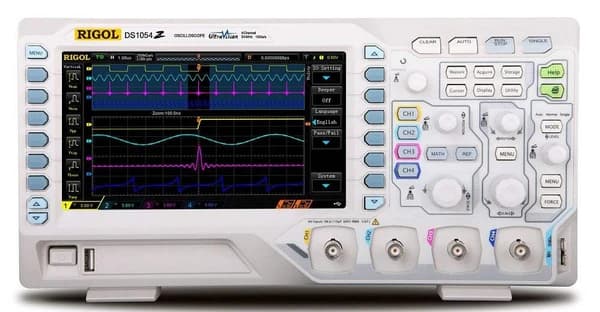
Rigol DS1054Z
4.8★★★★★The default beginner oscilloscope recommendation for years, and still worth it.
Specs side by side
| Keysight EDUX1052G | Rigol DS1054Z | |
|---|---|---|
| Rating | 4.5★★★★★ | 4.8★★★★★ |
| Bandwidth | 50MHz | 50MHz |
| Channels | 2 | 4 |
| Sample rate | 1 GSa/s (all channels) | 1 GSa/s |
| Best for | Students and classrooms that want built-in training signals and a generator | Hobbyists, students, general electronics |
| Sample rate, all channels on | 1 GSa/s on both channels | 250 MSa/s with 3–4 channels (500 MSa/s with 2) |
| Waveform update rate | 100,000 wfm/s | Up to 30,000 wfm/s |
| Memory depth | 200 kpts | Rigol conflicts: 12M standard / 24M optional (product page), 24 Mpts (datasheet) |
| ADC resolution | 8-bit (up to 12-bit in High Resolution mode) | 8-bit (up to 12-bit in high-res mode) |
| Display | 7-inch WVGA color TFT | 7-inch WVGA, 800 × 480 |
| Built-in signal generator | 20MHz WaveGen (sine to 20MHz, square/pulse to 10MHz) | None (Rigol fits one only to the -S models) |
| Serial trigger and decode | I2C and UART/RS-232, standard | Parallel, UART/RS232, I2C, SPI (option per product page; no option label in datasheet) |
| Digital channels | None (external trigger can be shown as a 3rd digital channel) | None |
| Connectivity | USB 2.0 host and device, 10/100 LAN | USB host and device, LAN |
| Power | Mains, 100–240 V, 50 W max | Mains, 100–240 V AC, 50 W max |
Specs checked against manufacturer documentation and official Amazon listings. Rigol DS1054Z is hands-on tested by OhmSavvy; the Keysight EDUX1052G assessment is desk research. How we research.
Key differences
- →Channels: the EDUX1052G has two analog inputs, the DS1054Z has four. That is the single biggest practical gap between them.
- →Only the Keysight has a built-in generator: a 20MHz WaveGen that also drives its Bode plot (frequency-response) mode. The DS1054Z has none; Rigol reserves the generator for its -S models.
- →Keysight builds training signals into the EDUX1052G, so a beginner can practice triggering and measuring without a circuit. These are not a feature Rigol lists for the DS1054Z.
- →Update rate is 100,000 wfm/s on the Keysight against up to 30,000 wfm/s on the Rigol, so the Keysight spends less time blind between captures.
- →Memory runs the other way: 200 kpts on the Keysight against 12 or 24 Mpts on the Rigol, depending on which Rigol document you read.
- →The Keysight keeps 1 GSa/s with both channels on; the Rigol drops to 500 MSa/s with two channels and 250 MSa/s with three or four.
- →Rigol's datasheet lists SPI and parallel decoding as well as UART and I2C (its product page calls decoding an option); Keysight lists I2C and UART/RS-232 as standard.
Spec by spec
Both scopes are rated at 50MHz and both peak at 1 GSa/s, so the headline numbers suggest twins. The charts show where they really part company: how the sample rate holds up as channels are added, how many waveforms reach the screen each second, and how much memory each one has to fill.
Bars use a logarithmic scale: each step is ten times the last.
Bars use a logarithmic scale: each step is ten times the last.
Memory decides how long a capture can last at full speed: divide the points by the sample rate. At 1 GSa/s, 200 kpts fills in 200 µs, while 12 Mpts lasts 12 ms. Ask either scope for a longer window and it lowers the sample rate to fit, which the Keysight has to do sixty times sooner. Bandwidth, by contrast, is a tie: Keysight quotes a calculated 7 ns rise time, and the usual 0.35 ÷ bandwidth approximation gives about the same for the Rigol. Our explainers on oscilloscope bandwidth and what GSa/s means cover the theory behind these figures.
Keysight EDUX1052G vs Rigol DS1054Z for beginners
The awkward truth about a first oscilloscope is that it arrives before you have anything interesting to look at. The EDUX1052G is designed around that problem. Keysight builds training signals into the scope, so a newcomer can connect a probe and practice the core routine of scaling, triggering and measuring on known waveforms straight away. Add the 20MHz WaveGen and you also have a source: feed a sine wave into an RC filter or a transistor amplifier, probe the input on channel 1 and the output on channel 2, and the Bode plot mode will sweep the generator and chart gain against frequency for you. For someone studying alone rather than in a lab with a bench generator beside every scope, that is a lot of teaching material in one box.
The DS1054Z assumes you bring the signals. Without a generator, your first waveforms will come from an Arduino pin, a 555 timer or whatever circuit you are building, which is fine for hobbyists who already have projects on the go but slower for someone starting from zero. What it gives back is breadth. Four channels let you watch a microcontroller talk to a sensor over SPI with every line visible, or compare the four coil signals of a stepper driver, and its memory lets a long burst be recorded at a high sample rate and then zoomed into afterwards. It carries our Hands-on Tested badge, and our DS1054Z review covers it in more depth.
So the choice for a beginner comes down to what you lack today. If you have no signal source and want guided practice, the Keysight removes that obstacle. If you already have circuits to debug and expect them to involve more than two lines at once, the Rigol is the one you will not outgrow on channel count. Neither has digital channels, and neither offers more than 50MHz, so a jump to faster logic or RF work means a different scope whichever you pick.
The wiring is the whole lesson in one picture. Three leads leave the Keysight and one circuit sits in the middle, so the ratio of output to input at each frequency becomes a curve without any arithmetic on your part. Rebuild the same test on the DS1054Z and a second instrument joins the bench: an external generator, whose dial you turn and whose readings you note down step by step before plotting them yourself.
Why update rate matters when you are learning
What each scope handles well, and where it runs short
| Job | Keysight EDUX1052G | Rigol DS1054Z |
|---|---|---|
| Practicing triggers and cursors with no circuit built yet | Yes: built-in training signals | Needs an external signal (Arduino, 555 timer, generator) |
| Frequency response of an RC filter or audio amplifier | Yes: WaveGen plus Bode plot mode | Only with a separate generator, point by point |
| Op-amp input against output | Yes, both channels at 1 GSa/s | Yes, with two channels spare |
| Full SPI bus: chip select, clock, MOSI, MISO | Two lines at a time; SPI decode not listed | All four lines together; SPI decode listed (option status conflicts) |
| I2C or UART at hobby speeds | Yes, decode standard | Yes, decode listed by Rigol (option status conflicts) |
| A 10 ms burst kept at 1 GSa/s for later zooming | No: 200 kpts lasts 200 µs at that rate | Yes on one channel: 12 ms or more of memory at 1 GSa/s |
| Spotting a rare glitch on a repetitive signal | Stronger: 100,000 wfm/s | Capable: up to 30,000 wfm/s |
| Logic edges faster than about 7 ns, or RF | No: 50MHz limit | No: 50MHz limit |
By the 3–5x rule, a 50MHz scope shows signals up to roughly 10–17MHz with their shape intact. That covers Arduino PWM, servo pulses, audio, I2C, UART and most SPI at hobby clock rates on either scope. The WaveGen's own limits matter too: Keysight rates sine output to 20MHz but square and pulse only to 10MHz and ramps to 200kHz, which is plenty for filter and amplifier experiments. To put either scope to work, start with setting up a trigger and measuring an amplifier's bandwidth; Keysight also notes that the EDUX1052G has no segmented memory, so the segmented-memory technique is not available on it.
Mains, earth and the generator output
Which should you buy?
| Buyer | Pick | Reason |
|---|---|---|
| Self-taught beginner with no circuits yet | Keysight EDUX1052G | Training signals and a generator give you something to measure on day one |
| Student studying filters and amplifiers | Keysight EDUX1052G | WaveGen and Bode plot turn a frequency-response lab into one setup |
| Arduino or Raspberry Pi tinkerer debugging SPI | Rigol DS1054Z | Four channels show the whole bus at once |
| Anyone recording long bursts and zooming in later | Rigol DS1054Z | 12 or 24 Mpts against 200 kpts |
| Hunting an occasional glitch on a clock line | Keysight EDUX1052G | 100,000 wfm/s against 30,000 wfm/s |
| Already owns a function generator | Rigol DS1054Z | The Keysight's main extra is then redundant; the extra channels are not |
If you like the Rigol platform but want a generator too, see Rigol DS1104Z-S Plus vs Siglent SDS1104X-E. Other DS1054Z matchups include Rigol DS1054Z vs Siglent SDS1104X-E, Rigol DHO804 vs Rigol DS1054Z and Rigol DS1054Z vs Hantek 6022BE for Beginners. For the wider field, read the best beginner oscilloscopes roundup and our oscilloscope buying guide.
Choose the Keysight EDUX1052G if…
- ✓You are learning on your own and want signals to practice on before you have built a circuit
- ✓You want a source and a scope in one box, for filters, amplifiers and Bode plots
- ✓You value the fastest screen refresh here for spotting rare glitches
- ✓Two channels cover your work: input against output, or clock against data
Choose the Rigol DS1054Z if…
- ✓You need to watch three or four signals at once, such as a full SPI bus or a stepper driver
- ✓You want long captures that keep a high sample rate, thanks to millions of points of memory
- ✓Your circuits already make their own signals, or you own a separate generator
- ✓You want the pick in this pairing that carries our Hands-on Tested badge
The bottom line
Pick the Keysight EDUX1052G if you are learning from scratch and want the scope to supply its own practice signals, a 20MHz generator and Bode plots, with the faster 100,000 wfm/s update rate as a bonus. Pick the Rigol DS1054Z if your projects already make signals and you need more of them on screen: four channels and 12 or 24 Mpts of memory serve bus debugging and long captures that two channels and 200 kpts cannot.
Frequently asked questions
Is the Keysight EDUX1052G or the Rigol DS1054Z better for a complete beginner?+
It depends on whether you already have signals to look at. The EDUX1052G includes training signals and a 20MHz generator, so you can practice from the first day without building anything. The DS1054Z has no generator but offers four channels and much deeper memory, which matter more once you are debugging real circuits with several lines.
What are the training signals on the Keysight EDUX1052G?+
They are practice waveforms that Keysight builds into the EDUX1052G so a student can learn scaling, triggering and measurement without an external source. They suit self-study and classroom exercises. The DS1054Z doesn't list an equivalent, so its owners usually start with a microcontroller pin, a 555 timer or a separate function generator.
Does the Rigol DS1054Z have a built-in signal generator?+
No. Rigol's DS1000Z datasheet fits a generator only to the -S models, such as the DS1104Z-S Plus. The Keysight EDUX1052G includes a 20MHz WaveGen as standard, rated for sine waves up to 20MHz and square or pulse waves up to 10MHz, with up to 20 Vpp into a high-impedance load.
Is 200 kpts of memory enough on a beginner oscilloscope?+
For repetitive signals viewed a screen at a time, usually yes. It becomes a limit when you need a long capture at high resolution: at 1 GSa/s, 200 kpts covers only 200 µs before the EDUX1052G must lower its sample rate. The DS1054Z's 12 or 24 Mpts (Rigol's documents disagree) keeps full speed for far longer.
Has OhmSavvy tested either of these scopes?+
The Rigol DS1054Z carries our Hands-on Tested badge. The Keysight EDUX1052G assessment is desk research based on Keysight's InfiniiVision 1000 X-Series data sheet and product page, so every figure quoted for it here comes from Keysight's published specifications.
Related