COMPARISON · OSCILLOSCOPES
HANMATEK DOS1102 vs Hantek DSO2C10
On bandwidth the HANMATEK DOS1102 vs Hantek DSO2C10 match-up looks even: 110 MHz against 100 MHz, two channels each, a 7-inch 800 × 480 screen on both. The real gap is behind the screen. The DOS1102 keeps 10K points per capture and triggers on edges and video only; the DSO2C10 keeps up to 8 Mpts, adds pulse, slope and pattern triggers, and decodes UART, I2C, SPI, CAN and LIN. That makes this a choice between a simple, light first scope and a deeper debugging tool.
By the OhmSavvy Research Team ·
Disclosure: OhmSavvy earns a commission from qualifying Amazon purchases made through these links, at no extra cost to you. How we're funded.

HANMATEK DOS1102
4.1★★★★☆A slim, low-cost two-channel 110 MHz benchtop with a 7-inch screen and simple controls.
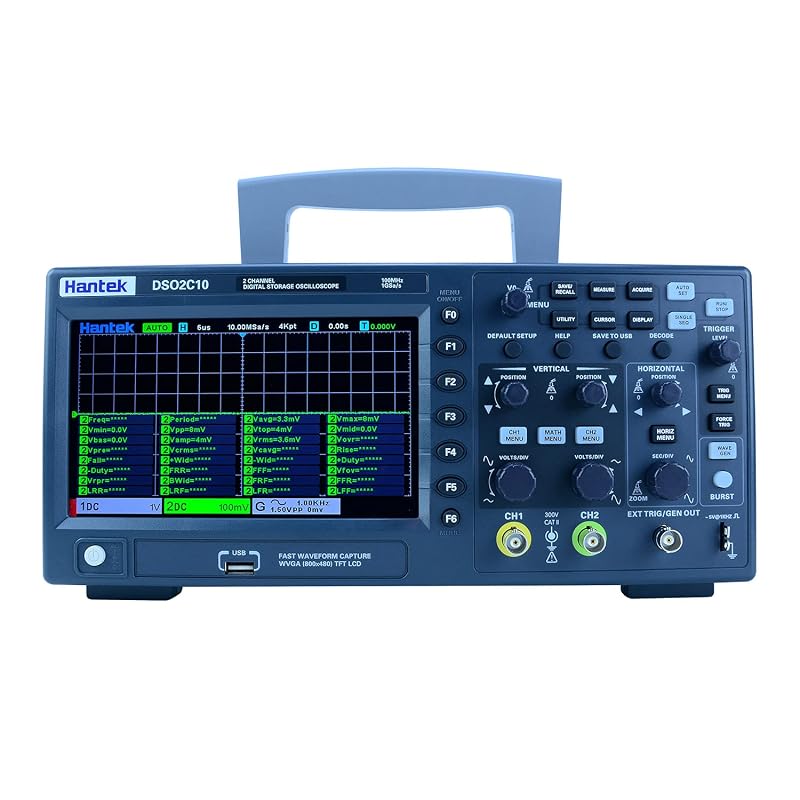
Hantek DSO2C10
4.3★★★★☆The DSO2D10 without the signal generator: two 100 MHz channels with deep memory and serial decoding.
Specs side by side
| HANMATEK DOS1102 | Hantek DSO2C10 | |
|---|---|---|
| Rating | 4.1★★★★☆ | 4.3★★★★☆ |
| Bandwidth | 110MHz | 100MHz |
| Channels | 2 | 2 |
| Sample rate | 500 MS/s per channel (1 GS/s combined) | 1 GSa/s (1 ch); 500 MSa/s (2 ch) |
| Best for | A first two-channel bench scope on a tight budget | Low-cost serial-bus debugging on two channels |
| Record length | 10K points | 8 Mpts (1 ch); 4 Mpts (2 ch) |
| Rise time | 3 ns or less (typical) | 3.5 ns (typical) |
| Vertical resolution | Not stated by HANMATEK | 8-bit; high-res mode up to 12-bit |
| Trigger types | Edge, video | Edge, pulse, video, slope, overtime, window, pattern, interval, under-amplitude, serial |
| Serial decoding | None (per HANMATEK's FAQ) | UART/RS232, I2C, SPI, CAN, LIN |
| Automatic measurements | 30 | 32, with statistics |
| Signal generator | None (the DOS1102S has one) | None (despite WAVE GEN labels on the panel) |
| Display | 7-inch, 800 × 480 | 7-inch, 800 × 480 |
| Input | 1 MΩ ‖ 20 pF | 1 MΩ ‖ 13 pF |
| Power | DC 5 V 2 A adapter | Mains AC, under 30 W |
| Size; weight | 301 × 152 × 70 mm; about 1.1 kg | 318 × 110 × 150 mm; 1.9 kg |
Specs checked against manufacturer documentation and official Amazon listings. Desk research, not bench testing. How we research.
Key differences
- →Memory is the headline gap: 10K points on the DOS1102 against 8 Mpts on one channel (4 Mpts on two) for the DSO2C10, hundreds of times deeper.
- →With both channels on, the two sample at the same 500 MS/s per channel. With one channel the DSO2C10 doubles to 1 GSa/s; HANMATEK's manual gives 500 MS/s per channel regardless, though its badge says 1 GSa/s.
- →The DSO2C10 decodes UART/RS232, I2C, SPI, CAN and LIN and triggers on them; HANMATEK lists no decoding and only edge and video triggers.
- →On the analog side the DOS1102 has a slight edge on paper: 110 MHz and 3 ns or less rise time against 100 MHz and 3.5 ns.
- →The DOS1102 is lighter (about 1.1 kg against 1.9 kg) and runs from a 5 V 2 A adapter; the DSO2C10 runs on mains.
- →Neither has a signal generator, and neither carries our Hands-on Tested badge. The DSO2C10 is rated 4.3 in our roundup, the DOS1102 4.1.
Spec by spec
The first two charts are close calls. The third is not: on a log scale, the record-length bars are three orders of magnitude apart, and that one number drives most of the practical differences below.
Bars use a logarithmic scale: each step is ten times the last.
| Setup | Window at full rate |
|---|---|
| DOS1102, 10K at 500 MS/s | 20 µs |
| DSO2C10, 4 Mpts at 500 MSa/s | 8 ms |
| DSO2C10, 8 Mpts at 1 GSa/s (1 ch) | 8 ms |
A note on the DOS1102's sample rate: the Amazon title says 500 MS/s ×2, the front badge and HANMATEK's shop page say 1 GSa/s, and the manual explains that each channel samples at 500 MS/s, adding up to 1 GS/s with both on. We use the manual's per-channel figure. HANMATEK doesn't publish the DOS1102's converter resolution.
Which should you buy?
| Buyer or job | Better fit | Why |
|---|---|---|
| Student learning to read waveforms | HANMATEK DOS1102 | Edge trigger, 30 measurements and FFT cover the basics |
| Arduino or ESP32 project talking I2C or SPI | Hantek DSO2C10 | Decodes the bytes instead of leaving you to count bits |
| Car or robot CAN bus | Hantek DSO2C10 | CAN trigger and decode are listed; the DOS1102 has neither |
| Audio amplifier and filter work | HANMATEK DOS1102 | Repetitive signals don't need deep memory |
| Catching a one-off glitch or a supply power-up | Hantek DSO2C10 | 8 Mpts keeps the sample rate high over a long window |
| Small desk or a scope that travels | HANMATEK DOS1102 | About 1.1 kg on a 5 V 2 A adapter |
| Composite video signal checks | Either | Both list a video trigger |
What 10K points can and can't do
Bandwidth sets which frequencies you can see; with the usual 3–5x rule, both scopes handle signals up to roughly 20–35 MHz with their shape intact, which covers almost every hobby clock and bus. Our bandwidth guide explains the rule. Memory sets how long you can look while still sampling fast, and that is where these two part ways.
Every scope fits a capture into its record: sample rate equals points divided by the time on screen. At 500 MS/s, the DOS1102's 10K points last 20 µs. Take a 9600-baud UART message of 20 characters, which runs a little over 20 ms. Set the timebase to show it all and the DOS1102 has to drop to roughly 500 kS/s, about 50 samples per bit. You will see the bits, but zoom in on one edge and there is nothing left to resolve. The DSO2C10 spreads 4 Mpts over the same message at up to roughly 200 MSa/s, so you can capture the whole message once and then zoom into any edge, while the decoder prints the characters underneath. For the relationship between sample rate and detail, see what GSa/s means.
Repetitive signals forgive short memory
Triggers are the other half
Where the DOS1102 pays you back is simplicity and size. A slim, light scope on a 5 V adapter is easy to set up on a crowded bench, and edge triggering plus 30 automatic measurements is a manageable set of tools to learn first. Its 110 MHz front end and 3 ns rise time are slightly ahead on paper, though with both channels sampling at 500 MS/s on either scope, you are unlikely to see that difference on screen.
Power, grounding and the missing generator
The DSO2C10 is a conventional mains bench scope. The DOS1102 runs from a DC 5 V 2 A adapter, though HANMATEK doesn't describe how its probe ground relates to the adapter's earth. Neither scope has a signal generator. The DSO2C10 shares a front panel with the DSO2D10, so it still shows WAVE GEN and GEN OUT markings, and its Amazon listing mentions waveform output, but Hantek's spec table lists none. On HANMATEK's side, a source is only on the separate DOS1102S. If you need one, compare the Hantek DSO2C10 vs DSO2D10.
Probe grounds are not floating
Related reading
Neither model has a standalone review yet; both appear in the beginner oscilloscope roundup. To see the DSO2C10 against a scope with a built-in generator, read Hantek DSO2C10 vs FNIRSI 1014D. If a bench scope is more than you need, the handheld pair in HANMATEK HO52 vs OWON HDS272S adds a multimeter, and the oscilloscope buying guide walks through every spec on this page.
Choose the HANMATEK DOS1102 if…
- ✓You want a first bench scope for repetitive analog signals: audio, PWM, ripple, oscillators
- ✓A 1.1 kg scope that runs from a 5 V 2 A adapter suits a small desk or a mobile setup
- ✓You will learn on edge triggering and basic measurements before needing anything fancier
Choose the Hantek DSO2C10 if…
- ✓You debug microcontroller projects and want I2C, SPI, UART, CAN or LIN decoded on screen
- ✓You need to capture a long event, such as a whole serial message or a power-up, at high sample rate
- ✓You want pulse-width, runt (under-amplitude) or pattern triggers to catch faults that edges miss
The bottom line
If your projects involve microcontrollers, buses or one-off events, the Hantek DSO2C10 is the better buy: 8 Mpts of memory, serial decoding and a long list of triggers do far more than the DOS1102's extra 10 MHz. Choose the HANMATEK DOS1102 if you want a light, simple two-channel scope for repetitive analog signals and learning the basics, and will not miss decoding or deep memory.
Frequently asked questions
Is 110 MHz on the DOS1102 better than 100 MHz on the DSO2C10?+
Only slightly, and only on paper. Both clear the 3-5x rule for signals up to roughly 20 MHz, and with two channels on both sample at 500 MS/s per channel. In practice the DSO2C10's 8 Mpts of memory and serial decoding matter far more for most projects than 10 MHz of extra bandwidth.
Can the HANMATEK DOS1102 decode I2C or UART?+
No. HANMATEK's FAQ says the DOS1102 has no serial protocol decoding, and its manual lists only edge and video triggers. You can still view I2C or UART lines and read the bits by hand, but the Hantek DSO2C10 triggers on and decodes UART, I2C, SPI, CAN and LIN directly.
Is the DOS1102 sample rate 1 GSa/s or 500 MS/s?+
Both figures appear. The front badge and HANMATEK's shop page say 1 GSa/s, the Amazon title says 500 MS/s x2, and the manual explains that each channel samples at 500 MS/s, adding to 1 GS/s with both channels enabled. Plan around 500 MS/s per channel.
Why does record length matter so much on a bench scope?+
A scope's sample rate is its record length divided by the time on screen. With 10K points, the DOS1102 can only hold 20 microseconds at full speed, so long captures force a low sample rate. The DSO2C10's 4 to 8 Mpts keep sampling fast across milliseconds, which is what lets you zoom into detail afterwards.
Does either scope have a built-in signal generator?+
No. The generator versions are separate models: the HANMATEK DOS1102S and the Hantek DSO2D10. The DSO2C10's panel still carries WAVE GEN markings, and its Amazon listing mentions waveform output, but Hantek's own specification table shows no generator for this model.
Related