COMPARISON · OSCILLOSCOPES
Rigol DHO914 vs Rigol DHO804
Rigol DHO914 vs Rigol DHO804 is a choice inside one family. Both are four-channel, 12-bit Rigol scopes with a 7-inch 1024 × 600 touchscreen, 1.25 GSa/s on one channel and USB-C power. The DHO914 adds 55 MHz of bandwidth (125 MHz against 70 MHz), twice the memory, LIN decoding and 16 digital channels that work once you buy Rigol's PLA2216 logic probe. This page sets out what those extras do and who actually needs them.
By the OhmSavvy Research Team ·
Disclosure: OhmSavvy earns a commission from qualifying Amazon purchases made through these links, at no extra cost to you. How we're funded.

Rigol DHO914
4.6★★★★★Four 12-bit channels at 125 MHz with 16 logic inputs built in, in a compact USB-C powered body.
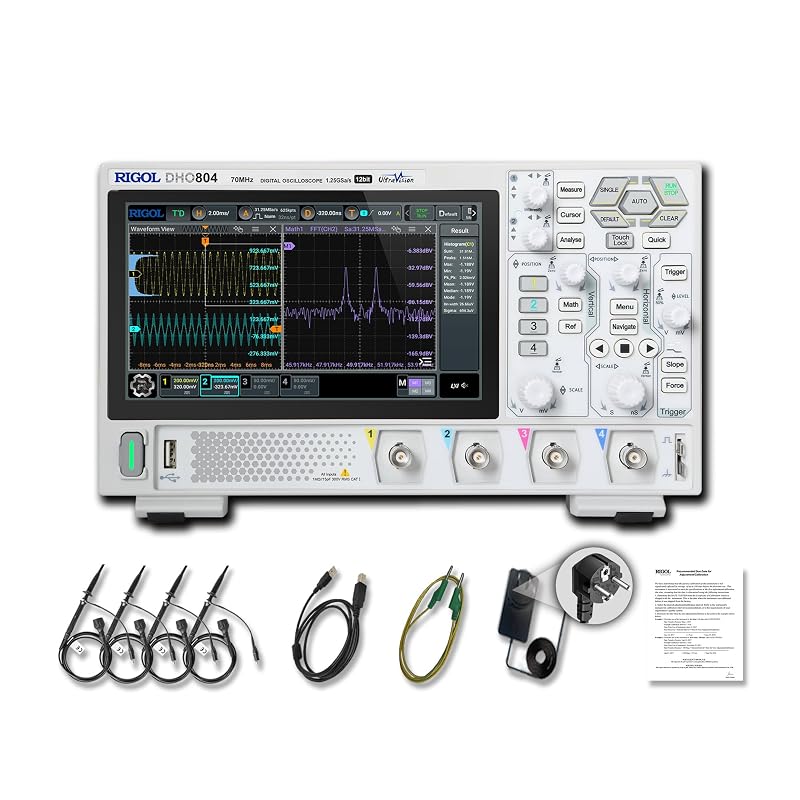
Rigol DHO804
4.8★★★★★Four channels, 12-bit resolution and a 7-inch touchscreen in a compact body that runs from USB-C power.
Specs side by side
| Rigol DHO914 | Rigol DHO804 | |
|---|---|---|
| Rating | 4.6★★★★★ | 4.8★★★★★ |
| Bandwidth | 125MHz | 70MHz |
| Channels | 4 + 16 digital (probe sold separately) | 4 |
| Sample rate | 1.25 GSa/s (1 ch); 312.5 MSa/s (4 ch) | 1.25 GSa/s (1 ch); 312.5 MSa/s (4 ch) |
| Best for | Mixed analog and logic debugging on a small bench | Hobbyists who want 12-bit detail and a touchscreen |
| Vertical resolution | 12-bit | 12-bit |
| Memory depth | 50 Mpts (1 ch); 10 Mpts (3–4 ch) | 25 Mpts (1 ch); 5 Mpts (4 ch) |
| Rise time (typical) | 2.8 ns | 5 ns |
| Digital channels | 16 (PLA2216 probe sold separately) | None |
| Standard decoding | Parallel, UART, I2C, SPI, CAN, LIN | Parallel, UART, I2C, SPI, CAN |
| Display | 7-inch 1024 × 600 touchscreen | 7-inch 1024 × 600 touchscreen |
| Power | USB-C, 15 V 3 A | USB-C, 15 V 3 A |
Specs checked against manufacturer documentation and official Amazon listings. Rigol DHO804 is hands-on tested by OhmSavvy; the Rigol DHO914 assessment is desk research. How we research.
Key differences
- →Bandwidth: 125 MHz on the DHO914 against 70 MHz on the DHO804, almost 1.8 times as much.
- →Sample rate is identical on paper: 1.25 GSa/s with one channel and 312.5 MSa/s per channel with all four on.
- →Memory doubles on one channel (50 Mpts against 25 Mpts) and is twice as deep with all four running (10 Mpts against 5 Mpts).
- →The DHO914 has 16 digital channels; they need Rigol's PLA2216 logic probe, which is sold separately. The DHO804 has none.
- →Both decode parallel, UART, I2C, SPI and CAN as standard; only the DHO914 adds LIN.
- →Same 12-bit resolution, 7-inch 1024 × 600 touchscreen, HDMI and LAN, USB-C power and published 1.78 kg weight and body size.
- →Neither has a built-in signal generator. In Rigol's line-up that is the DHO914S. Our roundup scores the DHO804 4.8 and the DHO914 4.6.
Spec by spec
Because the two scopes share a chassis, a converter and a screen, most rows of a spec sheet match. The charts below isolate the four places Rigol's numbers differ, and the table lists what you get either way. Product figures come from our verified pick data and Rigol's DHO800 and DHO900 data sheets.
Bars use a logarithmic scale: each step is ten times the last.
| Shared spec | DHO914 and DHO804 |
|---|---|
| Analog channels | 4 |
| Vertical resolution | 12-bit |
| Sample rate | 1.25 GSa/s (1 ch); 312.5 MSa/s per channel (4 ch) |
| Waveform rate | 30,000 wfms/s; up to 1,000,000 wfms/s in UltraAcquire mode |
| Screen | 7-inch 1024 × 600 capacitive touchscreen |
| Connections | HDMI, LAN, USB host and device |
| Power | USB-C, 15 V 3 A adapter |
| Size and weight | 265 × 162 × 77 mm, 1.78 kg |
| Built-in signal generator | None |
What the extra 55 MHz really buys
A scope's bandwidth figure marks where a sine wave has already dropped to about 70% of its true amplitude, so you want comfortable margin above the fastest signal you care about. Using the usual rule of keeping the signal three to five times below the rating, the DHO804 is accurate up to roughly 14 to 23 MHz and the DHO914 up to roughly 25 to 42 MHz. Our oscilloscope bandwidth explainer walks through where that rule comes from.
In bench terms, an Arduino's 16 MHz clock still falls inside the DHO804's comfortable range, but a 25 MHz SPI clock or a 33 MHz oscillator is past it, while both sit inside the DHO914's. The rise-time figures tell the same story: 2.8 ns against 5 ns typical, so a logic edge that switches in 4 ns is drawn close to its real speed on the DHO914 and visibly slowed on the DHO804. If your work stops at UART, I2C at 400 kHz, PWM for motors and LEDs, or audio, both scopes have more bandwidth than the job needs and the extra money buys nothing you will see.
There is a catch that the bandwidth headline hides. The two scopes sample at exactly the same rate, so the DHO914's extra bandwidth has to be fed by the same 312.5 MSa/s per channel once all four inputs are running. That works out to 2.5 samples per cycle of a 125 MHz sine, only just above the Nyquist minimum of two, whereas the DHO804 gets about 4.5 samples per cycle at its own 70 MHz limit. Interpolation helps on a clean sine, but for fast edges the DHO914 is at its best with one or two channels on, where Rigol lists 1.25 GSa/s and 625 MSa/s. Our guide to what GSa/s means explains why the per-channel figure is the one to read.
The picture below makes those ratios visible. Gray is the real sine, the dots are where a four-channel capture actually samples it, and the dashed line is what you would see if the scope simply joined the dots. Interpolation can redraw a smooth sine from sparse points, but it only has the samples to work with, so anything that happens between two dots, such as a short glitch, never reaches the screen.
Logic channels, memory and decoding
The bigger practical difference may be the 16 digital inputs. With the PLA2216 probe attached, the DHO914 can show an 8-bit parallel data bus plus its strobe, or an SPI bus with several chip-select lines, while its four analog channels watch the supply rail, a reset pin and an analog sensor output. The DHO804 has to do all of that with four analog inputs, so on a busy board you end up moving probes and repeating the capture. Budget for the probe though: without it, the DHO914's logic inputs do nothing, and the scope behaves like a faster DHO804.
Memory matters when you capture once and zoom in later. A brown-out on a 3.3 V rail or a dropped CAN frame is a one-off event; with deeper memory the DHO914 records 40 ms at the full 1.25 GSa/s on one channel, twice the DHO804's 20 ms, and with all four channels on it still holds 32 ms against 16 ms. For long serial transactions that difference decides whether the whole packet fits in one record at full resolution.
Both models decode parallel, UART, I2C, SPI and CAN at no extra cost. LIN, the single-wire bus used for body electronics in many cars, appears only in the DHO914's standard list. If you never touch automotive networks, that difference is irrelevant; if you do, it is one less thing to work out by hand.
Same scope, different ceiling
Probing mains-powered gear
Which should you buy?
| If you mainly… | Pick | Why, from the data |
|---|---|---|
| Learn on Arduino, ESP32 and sensor projects | Rigol DHO804 | 70 MHz covers these buses; same 12-bit screen for less |
| Check ripple and noise on supply rails | Either | Both are 12-bit with the same vertical system |
| Debug an 8-bit parallel bus or LCD interface | Rigol DHO914 | 16 digital channels with the PLA2216 probe |
| Look at 20 to 40 MHz clocks and fast logic edges | Rigol DHO914 | 125 MHz and 2.8 ns rise time vs 70 MHz and 5 ns |
| Decode LIN on a car or e-bike | Rigol DHO914 | LIN is in its standard decode list only |
| Capture long single-shot events at full speed | Rigol DHO914 | 50 Mpts gives 40 ms vs 20 ms at 1.25 GSa/s |
| Run all four channels on signals under 15 MHz | Rigol DHO804 | Same 312.5 MSa/s per channel; extra bandwidth goes unused |
| Need a built-in signal source | Neither | Look at the DHO914S, which adds a 25 MHz generator |
The DHO804 carries our Hands-on Tested badge; the DHO914 does not, and the figures in this comparison come from Rigol's published data. For the DHO804 against other four-channel scopes, see Rigol DHO804 vs Siglent SDS1104X-E and Rigol DHO804 vs Rigol DS1054Z; for the generator version of the DHO914, see Rigol DHO914S vs Siglent SDS1104X-E. The beginner oscilloscope roundup and the oscilloscope buying guide put both in context with the rest of the field.
Choose the Rigol DHO914 if…
- ✓You debug parallel buses or several SPI chip selects and want 16 logic inputs next to four analog channels
- ✓Your clocks or edges sit in the 20 to 40 MHz region, beyond what 70 MHz shows cleanly
- ✓You work on cars, e-bikes or other LIN-based systems and want LIN decoding included
- ✓You want the longest single-channel capture in this pair: 50 Mpts, or 40 ms at full speed
Choose the Rigol DHO804 if…
- ✓Your signals are mostly UART, I2C, PWM, audio and power rails well under 15 MHz
- ✓Four analog inputs cover everything you probe and you have no use for a logic analyzer
- ✓You want the same 12-bit screen and USB-C body for less money
- ✓UART, I2C, SPI, CAN and parallel decoding already cover the buses you use
Neither if…
You need a built-in signal generator: neither the DHO804 nor the DHO914 has one — that's the separate DHO914S in Rigol's own line-up.
The bottom line
Buy the Rigol DHO804 if your projects are microcontrollers, sensors, audio and power supplies: it has the same 12-bit converter, touchscreen, sample rate and USB-C body as the DHO914, and 70 MHz is plenty below about 15 MHz. Pay for the DHO914 when you will use what it adds: 125 MHz for faster clocks and edges, 50 Mpts for long captures, LIN decoding, or 16 digital channels with the separately sold PLA2216 probe.
Frequently asked questions
Is the Rigol DHO914 just a faster DHO804?+
Mostly, plus logic. Both share 12-bit resolution, 1.25 GSa/s, the 7-inch 1024 × 600 touchscreen and USB-C power. The DHO914 raises bandwidth from 70 to 125 MHz, doubles memory to 50 Mpts, adds LIN decoding and has 16 digital channels that need Rigol's PLA2216 probe, sold separately.
Do I need the PLA2216 probe to use the DHO914's digital channels?+
Yes. Rigol lists the 16 digital channels as standard on the DHO914 but they only work with the PLA2216 logic analyzer probe, which is sold separately. Without it you still have four 12-bit analog channels at 125 MHz, but no logic inputs, so include the probe in your budget if mixed-signal work is why you are choosing the DHO914.
Does the DHO914 sample faster than the DHO804?+
No. Rigol lists the same rates for both: 1.25 GSa/s with one channel and 312.5 MSa/s per channel with all four on. The DHO914's extra bandwidth is therefore best used with one or two channels active, where it gets 10 or 5 samples per cycle at 125 MHz rather than 2.5 with all four.
Is 70 MHz enough for Arduino and ESP32 projects?+
For most of them, yes. UART, I2C, PWM and typical SPI rates sit well inside the DHO804's comfortable range of roughly 14 to 23 MHz. You would want the DHO914's 125 MHz mainly for fast SPI clocks, crystal oscillators in the tens of megahertz, or for judging the true shape of sharp logic edges.
Are the DHO914 and DHO804 different sizes?+
No. Rigol's DHO800 and DHO900 data sheets give the same 265 × 162 × 77 mm body and 1.78 kg weight, and both run from a USB-C 15 V 3 A adapter. The difference is inside: bandwidth, memory depth, decoding and the logic analyzer connector, not how much room the scope takes on your bench.
Related