COMPARISON · OSCILLOSCOPES
Rigol DHO802 vs Hantek DSO2D10
Rigol DHO802 vs Hantek DSO2D10 is a fair fight: both are compact two-channel scopes for a home bench. The difference is what each adds to those two channels. The Rigol adds 12-bit vertical resolution, a 1024 × 600 touchscreen, standard serial decoding and USB-C power. The Hantek adds 100 MHz of bandwidth (against 70 MHz) and a built-in one-channel waveform generator up to 25 MHz.
By the OhmSavvy Research Team ·
Disclosure: OhmSavvy earns a commission from qualifying Amazon purchases made through these links, at no extra cost to you. How we're funded.

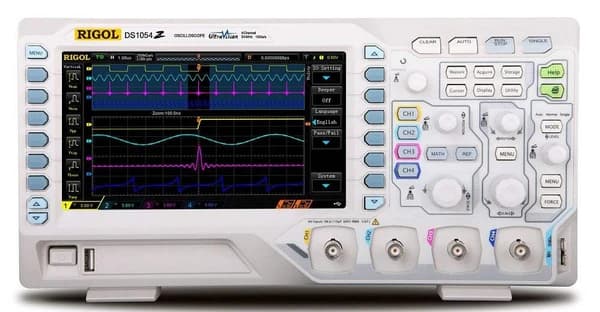
Rigol DHO802
4.6★★★★★The two-channel DHO800: 12-bit resolution, a 7-inch touchscreen and USB-C power for a lower price than the four-channel DHO804.

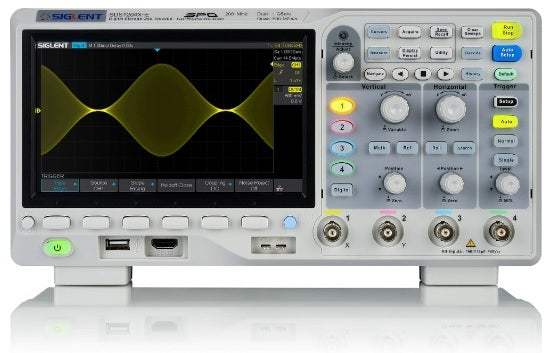
Hantek DSO2D10
4.3★★★★☆An oscilloscope and waveform generator in one unit — practical for space-limited benches.
Specs side by side
| Rigol DHO802 | Hantek DSO2D10 | |
|---|---|---|
| Rating | 4.6★★★★★ | 4.3★★★★☆ |
| Bandwidth | 70MHz | 100MHz |
| Channels | 2 | 2 |
| Sample rate | 1.25 GSa/s (1 ch); 625 MSa/s (2 ch) | 1 GSa/s |
| Best for | Two-channel work that benefits from 12-bit detail | Space-limited benches, combined testing |
| Sample rate, both channels on | 625 MSa/s per channel | Not stated in our data |
| Vertical resolution | 12-bit | Not stated in our data |
| Display | 7-inch 1024 × 600 capacitive touchscreen | 7-inch 800 × 480 |
| Built-in generator | None | 1 channel, up to 25 MHz |
| Serial decoding | Standard: parallel, UART, I2C, SPI, CAN | Not stated in our data |
Specs checked against manufacturer documentation and official Amazon listings. Desk research, not bench testing. How we research.
Key differences
- →Both have two channels, so channel count doesn't decide this one.
- →The Hantek has a built-in waveform generator (one channel, up to 25 MHz); Rigol lists no generator and no logic channels for the DHO802.
- →Bandwidth: 100 MHz on the Hantek against 70 MHz on the Rigol.
- →The DHO802 is a 12-bit scope; our data for the Hantek doesn't state its vertical resolution.
- →With one channel on the DHO802 samples at 1.25 GSa/s against the Hantek's 1 GSa/s, and it states 625 MSa/s per channel with both on.
- →The DHO802 adds a 1024 × 600 touchscreen, HDMI out, LAN, standard serial decoding and a USB-C 15 V supply; the Hantek's 7-inch screen is 800 × 480.
- →Neither carries our Hands-on Tested badge; both assessments are desk research against maker specifications.
Spec by spec
With channels tied at two, the comparison comes down to speed, detail and extras. The Hantek has the higher bandwidth; the Rigol has the higher single-channel sample rate, the only stated two-channel rate, and the higher-resolution screen.
| DHO802 | DSO2D10 | |
|---|---|---|
| Signal generator | None | 1 ch, to 25 MHz |
| Vertical resolution | 12-bit | Not stated |
| Memory | 25 Mpts (1 ch); 10 Mpts (2 ch) | Not stated |
| Video out / network | HDMI, LAN | Not stated |
| Power | USB-C, 15 V | Not stated |
Rigol DHO802 vs Hantek DSO2D10 for a Home Lab
A home lab usually means one shared bench, a limited budget and a mix of projects: an Arduino or ESP32 sketch one weekend, a guitar pedal or a bench supply the next. That mix decides this comparison better than any single spec.
The Hantek's case rests on one fact: it is two instruments in one enclosure. A home bench without a signal generator can't easily test a filter, an amplifier or an input stage, because there is nothing to feed in. The DSO2D10's built-in output (one channel, up to 25 MHz) fills that gap with no extra box, power lead or desk space. If you would otherwise buy a separate generator, that is the strongest reason to choose it.
The Rigol's case is about what you see on the screen. 12-bit resolution means 4,096 vertical levels against the 256 of an 8-bit scope, so the small ripple on a 5 V rail or the output of a slow sensor stays smooth when you zoom in. Standard decoding of UART, I2C, SPI and CAN turns microcontroller traffic into readable bytes, which is most of what hobby debugging involves. HDMI output lets you put the trace on a monitor, LAN connects it to your network, and Rigol specifies a USB-C 15 V supply. It is the lower-priced two-channel sibling of the four-channel DHO804.
| Home-lab project | Better fit | Why |
|---|---|---|
| Arduino or ESP32 serial bus debugging | Rigol DHO802 | UART, I2C, SPI and CAN decoding are standard |
| Bench power supply or USB charger ripple | Rigol DHO802 | 12-bit resolution keeps small ripple readable |
| Audio amplifiers and guitar pedals | Hantek DSO2D10 | Built-in generator supplies the test tone; two channels show in and out |
| Active and passive filter experiments | Hantek DSO2D10 | Sweep the generator and watch the output change |
| Bench with no signal generator yet | Hantek DSO2D10 | Scope and 25 MHz generator in one unit |
| Showing a trace on a monitor or to a class | Rigol DHO802 | HDMI output and a 1024 × 600 screen |
| Fast logic edges | Hantek DSO2D10 | 100 MHz against 70 MHz rated bandwidth |
What each one can and can't measure
Rated bandwidth is the frequency at which a sine wave is shown about 3 dB low, roughly 70% of its true amplitude. The common 3–5x rule says a scope should have three to five times the bandwidth of the fastest signal you care about, which gives the DHO802 roughly 14–23 MHz and the DSO2D10 roughly 20–33 MHz. Both comfortably cover hobby work: 16 MHz microcontroller clocks are near the top of the DHO802's range, while UART, I2C, PWM, audio and typical switching supplies sit far below it. Square waves need more margin than sines because their edges carry higher harmonics, so the Hantek shows sharp digital edges a little more faithfully. See what oscilloscope bandwidth means for the full explanation.
On sample rate the Rigol holds up well with both channels running: 625 MSa/s each is nearly nine samples per cycle of a 70 MHz sine, well above the Nyquist minimum of two. The Hantek reaches 1 GSa/s, ten samples per cycle at 100 MHz, but our data doesn't state its rate with both channels on, so check Hantek's datasheet if you plan to run both near full bandwidth. Our explainer on what GSa/s means covers why that figure matters.
Both run out at the same point: a third signal. Two channels cover input against output, a PWM signal against its filtered result, or a clock against one data line. For an SPI bus with chip select and two data lines, or several supply rails powering up in order, you need four channels, which puts the Rigol DHO804 on the list instead. And on the Hantek, using the generator for a stimulus-response test normally takes both inputs, one for the signal going in and one for what comes out.
Ask what your bench is missing
Mains and high-voltage circuits
For more options, see the best oscilloscope for a home electronics lab, the beginner oscilloscope roundup, the oscilloscope buying guide and our full Hantek DSO2D10 review.
Choose the Rigol DHO802 if…
- ✓You look at power-supply ripple, audio or sensor signals where 12-bit detail helps
- ✓You debug microcontroller projects and want UART, I2C, SPI and CAN decoding as standard
- ✓You want a sharper 1024 × 600 touchscreen, HDMI out to a monitor and LAN
Choose the Hantek DSO2D10 if…
- ✓You don't own a signal generator and want one in the same box as the scope
- ✓Your projects involve filters, amplifiers or sensor inputs you need to drive with a test signal
- ✓You want 100 MHz of bandwidth on your two channels
The bottom line
For a home lab that already has a signal source, or works mostly on microcontroller and power projects, the Rigol DHO802 is the better two-channel scope: 12-bit resolution, standard serial decoding, a sharper touchscreen, HDMI and LAN. If your bench has no generator and you build audio circuits, filters or amplifiers, the Hantek DSO2D10's built-in 25 MHz generator and 100 MHz bandwidth make it the more complete single purchase.
Frequently asked questions
Which is better for a home lab, the Rigol DHO802 or the Hantek DSO2D10?+
It depends on what your bench already has. Without a signal generator, the Hantek's built-in 25 MHz output makes it the more complete single instrument. With a generator, or for mostly microcontroller and power-supply work, the DHO802's 12-bit resolution, standard decoding and 1024 × 600 touchscreen give it the edge.
Can the Hantek DSO2D10's generator replace a separate function generator?+
For many home-lab tasks, yes. It is a single output up to 25 MHz, enough to drive audio circuits, filters and sensor inputs while the scope watches the result. It won't give you two independent signals at once, and it doesn't add scope channels, so check Hantek's documentation for waveform options.
Should I buy the DHO802 or the four-channel DHO804?+
Both share 70 MHz, 12-bit resolution and the same touchscreen. The DHO802 is the lower-priced two-channel model and keeps 625 MSa/s per channel with both on. Pick the DHO804 if you expect to watch three or four signals together, such as an SPI bus or several supply rails.
Is two channels enough for Arduino and ESP32 projects?+
Usually. Two channels cover a clock against data on I2C, a PWM pin against its filtered output, or a trigger against a response. On the DHO802, standard UART, I2C and SPI decoding helps further. You need four when chip select and two SPI data lines must line up with the clock.
Does the Rigol DHO802 need mains power?+
Rigol specifies a USB-C 15 V supply for the DHO802 as its power input. Our data doesn't state battery operation for this model. Like any scope, its ground can connect to earth through the supply or connected equipment, so treat it like any bench scope around mains circuits.
Related