HOW-TO GUIDE
What Does GSa/s Mean on an Oscilloscope?
By the OhmSavvy Research Team ·
Reading the unit
A digital oscilloscope does not record a continuous line. Its analog-to-digital converter measures the input voltage at regular instants, and the scope joins those points up on screen. "Sa" stands for samples, not seconds or bits, and the prefix tells you the scale. The time between samples is simply 1 divided by the sample rate.
01
Probe & front end
Scales the signal; bandwidth filters it
02
ADC sampling
Measures voltage every 1 / sample rate
03
Memory
Stores samples; depth sets capture length
04
Display
Joins or interpolates the dots on screen
Converting the prefixes for the scopes in our comparison gives these figures:
| Written as | Samples per second | Time between samples | Example |
|---|---|---|---|
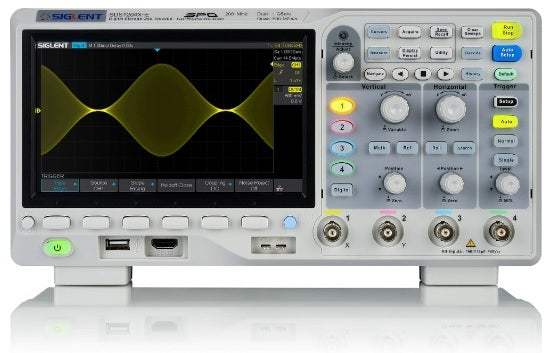
| 1 GSa/s | 1,000,000,000 | 1 ns | Rigol DS1054Z, Siglent SDS1104X-E, Hantek DSO2D10 |
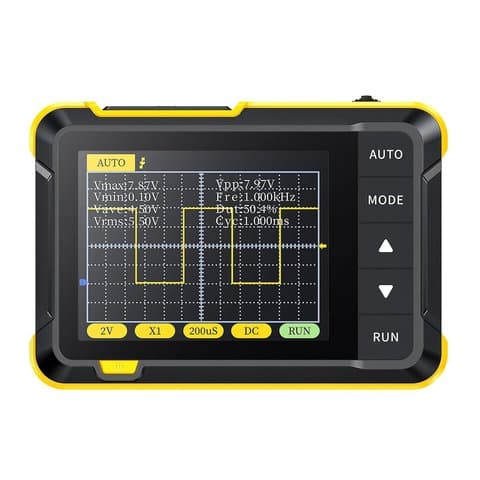
| 2.5 MSa/s | 2,500,000 | 400 ns | FNIRSI DSO152 |
| 100 MSa/s | 100,000,000 | 10 ns | General example |
You will also see GS/s or GSPS; they mean the same thing. Sample rate is not the same as vertical resolution (usually 8 bits on budget scopes), which is how finely each sample is measured; the buying guide covers that separately.
On a chart the gap between a pocket scope and a bench scope is easier to see. The FNIRSI DSO152's 2.5 MSa/s is 400 times lower than the 1 GSa/s of the other three models:
Bars use a logarithmic scale: each step is ten times the last.
The Nyquist minimum: more than 2x
The Nyquist-Shannon sampling theorem says that to represent a signal without ambiguity, you must sample at more than twice its highest frequency component. Half the sample rate is called the Nyquist frequency: 500MHz for a 1 GSa/s scope, 1.25MHz for a 2.5 MSa/s one.
Break that rule and the scope does not show an error. It shows a wrong waveform that looks perfectly plausible, called an alias. A sine above the Nyquist frequency folds back down to a lower apparent frequency. For example, a 900kHz sine sampled at 1 MSa/s produces samples that fit a 100kHz sine (1MHz minus 900kHz), and that is what the scope draws.
The pair below shows the mechanism. On the left, 20 samples land on every cycle and the joined dots trace the real wave closely. On the right, the signal completes 9 cycles while only 10 samples are taken, about 1.1 samples per cycle. Each dot is genuinely on the real waveform, yet joining them draws one slow cycle that does not exist.
20 samples per cycle
1.1 samples per cycle: aliasing
How to catch an alias
Why 2x is not enough in practice
Nyquist tells you the minimum needed to identify a frequency, not to see its shape. At just over 2 samples per cycle, the peaks can fall between samples, and edges get only one or two points. A more useful way to think about sample rate is samples per cycle of your signal:
| Sample rate | Signal | Samples per cycle |
|---|---|---|
| 1 GSa/s | 10MHz | 100 |
| 1 GSa/s | 50MHz | 20 |
| 1 GSa/s | 100MHz | 10 |
| 2.5 MSa/s | 200kHz | 12.5 |
| 2.5 MSa/s | 1MHz | 2.5 |
The last row is legal by Nyquist but not pretty. At 2.5 samples per cycle the frequency survives, yet the dots never land exactly on the peaks, so straight lines between them give a jagged wave whose height varies from cycle to cycle:
Scopes help by interpolating between samples. Many offer a choice between linear (straight lines between dots) and sin(x)/x interpolation, which reconstructs smooth curves from fewer points; check your model's manual for what it uses. Even so, a common guideline is a sample rate at least 4-5x the scope's bandwidth, and more is better. The four scopes in our beginner comparison all clear that at their headline rate:
| Model | Bandwidth | Headline sample rate | Ratio |
|---|---|---|---|
| Rigol DS1054Z | 50MHz | 1 GSa/s | 20x |
| Siglent SDS1104X-E | 100MHz | 1 GSa/s | 10x |
| Hantek DSO2D10 | 100MHz | 1 GSa/s | 10x |
| FNIRSI DSO152 | 200kHz | 2.5 MSa/s | 12.5x |
The catch is the word headline. Two common design choices mean you will not always get it.
Sample rates in our reviews
2.5 MSa/s on 1 channel, 200kHz bandwidth, pocket-sized.
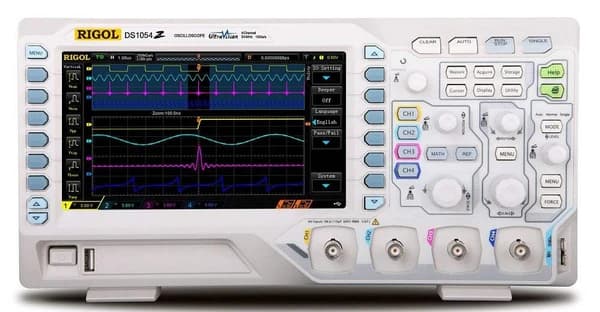
1 GSa/s, 4 channels, 50MHz, 7-inch display, strong community documentation.
As an Amazon Associate I earn from qualifying purchases. Prices and availability are shown on Amazon.
Catch 1: sample rate is often shared across channels
On many multi-channel scopes, the maximum sample rate is quoted for one channel (or one channel per converter). The converters are shared, so turning on more channels divides the available rate between them. A scope advertised at 1 GSa/s may sample each channel at a fraction of that with all channels active. How it splits varies by model, so check your model's datasheet for the per-channel figure with two, three and four channels on. In practice, switch off channels you are not using when you need the fastest sampling on the ones you are.
Catch 2: memory depth caps the rate at slow time/div
Every sample has to be stored. Memory depth (record length, in points) and sample rate set how long one capture lasts:
The relationship
On most scopes the screen spans 10 horizontal divisions, so the capture time is roughly 10 x the time/div setting. When the window gets long, a scope with limited memory has to drop its sample rate to fit. Here is a generic scope with 1 Mpts of memory and a 1 GSa/s maximum:
| Time/div | Screen window | Points needed at 1 GSa/s | Rate with 1 Mpts |
|---|---|---|---|
| 100 ns/div | 1 µs | 1,000 | 1 GSa/s |
| 10 µs/div | 100 µs | 100,000 | 1 GSa/s |
| 1 ms/div | 10 ms | 10,000,000 | 100 MSa/s |
| 100 ms/div | 1 s | 1,000,000,000 | 1 MSa/s |
Exact behavior varies: some scopes capture more than the visible window, step the rate in fixed increments, or let you choose the memory depth manually. Many show the actual sample rate in use on screen, which is worth glancing at. The practical lesson is that deeper memory is what lets a scope keep a high sample rate on long captures, such as catching a short glitch inside a slow serial transaction.
When sample rate matters most: one-shot events
On a steady, repeating waveform, the scope captures cycle after cycle and the picture builds up from many acquisitions, so a modest sample rate is often forgiving. A one-off event is different: a single glitch, a power-up sequence or one serial packet happens once, and the scope gets exactly one chance to sample it. If a 5 ns spike lands between two samples taken 10 ns apart, it can be missed entirely. For single-shot captures, the real-time sample rate in use at that moment, after channel sharing and memory limits, is the number that decides what you see. Set up the capture with a Single trigger, use only the channels you need, and keep the time/div no longer than the event requires.
Checklist: sample rate on a spec sheet
Check the ratio
Sample rate should be at least 4-5x the bandwidth, ideally more.
Read the footnote
Find the rate with all channels on, not just the headline single-channel figure.
Look at memory
Deep memory protects the sample rate at slow time/div settings.
Watch the readout
Many scopes display the live sample rate; it can be far below the maximum.
Suspect aliases
If frequency changes when you change time/div, sampling is too slow.
Pair with bandwidth
A fast sample rate cannot recover detail the front end already filtered out.
New to the instrument? Start with what an oscilloscope is and how to use one, or read the Rigol DS1054Z review to see these specs in the context of a real scope.
Frequently asked questions
What is the difference between sample rate and bandwidth?
Bandwidth describes the analog front end: the frequency at which a sine is reduced to about 70.7% of its true size before it is ever digitised. Sample rate describes how often the converter then measures that filtered signal. You need both: a fast sample rate cannot restore detail the front end has already removed, and a wide front end is wasted if too few samples are taken.
What does MSa/s mean on an oscilloscope?
MSa/s means mega-samples per second, or millions of voltage measurements each second. It is a thousand times slower than GSa/s. A 2.5 MSa/s scope such as the FNIRSI DSO152 takes one sample every 400 ns, so its Nyquist frequency is 1.25MHz, which is why scopes at that rate are suited to audio-range and slow control signals rather than fast digital work.
Is a higher sample rate always better on an oscilloscope?
Up to a point. A higher rate puts more samples on each cycle and makes short glitches harder to miss, but beyond about 4-5x the bandwidth the extra samples add less, because the front end has already filtered out faster content. Memory depth matters too: a high rate with shallow memory has to slow down on long time/div settings, which can cancel out the headline figure.
How many samples per cycle do you need to see a waveform?
More than two samples per cycle is the theoretical minimum to identify a frequency, but that is not enough to see its shape. At 2.5 samples per cycle peaks are often missed, while 10 or more samples per cycle give a recognizable sine even with straight-line interpolation. Sin(x)/x interpolation can rebuild smooth curves from fewer points, which is why it is offered on many scopes.
Does turning off channels increase the sample rate?
On many multi-channel scopes, yes. The analog-to-digital converters are shared, so the headline rate often applies to one channel and is divided when more channels are switched on. The exact split depends on the model, so check the datasheet for the per-channel figure. If you need the fastest sampling on one signal, switch off the channels you are not using.
