COMPARISON · OSCILLOSCOPES
FNIRSI 1014D vs FNIRSI DSO-TC3
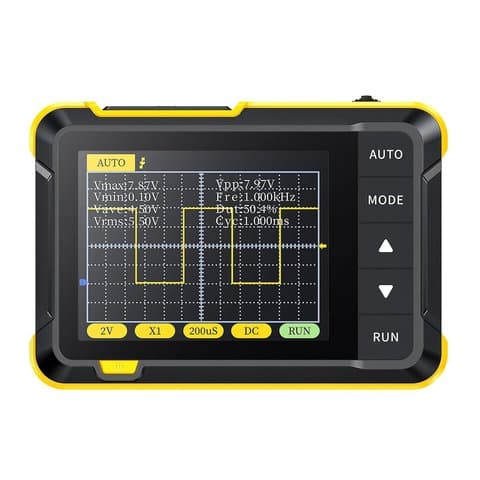
FNIRSI 1014D vs FNIRSI DSO-TC3 pits two FNIRSI tools that both include a signal generator against each other, but they are built for different projects. The 1014D is a two-channel, 100MHz, 1 GSa/s benchtop scope with a 7-inch screen and a DDS generator. The DSO-TC3 is a battery-powered pocket box: a 500kHz, 10 MSa/s single-channel scope, a component tester and a 6-waveform generator up to 100kHz.
By the OhmSavvy Research Team ·
Disclosure: OhmSavvy earns a commission from qualifying Amazon purchases made through these links, at no extra cost to you. How we're funded.

FNIRSI 1014D
4.3★★★★☆A two-channel 100 MHz benchtop with a built-in signal generator at an entry-level price.

FNIRSI DSO-TC3
4.1★★★★☆A battery-powered pocket scope, component tester and signal generator in one small box.
Specs side by side
| FNIRSI 1014D | FNIRSI DSO-TC3 | |
|---|---|---|
| Rating | 4.3★★★★☆ | 4.1★★★★☆ |
| Bandwidth | 100MHz | 500kHz |
| Channels | 2 | 1 |
| Sample rate | 1 GSa/s | 10 MSa/s |
| Best for | Budget benches that need a scope and a signal source | Beginners who want a scope, component tester and generator in one |
| Form factor | Benchtop | Pocket-sized, fold-out stand |
| Display | 7-inch, 800 × 480 | 2.4-inch |
| Signal generator | 1-channel DDS: sine to 10MHz, other waveforms to 2MHz, 2.5 Vpp | 6 waveforms, up to 100kHz |
| Power | 5 V adapter | Built-in rechargeable battery, USB-C charging |
| Vertical resolution | 8-bit | Not stated by FNIRSI |
| Memory | Quoted by FNIRSI as "240Kbit" | Not stated by FNIRSI |
| Comfortable signal range (3–5× rule) | Up to roughly 20–33MHz | Up to roughly 100–170kHz |
Specs checked against manufacturer documentation and official Amazon listings. Desk research, not bench testing. How we research.
Key differences
- →Bandwidth: 100MHz on the 1014D against 500kHz on the DSO-TC3, a 200-fold gap. By the 3–5× rule the 1014D is comfortable to roughly 20–33MHz; the DSO-TC3 to roughly 100–170kHz.
- →Sample rate: 1 GSa/s against 10 MSa/s, 100 times faster. FNIRSI doesn't state the 1014D's per-channel rate with both channels on.
- →Channels: 2 against 1. Only the 1014D can show two signals together for timing and input-versus-output checks.
- →Generators: the 1014D's DDS output reaches 10MHz sine and 2MHz on other waveforms at 2.5 Vpp; the DSO-TC3's 6 waveforms go up to 100kHz.
- →Only the DSO-TC3 has a component tester; only the 1014D lists FFT, X-Y mode, roll mode and USB export, and its Amazon kit adds a 100X high-voltage probe.
- →The DSO-TC3 runs on a built-in rechargeable battery with USB-C charging; the 1014D runs from a 5 V adapter on the bench.
Spec by spec
The scope halves of these tools sit in different classes, so the bandwidth, sample-rate and generator charts use a log scale; on a linear scale the DSO-TC3's bars would be invisible. Every number comes from FNIRSI's published specs as recorded in our beginner roundup.
Bars use a logarithmic scale: each step is ten times the last.
Bars use a logarithmic scale: each step is ten times the last.
Bars use a logarithmic scale: each step is ten times the last.
Both scopes pair sample rate sensibly with bandwidth on one channel: 10 samples per cycle at the 1014D's 100MHz limit and 20 per cycle at the DSO-TC3's 500kHz, both well above the Nyquist minimum of two. Two specs are loosely documented. FNIRSI quotes the 1014D's memory as "240Kbit" without a per-channel point count, and states neither ADC resolution nor memory depth for the DSO-TC3. FNIRSI's own 1014D page also gives both 12 and 14 standard generator signals; its spec table and Amazon listing say 14. For background, see what oscilloscope bandwidth is and what GSa/s means.
Which fits your projects?
Start from the fastest signal you expect to look at, not from the feature list. If everything you build runs at audio frequencies or slower, the DSO-TC3 covers it, and you gain a component tester and a tool that runs on its own battery. If you build anything with a microcontroller clock, a serial bus or a switching regulator, the 1014D is the one that can actually show those signals, and its second channel is what lets you see cause and effect.
Audio, sensors and learning: DSO-TC3
Guitar pedals, small amplifiers, linear supplies, slow sensors and low-frequency PWM all sit inside the DSO-TC3's comfortable range of roughly 100–170kHz. Its generator can feed a test tone into an amplifier while the scope watches the output, though only one at a time on screen. The component tester earns its place on any bench built from salvaged or unmarked parts. Its 2.4-inch screen is small for detailed reading, which matters less for quick checks.
Microcontrollers, logic and power: 1014D
At 100MHz the 1014D is comfortable up to roughly 20–33MHz. That covers UART, I2C and SPI at typical hobby speeds, PWM motor drives and most switching-supply waveforms. Two channels let you put a clock and a data line, or a filter's input and output, on the same 7-inch screen. Its generator doubles as a test source for filters and amplifiers up to 10MHz on sine. FFT shows the frequency content of a signal, and roll mode suits slow-changing signals such as a battery charging.
Where the 1014D falls short
Which should you buy?
| If your project is… | Pick | Why |
|---|---|---|
| Arduino, ESP32 or other microcontroller debugging | FNIRSI 1014D | 100MHz and 2 channels for clocks, buses and timing |
| Audio circuits and guitar pedals | Either; DSO-TC3 if portable matters | Both cover the audio band; the DSO-TC3 runs on battery |
| Sorting and checking components | FNIRSI DSO-TC3 | Only it has a component tester |
| Testing filters or amplifiers across a wide range | FNIRSI 1014D | Generator to 10MHz sine and a second channel for the output |
| Switching power supplies | FNIRSI 1014D | Switching waveforms usually exceed the DSO-TC3's comfortable range |
| Field checks away from mains power | FNIRSI DSO-TC3 | Built-in rechargeable battery with USB-C charging |
| Learning scope basics on a small budget | Either | Both include a generator to practice on known signals |
What each one can and can't measure
Bandwidth is the frequency at which a sine wave is shown about 3 dB low, roughly 70% of its true amplitude. The usual rule of thumb is a scope with 3–5 times the signal's frequency, and more for square waves, because their edges are built from harmonics far above the fundamental. A 1MHz square wave, a slow SPI clock, shows the gap clearly: it is twice the DSO-TC3's bandwidth, so the DSO-TC3 will show something closer to a rounded wave than a square one, while for the 1014D it is a small fraction of its bandwidth.
Rise time in numbers
Mains and high voltage
Other comparisons
If you are weighing the DSO-TC3 against a cheaper scope-only pocket tool, see FNIRSI DSO-TC3 vs FNIRSI DSO152. For other two- and four-channel bench options, see FNIRSI DSO152 vs Hantek DSO2D10, Hantek DSO2D10 vs Siglent SDS1104X-E and Rigol DS1054Z vs Siglent SDS1104X-E, the beginner oscilloscope roundup or the oscilloscope buying guide.
Choose the FNIRSI 1014D if…
- ✓You debug microcontroller, logic or switching-supply circuits with signals in the megahertz
- ✓You need two channels to compare input with output, or clock with data
- ✓You want a generator that reaches 10MHz sine and 2MHz on other waveforms
- ✓You want a 7-inch screen plus FFT, X-Y and roll modes
Choose the FNIRSI DSO-TC3 if…
- ✓Your projects are audio-range or other slow signals, up to around 100kHz
- ✓You want a component tester for transistors, MOSFETs, diodes, capacitors, resistors and inductors
- ✓You want a battery-powered tool with USB-C charging to carry around
- ✓One input channel is enough for what you check
The bottom line
If your projects involve microcontrollers, digital buses or switching supplies, the FNIRSI 1014D is the one to buy: 200 times the bandwidth, two channels, a 7-inch screen and a generator that reaches 10MHz, at an entry-level price, with loosely specified memory as the main caveat. The FNIRSI DSO-TC3 fits audio-range work, component sorting and portable checks, where its battery, component tester and pocket size matter more than speed.
Frequently asked questions
Is the FNIRSI 1014D or the DSO-TC3 better for Arduino projects?+
The 1014D. Its 100MHz bandwidth and 1 GSa/s cover microcontroller clocks, UART, I2C and SPI at typical hobby speeds, and its two channels show clock and data together. The DSO-TC3's 500kHz and single channel limit it to slow signals such as low-frequency PWM.
Which FNIRSI has the better signal generator?+
The 1014D's generator reaches further: a single-channel DDS output with sine up to 10MHz and other waveforms up to 2MHz at 2.5 Vpp. The DSO-TC3 offers 6 waveforms up to 100kHz. For audio work either is enough; for testing filters and amplifiers above the audio band, the 1014D covers far more.
Does the FNIRSI 1014D have a battery?+
Our verified data lists the 1014D as running from a 5 V adapter, with no built-in battery stated. The DSO-TC3 is the battery-powered option, with a built-in rechargeable battery and USB-C charging, which suits checks away from a bench.
Can the FNIRSI 1014D test components like the DSO-TC3?+
A component tester isn't in our verified 1014D data. The DSO-TC3 has one, covering transistors, MOSFETs, diodes, capacitance, resistance and inductance. If you need both fast scope work and component checks, the 1014D plus a separate component tester is one route.
What are the FNIRSI 1014D's weak points?+
Memory and multichannel sampling are loosely documented. FNIRSI quotes the memory as "240Kbit" without a clear point count and doesn't state the per-channel sample rate with both channels on. Its own page also lists both 12 and 14 standard generator signals, while the spec table says 14.
Related