COMPARISON · OSCILLOSCOPES
Rigol DHO914S vs Siglent SDS1104X-E for a Home Lab
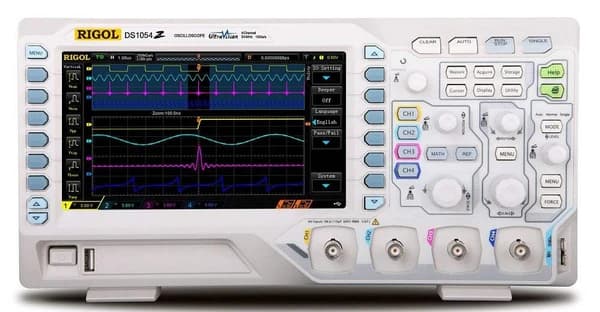
Rigol DHO914S vs Siglent SDS1104X-E pits a one-box bench against an established four-channel bench scope. The DHO914S is a 125 MHz, 12-bit scope with a built-in 25 MHz signal generator, a Bode plot function, 16 digital channels (with a separately sold probe) and up to 50 Mpts. The SDS1104X-E has 100 MHz, keeps 500 MSa/s on all four channels, decodes I2C, SPI, UART, CAN and LIN for free and has a widely praised, intuitive interface.
By the OhmSavvy Research Team ·
Disclosure: OhmSavvy earns a commission from qualifying Amazon purchases made through these links, at no extra cost to you. How we're funded.

Rigol DHO914S
4.6★★★★★The DHO914 plus a built-in 25 MHz signal generator and Bode plot, for a one-box home lab.
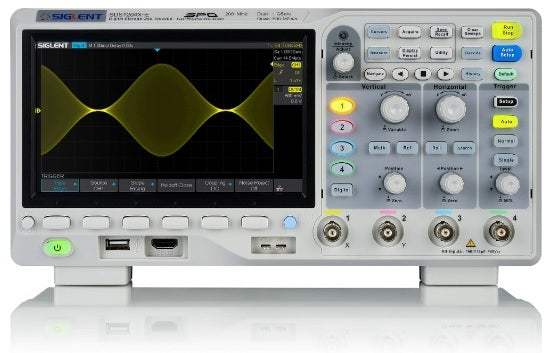
Siglent SDS1104X-E
4.8★★★★★More bandwidth and a better UI than the Rigol, for projects that will get more demanding.
Specs side by side
| Rigol DHO914S | Siglent SDS1104X-E | |
|---|---|---|
| Rating | 4.6★★★★★ | 4.8★★★★★ |
| Bandwidth | 125MHz | 100MHz |
| Channels | 4 + 16 digital (probe sold separately) | 4 |
| Sample rate | 1.25 GSa/s (1 ch); 312.5 MSa/s (4 ch) | 1 GSa/s |
| Best for | A home lab that wants scope, logic and signal source in one | Intermediate hobbyists, future-proofing |
| Sample rate, 4 channels on | 312.5 MSa/s per channel | 500 MSa/s per channel |
| Vertical resolution | 12-bit | 8-bit |
| Memory depth | 50 Mpts (1 ch); 10 Mpts (3–4 ch) | 14 Mpts (interleaved); 7 Mpts per channel |
| Built-in signal generator | 1 channel, 25 MHz, with Bode plot | None (USB AWG module optional) |
| Digital channels | 16 (PLA2216 probe sold separately) | 16 as a paid MSO option |
| Standard decoding | Parallel, UART, I2C, SPI, CAN, LIN | I2C, SPI, UART/RS232, CAN, LIN |
| Waveform update rate | 30,000 wfms/s; 1,000,000 in UltraAcquire | 100,000 wfm/s; 400,000 in sequence mode |
| Display | 7-inch 1024 × 600 touchscreen | 7-inch 800 × 480 TFT-LCD |
| Power | USB-C, 15 V 3 A (45 W max) | 100–240 V AC, 50 W max |
Specs checked against manufacturer documentation and official Amazon listings. Siglent SDS1104X-E is hands-on tested by OhmSavvy; the Rigol DHO914S assessment is desk research. How we research.
Key differences
- →The DHO914S has a built-in single-channel 25 MHz arbitrary/function generator and a Bode plot function; Siglent sells a USB generator module for the SDS1104X-E as an option.
- →Bandwidth: 125 MHz on the Rigol against 100 MHz on the Siglent.
- →Per-channel sample rate with all four channels on favors the Siglent, 500 MSa/s against 312.5 MSa/s; with one channel on the Rigol leads, 1.25 GSa/s against 1 GSa/s.
- →Resolution: 12-bit (4,096 levels) on the Rigol, 8-bit (256 levels) on the Siglent.
- →Memory: up to 50 Mpts on the Rigol against 14 Mpts, and 10 Mpts against 7 Mpts per channel with four on.
- →Both decode UART, I2C, SPI, CAN and LIN as standard; the Rigol also lists parallel.
- →Siglent quotes a faster normal update rate (100,000 against 30,000 wfm/s); Rigol's UltraAcquire mode reaches 1,000,000.
- →Rigol gives you a 1024 × 600 touchscreen and USB-C power; the Siglent is an 800 × 480 mains-powered bench scope. Our roundup scores the SDS1104X-E 4.8 and the DHO914S 4.6. The SDS1104X-E carries our Hands-on Tested badge; the DHO914S does not.
Spec by spec
These two trade wins row by row, so the charts split them out. Rigol figures come from our verified pick data and the DHO900 data sheet; Siglent figures from our pick data and Siglent's SDS1000X-E series page and data sheet.
Bars use a logarithmic scale: each step is ten times the last.
Bars use a logarithmic scale: each step is ten times the last.
Bars use a logarithmic scale: each step is ten times the last.
| Generator item | Rigol DHO914S |
|---|---|
| Channels | 1 |
| Sine | 2 mHz to 25 MHz |
| Square | 2 mHz to 15 MHz |
| Ramp | 2 mHz to 150 kHz |
| Arbitrary | 2 mHz to 10 MHz, 156 MSa/s, 14-bit |
| Amplitude | 2 mV to 10 V up to 10 MHz; 2 mV to 5 V above |
| Bode plot sweep | Start 10 Hz to 24.99 MHz, stop 100 Hz to 25 MHz |
Rigol DHO914S vs Siglent SDS1104X-E for a Home Lab
A home lab rarely has room or budget for every instrument at once, so the real question is what you will plug into the scope. A scope only observes; to test a filter, an amplifier or a sensor input you also need something that produces a known signal. The DHO914S includes that source. With the SDS1104X-E you either already own a function generator, buy Siglent's USB generator module, or use whatever your circuit makes on its own.
Bode plot is the feature that turns the DHO914S generator from handy into useful. It sweeps the generator across a frequency range, from as low as 10 Hz up to 25 MHz, measures input and output at each step and draws the gain and phase curve. That is how you check the corner frequency of an RC filter, the response of a guitar pedal tone stack or the roll-off of an op-amp stage without plotting dozens of points by hand.
The Siglent earns its place on a different kind of bench: one where four signals move quickly at the same time. Holding 500 MSa/s per channel with all inputs active, it captures a clock, chip select, data line and interrupt together with more samples on each than the Rigol can give. Its 100,000 wfm/s normal update rate helps a glitch show up on screen without switching modes, and Siglent includes LIN, CAN, I2C, SPI and UART decoding at no charge. Its interface is also widely regarded as intuitive, which counts on a tool you reach for in short evening sessions.
| Home-lab job | Better fit | Why, from the data |
|---|---|---|
| Plot an RC, audio or active filter's response | Rigol DHO914S | Built-in generator plus Bode plot |
| Feed a test tone into an amplifier and watch the output | Rigol DHO914S | Sine to 25 MHz from the same box |
| Simulate a sensor or clock signal for a microcontroller input | Rigol DHO914S | Square to 15 MHz, arbitrary to 10 MHz |
| Four-line SPI capture at speed | Siglent SDS1104X-E | 500 MSa/s per channel vs 312.5 MSa/s |
| Hunting a rare glitch in normal acquisition | Siglent SDS1104X-E | 100,000 vs 30,000 wfm/s in normal mode |
| Ripple and noise on a 3.3 V or 5 V rail | Rigol DHO914S | 12-bit vs 8-bit resolution |
| Long single-shot capture of a power-up sequence | Rigol DHO914S | 50 Mpts vs 14 Mpts |
| You already own a bench generator | Siglent SDS1104X-E | You would be paying the Rigol for a source you have |
What each scope can and can't measure
A bandwidth rating is the frequency at which a sine reads 3 dB low, so a scope is only accurate well below it. Keeping signals three to five times under the rating gives the DHO914S a useful range of roughly 25 to 42 MHz and the SDS1104X-E roughly 20 to 33 MHz. Both comfortably cover UART, I2C, PWM, audio and the switching frequency of small converters; the gap only shows on clocks or edges in the 30 MHz region. Read more in what oscilloscope bandwidth means.
That bandwidth edge reverses once you use every input. Dividing each scope's four-channel sample rate by its rated bandwidth, the Rigol gets 2.5 samples per cycle at 125 MHz and the Siglent 5 at 100 MHz. Both are above the Nyquist minimum of two, but the Siglent has more room for interpolation, so on four fast channels at once it draws edges more faithfully. On one or two channels the Rigol's 1.25 GSa/s and 625 MSa/s reverse that again. The GSa/s explainer covers why per-channel rate matters more than the headline.
Resolution decides how small a detail you can read. At 100 mV per division across eight divisions, an 8-bit converter divides the 800 mV screen into steps of about 3.1 mV, while a 12-bit converter gets about 0.2 mV. Real scopes add their own noise, so the practical gain is smaller than that ratio, but on a 20 mV ripple riding on a 5 V rail the Rigol shows a cleaner, steadier shape when you zoom in.
Instrument count versus channel speed
Mains-connected circuits
For the same Siglent against Rigol's cheaper 70 MHz model, see Rigol DHO804 vs Siglent SDS1104X-E; for the DHO914 without the generator, see Rigol DHO914 vs Rigol DHO804; and for another scope with a built-in generator, see Rigol DS1104Z-S Plus vs Siglent SDS1104X-E. Our Siglent SDS1104X-E review, the home electronics lab scope guide, the beginner oscilloscope roundup and the buying guide cover the wider field.
Choose the Rigol DHO914S if…
- ✓You want a signal source on the bench without buying and storing a separate generator
- ✓You plan to measure filter, amplifier or speaker-crossover frequency response with Bode plot
- ✓Small details such as ripple on a rail matter, and 12-bit resolution helps you see them
- ✓You want 16 logic inputs available later through the PLA2216 probe
Choose the Siglent SDS1104X-E if…
- ✓You often watch four fast signals together and want 500 MSa/s on each
- ✓You already own a function generator, or don't need one
- ✓A widely praised, approachable interface matters more to you than a touchscreen
- ✓You want serial decoding including LIN with no add-ons and a high normal-mode update rate
The bottom line
For a home lab starting from scratch, the Rigol DHO914S is the more complete bench: a 125 MHz 12-bit scope, a 25 MHz generator with Bode plot, up to 50 Mpts and a path to 16 logic channels, all in one USB-C powered box. Choose the Siglent SDS1104X-E if you already own a generator or mostly watch four fast signals together, where its 500 MSa/s per channel, 100,000 wfm/s update rate and free decoding including LIN make it the stronger pure oscilloscope.
Frequently asked questions
Does the Siglent SDS1104X-E have a built-in signal generator like the DHO914S?+
No. Siglent offers a generator for the four-channel SDS1000X-E models only as an optional USB AWG module. The DHO914S has a single-channel 25 MHz arbitrary/function generator built in, with sine to 25 MHz, square to 15 MHz and arbitrary waveforms to 10 MHz, plus a Bode plot function that uses it.
What can I do with the DHO914S Bode plot in a home lab?+
Measure frequency response. The scope sweeps its generator from as low as 10 Hz up to 25 MHz into your circuit and plots gain and phase at each point. That shows the cutoff of an RC or active filter, the bandwidth of an op-amp stage or the tone curve of an audio circuit without taking readings by hand.
Which is better for four-channel work, the DHO914S or the SDS1104X-E?+
The SDS1104X-E when all four signals are fast. It keeps 500 MSa/s per channel against the Rigol's 312.5 MSa/s, giving about 5 samples per cycle at its rated bandwidth versus 2.5. The Rigol counters with 10 Mpts per channel against 7 Mpts and 12-bit resolution, which help with slower, longer or smaller signals.
Is 12-bit resolution or a faster update rate more useful?+
It depends on the fault. The Rigol's 12 bits show small amplitude details such as rail ripple and sensor noise more clearly. The Siglent's 100,000 wfm/s normal update rate, against Rigol's 30,000, helps rare glitches appear sooner in normal mode, though Rigol's UltraAcquire mode reaches 1,000,000 wfm/s when you switch to it.
Do both scopes decode serial buses without extra licenses?+
Yes. Rigol lists parallel, UART, I2C, SPI, CAN and LIN decoding as standard on the DHO914S, and Siglent lists I2C, SPI, UART/RS232, CAN and LIN as standard on the SDS1104X-E. For a home lab working with Arduino, ESP32 or automotive modules, neither scope needs a paid upgrade to read those buses.
Related