COMPARISON · OSCILLOSCOPES
Rigol DS1102Z-E vs Siglent SDS1102CML+
Rigol DS1102Z-E vs Siglent SDS1102CML+ pits two 100 MHz, two-channel benchtop scopes with 1 GSa/s and 7-inch 800 × 480 screens against each other. On paper they look alike; in use, the Rigol's 24 Mpts of memory and standard serial decoding set it well apart from the Siglent, whose memory is 40 Kpts in normal mode.
By the OhmSavvy Research Team ·
Disclosure: OhmSavvy earns a commission from qualifying Amazon purchases made through these links, at no extra cost to you. How we're funded.

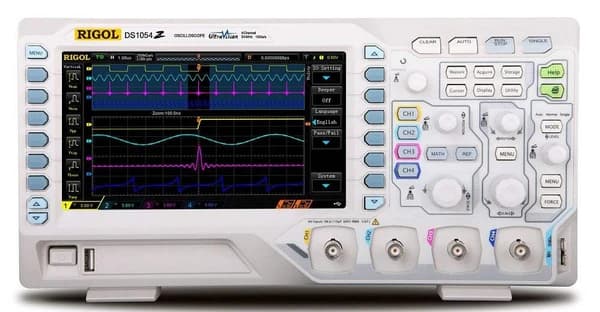
Rigol DS1102Z-E
4.4★★★★☆Rigol's two-channel, 100 MHz benchtop with deep memory, for people who never need a third or fourth channel.

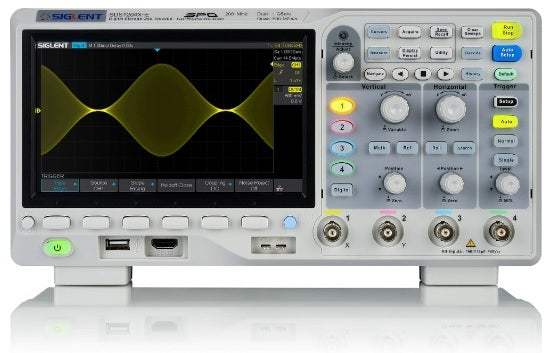
Siglent SDS1102CML+
4.2★★★★☆A simple 100 MHz, two-channel benchtop with a frequency counter and pass/fail testing, but shallow memory.
Specs side by side
| Rigol DS1102Z-E | Siglent SDS1102CML+ | |
|---|---|---|
| Rating | 4.4★★★★☆ | 4.2★★★★☆ |
| Bandwidth | 100MHz | 100MHz |
| Channels | 2 | 2 |
| Sample rate | 1 GSa/s (1 ch); 500 MSa/s (2 ch) | 1 GSa/s |
| Best for | Two-channel debugging, students | Classrooms and basic waveform viewing |
| Sample rate, 1 / 2 channels | 1 GSa/s / 500 MSa/s | 1 GSa/s real-time; per-channel split not stated |
| Memory depth | 24 Mpts (1 ch); 12 Mpts (2 ch) | 40 Kpts normal; 2 Mpts long-memory |
| Vertical resolution | 8-bit (12-bit High Resolution mode) | 8-bit |
| Waveform rate | Up to 30,000 wfms/s | Not stated by Siglent |
| Serial decoding | Parallel, RS232/UART, I2C, SPI | None listed |
| Equivalent-time sampling | Not listed | Up to 50 GSa/s (series figure) |
| Triggers | Not detailed here | Edge, pulse, video, slope, alternate |
| Measurements and math | Not detailed here | 32 measurements; +, −, ×, ÷, FFT |
| Recording | Up to 60,000 frames | Digital recorder, 7 M memory |
| Display | 7-inch 800 × 480, intensity graded | 7-inch 800 × 480 |
| Interfaces | USB host/device, LAN (LXI), Aux out | USB host/device, LAN, Pass/Fail |
Specs checked against manufacturer documentation and official Amazon listings. Desk research, not bench testing. How we research.
Key differences
- →Rigol's datasheet gives the DS1102Z-E 24 Mpts of memory; Siglent lists 40 Kpts in normal mode and 2 Mpts in long-memory mode for the SDS1102CML+, and its Amazon listing says 1 Mpts.
- →The DS1102Z-E includes serial decoding of parallel, UART, I2C and SPI buses; Siglent lists no serial decoding for the CML+.
- →Rigol states up to 30,000 waveforms per second; Siglent doesn't state an update rate for the CML+.
- →The CML+ offers equivalent-time sampling up to 50 GSa/s for repetitive signals, plus a 6-digit frequency counter and pass/fail mask testing.
- →Both are 100 MHz, two-channel, 1 GSa/s scopes with a 7-inch 800 × 480 screen.
At a glance
Same front end
100 MHz, two channels, 1 GSa/s, 7-inch 800 × 480 screen.
Rigol extra: memory
24 Mpts, 600 times the Siglent's normal-mode 40 Kpts.
Rigol extra: decoding
UART, I2C, SPI and parallel included.
Siglent extra: counter
A 6-digit frequency counter and pass/fail mask testing.
Siglent extra: ET sampling
Up to 50 GSa/s on repeating signals.
Verdict
Most buyers: Rigol. Basic classroom viewing on a budget: Siglent.
Rigol DS1102Z-E vs Siglent SDS1102CML+ spec by spec
Memory decides how long the scope can keep sampling at full speed. At 1 GSa/s, 24 Mpts holds 24 ms of signal; 40 Kpts holds 40 µs. Beyond that, a scope has to lower its sample rate to fit the timebase. The front-end numbers on the two spec sheets match, so memory, decoding and update rate are where the money goes.
Bars use a logarithmic scale: each step is ten times the last.
Bars use a logarithmic scale: each step is ten times the last.
| Scope and mode | Memory | Time at 1 GSa/s | Sample rate with 100 ms on screen |
|---|---|---|---|
| Rigol DS1102Z-E, one channel | 24 Mpts | 24 ms | ≈ 240 MSa/s |
| Siglent SDS1102CML+, long memory | 2 Mpts | 2 ms | ≈ 20 MSa/s |
| Siglent SDS1102CML+, normal | 40 Kpts | 40 µs | ≈ 0.4 MSa/s |
The last column is memory divided by the time on screen, capped at 1 GSa/s, and scopes round to their own steps, so treat it as a guide. It shows why shallow memory hurts: at a slow timebase the Siglent in normal mode samples a thousand times slower than its headline figure.
How the Siglent reaches 50 GSa/s
The CML+'s 50 GSa/s figure is equivalent-time sampling, not real-time. On a signal that repeats exactly, the scope takes a sample on each trigger, shifted slightly later each time, and stitches the results into one finely resolved cycle. It is a genuine way to see fast edges on a clock or a test signal, but it can't capture anything that happens once.
Why this matters for serial buses
Rigol DS1102Z-E vs SDS1102CML+: which should you buy?
| You are… | Better fit | Why |
|---|---|---|
| Debugging Arduino serial buses | Rigol DS1102Z-E | UART, I2C and SPI decoding plus 24 Mpts to hold whole packets |
| Hunting an intermittent glitch | Rigol DS1102Z-E | Stated 30,000 wfms/s and 60,000-frame recording |
| Teaching basic waveform viewing | Siglent SDS1102CML+ | Simple controls, counter and pass/fail for lab exercises |
| Measuring a clock's frequency precisely | Either | Both are 100 MHz; the Siglent adds a 6-digit counter |
| Looking at fast edges on a repeating signal | Either | Same 100 MHz; Siglent's ET mode adds detail on repeats |
| Logging long, slow signals | Rigol DS1102Z-E | Deep memory keeps the sample rate up on slow timebases |
Use cases in practice
Students and hobbyists tend to outgrow a scope through serial buses and one-off events, and both point to the Rigol. Decoding turns an I2C transaction into readable addresses and bytes, and deep memory lets you capture the whole transaction at a sample rate high enough to see the edges. Our guide to using persistence to find intermittent glitches shows why update rate matters too.
The Siglent's strengths suit a classroom: 32 automatic measurements with five on screen, a frequency counter, and a pass/fail mask that flags when a waveform leaves a template. If a lab only needs students to read amplitude, period and phase on sine and square waves, it does that well. For a broader comparison, see the DS1102Z-E against the four-channel DS1054Z or our oscilloscope buying guide.
Safety: bench scope inputs are not for mains
Choose the Rigol DS1102Z-E if…
- ✓You capture long records, such as a full serial packet at a fast timebase
- ✓You want UART, I2C, SPI and parallel decoding without extra cost
- ✓You want hardware recording and playback of up to 60,000 frames
Choose the Siglent SDS1102CML+ if…
- ✓You mostly view repetitive waveforms in a classroom or on a basic bench
- ✓You want a 6-digit frequency counter and pass/fail testing
- ✓You find it at a clear discount to the Rigol
The bottom line
The Rigol DS1102Z-E is the better buy for almost everyone: far deeper memory, standard serial decoding and a stated 30,000 wfms/s update rate on the same 100 MHz, two-channel base. The Siglent SDS1102CML+ only makes sense for basic classroom viewing at a clearly lower price.
Frequently asked questions
How much memory does the SDS1102CML+ have?+
Siglent lists 40 Kpts in normal mode and 2 Mpts in long-memory mode; its Amazon listing says 1 Mpts. We use Siglent's own figures and flag the conflict. Either way it is far short of the Rigol DS1102Z-E's 24 Mpts, which matters as soon as you slow the timebase or capture a serial packet.
Does the Rigol DS1102Z-E decode serial buses?+
Yes. Rigol's datasheet lists parallel, RS232/UART, I2C and SPI decoding as standard, two decodes at a time. That lets you read bytes and addresses on screen instead of counting edges. Siglent lists no serial decoding for the SDS1102CML+, so on that scope you would decode by hand from the waveform.
Are both scopes really 100 MHz?+
Yes. Both are 100 MHz, two-channel scopes with 1 GSa/s maximum real-time sampling and a 7-inch 800 × 480 display. With both channels on, Rigol's figure halves to 500 MSa/s per channel; Siglent's page doesn't break down the two-channel rate. Either is comfortable on signals up to roughly 20 to 30 MHz.
Is the SDS1102CML+ discontinued?+
Siglent North America still sells it new, and we found no discontinued notice on its site. It is an older and simpler design than the Rigol, with no serial decoding and shallow memory, so check the live Amazon listing before buying, since stock on older models can come and go.
Which is better for students, the DS1102Z-E or the SDS1102CML+?+
The DS1102Z-E, because deep memory and decoding stay useful as projects grow from blinking LEDs to sensors and serial buses. The CML+ covers basic waveform viewing, automatic measurements and frequency counting, which is enough for an introductory lab but limiting once you start debugging microcontroller communications.
Related