COMPARISON · OSCILLOSCOPES
Rigol DS1054Z vs OWON SDS1102
Rigol DS1054Z vs OWON SDS1102 is a trade between channels and bandwidth. Both are benchtop scopes with 7-inch displays and 1 GSa/s headline sample rates. The Rigol gives you four channels at 50MHz; the OWON gives you two channels at 100MHz in a slim, light body, but with a short 10K-point record and only edge and video triggers.
By the OhmSavvy Research Team ·
Disclosure: OhmSavvy earns a commission from qualifying Amazon purchases made through these links, at no extra cost to you. How we're funded.
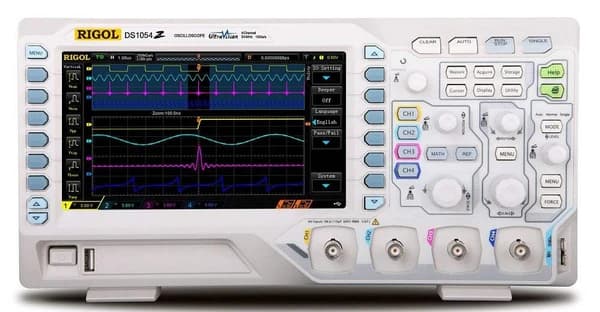
Rigol DS1054Z
4.8★★★★★The default beginner oscilloscope recommendation for years, and still worth it.

OWON SDS1102
4.2★★★★☆A slim, light two-channel 100 MHz benchtop with a 7-inch screen and simple controls.
Specs side by side
| Rigol DS1054Z | OWON SDS1102 | |
|---|---|---|
| Rating | 4.8★★★★★ | 4.2★★★★☆ |
| Bandwidth | 50MHz | 100MHz |
| Channels | 4 | 2 |
| Sample rate | 1 GSa/s | 1 GSa/s (real-time) |
| Best for | Hobbyists, students, general electronics | A compact two-channel bench scope |
| Display | 7-inch | 7-inch, 800 × 480 |
| Form factor | Benchtop | Slim benchtop, 301 × 152 × 70 mm, about 1.1 kg |
| Comfortable signal range (3–5× rule) | Up to roughly 10–17MHz | Up to roughly 20–33MHz |
Specs checked against manufacturer documentation and official Amazon listings. Rigol DS1054Z is hands-on tested by OhmSavvy; the OWON SDS1102 assessment is desk research. How we research.
Key differences
- →Channels: 4 on the Rigol against 2 on the OWON. If you need to see more than two signals at the same moment, only the Rigol can do it.
- →Bandwidth: 100MHz on the OWON against 50MHz on the Rigol. By the 3–5× rule the OWON is comfortable to roughly 20–33MHz, the Rigol to roughly 10–17MHz.
- →Sample rate: both quote 1 GSa/s. Rigol's figure is for one channel and drops to 250 MSa/s per channel with three or four channels on; OWON quotes 1 GSa/s real-time, and the specs we verified don't give a per-channel split.
- →Record length: OWON lists 10K points for the SDS1102, which limits how long a window you can capture at full sample rate. The DS1054Z's memory depth isn't part of the pick data we verified, so we don't put a number on it here.
- →Triggers and features: OWON lists edge and video triggers only, with no serial decoding, generator or logic channels.
- →The Rigol carries our Hands-on Tested badge; the OWON assessment is desk research based on OWON's published specs.
Spec by spec
On paper these two pull in opposite directions: the OWON doubles the bandwidth, the Rigol doubles the channel count. The charts below use only the figures each maker publishes, which is why the OWON's sample rate appears once, without a per-channel breakdown.
Both sample fast enough for their bandwidth. At 50MHz the Rigol takes 20 samples per cycle on one channel, or 5 with three or four channels on. If the OWON's 1 GSa/s applies to the channel in use, it takes 10 samples per cycle at 100MHz. All of these are well above the Nyquist minimum of two. For background, see what oscilloscope bandwidth is and what GSa/s means.
Which should you buy?
| If you are… | Pick | Why |
|---|---|---|
| Debugging SPI, with clock, data, chip select and output | Rigol DS1054Z | Four signals at once; the OWON can show two |
| Checking an amplifier's input against its output | Either | Two channels and far more bandwidth than audio needs |
| Looking at signals in the 10–20MHz range | OWON SDS1102 | 100MHz keeps it inside the 3–5× rule; 50MHz is marginal |
| Capturing a long event, like a supply start-up, at a fast sample rate | Neither on our data | The OWON's 10K points are short; the Rigol's depth isn't in our verified data |
| Needing pulse-width or serial triggers | Not the OWON | OWON lists edge and video triggers only |
| Short on desk space | OWON SDS1102 | Slim body, 70 mm deep, about 1.1 kg per OWON |
| Wanting the pick with the most learning resources | Rigol DS1054Z | Strong community support and documentation |
What each one can and can't measure
Bandwidth is the frequency at which a sine wave is shown about 3 dB low, roughly 70% of its real amplitude. The usual rule of thumb is to buy 3–5 times the frequency you want to see accurately, and more for square waves, whose sharp edges are made of harmonics well above the fundamental. Both scopes clear the bar for the bulk of hobby work; the differences show up at the edges.
Rigol DS1054Z: wide, at moderate speed
With 50MHz the DS1054Z is comfortable to roughly 10–17MHz. That covers UART, I2C and SPI at typical hobby clock rates, PWM motor drives, audio, and many switching regulators. Its strength is breadth: with four channels you can trigger on a chip select and see clock, data and the resulting output in the same capture, which is how most timing faults get found. Its limit is speed. A 20MHz clock or a fast logic edge is past its comfortable range, so rise times and overshoot on those signals can't be trusted, and its review flags it as modest for RF.
OWON SDS1102: faster, but narrower
With 100MHz the SDS1102 is comfortable to roughly 20–33MHz, so faster clocks and edges look closer to their true shape. The trade-offs are elsewhere. Two channels means a four-wire bus can only be seen two lines at a time. Edge and video triggers suit repetitive signals, but there's no pulse-width trigger to catch a single short glitch. And the 10K-point record limits capture time: at 1 GSa/s, 10,000 points fill in 10 µs. To capture a 10 ms event, any scope with 10K points has to drop to about 1 MSa/s, and then the 100MHz bandwidth no longer helps much.
Record length decides your real sample rate
Mains and high voltage
Before you order
We show no photo of the SDS1102 on this page on purpose. Neither OWON's product page nor the Amazon listing we link shows a unit marked SDS1102 (the listing's main photo shows an SDS1022), so check the model name in the listing title before you buy. If neither scope fits, the Rigol DS1054Z vs Siglent SDS1104X-E comparison covers a four-channel 100MHz option, and Hantek DSO5102P vs Rigol DHO804 sets another two-channel 100MHz benchtop against a four-channel scope. Other matchups include Rigol DS1054Z vs Hantek DSO2D10, Rigol DHO804 vs Rigol DS1054Z and Rigol DS1054Z vs OWON VDS1022I, or start with the oscilloscope buying guide.
Choose the Rigol DS1054Z if…
- ✓You need to watch three or four signals at once, such as clock, data, chip select and output
- ✓Your signals sit comfortably below about 10MHz: microcontrollers, audio, typical hobby buses
- ✓You value strong community support and documentation while you learn
- ✓You'd rather buy the hands-on tested pick in this pairing
Choose the OWON SDS1102 if…
- ✓Two channels are enough and you want more bandwidth headroom than 50MHz
- ✓You want a slim, light bench scope (OWON lists about 1.1 kg) for a small desk
- ✓Your measurements are simple edge-triggered looks at repetitive signals
The bottom line
For most beginners and hobbyists the Rigol DS1054Z is the better buy: four channels let you see cause and effect across a whole bus, and 50MHz covers most microcontroller, audio and power work. The OWON SDS1102 makes sense when two channels are enough and you want 100MHz of headroom in a slim, light body, as long as a 10K-point record and edge and video triggers suit your measurements.
Frequently asked questions
Is the OWON SDS1102 better than the Rigol DS1054Z because it has 100MHz?+
Only for faster signals. Its 100MHz bandwidth keeps signals up to roughly 20–33MHz accurate, against roughly 10–17MHz on the Rigol. But it has two channels instead of four, a 10K-point record and only edge and video triggers. For most hobby work below 10MHz, the Rigol's extra channels matter more than the extra bandwidth.
Do both scopes really sample at 1 GSa/s?+
Both quote 1 GSa/s. Rigol's figure is for a single channel and falls to 250 MSa/s per channel with three or four channels on. OWON quotes 1 GSa/s real-time for the SDS1102, but the specs we verified don't state whether that rate is shared when both channels run.
Is 10K points of record length enough?+
For repetitive signals like clocks, PWM and audio tones, usually yes, because the scope redraws them continuously. For one-off events it is limiting: at 1 GSa/s, 10K points cover only 10 µs, so longer windows force the sample rate down. If you plan to capture start-up transients or long serial bursts, look for deeper memory.
Can the OWON SDS1102 decode I2C or SPI?+
Not according to OWON's specifications: it lists no serial decoding, no logic channels and only edge and video triggers. You can still view I2C or SPI waveforms two lines at a time and read bits by eye, but a scope with decoding saves a lot of time on bus debugging.
Which is better for a small desk?+
The OWON SDS1102. OWON lists it at 301 × 152 × 70 mm and about 1.1 kg, a slim body for a benchtop scope with a 7-inch display. Our verified data for the Rigol DS1054Z doesn't include its dimensions or weight, so we can't give an exact comparison, but it is a conventional benchtop design.
Related