COMPARISON · OSCILLOSCOPES
Rigol DS1054Z vs OWON VDS1022I
Rigol DS1054Z vs OWON VDS1022I is a choice between a bench scope and a laptop scope. The Rigol is a self-contained 4-channel, 50MHz, 1 GSa/s instrument with a 7-inch display. The OWON is a 0.26 kg USB box with two channels, 25MHz and 100 MSa/s, no screen of its own and an isolated USB link: it shows waveforms through OWON's PC software.
By the OhmSavvy Research Team ·
Disclosure: OhmSavvy earns a commission from qualifying Amazon purchases made through these links, at no extra cost to you. How we're funded.
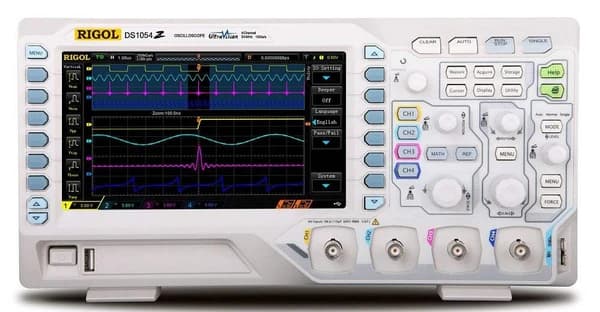
Rigol DS1054Z
4.8★★★★★The default beginner oscilloscope recommendation for years, and still worth it.

OWON VDS1022I
4.1★★★★☆A small, USB-powered two-channel PC oscilloscope with an isolated USB connection, for laptop-based work.
Specs side by side
| Rigol DS1054Z | OWON VDS1022I | |
|---|---|---|
| Rating | 4.8★★★★★ | 4.1★★★★☆ |
| Bandwidth | 50MHz | 25MHz |
| Channels | 4 | 2 |
| Sample rate | 1 GSa/s | 100 MSa/s |
| Best for | Hobbyists, students, general electronics | Laptop-based debugging on a small budget |
| Display | Built-in 7-inch | None: uses your computer's screen via OWON's PC software |
| Form factor | Benchtop | USB PC oscilloscope, 0.26 kg |
| Comfortable signal range (3–5× rule) | Up to roughly 10–17MHz | Up to roughly 5–8MHz |
| Sample rate by channels on | 1 GSa/s (1 ch), 500 MSa/s (2 ch), 250 MSa/s (3–4 ch) | 100 MSa/s (2-channel split not stated) |
| Record length | 24 Mpts (datasheet); 12M standard, 24M optional (product page) | 5K points |
| Vertical resolution | 8-bit (12-bit high-res mode) | 8-bit |
| Waveform update rate | Up to 30,000 wfm/s | Not stated |
| Rise time | ≈7 ns (0.35 ÷ 50MHz estimate) | 14 ns (OWON figure) |
| Power | 100–240 V AC, 50 W max | USB bus power, 2.5 W max |
| Computer link | USB host/device and LAN (not needed to operate) | Isolated USB 2.0 (required) |
Specs checked against manufacturer documentation and official Amazon listings. Rigol DS1054Z is hands-on tested by OhmSavvy; the OWON VDS1022I assessment is desk research. How we research.
Key differences
- →Form factor: the Rigol is a complete benchtop instrument with a 7-inch display; the VDS1022I has no screen and needs a computer running OWON's software.
- →Bandwidth: 50MHz against 25MHz. By the 3–5× rule the Rigol is comfortable to roughly 10–17MHz, the OWON to roughly 5–8MHz.
- →Sample rate: 1 GSa/s on one Rigol channel (250 MSa/s per channel with three or four on) against 100 MSa/s on the OWON.
- →Channels: 4 against 2.
- →The OWON is USB-powered and its USB link to the computer is isolated; OWON lists edge, pulse, video, slope and alternate triggers, math and FFT, and a 5K-point record.
- →The Rigol carries our Hands-on Tested badge; the OWON assessment is desk research based on OWON's published specs.
Spec by spec
The Rigol leads on every headline number, by a factor of two on bandwidth and channels and ten on sample rate. One caution on sources: the Amazon listing for the VDS1022I quotes figures for OWON's whole VDS series, which don't apply to this model. The numbers below are the ones OWON publishes for the VDS1022I itself: 25MHz, 100 MSa/s and 5K points.
Bars use a logarithmic scale: each step is ten times the last.
Four samples per cycle at 25MHz is above the Nyquist minimum, but a waveform near the OWON's limit is drawn from very few points, so its shape relies heavily on the software's interpolation. OWON doesn't state in the specs we verified whether the 100 MSa/s rate is shared when both channels run. For more on these figures, see what oscilloscope bandwidth is and what GSa/s means.
Rigol DS1054Z vs OWON VDS1022I for electronics testing
For electronics testing the real question isn't only bandwidth, it's how you work. A bench scope sits beside the circuit with its own screen and controls: you turn a knob and the trace moves, with nothing else to boot or connect. A PC scope like the VDS1022I turns your laptop into the display and control panel. That makes it small enough to carry to a project, and a laptop screen is usually larger than a 7-inch panel, but every session starts with plugging in, opening OWON's software and working through a mouse rather than dedicated knobs.
What the OWON VDS1022I handles
With 25MHz the VDS1022I is comfortable to roughly 5–8MHz. That covers audio circuits, sensor outputs, PWM for motors and LEDs, UART at common baud rates and 100kHz or 400kHz I2C. Its two channels let you compare an amplifier's input with its output, or watch clock and data on an I2C bus. OWON lists edge, pulse, video, slope and alternate triggers plus math and FFT, so a pulse trigger is available for catching a short glitch. The limits are the 5K-point record, which at 100 MSa/s fills in 50 µs, and the fact that it can't be used without a computer.
What the Rigol DS1054Z adds
At 50MHz the DS1054Z stays comfortable to roughly 10–17MHz, so faster SPI clocks, sharper logic edges and many switching regulators look closer to their real shape. Four channels mean you can watch chip select, clock, data and an output in one capture. And because it is self-contained, it is always ready on the bench. Its review notes that menus take some learning and that 50MHz is modest for RF; at that point both scopes are out of their depth.
Rise time sets the fastest edge you can trust
Record length: 50 µs against 24 ms
Memory decides how much time one capture holds at full speed. The VDS1022I's 5K points at 100 MSa/s cover 5,000 ÷ 100,000,000 = 50 µs. That is enough for a few cycles of a 100kHz signal, but a single 115,200-baud UART byte lasts about 87 µs (10 bits × 8.7 µs), so catching a whole byte means slowing the timebase and the sample rate with it. Rigol's datasheet gives the DS1054Z 24 Mpts, which at 1 GSa/s spans 24 ms; its product page lists 12M as standard, which halves that. Either figure holds an entire burst of serial traffic at a rate that still resolves every edge.
Where the probe ground goes
The two designs also differ in a way the spec sheet barely mentions: what the probe's ground clip is connected to. On the Rigol it is the scope chassis, and through the power cord, mains earth. On the OWON it is the scope's own front end, which talks to your laptop across an isolation barrier in the USB link.
In practice the isolation helps most on battery and bench-supply circuits whose ground isn't at earth potential, such as a USB-powered gadget plugged into a different computer: with a non-isolated scope, the two grounds meet through the probe and can cause a ground loop or worse. With the Rigol, that same situation is handled by making sure the circuit's ground is the point you clip to, or by floating the circuit from a battery.
Grounds, isolation and mains
Which should you buy?
| If you are… | Pick | Why |
|---|---|---|
| Building a permanent home bench | Rigol DS1054Z | Self-contained, with its own 7-inch screen and controls |
| Working from a laptop, or moving between places | OWON VDS1022I | 0.26 kg, USB-powered, uses the laptop's screen |
| Debugging SPI with chip select, clock, data and output | Rigol DS1054Z | Four channels; the OWON has two |
| Checking audio, sensors or PWM | Either | Both are well above these frequencies |
| Looking at signals around 5–10MHz | Rigol DS1054Z | Past the OWON's comfortable range of roughly 5–8MHz |
| Catching a short glitch | Either, with care | The OWON lists a pulse trigger; check the Rigol's trigger list for your case |
| Wanting the pick with the most learning resources | Rigol DS1054Z | Strong community support and documentation |
If a laptop scope appeals, the PicoScope 2204A vs Digilent Analog Discovery 3 comparison covers two more USB instruments. For other bench scopes against the Rigol, see Rigol DS1054Z vs OWON SDS1102, Rigol DS1054Z vs Siglent SDS1104X-E, Rigol DS1054Z vs Hantek DSO2D10 and Rigol DS1054Z vs FNIRSI DSO152, or read the oscilloscope buying guide.
Choose the Rigol DS1054Z if…
- ✓You want a standalone instrument with its own screen and knobs, no computer needed
- ✓You need three or four channels for bus and timing work
- ✓Your signals run into the 5–10MHz range, past the OWON's comfortable limit
- ✓You'd rather buy the hands-on tested pick in this pairing
Choose the OWON VDS1022I if…
- ✓You already work at a laptop and want a scope that fits in a laptop bag
- ✓You want two channels with USB power and an isolated USB connection to your computer
- ✓Your signals are audio, sensors, PWM and slower digital, comfortably below about 5MHz
The bottom line
For a home bench and general electronics testing, the Rigol DS1054Z is the stronger tool: twice the bandwidth, four channels instead of two, a much higher sample rate and its own screen, so it is ready the moment you switch it on. The OWON VDS1022I suits people who already work at a laptop and want a light, USB-powered two-channel scope with an isolated USB link for signals below about 5MHz.
Frequently asked questions
Does the OWON VDS1022I have a screen?+
No. It is a PC oscilloscope: the box holds the two input channels and connects to your computer over isolated USB 2.0, and you view and control the waveforms in OWON's PC software. Without a computer it can't be used, which is the main practical difference from the Rigol DS1054Z.
Why do the VDS1022I's specs on Amazon look different?+
The Amazon listing's bullets quote figures for OWON's whole VDS series, and they don't all apply to this model. OWON's own product page and datasheet list 25MHz, 100 MSa/s and 5K points for the VDS1022I, which are the figures we use on this page.
Is the OWON VDS1022I enough for Arduino projects?+
For many of them, yes. At 25MHz it is comfortable to roughly 5–8MHz, which covers PWM, UART and standard I2C, and two channels let you watch clock and data together. Faster SPI clocks and sharp edges are better served by the 50MHz Rigol DS1054Z, which also adds two more channels.
What does isolated USB mean on the VDS1022I?+
It means the USB connection to your computer is electrically isolated, so the scope's probe ground isn't tied directly to the computer's ground. That reduces ground-loop and shorting risk on bench circuits. OWON's isolation voltage rating isn't in our verified data, so it isn't a substitute for a differential probe on mains.
Which is better for a beginner, the Rigol DS1054Z or the OWON VDS1022I?+
A beginner with a desk to dedicate to electronics will get more from the Rigol DS1054Z: a real front panel to learn on, four channels and 50MHz. The VDS1022I is the better fit if you don't have bench space, always work at a laptop, or want a light second scope to carry between places.
How much does the OWON VDS1022I record in one capture?+
OWON lists a 5K-point record length. At the full 100 MSa/s that is 50 µs of signal, a few cycles of a 100kHz waveform. Slower timebases stretch the window by lowering the sample rate. The Rigol DS1054Z's 24 Mpts per its datasheet, or 12M standard per its product page, holds milliseconds at full speed.
Related