COMPARISON · OSCILLOSCOPES
Hantek DSO2C10 vs FNIRSI 1014D for Beginners
Hantek DSO2C10 vs FNIRSI 1014D for beginners looks like a tie at first glance: both are two-channel, 100 MHz, 1 GSa/s benchtops with an 8-bit converter and a 7-inch 800 × 480 screen. Underneath they are built for different first projects. The Hantek adds serial decoding, 8 Mpts of documented memory and a long list of trigger types, but no signal output. The FNIRSI adds a DDS generator, with memory FNIRSI describes only loosely.
By the OhmSavvy Research Team ·
Disclosure: OhmSavvy earns a commission from qualifying Amazon purchases made through these links, at no extra cost to you. How we're funded.
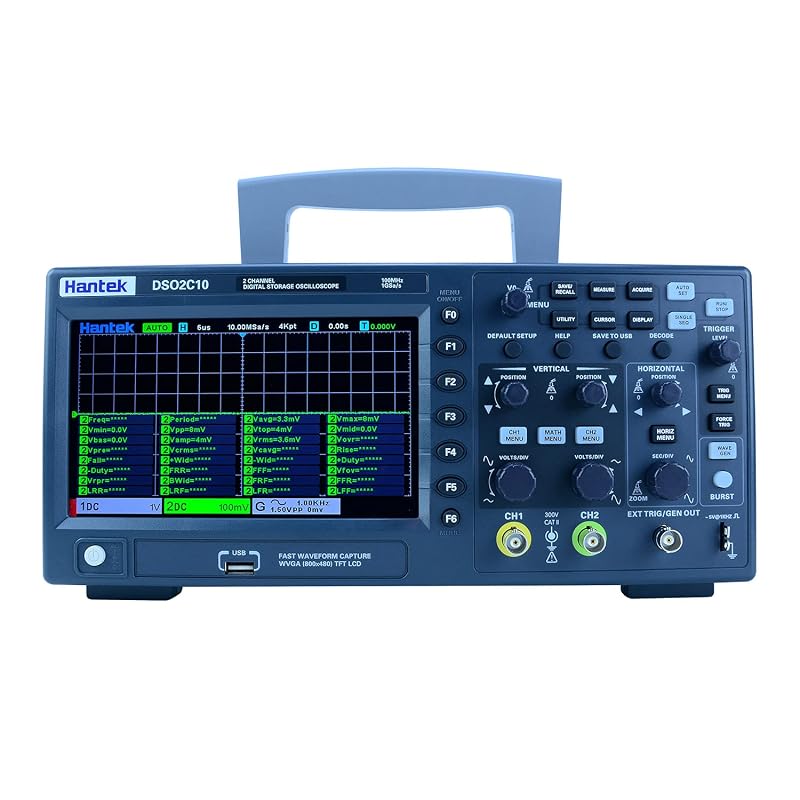
Hantek DSO2C10
4.3★★★★☆The DSO2D10 without the signal generator: two 100 MHz channels with deep memory and serial decoding.

FNIRSI 1014D
4.3★★★★☆A two-channel 100 MHz benchtop with a built-in signal generator at an entry-level price.
Specs side by side
| Hantek DSO2C10 | FNIRSI 1014D | |
|---|---|---|
| Rating | 4.3★★★★☆ | 4.3★★★★☆ |
| Bandwidth | 100MHz | 100MHz |
| Channels | 2 | 2 |
| Sample rate | 1 GSa/s (1 ch); 500 MSa/s (2 ch) | 1 GSa/s |
| Best for | Low-cost serial-bus debugging on two channels | Budget benches that need a scope and a signal source |
| Sample rate, 2 channels on | 500 MSa/s | Not stated by FNIRSI |
| Memory | 8 Mpts (1 ch); 4 Mpts (2 ch) | Quoted by FNIRSI as "240Kbit" |
| Vertical resolution | 8-bit; high-res mode up to 12-bit | 8-bit |
| Display | 7-inch, 800 × 480 | 7-inch, 800 × 480 |
| Serial trigger and decode | UART/RS232, I2C, SPI, CAN, LIN | Not listed by FNIRSI |
| Trigger types | Edge, pulse, video, slope, overtime, window, pattern, interval, under-amplitude, serial | Rising or falling edge |
| Automatic measurements | 32, with statistics | 12 |
| Built-in signal generator | None | 1-ch DDS: sine to 10 MHz, other waveforms to 2 MHz, 2.5 Vpp |
| Power | Mains, under 30 W | 5 V adapter |
| Weight | 1.9 kg | 3.46 lb (about 1.6 kg, Amazon listing) |
Specs checked against manufacturer documentation and official Amazon listings. Desk research, not bench testing. How we research.
Key differences
- →Generator: the 1014D has a one-channel DDS source (sine to 10 MHz, other waveforms to 2 MHz, 2.5 Vpp). Hantek's table shows none for the DSO2C10, even though its front panel carries WAVE GEN and GEN OUT labels.
- →Decoding: Hantek lists UART/RS232, I2C, SPI, CAN and LIN triggering and decoding on the DSO2C10. FNIRSI lists no serial decoding for the 1014D.
- →Memory: 8 Mpts on one channel and 4 Mpts on two for the Hantek, against a figure FNIRSI writes only as "240Kbit".
- →Two-channel sampling: Hantek states 500 MSa/s with both channels on; FNIRSI gives only the 1 GSa/s maximum.
- →Triggering and measurements: the DSO2C10 lists nine trigger types plus serial triggers and 32 automatic measurements; the 1014D lists edge triggering and 12 automatic parameters, plus FFT, X-Y and roll modes.
- →Same 100 MHz bandwidth, same 1 GSa/s peak, same 8-bit converter and the same 7-inch 800 × 480 screen size; the Hantek adds a high-resolution mode up to 12-bit.
- →Both rate 4.3 in our roundup; neither has our Hands-on Tested badge.
Spec by spec
Bandwidth gives no separation here, so the charts skip it and focus on the figures that do differ. Where FNIRSI publishes no number, the chart says so rather than guessing one. Hantek's figures come from its DSO2000 series table; FNIRSI's from its 1014D specification table.
Bars use a logarithmic scale: each step is ten times the last.
| Channels on | DSO2C10 | 1014D |
|---|---|---|
| 1 | 8 Mpts ÷ 1 GSa/s = 8 ms | Not calculable |
| 2 | 4 Mpts ÷ 500 MSa/s = 8 ms | Not calculable |
The last table is the practical meaning of the memory figure. Whether you use one channel or two, the DSO2C10 can hold about 8 ms of signal before it has to sample more slowly; at a slower timebase it keeps more samples per division than a short-memory scope would. That window comfortably holds a complete I2C transaction at 100 kHz or several UART bytes at 115,200 baud. For how the rate relates to what appears on screen, see what GSa/s means.
Hantek DSO2C10 vs FNIRSI 1014D for beginners
Most people buy a first scope because something in a project isn't working. What that project is decides which of these two helps more, so start by being honest about what is on your bench.
If your projects are digital: the DSO2C10
A beginner's typical microcontroller fault is a sensor or display that won't answer. On a scope without decoding you see a burst of square edges and must count bits by hand against the protocol. With the DSO2C10 you set up I2C, SPI or UART decoding and read the address and data bytes printed over the trace, so you can see straight away whether the device acknowledged or the address was wrong. The serial triggers mean you can wait for one specific frame instead of scrolling through traffic. CAN and LIN are on the list too, which matters if a car or robot project follows.
If your projects are analog: the 1014D
Amplifiers, tone controls, RC filters and op-amp stages don't produce a signal of their own; you have to drive them. The 1014D's generator does that from the same box: FNIRSI lists 14 standard signals in its spec table (its description elsewhere says 12) plus one custom or captured waveform, with 1 Hz resolution. Feed the circuit, put the input on channel 1 and the output on channel 2, and you can watch gain, clipping and phase as you turn the frequency. With the DSO2C10 the same experiment needs a separate generator or a microcontroller pin, which covers square waves well and sine waves poorly.
Trusting what you see
Beginners lean on automatic measurements while they learn to read a graticule. The DSO2C10 lists 32 with statistics, two DVM readouts and a six-digit hardware frequency counter; the 1014D lists 12 parameters plus cursors. Documentation matters too. Hantek publishes the two-channel sample rate and the memory depth per channel; FNIRSI publishes neither in a directly usable form, so a 1014D owner learning about record length and sample-rate trade-offs has less to go on.
Edge triggering is enough at first, not forever
What both can and can't measure
With identical 100 MHz ratings, the measurement ceiling is the same for both: by the usual three-to-five- times rule, signals up to roughly 20–33 MHz display accurately. That spans every common beginner signal, from 50/60 Hz waveforms through audio, PWM, 400 kHz I2C and multi-megahertz SPI clocks. Rise-time estimates are close too: Hantek quotes 3.5 ns typical for the DSO2C10 and FNIRSI under 3 ns for the 1014D. Read our bandwidth explainer for why the rated figure isn't the usable one.
Where they part is in what happens around the measurement. With both channels running, the DSO2C10 still takes five samples per cycle of a 100 MHz sine at its stated 500 MSa/s; for the 1014D FNIRSI doesn't say. The DSO2C10 can capture a long, slow event at a fast rate thanks to its memory; the 1014D can create the stimulus for an experiment. Neither offers more than two analog inputs, so a four-wire SPI bus has to be viewed two lines at a time on either.
| Beginner task | DSO2C10 | 1014D |
|---|---|---|
| Read I2C, SPI or UART bytes | Yes, decoded | Bits by eye |
| Drive a filter or amplifier | Needs external source | Built-in, sine to 10 MHz |
| Catch a one-off glitch | Pulse, window, pattern triggers | Edge trigger |
| Long capture at full rate | 8 ms (1 or 2 ch) | Not calculable |
| Read frequency precisely | 6-digit hardware counter | Automatic parameters, cursors |
Mains-powered bench, earthed ground
Which should you buy?
| Buyer or job | Better fit | Why |
|---|---|---|
| Arduino, ESP32 or Pico projects with sensors and displays | Hantek DSO2C10 | UART, I2C and SPI decoding and serial triggers |
| First scope, no other test gear at all | FNIRSI 1014D | Built-in generator supplies practice and test signals |
| Audio amplifiers, guitar pedals and filters | FNIRSI 1014D | Sine to 10 MHz to drive the circuit under test |
| Car or robot projects with CAN or LIN | Hantek DSO2C10 | CAN and LIN trigger and decode listed |
| Intermittent faults that need a specific trigger | Hantek DSO2C10 | Nine trigger types plus serial triggers |
| Learning from fully published specs | Hantek DSO2C10 | Memory and two-channel rate both stated |
| Higher-voltage signals with the probe included | FNIRSI 1014D | Amazon kit adds a P4100 100X probe |
Want the generator and the decoding together? The Hantek DSO2C10 vs DSO2D10 page covers the generator-equipped version of this Hantek, and our DSO2D10 review goes deeper. For other 1014D match-ups, see FNIRSI 2C53T vs 1014D (handheld against bench) and Rigol DHO804 vs FNIRSI 1014D. The beginner oscilloscope roundup ranks both, and the oscilloscope buying guide explains each spec from scratch.
Choose the Hantek DSO2C10 if…
- ✓Your first projects are microcontroller boards talking UART, I2C or SPI to sensors and displays
- ✓You want every key spec published, including memory and the two-channel sample rate
- ✓You expect to need pulse-width, runt-style or pattern triggers to catch faults
- ✓You already have an Arduino, a Raspberry Pi Pico or a generator to make test signals
Choose the FNIRSI 1014D if…
- ✓You own no other test equipment and want a signal source in the same box
- ✓You are more interested in analog circuits, filters and audio than digital buses
- ✓You want a kit that already includes a 100X probe for higher-voltage signals
- ✓You want a scope that runs from a 5 V adapter rather than a mains cord
Neither if…
You need to view a full four-wire SPI bus at once: neither offers more than two analog inputs, so chip select, clock, MOSI and MISO have to be viewed two lines at a time on either one — a four-channel scope is what that job actually needs.
The bottom line
For a beginner whose projects are mostly microcontroller boards, the Hantek DSO2C10 is the better first scope: the same 100 MHz and 1 GSa/s as the FNIRSI, plus serial decoding, 8 Mpts of documented memory, far more trigger types and 32 automatic measurements. The FNIRSI 1014D is the better buy for a beginner with no other test gear who leans toward analog circuits, because its built-in generator lets you drive what you measure.
Frequently asked questions
Are the Hantek DSO2C10 and FNIRSI 1014D the same speed?+
On headline figures, yes: both are rated 100 MHz with a 1 GSa/s maximum sample rate and an 8-bit converter. The difference is documentation. Hantek states 500 MSa/s per channel with both channels on, while FNIRSI gives only the 1 GSa/s maximum, so the 1014D's two-channel rate is unknown.
Does the Hantek DSO2C10 have a signal generator?+
No. Hantek's DSO2000 series table shows no generator for the DSO2C10; the one-channel generator is on the DSO2D10. The DSO2C10's front panel still carries WAVE GEN and GEN OUT labels shared with that model, so go by the specification, not the panel. The FNIRSI 1014D does have a built-in DDS generator.
Can the FNIRSI 1014D decode I2C, SPI or UART?+
FNIRSI doesn't list serial decoding or serial triggering for the 1014D; its specification lists edge triggering, FFT, X-Y and roll modes. You can still view I2C, SPI or UART signals and read the bits by hand. The DSO2C10 lists trigger and decode for UART/RS232, I2C, SPI, CAN and LIN.
Which is easier for a complete beginner to learn on?+
If you have nothing to measure yet, the 1014D, because its generator produces known waveforms to practice triggering and timebase settings. If you are learning while fixing an Arduino or ESP32 project, the DSO2C10 is easier day to day: decoded bytes, 32 automatic measurements and a frequency counter save a lot of manual reading.
How much memory does each scope have?+
Hantek lists 8 Mpts on one channel and 4 Mpts with both channels on, enough for about 8 ms at full sample rate either way. FNIRSI writes the 1014D's memory as 240Kbit without a per-channel point count, so it can't be compared directly; expect shorter captures at fast timebases.
Related