COMPARISON · OSCILLOSCOPES
Rigol DHO804 vs Siglent SDS1202X-E for a Home Lab
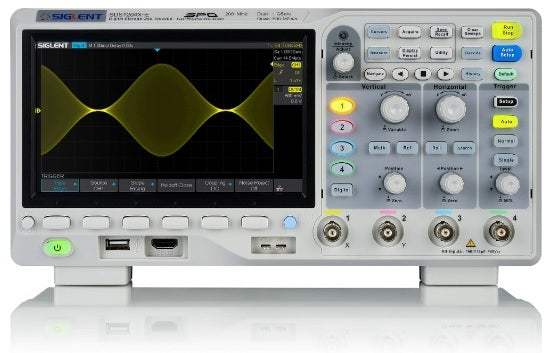
Rigol DHO804 vs Siglent SDS1202X-E is a trade between breadth and speed. The Rigol watches four signals at 70 MHz with 12-bit resolution, a 1024 × 600 touchscreen and USB-C power. The Siglent watches two, but at 200 MHz, with a 100,000 waveforms-per-second update rate and serial trigger and decode that includes LIN. Which suits a home lab depends on whether your projects are wide or fast.
By the OhmSavvy Research Team ·
Disclosure: OhmSavvy earns a commission from qualifying Amazon purchases made through these links, at no extra cost to you. How we're funded.
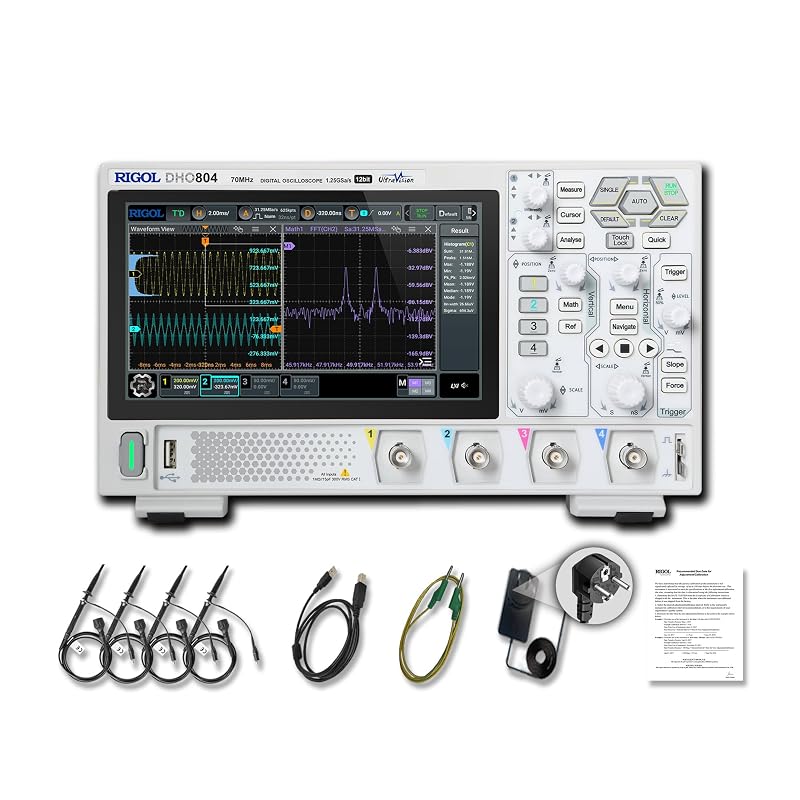
Rigol DHO804
4.8★★★★★Four channels, 12-bit resolution and a 7-inch touchscreen in a compact body that runs from USB-C power.

Siglent SDS1202X-E
4.5★★★★★200 MHz on two channels with a fast 100,000 wfm/s update rate and standard serial decoding.
Specs side by side
| Rigol DHO804 | Siglent SDS1202X-E | |
|---|---|---|
| Rating | 4.8★★★★★ | 4.5★★★★★ |
| Bandwidth | 70MHz | 200MHz |
| Channels | 4 | 2 |
| Sample rate | 1.25 GSa/s (1 ch); 312.5 MSa/s (4 ch) | 1 GSa/s (1 ch); 500 MSa/s (2 ch) |
| Best for | Hobbyists who want 12-bit detail and a touchscreen | Faster digital and switching work on two channels |
| Sample rate, all channels on | 312.5 MSa/s per channel (4 ch) | 500 MSa/s per channel (2 ch) |
| Memory | 25 Mpts (1 ch); 5 Mpts (4 ch) | 14 Mpts (1 ch); 7 Mpts per channel (2 ch) |
| Vertical resolution | 12-bit | Not stated in our data |
| Display | 7-inch 1024 × 600 capacitive touchscreen | 7-inch 800 × 480 |
| Waveform update rate | Not stated in our data | 100,000 wfm/s (400,000 in sequence mode) |
| Serial decoding | UART, I2C, SPI, CAN, parallel | I2C, SPI, UART, CAN, LIN (trigger and decode) |
| Built-in generator | None | None (AWG is a four-channel-model option) |
Specs checked against manufacturer documentation and official Amazon listings. Rigol DHO804 is hands-on tested by OhmSavvy; the Siglent SDS1202X-E assessment is desk research. How we research.
Key differences
- →Channels: four on the DHO804, two on the SDS1202X-E.
- →Bandwidth: 200 MHz on the Siglent, almost three times the Rigol's 70 MHz.
- →With every channel on, the Siglent keeps 500 MSa/s on each of two, while the Rigol shares its budget to 312.5 MSa/s across four. With one channel on, the Rigol's 1.25 GSa/s is the higher figure.
- →The DHO804 is 12-bit with a 1024 × 600 touchscreen, HDMI output and USB-C power; our data doesn't state the Siglent's resolution, and its 7-inch screen is 800 × 480.
- →The Siglent lists a 100,000 wfm/s update rate and serial trigger and decode including LIN; our data gives no update rate for the Rigol, which decodes parallel buses as well as UART, I2C, SPI and CAN.
- →Neither has a built-in signal generator or logic channels. The DHO804 carries our Hands-on Tested badge; the SDS1202X-E assessment is desk research from Siglent's published specs.
Spec by spec
Most of the numbers split cleanly: the Siglent wins on bandwidth and per-channel sample rate once everything is switched on, the Rigol on input count, single-channel sample rate, memory with one channel and screen resolution.
Rigol DHO804 vs Siglent SDS1202X-E for a Home Lab
A home lab scope has to cover whatever lands on the bench that month. Sort your last few projects into two piles. In the wide pile are jobs where several signals relate to each other: a board with 3.3 V, 5 V and 12 V rails that must start in order, an ESP32 talking to an SPI display, a four-phase stepper driver. In the fast pile are jobs where one or two signals change quickly: the switch node of a buck converter, a gate drive, a fast logic edge with overshoot. The DHO804 is built for the first pile and the SDS1202X-E for the second.
The DHO804 also suits a cramped or shared space. Rigol powers it from USB-C, so it can run from a portable power source, and HDMI output lets a large monitor stand in for the 7-inch panel. Its 12-bit converter gives 4,096 vertical steps, which keeps a few millivolts of ripple or a quiet audio signal readable at high zoom. Our data doesn't state the Siglent's power input or resolution.
The SDS1202X-E earns its place with speed of a different kind too. At 100,000 waveforms per second (up to 400,000 in sequence mode) it spends more of its time acquiring and less redrawing, which raises the odds of catching a glitch that happens once in thousands of cycles. Its trigger and decode cover I2C, SPI, UART, CAN and LIN, so a car body module or a LIN-bus seat controller is in reach. Siglent reserves the logic-channel, AWG, Bode plot and Wi-Fi options for its four-channel models, so they aren't upgrades you can add here.
| Home-lab project | Better fit | Why |
|---|---|---|
| Power-up sequencing of three or four rails | Rigol DHO804 | Four channels on one trigger |
| Buck or boost converter switch node | Siglent SDS1202X-E | 200 MHz shows faster edges and ringing |
| Linear supply or USB charger ripple | Rigol DHO804 | 12-bit resolution keeps millivolt ripple smooth |
| ESP32 or Arduino SPI peripherals | Rigol DHO804 | Clock, chip select and both data lines together, with SPI decode |
| Car CAN or LIN bus diagnostics | Siglent SDS1202X-E | LIN is in its trigger and decode list; not in the DHO804's |
| Rare, intermittent glitches | Siglent SDS1202X-E | 100,000 wfm/s; the Rigol's figure isn't in our data |
| Audio amplifiers and effects pedals | Rigol DHO804 | 12-bit detail on slow analog waveforms |
| Bench that also serves as a teaching desk | Rigol DHO804 | Touchscreen and HDMI output to a monitor |
Which should you buy?
| Buyer | Pick | One-line reason |
|---|---|---|
| Microcontroller hobbyist | Rigol DHO804 | Four channels and standard UART, I2C, SPI and CAN decoding |
| Power-electronics tinkerer | Siglent SDS1202X-E | 200 MHz and 500 MSa/s on both channels |
| Audio and analog builder | Rigol DHO804 | 12-bit vertical resolution |
| Automotive DIYer | Siglent SDS1202X-E | CAN and LIN trigger and decode |
| Small desk or portable setup | Rigol DHO804 | USB-C powered with HDMI out |
| Owner of a separate signal generator who needs a fast second scope | Siglent SDS1202X-E | Bandwidth the DHO804 can't match |
What each one can and can't measure
Bandwidth is specified at the −3 dB point, where a sine already reads about 30% low, so treat it as a ceiling. With the common 3–5x margin, the DHO804 is accurate on signals up to roughly 14–23 MHz and the SDS1202X-E up to roughly 40–67 MHz. That puts PWM, I2C, UART, audio and most hobby SPI well inside both. The gap opens on edges: from the 0.35 ÷ bandwidth estimate, the Rigol can show rise times down to about 5 ns and the Siglent about 1.75 ns. A modern MOSFET can switch faster than 5 ns, so on a switch node the DHO804 tends to round off the edge and soften the ringing after it, while the Siglent shows more of what is really there. Our guide to oscilloscope bandwidth and bandwidth for switching power supplies go further.
Sample rate qualifies the Siglent's advantage. With both channels on it samples each at 500 MSa/s, which is 2.5 samples per cycle at 200 MHz: just above the Nyquist minimum of two, so signals near the top of its bandwidth are best viewed on one channel at 1 GSa/s. The Rigol with all four channels on gets 312.5 MSa/s each, about 4.5 samples per cycle at its 70 MHz limit. Memory sets how long either can record at those rates. At its maximum rate the DHO804's 25 Mpts hold about 20 ms on one channel, the SDS1202X-E's 14 Mpts about 14 ms; with all channels on, both still hold roughly 14–16 ms. For the basics, read what GSa/s means.
The hard limits are simple. The SDS1202X-E can't show a third signal, and Siglent offers no digital channels for it, so wide buses need a separate logic analyzer. The DHO804 can't resolve edges much faster than about 5 ns, and its decode list doesn't include LIN. Neither can supply a test signal, so a filter or amplifier test needs a separate generator on either bench.
Wide or fast?
Switching supplies and mains
For more options, see the best oscilloscope for a home electronics lab, the beginner oscilloscope roundup, the oscilloscope buying guide, and the related matchups Siglent SDS1104X-E vs SDS1202X-E and Rigol DHO804 vs DS1054Z.
Choose the Rigol DHO804 if…
- ✓You check several supply rails, or a clock, chip select and data lines, in one capture
- ✓You care about small details on slow signals: ripple, audio, sensor outputs
- ✓You want a touchscreen, HDMI out and a scope that runs from USB-C power
Choose the Siglent SDS1202X-E if…
- ✓You build or repair switching supplies and want to see fast edges and ringing
- ✓You hunt rare glitches and want a fast 100,000 wfm/s update rate
- ✓You work on vehicle electronics and want CAN and LIN trigger and decode
Neither if…
You need to feed a test signal into a circuit or capture digital lines alongside the analog ones: neither has a built-in signal generator or logic channels, so both need a separate source and a logic analyzer for that work.
The bottom line
For a general home lab built around microcontrollers, power rails and analog circuits, the Rigol DHO804 is the more useful scope: four channels, 12-bit resolution, standard decoding, a sharper touchscreen and USB-C power. Choose the Siglent SDS1202X-E if your bench work is mostly switching supplies, fast edges, rare glitches or CAN and LIN buses, where 200 MHz, 500 MSa/s on both channels and 100,000 wfm/s count for more than extra inputs.
Frequently asked questions
Is the Rigol DHO804 or the Siglent SDS1202X-E better for a home lab?+
For most mixed hobby benches, the DHO804: four channels cover multi-rail and SPI work, and 12-bit resolution helps with ripple and audio. The SDS1202X-E is the better choice if your projects are mainly switching power supplies, fast digital edges or automotive buses, where its 200 MHz bandwidth and LIN decoding matter.
Is 200 MHz worth giving up two channels?+
Only if you measure fast edges often. By the 3–5x rule, 70 MHz handles signals up to roughly 14–23 MHz, enough for most microcontroller, audio and sensor work. The SDS1202X-E's 200 MHz extends that to roughly 40–67 MHz and shows edges near 1.75 ns, mainly useful on switch nodes and fast logic.
Does the Siglent SDS1202X-E have a signal generator or logic channels?+
No. Siglent offers the MSO logic channels, AWG module, Bode plot and Wi-Fi options only on its four-channel X-E models, so the SDS1202X-E can't add them. The Rigol DHO804 has no built-in generator or logic channels either, so plan for a separate signal source with either scope.
Which has more memory, the DHO804 or the SDS1202X-E?+
With one channel on, the DHO804: 25 Mpts against 14 Mpts. With every channel running, the SDS1202X-E keeps 7 Mpts on each of its two channels, while the DHO804 drops to 5 Mpts with all four on. At maximum sample rate both record roughly 14–20 ms per capture.
Can the Rigol DHO804 run without a mains outlet?+
Rigol powers the DHO804 over USB-C, so it can run from a suitable portable power source, which helps on a small or mobile bench. Our data doesn't state the SDS1202X-E's power input. Either way, the probe ground still connects to earth through connected equipment, so take care around mains circuits.
Related