Disclosure: OhmSavvy earns a commission from qualifying Amazon purchases made through the links below, at no extra cost to you. How we're funded.
At a glance
Our top picks

Rigol DHO914S
The DHO914 plus a built-in 25 MHz signal generator and Bode plot, for a one-box home lab.
Check price on Amazon →Why we picked it ↓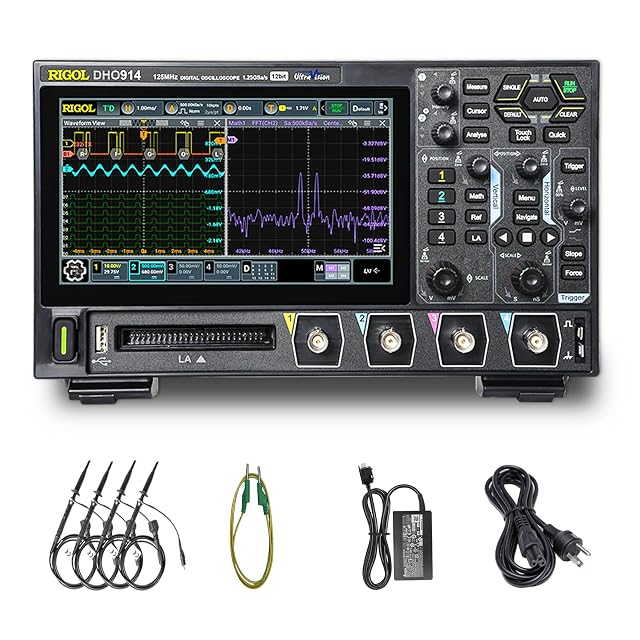
Rigol DHO914
Four 12-bit channels at 125 MHz with 16 logic inputs built in, in a compact USB-C powered body.
Check price on Amazon →Why we picked it ↓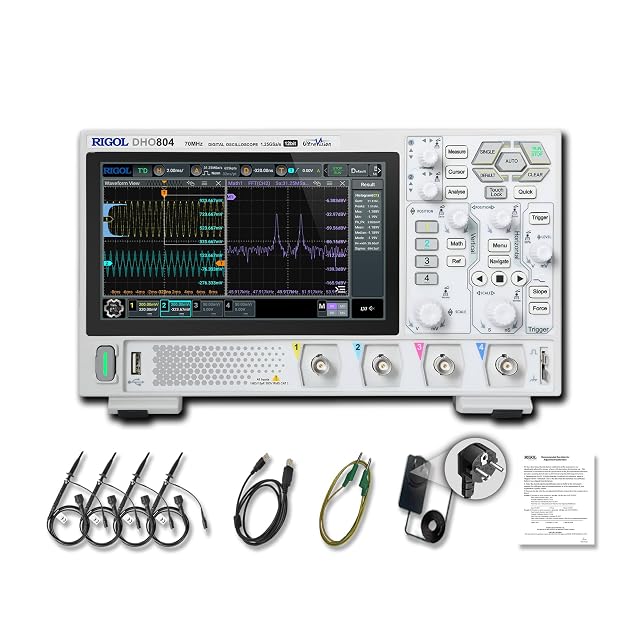
Rigol DHO804
Four channels, 12-bit resolution and a 7-inch touchscreen in a compact body that runs from USB-C power.
Check price on Amazon →Why we picked it ↓Also great
- 4
 Siglent SDS1104X-ECheck pricePrice →Best for Growing Into4.8★★★★★
- 5
 Rigol DHO802Check pricePrice →Best 2-Channel 12-bit4.6★★★★★
- 6
 Siglent SDS1202X-ECheck pricePrice →Best 200MHz Value4.5★★★★★
- 7
 Hantek DSO2D15Check pricePrice →Best 150 MHz Budget Bench4.4★★★★☆
- 8
 Rigol DS1054ZCheck pricePrice →Best Overall4.8★★★★★
- 9
 PicoScope 2206BCheck pricePrice →Best Deep-Memory USB Scope4.4★★★★☆
- 10
 OWON HDS2202SCheck pricePrice →Best 3-in-1 Handheld4.3★★★★☆
Quick shopping
Compare at a glance
Swipe sideways on mobile to see every spec.
| Model | Award | Rating | Bandwidth | Channels | Sample rate | |
|---|---|---|---|---|---|---|
 #1Rigol DHO914S | Best 12-bit Scope + Generator | 4.6★★★★★ | 125MHz | 4 + 16 digital (probe sold separately) | 1.25 GSa/s (1 ch); 312.5 MSa/s (4 ch) | Check price → |
 #2Rigol DHO914 | Best 125 MHz 12-bit | 4.6★★★★★ | 125MHz | 4 + 16 digital (probe sold separately) | 1.25 GSa/s (1 ch); 312.5 MSa/s (4 ch) | Check price → |
 #3Rigol DHO804✓ Tested | Best 12-bit Upgrade | 4.8★★★★★ | 70MHz | 4 | 1.25 GSa/s (1 ch); 312.5 MSa/s (4 ch) | Check price → |
| #4Siglent SDS1104X-E✓ Tested | Best for Growing Into | 4.8★★★★★ | 100MHz | 4 | 1 GSa/s | Check price → |
| #5Rigol DHO802 | Best 2-Channel 12-bit | 4.6★★★★★ | 70MHz | 2 | 1.25 GSa/s (1 ch); 625 MSa/s (2 ch) | Check price → |
| #6Siglent SDS1202X-E | Best 200MHz Value | 4.5★★★★★ | 200MHz | 2 | 1 GSa/s (1 ch); 500 MSa/s (2 ch) | Check price → |
| #7Hantek DSO2D15 | Best 150 MHz Budget Bench | 4.4★★★★☆ | 150MHz | 2 | 1 GSa/s (1 ch); 500 MSa/s (2 ch) | Check price → |
| #8Rigol DS1054Z✓ Tested | Best Overall | 4.8★★★★★ | 50MHz | 4 | 1 GSa/s | Check price → |
| #9PicoScope 2206B | Best Deep-Memory USB Scope | 4.4★★★★☆ | 50MHz | 2 | 500 MS/s (1 ch); 250 MS/s (2 ch) | Check price → |
| #10OWON HDS2202S | Best 3-in-1 Handheld | 4.3★★★★☆ | 200MHz | 2 | 1 GSa/s | Check price → |
In depth
Detailed reviews
Rigol DHO914S
The DHO914 plus a built-in 25 MHz signal generator and Bode plot, for a one-box home lab.
Best for:A home lab that wants scope, logic and signal source in one
The DHO914S has everything in the DHO914 (four 12-bit channels at 125 MHz, 1.25 GSa/s, up to 50 Mpts, 16 digital channels with the separate PLA2216 probe, standard serial decoding, a 7-inch 1024 × 600 touchscreen and USB-C power) and adds a single-channel 25 MHz arbitrary/function generator. Rigol lists sine to 25 MHz, square to 15 MHz, ramp to 150 kHz and arbitrary waveforms to 10 MHz at 156 MSa/s and 14-bit, plus a Bode plot function that uses the generator to sweep a circuit's frequency response.
Why it fits: It takes first place because it pairs four 12-bit channels and 50 Mpts with a 25 MHz generator and a Bode plot, so ripple, sequencing and control-loop response all happen on one instrument. The trade-off is cost over the DHO914, and the 16 logic channels need the separately sold PLA2216 probe.
- Bandwidth
- 125MHz
- Channels
- 4 + 16 digital (probe sold separately)
- Sample rate
- 1.25 GSa/s (1 ch); 312.5 MSa/s (4 ch)
- Best for
- A home lab that wants scope, logic and signal source in one
Reasons to buy
- +Built-in 25 MHz generator with Bode plot
- +12-bit resolution and 50 Mpts of memory
- +16 digital channels and standard decoding
Reasons to avoid
- −Logic probe (PLA2216) sold separately
- −Costs more than the DHO914
Rigol DHO914
Four 12-bit channels at 125 MHz with 16 logic inputs built in, in a compact USB-C powered body.
Best for:Mixed analog and logic debugging on a small bench
The DHO914 is a four-channel, 125 MHz, 12-bit scope: 1.25 GSa/s on one channel (625 MSa/s on two, 312.5 MSa/s on three or four) and 50 Mpts of memory on one channel (25 Mpts on two, 10 Mpts on three or four). Rigol lists a 7-inch 1024 × 600 multi-touch screen, HDMI and LAN, standard parallel, UART, I2C, SPI, CAN and LIN decoding, and 16 digital channels that need the separately sold PLA2216 logic probe. It runs from a USB-C 15 V supply and weighs 1.78 kg. There is no built-in signal generator; that is the DHO914S.
Why it fits: The same 12-bit, four-channel, 125 MHz acquisition as the DHO914S, with up to 50 Mpts, makes it just as good for ripple and multi-rail start-up captures. It ranks second only because loop-response testing needs an external generator.
- Bandwidth
- 125MHz
- Channels
- 4 + 16 digital (probe sold separately)
- Sample rate
- 1.25 GSa/s (1 ch); 312.5 MSa/s (4 ch)
- Best for
- Mixed analog and logic debugging on a small bench
Reasons to buy
- +12-bit resolution and 50 Mpts of memory
- +16 digital channels built in
- +Standard decoding including CAN and LIN
Reasons to avoid
- −Logic probe (PLA2216) sold separately
- −No built-in signal generator
Rigol DHO804
Four channels, 12-bit resolution and a 7-inch touchscreen in a compact body that runs from USB-C power.
Best for:Hobbyists who want 12-bit detail and a touchscreen
The DHO804 brings 12-bit vertical resolution to a beginner budget: 70 MHz, four channels, up to 1.25 GSa/s and 25 Mpts with one channel on, a 7-inch 1024 × 600 capacitive touchscreen, HDMI output and serial decoding of UART, I2C, SPI, CAN and parallel buses. It is powered over USB-C, so it can run from a portable power source. There is no built-in signal generator or logic channels, and sample rate and memory fall as you enable more channels (312.5 MSa/s and 5 Mpts with all four on).
Why it fits: Four 12-bit channels and up to 25 Mpts cover ripple and sequencing well, and it carries our Hands-on Tested badge. Its 70 MHz bandwidth is the limit when you want sharp switch-node edges, and memory falls to 5 Mpts with all four channels on.
- Bandwidth
- 70MHz
- Channels
- 4
- Sample rate
- 1.25 GSa/s (1 ch); 312.5 MSa/s (4 ch)
- Best for
- Hobbyists who want 12-bit detail and a touchscreen
Reasons to buy
- +12-bit vertical resolution
- +7-inch 1024 × 600 touchscreen and HDMI out
- +USB-C powered, compact body
Reasons to avoid
- −No built-in signal generator or logic channels
- −Per-channel sample rate drops to 312.5 MSa/s with four channels on
Siglent SDS1104X-E
More bandwidth and a better UI than the Rigol, for projects that will get more demanding.
Best for:Intermediate hobbyists, future-proofing
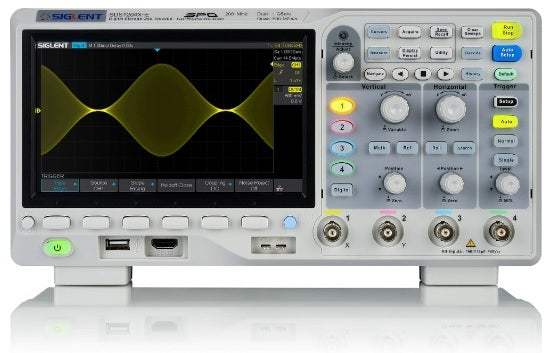
Double the Rigol's bandwidth (100MHz vs 50MHz) and twice its per-channel sample rate with three or four channels on (500 MSa/s vs 250 MSa/s), with a well-regarded user interface. A strong pick for anyone who expects their projects to get more demanding over time.
Why it fits: Four 100 MHz channels, 14 Mpts and a 100,000 wfm/s update rate make switching noise and rare glitches easy to see, and it carries our Hands-on Tested badge. It sits behind the DHOs because its 8-bit converter resolves small ripple less finely; Siglent sells the AWG and Bode plot as options for its four-channel models.
- Bandwidth
- 100MHz
- Channels
- 4
- Sample rate
- 1 GSa/s
- Best for
- Intermediate hobbyists, future-proofing
Reasons to buy
- +Higher bandwidth headroom than entry-level scopes
- +Well-regarded, intuitive UI
- +Strong value at the 100MHz tier
Reasons to avoid
- −Pricier than the Rigol DS1054Z
- −Overkill for pure beginners
Rigol DHO802
The two-channel DHO800: 12-bit resolution, a 7-inch touchscreen and USB-C power for a lower price than the four-channel DHO804.
Best for:Two-channel work that benefits from 12-bit detail
The DHO802 is the two-channel model of Rigol's DHO800 series: 70 MHz, 12-bit vertical resolution, 1.25 GSa/s with one channel on (625 MSa/s with both) and 25 Mpts of memory on one channel (10 Mpts on both). It has a 7-inch 1024 × 600 capacitive touchscreen, HDMI output, LAN and standard decoding of parallel, UART, I2C, SPI and CAN, and it runs from a USB-C 15 V supply. There is no built-in signal generator and no logic channels.
Why it fits: It keeps the DHO800's 12-bit resolution and 25 Mpts on a two-channel body, ideal for comparing input and output ripple on one regulator. Two channels rule out multi-rail sequencing in a single capture.
- Bandwidth
- 70MHz
- Channels
- 2
- Sample rate
- 1.25 GSa/s (1 ch); 625 MSa/s (2 ch)
- Best for
- Two-channel work that benefits from 12-bit detail
Reasons to buy
- +12-bit vertical resolution
- +7-inch 1024 × 600 touchscreen with HDMI out
- +Standard serial decoding (UART, I2C, SPI, CAN)
Reasons to avoid
- −Two channels only
- −No built-in signal generator or logic channels
Siglent SDS1202X-E
200 MHz on two channels with a fast 100,000 wfm/s update rate and standard serial decoding.
Best for:Faster digital and switching work on two channels
The SDS1202X-E is the two-channel member of Siglent's X-E line with 200 MHz bandwidth: 1 GSa/s with one channel (500 MSa/s each with two), 14 Mpts of memory on one channel, 100,000 waveforms per second (400,000 in sequence mode), a 7-inch 800 × 480 display and standard I2C, SPI, UART, CAN and LIN trigger and decode. The MSO, AWG module, Bode plot and Wi-Fi options belong to the four-channel models, so don't count on them here.
Why it fits: At 200 MHz it has the most bandwidth of the bench scopes here, which suits ringing at a fast switch node, and it keeps 14 Mpts and 100,000 wfm/s. Two 8-bit channels make it weaker for small ripple on multiple rails.
- Bandwidth
- 200MHz
- Channels
- 2
- Sample rate
- 1 GSa/s (1 ch); 500 MSa/s (2 ch)
- Best for
- Faster digital and switching work on two channels
Reasons to buy
- +200 MHz bandwidth
- +100,000 wfm/s update rate
- +Serial trigger and decode as standard
Reasons to avoid
- −Only 2 channels
- −No MSO, AWG or Bode plot (four-channel models only)
- −Memory halves to 7 Mpts per channel with both on
Hantek DSO2D15
The 150 MHz version of Hantek's DSO2000 bench scope, with a 25 MHz generator and serial decoding.
Best for:A budget bench that wants extra bandwidth and a signal source
The DSO2D15 is a two-channel, 150 MHz benchtop (2.4 ns rise time) with 1 GSa/s on one channel and 500 MSa/s on two, 8-bit resolution with a 12-bit high-resolution mode, 8 Mpts of memory on one channel (4 Mpts on two) and a 7-inch 800 × 480 display. Its built-in generator reaches 25 MHz sine and 10 MHz square or arbitrary at 200 MSa/s and 12-bit. Hantek lists UART, I2C, SPI, CAN and LIN triggering and decoding and 32 automatic measurements. It runs on mains power. This listing bundles a P4100 100X probe.
Why it fits: A 150 MHz two-channel bench with a 25 MHz generator for simple load-step stimulus, two DVMs and a frequency counter gives broad coverage at a lower tier. The 8-bit converter (12-bit only in high-resolution mode) and 4 Mpts per channel with both on keep it mid-table.
- Bandwidth
- 150MHz
- Channels
- 2
- Sample rate
- 1 GSa/s (1 ch); 500 MSa/s (2 ch)
- Best for
- A budget bench that wants extra bandwidth and a signal source
Reasons to buy
- +150 MHz bandwidth
- +Built-in 25 MHz signal generator
- +UART, I2C, SPI, CAN and LIN decoding
Reasons to avoid
- −8-bit converter
- −Two channels only
Rigol DS1054Z
The default beginner oscilloscope recommendation for years, and still worth it.
Best for:Hobbyists, students, general electronics
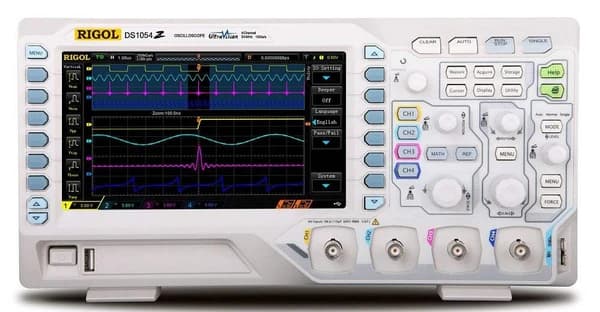
The DS1054Z has been the default recommendation for beginner oscilloscopes for years, and for good reason — 4 channels and 50MHz of bandwidth at a genuinely approachable price.
Why it fits: Four channels and the datasheet's 24 Mpts handle linear supplies and sequencing, and it carries our Hands-on Tested badge. At 50 MHz and 8-bit, with high-resolution mode as the workaround, it is outclassed for switching ripple by the 12-bit DHOs.
- Bandwidth
- 50MHz
- Channels
- 4
- Sample rate
- 1 GSa/s
- Best for
- Hobbyists, students, general electronics
Reasons to buy
- +4 channels at this price is rare
- +Large, clear 7-inch display
- +Strong community support and documentation
Reasons to avoid
- −Menu navigation has a learning curve
- −Bandwidth is modest for RF work
PicoScope 2206B
A pocket-sized 50 MHz USB scope with 32 MS of memory and a built-in AWG, run from PicoScope 7 on your PC.
Best for:Laptop users who want deep memory and solid PC software
The PicoScope 2206B is a two-channel USB oscilloscope with no screen of its own: 50 MHz, 500 MS/s with one channel (250 MS/s with two), 8-bit with resolution enhancement to 12-bit, and a 32 MS buffer. It includes a function generator and AWG (up to 1 MHz, 20 MS/s, 12-bit), is powered over USB, measures 130 × 104 × 18.8 mm and weighs under 0.2 kg. Everything is controlled from Pico's PicoScope 7 software on a PC.
Why it fits: Its 32 MS buffer, 250 MS streaming and resolution enhancement to 12-bit suit long logging of a supply's drift or a slow brown-out from a laptop. Inputs limited to plus or minus 20 V and 50 MHz bandwidth place it near the bottom for general supply testing.
- Bandwidth
- 50MHz
- Channels
- 2
- Sample rate
- 500 MS/s (1 ch); 250 MS/s (2 ch)
- Best for
- Laptop users who want deep memory and solid PC software
Reasons to buy
- +32 MS buffer memory
- +Built-in function generator and AWG
- +USB-powered and very light
Reasons to avoid
- −No built-in screen: needs a PC
- −50 MHz bandwidth
OWON HDS2202S
A battery handheld that combines a 200 MHz two-channel scope, a 20,000-count multimeter and a 25 MHz generator.
Best for:Field work that needs a scope, meter and signal source in one
The HDS2202S is a handheld with three instruments: a two-channel, 200 MHz, 1 GSa/s, 8-bit oscilloscope with an 8K record length and 10,000 waveforms per second; a 20,000-count multimeter (1000 V DC, 750 V AC, 10 A); and a single-channel generator (sine to 25 MHz, square, pulse and arbitrary to 5 MHz). It has a 3.5-inch LCD, runs 3 to 6 hours on an 18650 battery and charges over USB-C. OWON doesn't state the per-channel sample rate with both channels on or the screen resolution.
Why it fits: Battery operation and a built-in 20,000-count meter make it handy for checking a supply in a cabinet or on site. Its 8K record and 8-bit converter limit start-up and fine ripple work, so it ranks last for a dedicated power bench.
- Bandwidth
- 200MHz
- Channels
- 2
- Sample rate
- 1 GSa/s
- Best for
- Field work that needs a scope, meter and signal source in one
Reasons to buy
- +Scope, multimeter and generator in one handheld
- +200 MHz on two channels
- +Battery-powered with USB-C charging
Reasons to avoid
- −Small 3.5-inch screen
- −8K record length
Before you buy
Buying advice
Prioritize resolution if you design low-voltage rails
Point-of-load converters for 3.3 V, 1.8 V and lower rails often have ripple budgets of a few tens of millivolts. A 12-bit scope such as the DHO914S, DHO914, DHO804 or DHO802 shows that ripple at fine vertical steps without relying on averaging. If you mostly work on 12 V and 24 V supplies with looser limits, an 8-bit scope with a high-resolution mode is a reasonable saving.
Buy memory for the slowest event you care about
A soft-start ramp, a hold-up test after mains removal or a slow load cycle can last tens or hundreds of milliseconds. To see switching detail inside that window you need millions of points per channel. Check the figure with all the channels you plan to use enabled, because most scopes here split memory as channels switch on.
Get the probing right before blaming the scope
A long ground lead adds an inductive loop that turns switching edges into fake ringing on a ripple trace. Use the probe's spring ground tip, AC coupling with the bandwidth limit on for ripple, and a current probe if you need inductor or output current. A differential probe is the safe way onto any node referenced to mains.
Decide whether you will test the control loop
Loop stability testing needs a swept signal source and gain and phase analysis. The DHO914S does this on board. With any other scope here you need a separate generator or frequency response analyzer, which can cost more than the price gap between the DHO914 and DHO914S.
Methodology
How we chose
We ranked these ten for supply and regulator testing: native vertical resolution and memory per channel first, then channel count, bandwidth for switching edges and built-in loop-analysis tools. All figures come from maker datasheets, product pages or official listings; the ranking is desk research, and only the Rigol DHO804, Siglent SDS1104X-E and Rigol DS1054Z carry our Hands-on Tested badge.
Picks marked "Hands-on Tested" have been bought and tested by us; the rest are desk research. A pick only carries that badge once we have actually bought and tested that unit. More on how we research.
Questions
Frequently asked questions
What oscilloscope specs matter most for power supply testing?+
Vertical resolution and memory depth come first. Ripple and noise are often tens of millivolts on a rail of several volts, so a 12-bit converter shows detail an 8-bit one rounds off. Start-up and load-step events last milliseconds, so deep memory keeps the sample rate high across them. Bandwidth matters for switch-node edges, and four channels let you watch several rails at once.
Is a 12-bit oscilloscope worth it for measuring ripple?+
For low-voltage switching supplies, usually yes. With an 8-bit scope set to 10 mV/div across eight divisions, each step is about 0.31 mV; a 12-bit scope at the same setting steps about 0.02 mV. High-resolution modes on 8-bit scopes narrow the gap by averaging, at the cost of effective bandwidth. For a quick pass or fail check, 8-bit is fine.
How much bandwidth do I need to test a switching power supply?+
The switching frequency itself is low, often tens of kilohertz to a few megahertz, but the edges at the switch node are fast. A common rule is to choose bandwidth of about 0.35 divided by the fastest rise time you need to see. For ripple measurements, many engineers enable a 20 MHz bandwidth limit anyway to cut out-of-band noise.
Can I measure a mains-powered supply with a normal oscilloscope probe?+
Not on the primary side without precautions. A bench scope's probe ground connects to mains earth, so clipping it onto a non-isolated node creates a short circuit. Use a differential probe or an isolation transformer on the device under test, and measure the isolated secondary side with standard probes. None of the scopes here have isolated channels.
What is a Bode plot used for in power supply design?+
It shows how a supply's control loop responds across frequency, so you can read gain margin and phase margin and judge whether the regulator will oscillate or ring after a load step. The Rigol DHO914S runs a Bode sweep from 10 Hz to 25 MHz with its built-in generator; you still need an injection transformer and resistor in the feedback loop.
Do I need four channels for power supply work?+
Two channels cover input against output ripple and a single rail's start-up. Four become useful for power sequencing on boards with several rails, or for watching gate drive, switch node, output and a current probe together. If you mostly test bench supplies or single regulators, a two-channel scope such as the DHO802 or SDS1202X-E is enough.