COMPARISON · OSCILLOSCOPES
Rigol DHO804 vs Hantek DSO2D10
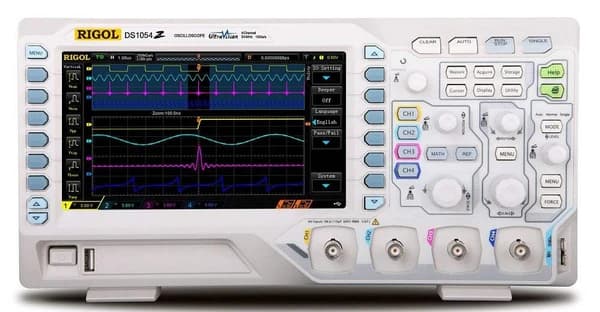
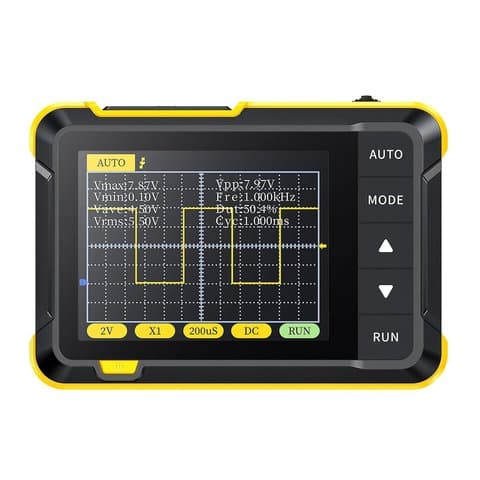
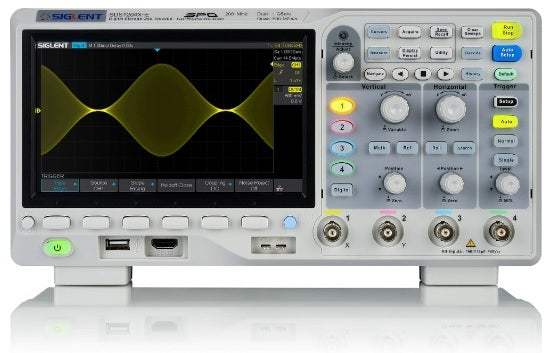
Rigol DHO804 vs Hantek DSO2D10 is a choice between two different ideas of a compact scope. The Rigol puts four channels, 12-bit vertical resolution and a 1024 × 600 touchscreen into a USB-C powered body, with no signal generator. The Hantek has two channels and more bandwidth (100 MHz against 70 MHz), plus a built-in one-channel waveform generator up to 25 MHz.
By the OhmSavvy Research Team ·
Disclosure: OhmSavvy earns a commission from qualifying Amazon purchases made through these links, at no extra cost to you. How we're funded.
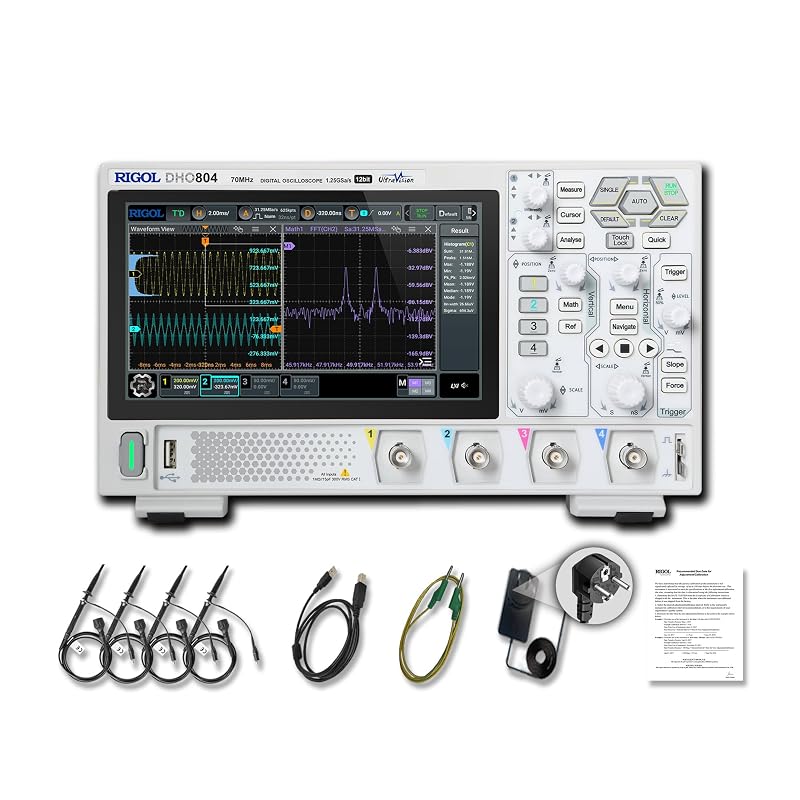
Rigol DHO804
4.8★★★★★Four channels, 12-bit resolution and a 7-inch touchscreen in a compact body that runs from USB-C power.

Hantek DSO2D10
4.3★★★★☆An oscilloscope and waveform generator in one unit — practical for space-limited benches.
Specs side by side
| Rigol DHO804 | Hantek DSO2D10 | |
|---|---|---|
| Rating | 4.8★★★★★ | 4.3★★★★☆ |
| Bandwidth | 70MHz | 100MHz |
| Channels | 4 | 2 |
| Sample rate | 1.25 GSa/s (1 ch); 312.5 MSa/s (4 ch) | 1 GSa/s |
| Best for | Hobbyists who want 12-bit detail and a touchscreen | Space-limited benches, combined testing |
| Max sample rate, all channels on | 312.5 MSa/s per channel (4 ch) | Not stated in our data |
| Vertical resolution | 12-bit | Not stated in our data |
| Display | 7-inch 1024 × 600 capacitive touchscreen | 7-inch 800 × 480 |
| Built-in generator | None | 1 channel, up to 25 MHz |
| Logic channels | None | Not stated in our data |
Specs checked against manufacturer documentation and official Amazon listings. Rigol DHO804 is hands-on tested by OhmSavvy; the Hantek DSO2D10 assessment is desk research. How we research.
Key differences
- →Channels: the DHO804 has four, the DSO2D10 two. This is the biggest practical difference between them.
- →Bandwidth: 100 MHz on the Hantek against 70 MHz on the Rigol, so the Hantek has more headroom for fast edges.
- →Sample rate: the DHO804 reaches 1.25 GSa/s with one channel on against the Hantek's 1 GSa/s, but drops to 312.5 MSa/s per channel with all four on.
- →The DHO804 is a 12-bit scope; our data for the Hantek doesn't state its vertical resolution.
- →Only the Hantek has a built-in waveform generator (one channel, up to 25 MHz). Rigol lists no generator and no logic channels for the DHO804.
- →The DHO804 adds a 1024 × 600 capacitive touchscreen, HDMI output, standard serial decoding and USB-C power; the Hantek's 7-inch screen is 800 × 480.
- →The DHO804 carries our Hands-on Tested badge; the Hantek DSO2D10 assessment is desk research against maker specifications.
Spec by spec
On a spec sheet these two trade blows. The Hantek wins on bandwidth, the Rigol on single-channel sample rate and channel count. The figure that matters most depends on whether you spend your time on one fast signal or on several related ones, so the charts show both.
Bars use a logarithmic scale: each step is ten times the last.
| DHO804 | DSO2D10 | |
|---|---|---|
| Vertical resolution | 12-bit | Not stated |
| Signal generator | None | 1 ch, to 25 MHz |
| Screen | 1024 × 600 touch | 800 × 480 |
| Serial decoding | UART, I2C, SPI, CAN, parallel | Not stated |
Which should you buy?
Pick the scope that removes the bottleneck you will hit first: not enough channels, not enough vertical detail, or no way to generate a test signal.
| Buyer or job | Better fit | Why |
|---|---|---|
| SPI or parallel-bus timing | Rigol DHO804 | Four channels show clock, chip select and two data lines in one capture |
| Power-up sequencing of several rails | Rigol DHO804 | Up to four rails on the same trigger |
| Supply ripple, noise, small sensor signals | Rigol DHO804 | 12-bit resolution; the Hantek's figure isn't stated in our data |
| Decoding UART, I2C, SPI or CAN traffic | Rigol DHO804 | Decoding is standard on the DHO804; not stated for the Hantek |
| Testing filters and amplifiers | Hantek DSO2D10 | Built-in generator drives the circuit while the two channels show input and output |
| Bench with room for one instrument and no generator | Hantek DSO2D10 | Scope and 25 MHz generator in one unit |
| Fastest edges on one or two signals | Hantek DSO2D10 | 100 MHz against 70 MHz rated bandwidth |
Four channels and 12 bits, or two channels and a generator
Start with bandwidth, since it sets the ceiling for both. Rated bandwidth is the frequency at which a sine wave is shown about 3 dB low, roughly 70% of its true amplitude, so a scope is accurate only well below that figure. The usual 3–5x rule says the scope should have three to five times the bandwidth of the fastest signal you care about. That puts the DHO804 at roughly 14–23 MHz and the DSO2D10 at roughly 20–33 MHz. Both cover UART, I2C, most SPI, PWM, audio and the switching frequency of typical hobby supplies. Square waves need more margin than sines because their edges carry higher harmonics, which is where the Hantek's extra 30 MHz shows up: a common estimate of the fastest rise time a scope can display is 0.35 divided by bandwidth, about 5 ns for 70 MHz and 3.5 ns for 100 MHz. Our guide to oscilloscope bandwidth explains the rule in more detail.
Sample rate tells a different story. With one channel on, the DHO804's 1.25 GSa/s is about 18 samples per cycle of a 70 MHz sine, and the Hantek's 1 GSa/s is 10 per cycle at 100 MHz; both are far above the Nyquist minimum of two. Turn on all four of the Rigol's channels and each gets 312.5 MSa/s, about four and a half samples per cycle at 70 MHz. That is enough to see the signal but leaves less detail on fast edges, so for edge work keep fewer channels on. Memory follows the same pattern: 25 Mpts with one channel, 5 Mpts with four. If GSa/s is new to you, read what GSa/s means.
The real reason to choose the DHO804 is its four channels. Timing faults rarely involve just two signals. An SPI transaction has a clock, a chip select and two data lines; a board with several regulators has rails that must come up in order. The DHO804 shows all four on one trigger and decodes UART, I2C, SPI, CAN and parallel buses as standard. Its 12-bit converter gives 4,096 vertical levels against the 256 of an 8-bit design, so millivolt ripple on a supply rail or a small sensor output stays smooth when you zoom in instead of breaking into steps. Our data doesn't state the Hantek's resolution, so check Hantek's datasheet if that matters to you.
The real reason to choose the DSO2D10 is its generator. Testing a filter, amplifier or sensor input needs a known signal going in. The Hantek's single output (up to 25 MHz) drives the circuit while channel 1 watches the input and channel 2 the output. The DHO804 can do the same measurement, with two channels spare, but only if you buy a separate signal source. Note that the generator doesn't add channels: once it is driving a circuit, both Hantek inputs are usually spoken for.
The trade in one line
Mains and high-voltage circuits
For the wider field, see the beginner oscilloscope roundup, the oscilloscope buying guide, our full Hantek DSO2D10 review, and the two-channel version of this match-up, Rigol DHO802 vs Hantek DSO2D10.
Choose the Rigol DHO804 if…
- ✓You need to watch three or four signals at once, such as a clock, chip select and two data lines
- ✓You want 12-bit resolution to look at small ripple, noise or sensor signals
- ✓You want standard UART, I2C, SPI, CAN and parallel decoding, HDMI out and USB-C power
Choose the Hantek DSO2D10 if…
- ✓You need a test-signal source as well as a scope, with room for only one instrument
- ✓Two channels cover what you measure at the same time
- ✓You want 100 MHz of bandwidth headroom over the DHO804's 70 MHz
The bottom line
For most hobbyists who already own a signal source, or rarely need one, the Rigol DHO804 is the stronger scope: four channels, 12-bit resolution, standard serial decoding and a sharper touchscreen. The Hantek DSO2D10 is the better buy if you have room for one instrument and your work is mostly feeding a test signal into a circuit and watching what comes out, where its generator and 100 MHz bandwidth earn their place.
Frequently asked questions
Is the Rigol DHO804 better than the Hantek DSO2D10?+
For multi-signal work, yes. The DHO804 has four channels, 12-bit resolution, standard serial decoding and a 1024 × 600 touchscreen, and rates 4.8 in our roundup against 4.3. The Hantek is better if you need a built-in generator or the extra headroom of 100 MHz on two channels.
Does the Rigol DHO804 have a built-in signal generator?+
No. Rigol lists no built-in generator and no logic channels for the DHO800 series. If you need to inject test signals, you would add a separate generator, or choose the Hantek DSO2D10, which has a one-channel generator up to 25 MHz built in.
Is 70 MHz enough, or do I need the Hantek's 100 MHz?+
By the 3-5x rule, 70 MHz covers signals up to roughly 14-23 MHz, which includes most microcontroller, serial bus, PWM and audio work. The Hantek's 100 MHz stretches that to roughly 20-33 MHz and shows faster edges more faithfully, which matters mostly for fast digital rise times.
What happens to the DHO804's sample rate with all four channels on?+
It shares its sample-rate budget, falling from 1.25 GSa/s with one channel to 312.5 MSa/s per channel with four, and memory drops from 25 Mpts to 5 Mpts. That is still above the Nyquist minimum at 70 MHz, but turn off unused channels when edge detail matters.
What does 12-bit resolution do that an 8-bit scope can't?+
A 12-bit converter divides the screen into 4,096 vertical levels against 256 for 8-bit, sixteen times finer. Small signals such as supply ripple or sensor outputs stay smooth when zoomed instead of showing steps. Our data doesn't state the Hantek's resolution, so check its datasheet before comparing directly.
Related