COMPARISON · OSCILLOSCOPES
FNIRSI DSO152 vs Hantek DSO2D10
The FNIRSI DSO152 vs Hantek DSO2D10 choice is less a contest than a question of which job you have. The FNIRSI is a pocket-sized, one-channel scope with 200kHz of bandwidth for quick checks and learning. The Hantek is a compact two-channel bench scope with 100MHz of bandwidth, 1 GSa/s and a built-in waveform generator. One shows you slow signals cheaply; the other can debug real digital circuits.
By the OhmSavvy Research Team ·
Disclosure: OhmSavvy earns a commission from qualifying Amazon purchases made through these links, at no extra cost to you. How we're funded.
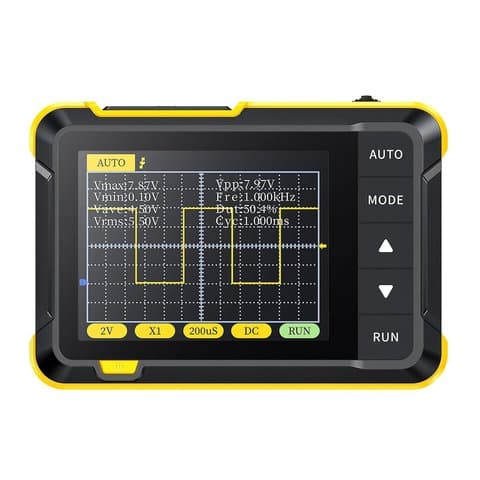
FNIRSI DSO152
4.1★★★★☆A genuinely pocket-sized scope for quick diagnostics — not a bench replacement.

Hantek DSO2D10
4.3★★★★☆An oscilloscope and waveform generator in one unit — practical for space-limited benches.
Specs side by side
| FNIRSI DSO152 | Hantek DSO2D10 | |
|---|---|---|
| Rating | 4.1★★★★☆ | 4.3★★★★☆ |
| Bandwidth | 200kHz | 100MHz |
| Channels | 1 | 2 |
| Sample rate | 2.5 MSa/s | 1 GSa/s |
| Best for | Basic diagnostics, learning the fundamentals | Space-limited benches, combined testing |
| Form factor | Pocket-sized handheld | Compact benchtop |
| Comfortable signal ceiling (3–5x rule) | About 40–67kHz | About 20–33MHz |
Specs checked against manufacturer documentation and official Amazon listings. Desk research, not bench testing. How we research.
Key differences
- →Bandwidth: 200kHz on the FNIRSI against 100MHz on the Hantek, a 500-fold gap that decides which signals each can show accurately.
- →Sample rate: 2.5 MSa/s against 1 GSa/s, 400 times more samples per second on the Hantek.
- →Channels: one on the FNIRSI, two on the Hantek, so only the Hantek can show an input and output, or a clock and data line, at the same time.
- →The Hantek includes a single-channel waveform generator (to 25 MHz); the FNIRSI DSO152's listed specs include no signal source.
- →The FNIRSI is genuinely pocket-sized; the Hantek is a compact bench instrument meant to stay on a desk.
- →The FNIRSI is the low-cost entry point of the two; check the live Amazon prices, as both move often.
Spec by spec
On paper these two are separated by more than two orders of magnitude on the specs that matter most. The bars below use a logarithmic scale, because on a linear one the FNIRSI's bar would be too thin to see. Bandwidth decides how fast a signal can be before the scope starts to shrink and round it off; sample rate decides how many points the scope captures to draw it. Our explainers on oscilloscope bandwidth and what GSa/s means cover both in more depth.
Bars use a logarithmic scale: each step is ten times the last.
Bars use a logarithmic scale: each step is ten times the last.
Bars use a logarithmic scale: each step is ten times the last.
The sample rate gap matters less than it looks inside each scope's own bandwidth. At 2.5 MSa/s the FNIRSI still takes about 125 samples per cycle of a 20kHz audio tone, which is plenty to draw it cleanly. The problem only appears when you point it at something faster than it was built for: a 1MHz clock would get just 2.5 samples per cycle, barely above the Nyquist minimum of two, and the trace would no longer resemble the real waveform.
What each one can and can't measure
A scope's rated bandwidth is the frequency at which a sine wave is already shown about 3 dB low, at roughly 70.7% of its true amplitude. That is why the common rule of thumb is to buy 3 to 5 times more bandwidth than the fastest signal you care about. Applied to these two, the FNIRSI DSO152 is comfortable up to roughly 40–67kHz and the Hantek DSO2D10 up to roughly 20–33MHz. For square waves and digital signals the bar is higher still, because a clean edge contains harmonics many times its basic frequency; exactly how much bandwidth an edge needs depends on its rise time, not just its repetition rate.
That puts the FNIRSI squarely in audio-range work: checking that an amplifier output isn't clipping, watching a slow PWM signal drive an LED or motor, seeing a sensor output change, or simply learning the difference between a sine, a square and a triangle wave on a real screen. It can't meaningfully show a microcontroller clock, an SPI bus, the switching node of most modern switch-mode supplies, or ringing on a fast edge, and with one channel it can't compare two signals in time at all.
The Hantek covers that whole audio range with huge headroom and then keeps going: UART, I2C and SPI signals at typical hobby speeds, PWM edges, switching-supply waveforms and microcontroller clocks in the tens of megahertz are all inside its 3–5x window. Its second channel is what turns it into a debugging tool rather than a viewer: trigger on a clock and watch data, or put channel 1 on a filter's input and channel 2 on its output. The built-in generator can supply that input, so you can test a filter or amplifier with nothing else on the bench. Note that it is a single-channel generator, and the scope's two channels stay two channels whether the generator is running or not.
Why a slow scope lies about fast edges
Which should you buy?
| If you are… | Pick | Why |
|---|---|---|
| Curious about scopes, unsure you will use one | FNIRSI DSO152 | Cheap way to learn waveform basics; little lost if it ends up in a drawer |
| Checking audio amps, guitar pedals or speaker signals | FNIRSI DSO152 | Audio sits inside its 200kHz bandwidth with room to spare |
| Carrying a scope in a toolbag for quick checks | FNIRSI DSO152 | Pocket-sized; the Hantek is a bench instrument |
| Debugging Arduino, ESP32 or Raspberry Pi projects | Hantek DSO2D10 | 100MHz and 1 GSa/s reach digital clocks and buses |
| Comparing an input to an output, or clock to data | Hantek DSO2D10 | Two channels; the FNIRSI has one |
| Testing filters, amplifiers or sensor inputs | Hantek DSO2D10 | Built-in generator (one channel, to 25 MHz) supplies the test signal |
| Working on switch-mode power supplies | Hantek DSO2D10 | Switching edges are far beyond 200kHz |
| Short on bench space but need a scope and a signal source | Hantek DSO2D10 | Two instruments in one compact unit |
If two channels are not enough for you either, the four-channel benches are compared in Rigol DS1054Z vs Hantek DSO2D10 and Hantek DSO2D10 vs Siglent SDS1104X-E. For the full field, see our best beginner oscilloscopes roundup and the oscilloscope buying guide.
Mains and high voltage
Choose the FNIRSI DSO152 if…
- ✓You want the lowest-cost way to see what waveforms look like before committing to a bench scope
- ✓Your signals are audio-range or slower: PWM, sensor outputs, audio clipping checks
- ✓You want a scope that fits in a pocket or a toolbag
Choose the Hantek DSO2D10 if…
- ✓You debug microcontroller, digital bus or switching circuits with edges well above audio frequencies
- ✓You need two channels to compare an input against an output, or a clock against data
- ✓You want a signal source and a scope in one compact unit on a small bench
The bottom line
Buy the FNIRSI DSO152 if you want to see slow signals for very little money, carry a scope in your pocket, or find out whether you will use a scope at all. Buy the Hantek DSO2D10 if you already know you will debug digital, switching or multi-signal circuits: its 100MHz, 1 GSa/s, second channel and built-in generator do work the FNIRSI cannot attempt. The two also pair well: a pocket scope for quick checks away from the bench, a bench scope for real debugging.
Frequently asked questions
Is the FNIRSI DSO152 good enough for Arduino projects?+
Only for the slow parts. It can show default PWM outputs, which run at a few hundred hertz to around 1kHz on common boards, and slow sensor signals. Its 200kHz bandwidth and single channel rule out viewing the board's clock, SPI traffic or fast I2C properly. For real Arduino debugging the Hantek DSO2D10's 100MHz and two channels are the better fit.
Can the Hantek DSO2D10 replace a separate function generator?+
For many hobby jobs, yes. Its built-in generator is single-channel and reaches 25 MHz, enough to drive filters, amplifiers and sensor inputs while you watch the response on the scope channels. If you need two independent outputs at once, a separate two-channel generator is still the better choice.
Why does the Hantek have a 400 times higher sample rate?+
Because it is built for 500 times more bandwidth. A scope needs comfortably more than two samples per cycle of the fastest signal it shows, and real scopes aim well above that minimum. The FNIRSI's 2.5 MSa/s suits its 200kHz bandwidth; the Hantek's 1 GSa/s suits 100MHz. Neither number helps much on its own without the other.
Should I buy the FNIRSI DSO152 first and upgrade later?+
It is a sensible path if you are unsure a scope will earn its place. The FNIRSI costs little and teaches waveform basics. If you soon hit its limits, wanting a second channel or faster signals, that tells you a bench scope like the Hantek is worth buying, and the pocket scope stays useful for quick checks.
Is one channel enough for a beginner?+
For learning what waveforms look like and checking a single signal, yes. Most real debugging soon involves comparing two signals in time: a clock against data, or an amplifier's input against its output. That needs at least two channels, which the Hantek DSO2D10 has and the FNIRSI DSO152 does not.
Related