COMPARISON · OSCILLOSCOPES
Rigol DS1054Z vs Siglent SDS1104X-E
Buy the Rigol DS1054Z if your signals stay below about 10 MHz and you want the cheapest proven four-channel bench scope; buy the Siglent SDS1104X-E if you work with faster clocks, SPI or CAN buses, or want serial decoding without paying for options. Both have four channels, 1 GSa/s and a 7-inch screen. The Siglent doubles the bandwidth to 100 MHz, keeps 500 MSa/s per channel with all four on against the Rigol's 250 MSa/s, and includes I2C, SPI, UART, CAN and LIN decoding as standard.
By the OhmSavvy Research Team ·
Disclosure: OhmSavvy earns a commission from qualifying Amazon purchases made through these links, at no extra cost to you. How we're funded.
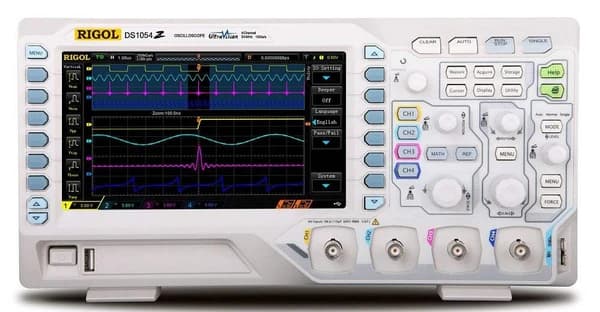
Rigol DS1054Z
4.8★★★★★The default beginner oscilloscope recommendation for years, and still worth it.
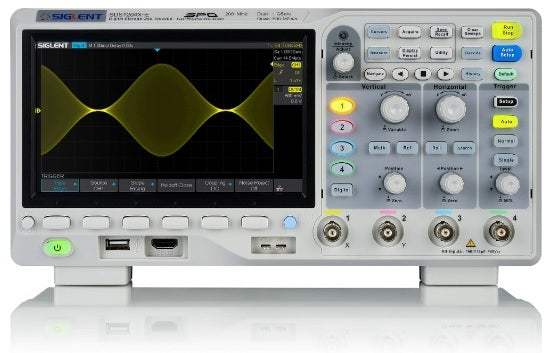
Siglent SDS1104X-E
4.8★★★★★More bandwidth and a better UI than the Rigol, for projects that will get more demanding.
Specs side by side
| Rigol DS1054Z | Siglent SDS1104X-E | |
|---|---|---|
| Rating | 4.8★★★★★ | 4.8★★★★★ |
| Bandwidth | 50MHz | 100MHz |
| Channels | 4 | 4 |
| Sample rate | 1 GSa/s | 1 GSa/s |
| Best for | Hobbyists, students, general electronics | Intermediate hobbyists, future-proofing |
| Sample rate, 3-4 channels on | 250 MSa/s per channel | 500 MSa/s per channel |
| Memory depth | 12 Mpts standard; 24 Mpts optional | 7 Mpts/ch; 14 Mpts interleaved |
| Waveform capture rate | Not listed on Rigol's 1000Z page | 100,000 wfm/s; 400,000 in sequence mode |
| Display | 7-inch | 7-inch 800 × 480 |
| Serial decoding | Optional: RS232/UART, I2C, SPI | Standard: I2C, SPI, UART/RS232, CAN, LIN |
| History / segmented memory | Not listed on Rigol's 1000Z page | Up to 80,000 frames |
| Remote control | USB cable included; LAN not listed on the page | USB device, LAN, browser web control |
| Logic channels | None (MSO1000Z is a separate model) | Optional 16-channel MSO add-on |
| Bandwidth upgrade | None listed by Rigol | None listed by Siglent |
Specs checked against manufacturer documentation and official Amazon listings. Both products hands-on tested by OhmSavvy. How we research.
Key differences
- →Bandwidth: 100 MHz on the Siglent against 50 MHz on the Rigol, which roughly halves the estimated rise time the scope adds to fast edges.
- →Sample rate with three or four channels on: 500 MSa/s per channel on the Siglent, 250 MSa/s on the Rigol. With one channel both reach 1 GSa/s.
- →Serial decoding: included on the Siglent for I2C, SPI, UART/RS232, CAN and LIN. On the Rigol, UART, I2C and SPI trigger and decode are paid options.
- →Memory: the Rigol lists 12 Mpts standard (24 Mpts optional); the Siglent lists 7 Mpts per channel, or 14 Mpts interleaved.
- →Capture tools: Siglent quotes 100,000 wfm/s, a 400,000 wfm/s sequence mode and an 80,000-frame history, useful for catching rare glitches.
- →Both are four-channel, 1 GSa/s, 7-inch benchtop scopes, and both are owner-tested at OhmSavvy.
At a glance
Same shape
Four channels, 1 GSa/s peak, 7-inch screen, mains-powered benchtop.
Siglent: speed
100 MHz bandwidth and 500 MSa/s per channel with all four on.
Siglent: decoding
I2C, SPI, UART, CAN and LIN decoding included.
Rigol: memory
12 Mpts standard, with a 24 Mpts option.
Rigol: ecosystem
A large user community and plenty of third-party documentation.
Verdict
Below 10 MHz on a budget: Rigol. Faster buses and decoding: Siglent.
The owner has bought and used both scopes, so both carry the Hands-on Tested badge, but the specs below come from Rigol's and Siglent's own pages. Single-scope detail is in the Rigol DS1054Z review and the Siglent SDS1104X-E review.
DS1054Z vs SDS1104X-E spec by spec
The headline "1 GSa/s" is the same on both boxes, but it only applies with one channel running. Four-channel scopes earn their keep with all four probes connected, and that is where the two split.
A common rule of thumb is to pick a scope with three to five times the bandwidth of the fastest fundamental you need to see with recognizable edges. By that rule the DS1054Z is comfortable to roughly 10 to 15 MHz, and the SDS1104X-E to roughly 20 to 30 MHz. An Arduino Uno's 16 MHz clock sits right at the Rigol's edge; its PWM, UART and I2C traffic, all well below 1 MHz, are easy for either.
What 50 MHz vs 100 MHz does to an edge
A scope's front end behaves like a low-pass filter. Every edge you feed it comes out slower, by roughly 0.35 divided by the bandwidth. On a 20 MHz clock, each half cycle lasts 25 ns, so a 7 ns rounded edge eats a noticeable share of it, while 3.5 ns keeps the trace looking square. That matters when you measure rise time, overshoot or setup-and-hold margins on fast logic; it does not matter for audio or a 1 kHz PWM signal.
Measured rise time includes the scope
Serial decoding: included or extra
Decoding turns a burst of ones and zeros into readable bytes and addresses on screen. Siglent lists I2C, SPI, UART/RS232, CAN and LIN decoding as free on the SDS1000X-E series. Rigol lists RS232/UART, I2C and SPI trigger and decode for the 1000Z as options, and no CAN or LIN. If you debug sensor buses, automotive CAN or a misbehaving UART link, the Siglent arrives ready; on the Rigol, factor the decode option into the cost.
| Protocol | Rigol DS1054Z | Siglent SDS1104X-E |
|---|---|---|
| UART / RS232 | Option | Included |
| I2C | Option | Included |
| SPI | Option | Included |
| CAN | Not listed | Included |
| LIN | Not listed | Included |
For a worked example, see diagnosing a UART problem with an oscilloscope.
DS1054Z vs SDS1104X-E: which should you buy?
| You are… | Better fit | Why |
|---|---|---|
| Student following a course | Rigol DS1054Z | Large community and documentation base; 50 MHz covers typical lab signals |
| Arduino or Raspberry Pi hobbyist | Either | PWM, UART and I2C are far below 50 MHz; Siglent if you want free decoding |
| Audio and amplifier work | Rigol DS1054Z | Audio is under 100 kHz; extra bandwidth adds nothing |
| SPI, fast clocks, FPGA I/O | Siglent SDS1104X-E | 100 MHz and 500 MSa/s per channel keep edges honest |
| Automotive CAN or LIN | Siglent SDS1104X-E | CAN and LIN decoding included; Rigol lists neither |
| Switching power supplies | Siglent SDS1104X-E | Faster front end shows switch-node ringing more faithfully |
| Tightest budget | Rigol DS1054Z | Usually the cheaper of the two; check both listings on the day |
Also weighing a newer platform? Compare Rigol DHO804 vs DS1054Z and Rigol DHO804 vs SDS1104X-E, or read what oscilloscope bandwidth means.
Safety: neither scope is for direct mains probing
Choose the Rigol DS1054Z if…
- ✓Your work is audio, Arduino-speed logic, PWM and power-supply ripple, well inside 50 MHz
- ✓You want the lowest-cost four-channel bench scope with a huge library of tutorials
- ✓You need 12 Mpts of standard memory and can live with paid decode options
Choose the Siglent SDS1104X-E if…
- ✓You probe fast clocks, SPI or fast-edge switching, where 100 MHz and 500 MSa/s per channel help
- ✓You want I2C, SPI, UART, CAN and LIN decoding included rather than bought as options
- ✓You value a 100,000 wfm/s capture rate, history mode and LAN web control
Neither if…
You need to probe a mains-referenced point directly: both are mains-powered bench scopes whose probe grounds tie to protective earth, so clipping a ground lead to a non-ground point on a live circuit can destroy the probe, the scope or the circuit — use an isolation transformer on the device under test or a differential probe instead.
The bottom line
Four channels and a 1 GSa/s peak are common ground. The Rigol DS1054Z remains the practical first scope for students and hobbyists whose signals stay below about 10 MHz. The Siglent SDS1104X-E earns its higher price with 100 MHz, twice the per-channel sample rate with all channels on, and free serial decoding, so buy it if you work on fast logic, buses or switching supplies.
Frequently asked questions
Is 50 MHz enough bandwidth for a beginner oscilloscope?+
For most beginner work, yes. Audio, PWM, UART, I2C, power-supply ripple and most microcontroller signals sit well below 10 MHz, where a 50 MHz scope like the DS1054Z draws clean edges. You outgrow it with fast clocks, high-speed SPI, FPGA I/O or RF, where the SDS1104X-E's 100 MHz shows more of the true edge.
Does the Siglent SDS1104X-E include serial decoding?+
Yes. Siglent lists I2C, SPI, UART/RS232, CAN and LIN decoding as standard on the SDS1000X-E series. On the Rigol DS1054Z, RS232/UART, I2C and SPI trigger and decode are sold as options, and Rigol's 1000Z page doesn't list CAN or LIN decoding.
Can the Rigol DS1054Z's bandwidth be upgraded past 50 MHz?+
Rigol sells and specifies the DS1054Z as a 50 MHz scope, and its 1000Z page lists no official bandwidth upgrade, only an extended warranty option. Plan around 50 MHz. If you need more bandwidth with full manufacturer support, buy a scope rated higher as sold, such as the 100 MHz SDS1104X-E.
Why does sample rate drop when I turn on more channels?+
Both scopes share their converters between channels. With one channel on, all of it goes to that channel for 1 GSa/s. With three or four on, the Rigol drops to 250 MSa/s per channel and the Siglent to 500 MSa/s. For a 20 MHz signal that means 12.5 versus 25 samples per cycle.
Which has more memory, the DS1054Z or the SDS1104X-E?+
On paper the Rigol: 12 Mpts standard and 24 Mpts as an option, against the Siglent's 7 Mpts per channel or 14 Mpts interleaved. Deep memory keeps the sample rate high on long time bases. The Siglent offsets this with segmented sequence capture and an 80,000-frame history for rare events.
Related