COMPARISON · OSCILLOSCOPES
Rigol DS1054Z vs Hantek DSO2D10
The Rigol DS1054Z vs Hantek DSO2D10 choice is four channels against a built-in signal source. Both are 1 GSa/s benchtop scopes with 7-inch 800 × 480 screens. The Rigol gives you four channels at 50MHz; the Hantek has two channels at 100MHz plus a one-channel 25 MHz waveform generator in the same case. Pick the Rigol if you watch several signals at once, the Hantek if you feed test signals into circuits.
By the OhmSavvy Research Team ·
Disclosure: OhmSavvy earns a commission from qualifying Amazon purchases made through these links, at no extra cost to you. How we're funded.
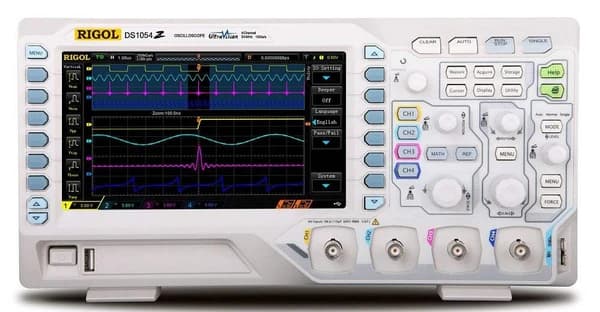
Rigol DS1054Z
4.8★★★★★The default beginner oscilloscope recommendation for years, and still worth it.

Hantek DSO2D10
4.3★★★★☆An oscilloscope and waveform generator in one unit — practical for space-limited benches.
Specs side by side
| Rigol DS1054Z | Hantek DSO2D10 | |
|---|---|---|
| Rating | 4.8★★★★★ | 4.3★★★★☆ |
| Bandwidth | 50MHz | 100MHz |
| Channels | 4 | 2 |
| Sample rate | 1 GSa/s | 1 GSa/s |
| Best for | Hobbyists, students, general electronics | Space-limited benches, combined testing |
| Sample rate, all channels on | 250 MSa/s per channel (3–4 ch) | 500 MSa/s per channel (2 ch) |
| Sample rate, 2 channels on | 500 MSa/s | 500 MSa/s |
| Memory depth | Rigol conflicts: 12 Mpts standard / 24 Mpts optional (product page); 24 Mpts (datasheet) | 8 Mpts (1 ch); 4 Mpts (2 ch) |
| Vertical resolution | 8-bit; 12-bit high-resolution mode | 8-bit; 12-bit high-resolution mode |
| Waveform update rate | Up to 30,000 wfms/s | Not stated by Hantek |
| Serial decode | Parallel, RS232/UART, I2C, SPI (option per product page) | UART/RS232, I2C, SPI, CAN, LIN |
| Built-in generator | None (generator is on the -S models) | 1 channel, 25 MHz, 200 MSa/s, 12-bit |
| Generator amplitude | Not applicable | 10 mV–7 Vpp (high impedance); 5 mV–3.5 Vpp (50 Ω) |
| Display | 7-inch, 800 × 480 | 7-inch, 800 × 480 |
| Power | 100–240 V AC, 50 W max | Mains, under 30 W |
| Interfaces | USB host and device, LAN | Not compared in our sources |
Specs checked against manufacturer documentation and official Amazon listings. Rigol DS1054Z is hands-on tested by OhmSavvy; the Hantek DSO2D10 assessment is desk research. How we research.
Key differences
- →Channels: four on the Rigol against two on the Hantek, so the Rigol can show a whole SPI transfer or a three-phase set in one capture.
- →Bandwidth: 50MHz on the Rigol against 100MHz on the Hantek, both with a 1 GSa/s single-channel maximum.
- →Only the Hantek has a waveform generator: one channel to 25 MHz with sine, square, ramp, exponential, noise, DC and four arbitrary slots.
- →With every channel on, the Hantek keeps 500 MSa/s per channel; the Rigol drops to 250 MSa/s per channel with three or four on.
- →Hantek lists CAN and LIN decoding as standard; Rigol's DS1000Z decoding covers parallel, UART, I2C and SPI, and its product page calls bus decoding an option.
- →Our ratings are editorial, not user scores: the DS1054Z carries 4.8 and our Hands-on Tested badge; the DSO2D10 carries 4.3 from desk research against Hantek's specs.
DS1054Z vs DSO2D10 spec by spec
The headline 1 GSa/s figure is the same on both, but it only holds with one channel on. Both scopes split one sampling budget across the channels you enable, so the number that matters is the per-channel rate in the configuration you actually use. Bandwidth and channel count pull in opposite directions here.
The usual rule of thumb is to choose bandwidth three to five times the highest frequency you want to see clearly. On that basis the Rigol is comfortable to roughly 10 to 17 MHz and the Hantek to roughly 20 to 33 MHz. A common approximation for rise time is 0.35 divided by bandwidth, which gives about 7 ns for the Rigol and about 3.5 ns for the Hantek. Those are textbook estimates, not measurements, but they show where the extra 100MHz helps: sharp logic edges and fast clocks. For background, read what oscilloscope bandwidth means and what GSa/s means.
Samples per cycle tell the same story with arithmetic. A 10 MHz clock on the Rigol with four channels on gets 250 ÷ 10 = 25 samples per cycle; on the Hantek with both channels on it gets 500 ÷ 10 = 50. Both are far above the Nyquist minimum of two, so either scope draws a usable 10 MHz waveform. The gap only shows on faster signals or when you zoom into a single edge.
Where the makers' documents leave gaps
When four channels beat a built-in generator
Many beginner projects end up on a serial bus. SPI uses four lines: chip select, clock, data out and data in. With the DS1054Z you can put all four on screen and trigger on chip select, so one capture shows the whole transaction. With the DSO2D10 you watch the clock and one data line, then move a probe and capture again. That works when the fault repeats, and it is a real nuisance when it doesn't.
The same applies to a motor driver with three phase outputs, a power supply where you want input, output and enable together, or a microcontroller timing problem across several pins. If that sounds like your bench, four channels matter more than the generator. Our best oscilloscope for Arduino projects guide ranks scopes for exactly this kind of work.
When the built-in generator wins
Some work starts with a test signal rather than a running circuit. To check a low-pass filter, an audio amplifier or a sensor input, you inject a known sine or square wave and compare input with output. The DSO2D10 does that from one box: its generator reaches 25 MHz at 200 MSa/s with 12-bit resolution, and puts out 10 mV to 7 Vpp into a high-impedance load. Channel 1 watches the input and channel 2 the output, which is exactly the two-channel job.
The DS1054Z has no generator; Rigol puts one only on its -S models. You can still do stimulus-response work with it, but you need a function generator or a microcontroller that outputs the test signal. Our guide to measuring an amplifier's bandwidth with an oscilloscope shows the method. Hantek also sells the same scope without the generator as the DSO2C10, compared in Hantek DSO2C10 vs DSO2D10.
Rigol DS1054Z vs Hantek DSO2D10: which should you buy?
| You are… | Better fit | Why |
|---|---|---|
| Student learning on Arduino and SPI or I2C buses | Rigol DS1054Z | Four channels show a whole bus transfer in one capture |
| Audio or filter hobbyist | Hantek DSO2D10 | Built-in generator supplies the test tone; two channels compare in and out |
| CAN or LIN automotive tinkerer | Hantek DSO2D10 | Hantek lists CAN and LIN decoding; Rigol's DS1000Z list stops at SPI |
| Motor driver or three-phase work | Rigol DS1054Z | Three phases plus a reference need more than two inputs |
| Fast logic edges, clocks above 20 MHz | Hantek DSO2D10 | 100MHz passes faster edges than 50MHz |
| Small desk, one instrument only | Hantek DSO2D10 | Scope and signal source share one case |
| Wants the most tutorials and forum help | Rigol DS1054Z | Years as a default beginner scope |
| Already owns a function generator | Rigol DS1054Z | The Hantek's main extra is one you already have |
If you want four channels and 100MHz together, see Hantek DSO2D10 vs Siglent SDS1104X-E and Rigol DS1054Z vs Siglent SDS1104X-E. For a 12-bit option, read Rigol DHO804 vs Hantek DSO2D10.
Safety: neither is a mains probe
Choose the Rigol DS1054Z if…
- ✓You need to watch three or four signals at once, such as all four lines of an SPI bus
- ✓You're a beginner who wants four channels and plenty of community tutorials
- ✓You already own a signal source, or your circuits make their own signals
Choose the Hantek DSO2D10 if…
- ✓You test filters, amplifiers or sensor inputs and need a known signal to feed in
- ✓You want bandwidth headroom above 50MHz and two channels are enough
- ✓You want CAN and LIN decoding listed as standard alongside UART, I2C and SPI
The bottom line
Buy the Rigol DS1054Z if you watch more than two signals at a time or want the scope most beginner tutorials assume; its four channels and our hands-on testing make it the safer general pick. Buy the Hantek DSO2D10 if your work starts with a test signal, such as filters, amplifiers and sensor inputs, or if you want 100MHz and CAN or LIN decoding and two channels are enough. Decide by which you'd run out of first: channels or a signal source.
Frequently asked questions
Is 50MHz enough for a beginner?+
Usually. By the three-to-five-times rule of thumb, 50MHz is comfortable on signals up to roughly 10 to 17MHz, which covers most microcontroller, audio and power-supply projects. The Hantek's 100MHz adds headroom for fast logic edges and clocks above 20MHz, where the Rigol starts to round off the corners of square waves.
Can the Rigol DS1054Z generate signals?+
No. Rigol puts the built-in generator on its -S models, and the DS1054Z has none. For stimulus-response tests you need a separate function generator or a microcontroller that outputs the test signal. The Hantek DSO2D10 has a one-channel generator to 25 MHz built in, which is its main advantage in this comparison.
Does the Hantek DSO2D10 decode serial buses?+
Yes. Hantek lists UART/RS232, I2C, SPI, CAN and LIN triggering and decoding on the DSO2D10. Rigol's DS1000Z datasheet lists parallel, RS232/UART, I2C and SPI decoding, and Rigol's product page describes bus decoding as an option, so check what your DS1054Z includes before relying on it.
Which has more memory, the DS1054Z or the DSO2D10?+
The Rigol, on Rigol's figures. Its datasheet lists 24 Mpts, though its product page says 12 Mpts standard with 24 Mpts optional. Hantek lists 8 Mpts with one channel and 4 Mpts with two. Deeper memory keeps the sample rate high on longer captures, useful for catching an event several milliseconds after the trigger.
Can I use a two-channel scope for SPI debugging?+
Yes, with patience. Put the clock on one channel and a data line on the other, trigger on the clock, and move the second probe between lines across repeated captures. It works when the transfer repeats identically. For a one-off glitch, or to see chip select against data, a four-channel scope like the DS1054Z is far easier.
Related