COMPARISON · OSCILLOSCOPES
Rigol DS1202Z-E vs Siglent SDS1202X-E: Which Is Better?
Both of these are 200 MHz, two-channel scopes at 1 GSa/s, which puts them head-to-head on headline bandwidth. The real differences show up underneath: Siglent documents a far faster waveform capture rate and adds CAN and LIN to its standard serial trigger and decode, while Rigol's datasheet gives deeper memory on one channel or two.
By the OhmSavvy Research Team ·
Disclosure: OhmSavvy earns a commission from qualifying Amazon purchases made through these links, at no extra cost to you. How we're funded.

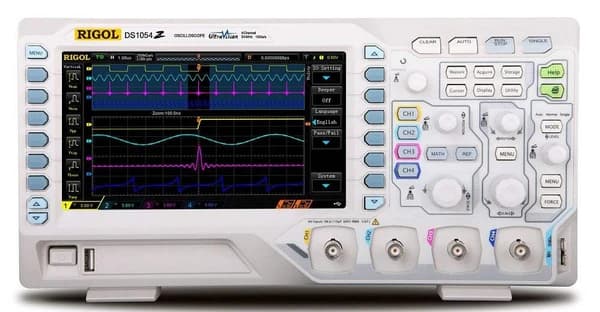
Rigol DS1202Z-E
4.5★★★★★The 200 MHz version of Rigol's DS1000Z-E platform, for two-channel work that outgrows the DS1102Z-E.

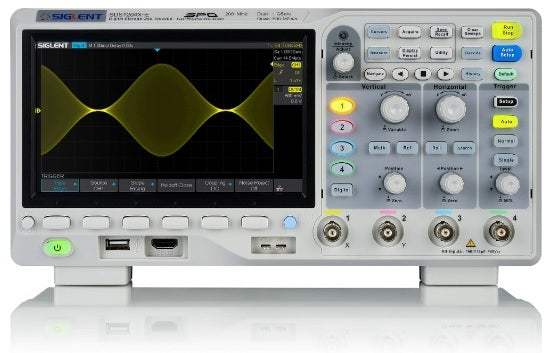
Siglent SDS1202X-E
4.5★★★★★200 MHz on two channels with a fast 100,000 wfm/s update rate and standard serial decoding.
Specs side by side
| Rigol DS1202Z-E | Siglent SDS1202X-E | |
|---|---|---|
| Rating | 4.5★★★★★ | 4.5★★★★★ |
| Bandwidth | 200MHz | 200MHz |
| Channels | 2 | 2 |
| Sample rate | 1 GSa/s | 1 GSa/s (1 ch); 500 MSa/s (2 ch) |
| Best for | Two-channel debugging that needs more bandwidth than 100 MHz | Faster digital and switching work on two channels |
| Bandwidth | 200MHz | 200MHz |
| Channels | 2 | 2 |
| Sample rate, 1 channel | 1 GSa/s | 1 GSa/s |
| Sample rate, 2 channels | Not broken out in this Pick's sourcing | 500 MSa/s |
| Memory depth | 24 Mpts (1 ch); 12 Mpts (2 ch) | 14 Mpts (1 ch); 7 Mpts per channel (2 ch) |
| Waveform capture rate | Up to 30,000 wfm/s | 100,000 wfm/s (400,000 in sequence mode) |
| Serial trigger | RS232/UART, I2C, SPI | I2C, SPI, UART, CAN, LIN (standard) |
| Serial decode | Parallel, RS232/UART, I2C, SPI (2 buses) | I2C, SPI, UART, CAN, LIN (standard) |
| Display | 7-inch, 800 × 480 | 7-inch, 800 × 480 |
| Expandability | Shares DS1000Z-E platform with the 100MHz DS1102Z-E | MSO/AWG/Bode/Wi-Fi options on 4-channel X-E models only |
Specs checked against manufacturer documentation and official Amazon listings. Desk research, not bench testing. How we research.
Key differences
- →Waveform capture rate: Siglent documents 100,000 wfm/s (400,000 in sequence mode) against Rigol's up to 30,000 wfm/s — more than a 3x difference, which matters for catching infrequent glitches.
- →Serial decode: both decode UART, I2C and SPI out of the box. Siglent adds CAN and LIN trigger and decode; Rigol's datasheet adds parallel-bus decode instead.
- →Memory depth: Rigol's datasheet gives 24 Mpts on one channel and 12 Mpts with both on, against Siglent's 14 Mpts and 7 Mpts per channel — an advantage for long single captures.
- →Both are rated 200 MHz with 1 GSa/s single-channel sampling and a 7-inch 800 × 480 display.
- →Siglent's four-channel X-E siblings add MSO, AWG, Bode plot and Wi-Fi options; those options don't extend to either two-channel model compared here.
Spec by spec
With identical headline bandwidth and single-channel sample rate, the meaningful differences are capture rate, memory and serial decode — not the numbers that show up first on a spec sheet.
A faster capture rate means fewer "dead time" gaps between acquisitions, which raises the odds of actually seeing a rare glitch the first time it happens, rather than needing to get lucky on a later trigger. Deeper memory instead buys a longer single window at full sample rate for one capture. Which matters more depends on whether your problem is "catch the rare event" or "see the whole event once triggered."
Dead time: why capture rate decides who sees the glitch
A digital scope doesn't watch continuously. It records a window, then spends time processing and drawing it before it can arm again, and anything that happens during that gap is simply never seen. The maximum capture rate tells you how short the whole cycle can get: 30,000 wfm/s works out to one acquisition every 33 µs or so on the Rigol, and 100,000 wfm/s to one every 10 µs on the Siglent.
With that assumed 2 µs window, the Rigol is live for about 2 ÷ 33 ≈ 6% of the time and the Siglent for about 2 ÷ 10 = 20%, so a glitch that comes and goes at random is roughly three times as likely to land in a Siglent capture on any given cycle. Sequence mode pushes the Siglent to 400,000 wfm/s by recording many short segments back to back and drawing them later. Neither number turns a scope into a gap-free recorder, which is why techniques such as persistence and segmented memory matter as much as the headline rate.
Rigol DS1202Z-E vs Siglent SDS1202X-E: which is better?
With bandwidth tied, the decision comes down to what kind of signal problem you're usually chasing and whether serial decode matters to your work.
If you work with CAN or LIN, or a wider mix of buses: the SDS1202X-E
Both scopes trigger on and decode UART, I2C and SPI as standard, so a sensor or display project is covered either way. Siglent goes further with CAN and LIN trigger and decode, which matters if you work on vehicle modules, industrial controllers or anything else that talks over those buses. Rigol's extra is parallel-bus decode, handy for older parallel interfaces such as character LCDs.
If you capture long single events: the DS1202Z-E
Rigol's datasheet documents 24 Mpts on one channel against Siglent's 14 Mpts, and 12 Mpts against 7 Mpts per channel with both on. For a single long capture at full sample rate — say, an extended analog event rather than a burst of digital traffic — that extra memory lets you zoom into detail later without having to recapture at a slower timebase.
Capture rate and memory solve different problems
Which should you buy?
| Buyer or job | Better fit | Why |
|---|---|---|
| Debugging CAN or LIN buses | Siglent SDS1202X-E | CAN and LIN trigger and decode are standard |
| Debugging UART, I2C or SPI only | Either | Both list these as standard; decide on capture rate vs memory |
| Hunting rare or intermittent glitches | Siglent SDS1202X-E | 100,000-400,000 wfm/s capture rate |
| Long single captures at full sample rate | Rigol DS1202Z-E | 24 Mpts documented memory depth |
| Already invested in Rigol's ecosystem | Rigol DS1202Z-E | Shares DS1000Z-E platform and accessories |
| Want room to grow into 4-channel, MSO or AWG later | Siglent SDS1202X-E | Shares a platform with Siglent's upgraded X-E models |
Want to see the 100 MHz version of this Rigol instead? See Rigol DS1102Z-E vs DS1054Z. The beginner oscilloscope roundup ranks both scopes, and the oscilloscope buying guide explains every spec from scratch.
Both are 200 MHz — bandwidth isn't the deciding factor here
Choose the Rigol DS1202Z-E if…
- ✓You want the deepest documented single-channel memory for long captures
- ✓You already know Rigol's DS1000Z menu system from another model
- ✓Your captures are mostly single, longer events rather than rapid glitch-hunting
- ✓You want the widest range of DS1000Z accessories and community guides
Choose the Siglent SDS1202X-E if…
- ✓You need CAN or LIN trigger and decode, not just I2C, SPI and UART
- ✓You're hunting infrequent or intermittent glitches that need a fast capture rate
- ✓You want Siglent's well-regarded user interface
- ✓You want the option to grow into a four-channel X-E model later with a familiar UI
The bottom line
Both the Rigol DS1202Z-E and Siglent SDS1202X-E are 200 MHz, two-channel, 1 GSa/s scopes, so bandwidth won't decide this one. Choose the Siglent if you need CAN or LIN decode or a fast capture rate for catching rare glitches; choose the Rigol if you want the deepest documented memory for long single captures or you're already in Rigol's ecosystem.
Frequently asked questions
Are the Rigol DS1202Z-E and Siglent SDS1202X-E the same bandwidth?+
Yes — both are rated 200 MHz with a 1 GSa/s single-channel sample rate. The meaningful differences are waveform capture rate (Siglent is faster) and documented memory depth (Rigol is deeper), not bandwidth.
Does the Rigol DS1202Z-E have serial decode?+
Yes. Rigol's DS1000Z-E datasheet lists parallel, RS232/UART, I2C and SPI decoding on up to two buses, with RS232/UART, I2C and SPI triggers, and gives no option code for them. What it lacks next to the Siglent SDS1202X-E is CAN and LIN, so for vehicle or industrial bus work the Siglent is the better fit.
Which has the faster waveform capture rate?+
The Siglent SDS1202X-E, by a wide margin: up to 100,000 waveforms per second in normal mode and 400,000 in sequence mode, against the Rigol DS1202Z-E's documented 30,000 wfm/s.
Can either of these grow into a four-channel scope later?+
Not directly — both are fixed two-channel models. Siglent's four-channel X-E siblings add MSO, AWG, Bode plot and Wi-Fi options that aren't available on either two-channel model here, so growing into those features means a separate purchase either way.
What is waveform capture rate and why does it matter?+
It is how many acquisitions a scope can record and display per second. Between acquisitions the scope is blind, so a higher rate means less dead time and a better chance of catching a rare glitch. The Siglent SDS1202X-E is rated 100,000 wfm/s (400,000 in sequence mode) and the Rigol DS1202Z-E 30,000 wfm/s, both as maximums that vary with timebase.
Related