COMPARISON · OSCILLOSCOPES
Siglent SDS1104X-E vs Siglent SDS1202X-E
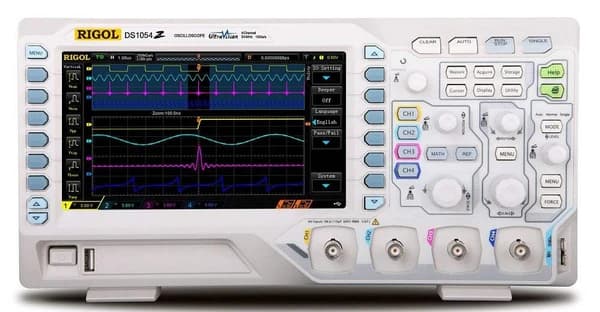
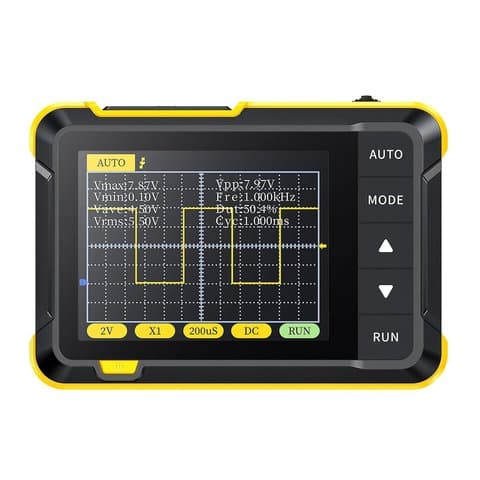
Siglent SDS1104X-E vs Siglent SDS1202X-E is a straight trade between channels and bandwidth inside the same X-E family. Both share 1 GSa/s, 14 Mpts, 100,000 waveforms per second and standard serial decoding. The SDS1104X-E gives you four channels at 100 MHz plus the MSO and Bode-plot options; the SDS1202X-E doubles the bandwidth to 200 MHz on two channels. Most buyers are better served by four channels; buy the 200 MHz model only if fast edges are your daily work.
By the OhmSavvy Research Team ·
Disclosure: OhmSavvy earns a commission from qualifying Amazon purchases made through these links, at no extra cost to you. How we're funded.
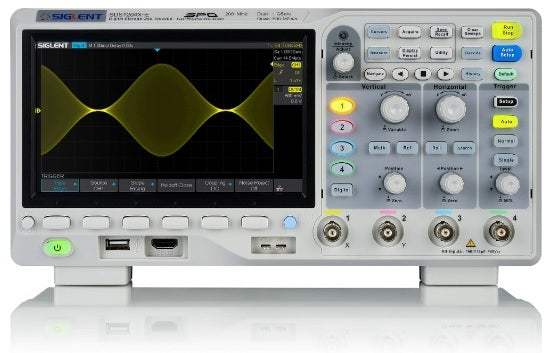
Siglent SDS1104X-E
4.8★★★★★More bandwidth and a better UI than the Rigol, for projects that will get more demanding.

Siglent SDS1202X-E
4.5★★★★★200 MHz on two channels with a fast 100,000 wfm/s update rate and standard serial decoding.
Specs side by side
| Siglent SDS1104X-E | Siglent SDS1202X-E | |
|---|---|---|
| Rating | 4.8★★★★★ | 4.5★★★★★ |
| Bandwidth | 100MHz | 200MHz |
| Channels | 4 | 2 |
| Sample rate | 1 GSa/s | 1 GSa/s (1 ch); 500 MSa/s (2 ch) |
| Best for | Intermediate hobbyists, future-proofing | Faster digital and switching work on two channels |
| Sample rate, all channels on | 500 MSa/s per channel | 500 MSa/s per channel |
| Memory depth | 14 Mpts; 7 Mpts with all channels on | 14 Mpts (1 ch); 7 Mpts per channel (2 ch) |
| Waveform rate | 100,000 wfm/s; 400,000 sequence | 100,000 wfm/s; 400,000 sequence |
| Rise time (approx., 0.35/BW) | About 3.5 ns | About 1.75 ns |
| Vertical sensitivity | 500 µV/div to 10 V/div | 500 µV/div to 10 V/div |
| Display | 7-inch 800 × 480 | 7-inch 800 × 480 |
| Serial decode | I2C, SPI, UART/RS232, CAN, LIN | I2C, SPI, UART/RS232, CAN, LIN |
| External trigger input | Not listed | Yes (2 + EXT) |
| MSO (16 digital) | Optional | Not available |
| USB AWG module | Optional (25 MHz) | Not available per our Pick notes; see below |
| Bode plot / Wi-Fi | Yes, with a Siglent generator / optional dongle | Not available |
Specs checked against manufacturer documentation and official Amazon listings. Siglent SDS1104X-E is hands-on tested by OhmSavvy; the Siglent SDS1202X-E assessment is desk research. How we research.
Key differences
- →The SDS1202X-E has 200 MHz of bandwidth, double the SDS1104X-E's 100 MHz.
- →The SDS1104X-E has four analog channels; the SDS1202X-E has two plus an external trigger input.
- →Siglent offers the 16-channel MSO, Bode plot and Wi-Fi only on the four-channel X-E models.
- →Both reach 1 GSa/s and drop to 500 MSa/s per channel when channels share an ADC.
- →Memory, waveform rate, display size, triggers and the standard decode list are the same on both.
At a glance
Same platform
1 GSa/s, 14 Mpts, 100,000 wfm/s, 7-inch screen, same triggers.
SDS1104X-E
Four channels at 100 MHz, MSO and Bode-plot options.
SDS1202X-E
Two channels at 200 MHz, plus an EXT trigger input.
Free decode
I2C, SPI, UART/RS232, CAN and LIN on both.
Deep history
Up to 80,000 recorded frames or segments on both.
Verdict
Multi-signal debugging: 1104X-E. Fast edges on two signals: 1202X-E.
The owner has bought and used the SDS1104X-E, which is why it carries our Hands-on Tested badge; the SDS1202X-E is assessed from Siglent's published specifications. Because both share one platform, the menus, triggers and measurement tools behave the same.
SDS1104X-E vs SDS1202X-E spec by spec
The sampling side is a tie: with every channel running, each scope samples at 500 MSa/s, so a 50 MHz signal gets 500 ÷ 50 = 10 samples per cycle on either model. Where they part is the analog front end that sits before the ADC, and that decides how sharp a fast edge looks.
What double the bandwidth buys on a real edge
A scope's front end has its own rise time, roughly 0.35 divided by bandwidth: about 3.5 ns at 100 MHz and 1.75 ns at 200 MHz. What you see on screen is approximately the square root of the signal's rise time squared plus the scope's rise time squared. For a 5 ns edge, that works out to √(25 + 12.25) ≈ 6.1 ns on the SDS1104X-E, about 22% slow, and √(25 + 3.06) ≈ 5.3 ns on the SDS1202X-E, about 6% slow.
For a 20 ns edge from a slow microcontroller pin, the error on the 100 MHz model falls to about 1.5%, which is why most hobby work never notices the difference. It matters on switch nodes of modern converters, fast logic families and ringing measurements. Our guides to measuring rise time with cursors and oscilloscope bandwidth go deeper.
SDS1104X-E vs SDS1202X-E: which should you buy?
| Project | Better fit | Why |
|---|---|---|
| SPI, I2C and multi-signal debugging | SDS1104X-E | Four channels, MSO option |
| Switching supplies and fast edges | SDS1202X-E | 200 MHz shows faster rise times |
| Filter and amplifier frequency response | SDS1104X-E | Bode plot with a Siglent generator |
| Comparing an input with an output | Either | Two channels are enough |
| Motor drive with three phases plus a trigger | SDS1104X-E | Needs four analog channels |
| Student lab learning the basics | SDS1104X-E | More channels for the same platform |
| Ringing on a MOSFET gate | SDS1202X-E | More bandwidth for the overshoot detail |
| Catching a rare glitch | Either | Same 100,000 wfm/s and 80,000-frame history |
How much bandwidth do you need?
Use cases in practice
Embedded debugging usually needs more signals than speed. An SPI transaction is a clock, MOSI, MISO and chip select: four lines that the SDS1104X-E shows at once, and with the decode running you read bytes on screen. On the SDS1202X-E you'd watch two lines and infer the rest. The four-channel model's MSO option extends that to 16 logic channels, which is where a parallel bus or a state machine becomes visible.
Power electronics is the opposite case. On a buck converter's switch node you usually want the switch voltage and the inductor current, and the detail you're after is the edge and the ringing that follows it. There, the SDS1202X-E's extra bandwidth matters more than extra inputs, and its EXT input can trigger from a gate signal without spending a channel.
One documentation conflict to note: the Siglent datasheet notes on our product records list the USB AWG module for the four-channel models, while the series web page lists the SAG1021I as an accessory without separating models. Confirm with Siglent before buying an SDS1202X-E for its generator. For a full look at the four-channel model, read our Siglent SDS1104X-E review.
Choose the Siglent SDS1104X-E if…
- ✓You need to watch three or four signals at once, such as SPI plus a reset line
- ✓You may add the 16-channel MSO option later
- ✓You want Bode plots of filters and amplifiers with a Siglent generator
Choose the Siglent SDS1202X-E if…
- ✓Edge speed matters more than channel count, as in switching supplies
- ✓Two channels plus an external trigger input cover your work
- ✓You don't need the MSO or Bode-plot options
The bottom line
Most hobbyists and students should buy the SDS1104X-E: four channels and the MSO and Bode-plot upgrade path matter more often than extra bandwidth. Buy the SDS1202X-E if your work centers on fast edges and two channels plus an external trigger will always be enough.
Frequently asked questions
Can the SDS1202X-E add logic channels?+
No. Siglent shows the SLA1016 16-channel MSO option, Bode plot and web control for the four-channel X-E models only, so the SDS1202X-E stays a two-channel analog scope. If you expect to debug parallel buses or many logic lines, choose the SDS1104X-E or pair the two-channel scope with a separate logic analyzer.
Do both scopes have the same sample rate?+
Yes. Both reach 1 GSa/s and run at 500 MSa/s per channel when the channels sharing an ADC are both on. That gives about 10 samples per cycle of a 50 MHz signal on either model. The difference between them is analog bandwidth, not sampling, so the same signal is sampled equally well on both.
Is serial decoding standard on both Siglent X-E models?+
Yes. Siglent lists I2C, SPI, UART/RS232, CAN and LIN trigger and decode as free, standard features across the SDS1000X-E series, so neither model needs a paid license. On the four-channel model you can show the clock, data and chip-select lines of an SPI bus at once while decoding.
Which has more memory, the SDS1104X-E or SDS1202X-E?+
They match. Siglent lists 14 Mpts when a channel has an ADC's memory to itself and 7 Mpts per channel when channels share it. At 500 MSa/s, 7 Mpts holds 14 ms of signal, enough for a full UART frame or a power-up sequence. Both also keep up to 80,000 history frames.
Is 100 MHz enough for Arduino and Raspberry Pi work?+
For most microcontroller buses, yes. I2C, UART and typical SPI clocks run well under 50 MHz, and a 100 MHz scope draws their edges with little distortion. Fast edges on high-speed SPI or SDIO benefit from more bandwidth. Our Arduino scope guide explains how bandwidth relates to the signals you'll measure.
Related