COMPARISON · OSCILLOSCOPES
Rigol DS1104Z-S Plus vs Siglent SDS1104X-E
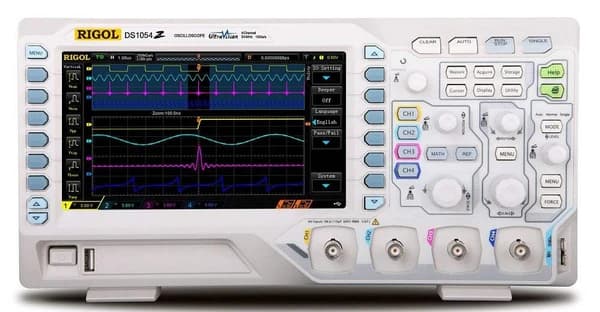
The Rigol DS1104Z-S Plus vs Siglent SDS1104X-E decision is between two scopes with the same headline: four channels, 100 MHz and 1 GSa/s. The Rigol builds in a two-channel 25 MHz signal generator. The Siglent keeps twice the Rigol's sample rate per channel when all four inputs are on, refreshes its display faster and includes CAN and LIN decoding as standard. Which matters more depends on whether you need to create signals or catch them.
By the OhmSavvy Research Team ·
Disclosure: OhmSavvy earns a commission from qualifying Amazon purchases made through these links, at no extra cost to you. How we're funded.

Rigol DS1104Z-S Plus
4.5★★★★★A four-channel 100 MHz classic with a two-channel 25 MHz signal generator built in.
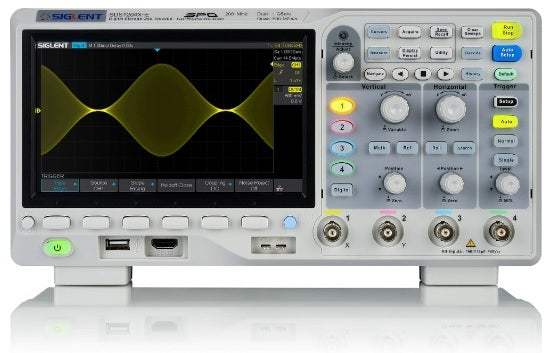
Siglent SDS1104X-E
4.8★★★★★More bandwidth and a better UI than the Rigol, for projects that will get more demanding.
Specs side by side
| Rigol DS1104Z-S Plus | Siglent SDS1104X-E | |
|---|---|---|
| Rating | 4.5★★★★★ | 4.8★★★★★ |
| Bandwidth | 100MHz | 100MHz |
| Channels | 4 | 4 |
| Sample rate | 1 GSa/s (1 ch); 250 MSa/s (4 ch) | 1 GSa/s |
| Best for | Four-channel work that also needs two signal sources | Intermediate hobbyists, future-proofing |
| Sample rate, all 4 channels on | 250 MSa/s per channel | 500 MSa/s per channel |
| Memory depth | 24 Mpts (1 ch) per Rigol datasheet; Rigol series page says 12 Mpts standard, 24 Mpts optional | 14 Mpts interleaved; 7 Mpts per channel |
| Waveform update rate | Up to 30,000 wfm/s | 100,000 wfm/s (400,000 in sequence mode) |
| Serial decoding | RS232/UART, I2C, SPI (Rigol series page lists decoding as optional) | I2C, SPI, UART/RS232, CAN, LIN as standard |
| Built-in generator | 2 channels, 25 MHz, 200 MSa/s, 14-bit | None (USB AWG is an option) |
| Logic channels | 16 with RPL1116 kit, sold separately | 16 with MSO option |
| Vertical resolution | 8-bit | 8-bit |
| Display | 7-inch, 800 × 480 | 7-inch, 800 × 480 |
| Power | 100–240 V AC, 50 W max | 100–240 V AC, 50 W max |
Specs checked against manufacturer documentation and official Amazon listings. Siglent SDS1104X-E is hands-on tested by OhmSavvy; the Rigol DS1104Z-S Plus assessment is desk research. How we research.
Key differences
- →The Rigol has a two-channel, 25 MHz signal generator built in (200 MSa/s, 14-bit); the Siglent has no generator unless you add its optional USB AWG.
- →With three or four channels running, the Siglent samples each at 500 MSa/s against the Rigol's 250 MSa/s.
- →Siglent states 100,000 waveforms per second (400,000 in sequence mode); Rigol states up to 30,000.
- →Siglent lists I2C, SPI, UART, CAN and LIN decoding as standard. Rigol lists RS232/UART, I2C and SPI, and its own series page marks decoding as optional.
- →Rigol's sources conflict on memory: 24 Mpts standard in the datasheet, 12 Mpts standard with 24 Mpts optional on the series page. Siglent states 14 Mpts interleaved, 7 Mpts per channel.
- →Bandwidth (100 MHz), channel count, peak sample rate (1 GSa/s), 8-bit resolution and the 7-inch 800 × 480 screen are the same on both.
Spec by spec
Put the two spec sheets side by side and the first lines match exactly, so the useful comparison starts lower down. The numbers that separate them are how the 1 GSa/s converter is shared out when you turn on more channels, how many waveforms per second each one draws, and how much acquisition memory sits behind the screen. Each chart below uses only figures published by Rigol and Siglent.
Bars use a logarithmic scale: each step is ten times the last.
| Feature | Rigol | Siglent |
|---|---|---|
| Signal generator | 2 ch, 25 MHz | Optional USB AWG |
| CAN / LIN decode | Not listed | Standard |
| I2C / SPI / UART decode | Listed; optional per series page | Standard |
| 16 logic channels | RPL1116 kit | MSO option |
Which should you buy?
Think about the jobs you will actually do in your first year with the scope, then read across.
| Buyer or job | Better fit | Why |
|---|---|---|
| Frequency response of filters and audio stages | Rigol DS1104Z-S Plus | Generator drives the input while two channels watch input and output |
| Testing a circuit that needs two separate stimulus signals | Rigol DS1104Z-S Plus | Two independent 25 MHz generator channels |
| SPI bus with clock, chip select and two data lines | Siglent SDS1104X-E | All four channels at 500 MSa/s each |
| Car and industrial networks (CAN, LIN) | Siglent SDS1104X-E | CAN and LIN decoding listed as standard |
| Hunting an intermittent glitch | Siglent SDS1104X-E | 100,000 wfm/s against 30,000 |
| Long captures on one channel | Check both | Rigol's memory figure depends on which Rigol document you trust |
| Single-signal work under about 20 MHz | Either | Same 100 MHz bandwidth and 1 GSa/s single-channel rate |
Generator or faster sampling: what each one can and can't do
Both scopes are rated at 100 MHz. Bandwidth is the frequency at which a sine wave reads about 3 dB low, around 70% of its real amplitude, and the usual 3–5x rule says the rating should be three to five times the highest frequency you care about. On that basis both handle signals up to roughly 20–33 MHz with one channel on: microcontroller clocks, PWM, UART, I2C, most hobby SPI and the switching frequency of common converters. Square waves need the lower end of that range because their edges are built from harmonics. Our explainer on oscilloscope bandwidth covers the rule properly.
The catch is that bandwidth assumes enough samples. Nyquist sets the bare minimum at two samples per cycle of the highest frequency present; in practice scopes want several. With all four channels on, the Rigol drops to 250 MSa/s per channel, which is only 2.5 samples per cycle of a 100 MHz sine. The Siglent's 500 MSa/s gives five. Both draw an interpolated trace between samples, so the display looks smoother than raw dots, but interpolation cannot recover detail between samples that were never taken. If your four-channel work stays below about 25 MHz the gap is unlikely to show; if you want the full 100 MHz on four inputs at once, the Siglent keeps more sampling margin. For more on how sample rate and bandwidth interact, see what GSa/s means.
The Rigol's answer is its generator, and it is a real one. Two outputs at up to 25 MHz, 200 MSa/s and 14-bit cover most bench stimulus jobs: sweep a sine into an active filter and watch the output fall away, feed a square wave into a comparator, or use the second output as a separate clock or enable signal while the first supplies the test waveform. You still have four scope inputs free to watch the result. Doing the same on the Siglent means buying either a separate function generator or Siglent's optional USB AWG.
On digital buses the Siglent pulls ahead. CAN and LIN decoding is listed as standard, which matters for automotive and industrial projects, and its 100,000 waveforms per second (400,000 in sequence mode) means less dead time between captures when you are waiting for a rare fault. Rigol lists RS232/UART, I2C and SPI decoding for the DS1000Z family, but its series page marks decoding as an option, so confirm what is enabled on the unit you buy before relying on it.
The memory question, stated plainly
Mains and high-voltage measurements
Where they sit among our other picks
The Siglent rates 4.8 in our beginner oscilloscope roundup and the Rigol 4.5; the Siglent carries our Hands-on Tested badge and the Rigol does not. If you want the Siglent's strengths explained in more depth, read our Siglent SDS1104X-E review. The 50 MHz, generator-free sibling of the Rigol is covered in Rigol DS1054Z vs Siglent SDS1104X-E, and a two-channel scope-plus-generator alternative in Hantek DSO2D10 vs Siglent SDS1104X-E. For a 12-bit route with a generator, see Rigol DHO914S vs Siglent SDS1104X-E. The oscilloscope buying guide explains each spec from scratch.
Choose the Rigol DS1104Z-S Plus if…
- ✓You need two test signals as well as four scope channels, and want one instrument on the bench
- ✓Your tests involve driving a circuit and watching how it responds, such as filters, amplifiers or comparators
- ✓You may add 16 logic channels later with Rigol's RPL1116 kit
Choose the Siglent SDS1104X-E if…
- ✓You will often run three or four channels on fast signals and want 500 MSa/s on each
- ✓You debug CAN or LIN buses, which Siglent decodes as standard
- ✓You already own a function generator, or rarely need one
The bottom line
If you need to generate signals as well as measure them, the Rigol DS1104Z-S Plus saves buying a second instrument: two 25 MHz outputs alongside four 100 MHz channels. If you mostly debug existing circuits, the Siglent SDS1104X-E is the stronger scope: 500 MSa/s per channel with all four on, a faster update rate, CAN and LIN decoding as standard and clear memory figures. For most buyers without a generator need, the Siglent is the better buy.
Frequently asked questions
Is the Rigol DS1104Z-S Plus generator good enough to replace a separate function generator?+
For most hobby and education bench work, yes. It has two channels up to 25 MHz at 200 MSa/s and 14-bit, which covers sine sweeps into filters, square waves into logic and a second signal for clocks or enables. Work needing higher frequencies or more output channels still calls for a dedicated generator.
Why does the Siglent SDS1104X-E sample faster with four channels on?+
Siglent states 500 MSa/s per channel with all four inputs active, while Rigol gives 250 MSa/s per channel with three or four on. At 100 MHz that is five samples per cycle against 2.5, so the Siglent keeps more real detail on fast edges when every channel is in use.
How much memory does the Rigol DS1104Z-S Plus have?+
Rigol's documents disagree. The datasheet lists 24 Mpts standard on one channel, 12 Mpts on two and 6 Mpts on three or four. Rigol's series page says 12 Mpts standard with 24 Mpts optional. Check the configuration of the unit you are buying if long captures matter to you.
Which of these scopes decodes CAN bus?+
The Siglent SDS1104X-E. Siglent lists I2C, SPI, UART/RS232, CAN and LIN trigger and decode as standard. Rigol lists RS232/UART, I2C and SPI decoding for the DS1104Z-S Plus and does not list CAN or LIN, and its series page marks decoding as an option.
Can either scope add logic analyzer channels?+
Both can reach 16 digital channels, at extra cost. The Rigol DS1104Z-S Plus needs Rigol's RPL1116 logic probe kit, sold separately. Siglent offers 16 digital channels as an MSO option for its four-channel SDS1000X-E models. Neither includes logic channels out of the box.
Related