Disclosure: OhmSavvy earns a commission from qualifying Amazon purchases made through the links below, at no extra cost to you. How we're funded.
At a glance
Our top picks

Klein Tools MM460S
A True RMS Klein whose Smart mode picks AC/DC voltage, resistance or continuity for you, a gentle start for beginners.
Check price on Amazon →Why we picked it ↓
KAIWEETS KM602
A rechargeable True RMS meter whose Smart mode measures voltage, resistance or continuity without turning a dial.
Check price on Amazon →Why we picked it ↓
Klein Tools MM420
Klein's everyday True RMS, auto-ranging meter: µA to 10 A, temperature and capacitance, rated CAT III 600V.
Check price on Amazon →Why we picked it ↓Also great
- 4
 KAIWEETS HT118ACheck pricePrice →Best Low-Cost True RMS4.4★★★★☆
- 5
 UNI-T UT139CCheck pricePrice →Best Value Auto-Ranging4.4★★★★☆
- 6
 KAIWEETS KM200sCheck pricePrice →Best Budget4.5★★★★★
- 7
 Fluke 115Check pricePrice →Best for Field Service4.8★★★★★
- 8
 AstroAI DM6000ARCheck pricePrice →Best for Electronics Hobbyists4.3★★★★☆
- 9Extech EX330Check pricePrice →Best Compact4.2★★★★☆
- 10
 Fluke 106Check pricePrice →Best Budget Pocket Fluke4.2★★★★☆
Quick shopping
Compare at a glance
Swipe sideways on mobile to see every spec.
| Model | Award | Rating | Accuracy | Safety rating | Auto-ranging | |
|---|---|---|---|---|---|---|
 #1Klein Tools MM460S | Best Smart-Mode Klein | 4.4★★★★☆ | True RMS, 4,000-count | CAT III 600V | Yes, plus Smart mode | Check price → |
 #2KAIWEETS KM602 | Best Rechargeable Smart Meter | 4.2★★★★☆ | True RMS, 6,000-count | CAT III 600V | Yes, plus Smart mode | Check price → |
 #3Klein Tools MM420 | Best Budget Klein True RMS | 4.5★★★★★ | True RMS, 4,000-count | CAT III 600V | Yes (manual RANGE button) | Check price → |
| #4KAIWEETS HT118A | Best Low-Cost True RMS | 4.4★★★★☆ | True RMS, 6,000-count | CAT III 1000V / CAT IV 600V | Yes | Check price → |
| #5UNI-T UT139C | Best Value Auto-Ranging | 4.4★★★★☆ | True RMS, 6,000-count | CAT III 600V | Yes | Check price → |
| #6KAIWEETS KM200s | Best Budget | 4.5★★★★★ | True RMS | CAT II 600V | Yes | Check price → |
| #7Fluke 115✓ Tested | Best for Field Service | 4.8★★★★★ | True RMS | CAT III 600V | Yes | Check price → |
| #8AstroAI DM6000AR | Best for Electronics Hobbyists | 4.3★★★★☆ | True RMS, 6,000-count | Not stated by AstroAI | Yes | Check price → |
| Best Compact | 4.2★★★★☆ | Auto-ranging (True RMS not stated) | CAT III 600V | Yes | Check price → | |
| #10Fluke 106 | Best Budget Pocket Fluke | 4.2★★★★☆ | Average-responding (not True RMS) | CAT III 600V | Yes | Check price → |
In depth
Detailed reviews
Klein Tools MM460S
A True RMS Klein whose Smart mode picks AC/DC voltage, resistance or continuity for you, a gentle start for beginners.
Best for:Beginners and quick household checks
In Smart mode the MM460S works out whether you're measuring AC or DC voltage, resistance or continuity without turning the dial (the minimum voltage it detects there is 0.8V). Outside Smart mode it is a regular auto-ranging True RMS meter. It reads current from a 400.0 µA range up to 10 A, resistance to 50 MΩ, capacitance to 4,000 µF and temperature to 1832°F. The 4,000-count reverse-contrast display is backlit, it's rated CAT III 600V with a 2 m drop rating, and Lead-Alert gives visual and audible warnings for wrong lead placement. There's no LoZ or NCV, and it is for indoor use.
Why it fits: Smart mode picks AC or DC voltage, resistance or continuity for you, and Lead-Alert warns both visually and audibly when a lead is in the wrong jack, so it removes the two commonest beginner errors. It is CAT III 600V True RMS with µA-to-10 A ranges; it lacks NCV and Klein rates it for indoor use.
- Accuracy
- True RMS, 4,000-count
- Safety rating
- CAT III 600V
- Auto-ranging
- Yes, plus Smart mode
- Best for
- Beginners and quick household checks
Reasons to buy
- +Smart mode auto-detects V, Ω and continuity
- +µA to 10 A plus temperature and capacitance
- +Backlit reverse-contrast display
Reasons to avoid
- −CAT III 600V only
- −No LoZ or non-contact voltage detection
KAIWEETS KM602
A rechargeable True RMS meter whose Smart mode measures voltage, resistance or continuity without turning a dial.
Best for:Beginners who want a no-dial, rechargeable meter
The KM602 starts in Smart mode, where it detects voltage, resistance and continuity on its own, and a FUNC button switches to manual mode. It has a full-screen colour display, 6,000 counts with an analog bar, True RMS, and a built-in 1,200 mAh lithium battery that charges by cable. It measures up to 600V AC/DC, current on 600 mA, 6 A and 10 A ranges (no µA), resistance to 60 MΩ, capacitance, frequency, duty cycle and temperature, and it has NCV, Live, Max/Min/Avg and a flashlight. KAIWEETS's manual rates it CAT III 600V, lower than the 1000V figure on its listing.
Why it fits: A Smart mode, a color screen and a built-in rechargeable battery make it the easiest meter to live with day to day, and NCV is included. It ranks second because current starts at a 600 mA range and the manual rates it CAT III 600V, lower than the listing suggests.
- Accuracy
- True RMS, 6,000-count
- Safety rating
- CAT III 600V
- Auto-ranging
- Yes, plus Smart mode
- Best for
- Beginners who want a no-dial, rechargeable meter
Reasons to buy
- +Smart mode plus manual mode
- +Rechargeable, no batteries to buy
- +NCV, temperature and Max/Min/Avg
Reasons to avoid
- −No µA range; smallest current resolution 0.1 mA
- −Listing's CAT IV claim isn't backed by the manual
Klein Tools MM420
Klein's everyday True RMS, auto-ranging meter: µA to 10 A, temperature and capacitance, rated CAT III 600V.
Best for:Home electrical, HVAC and appliance work
The MM420 is a 4,000-count, True RMS, auto-ranging meter rated CAT III 600V. It measures AC/DC current from a 400.0 µA range (0.1 µA resolution) up to 10 A, resistance to 50 MΩ, capacitance to 400 µF, frequency to 50 kHz and temperature from -40 to 1832°F with the included thermocouple. Lead-Alert lights show which jacks to use, it has Min/Max, a backlight and a 2 m drop rating. There's no LoZ mode or NCV, and Klein rates it for indoor use only.
Why it fits: Lead-Alert jack lights, True RMS and current from 400.0 µA to 10 A make it a first meter you won't outgrow quickly, with temperature for HVAC curiosity. There is no Smart mode, so you still choose the function, which places it behind the top two.
- Accuracy
- True RMS, 4,000-count
- Safety rating
- CAT III 600V
- Auto-ranging
- Yes (manual RANGE button)
- Best for
- Home electrical, HVAC and appliance work
Reasons to buy
- +µA, mA and 10 A ranges on AC and DC
- +Temperature, capacitance and frequency included
- +Lead-Alert jack lights help beginners
Reasons to avoid
- −No LoZ mode or non-contact voltage detection
- −CAT III 600V only, not for service-entrance work
KAIWEETS HT118A
True RMS, CAT III 1000V and µA current with NCV and temperature at a low price.
Best for:Budget all-rounder for home, car and hobby
The HT118A is a 6,000-count, auto-ranging True RMS meter with an analog bar. KAIWEETS's manual rates it CAT III 1000V / CAT IV 600V for up to 1000V DC and 750V AC, and current runs from a 600 µA range (0.1 µA) to 10 A. It also measures resistance to 60 MΩ, capacitance, frequency to 10 MHz, duty cycle and temperature, and adds NCV, a Live-wire test, Min/Max, jack lights, a flashlight and a kickstand. KAIWEETS gives a 3-year warranty. Its own product page lists 600V AC/DC, which disagrees with the manual and the meter face.
Why it fits: It gives beginners the most measurement capability for the money: CAT IV 600V, True RMS, µA to 10 A, temperature, NCV and lit jacks, backed by a 3-year warranty. The longer function list on the dial takes more learning than the Smart-mode meters.
- Accuracy
- True RMS, 6,000-count
- Safety rating
- CAT III 1000V / CAT IV 600V
- Auto-ranging
- Yes
- Best for
- Budget all-rounder for home, car and hobby
Reasons to buy
- +µA, mA and 10 A ranges
- +NCV, temperature and Min/Max included
- +3-year warranty
Reasons to avoid
- −Maker's product page and manual disagree on max voltage
- −Bulky compared with slim meters
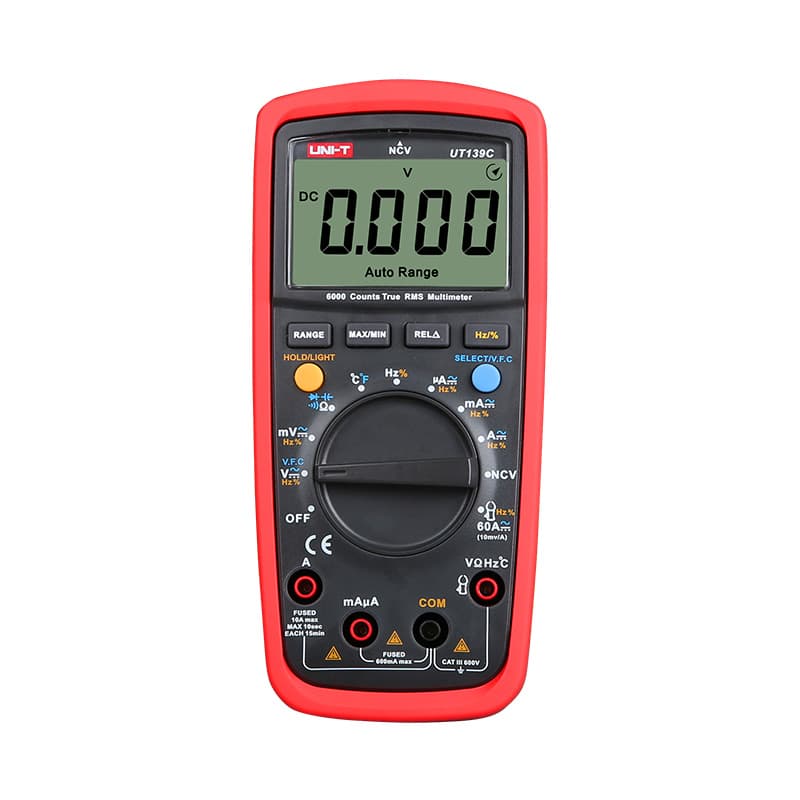
UNI-T UT139C
True RMS and auto-ranging at a price that undercuts most of this list.
Best for:Budget-conscious buyers who still want True RMS
UNI-T's UT139C packs True RMS accuracy, a 6,000-count display, and both auto and manual ranging into one of the more affordable meters here — a strong value pick if you don't need a specific brand name.
Why it fits: True RMS, a 6,000-count display, NCV and CAT III 600V in an auto-ranging meter that lets you lock a range when you are ready. It has no lead guidance, so it sits below the Klein and KAIWEETS models that show you where the leads go.
- Accuracy
- True RMS, 6,000-count
- Safety rating
- CAT III 600V
- Auto-ranging
- Yes
- Best for
- Budget-conscious buyers who still want True RMS
Reasons to buy
- +True RMS at a budget price
- +Both auto and manual ranging
- +Non-contact voltage detection included
Reasons to avoid
- −Less established brand recognition than Fluke/Klein
- −Build quality is adequate, not rugged
KAIWEETS KM200s
Covers the fundamentals of the Fluke at under half the price — the sensible first meter.
Best for:Home use, beginners
For under half the price of the Fluke, the KM200s covers the fundamentals well: auto-ranging, True RMS, and a non-contact voltage detector. A sensible first meter for home and hobby use.
Why it fits: It is the cheapest auto-ranging True RMS meter here, with NCV and a backlight, which makes it a fine way to learn on batteries, electronics and plug-in appliances. Its CAT II 600V rating means it should stay out of breaker panels.
- Accuracy
- True RMS
- Safety rating
- CAT II 600V
- Auto-ranging
- Yes
- Best for
- Home use, beginners
Reasons to buy
- +Excellent value for the feature set
- +Backlit display for low-light use
- +Smart auto-ranging simplifies readings
Reasons to avoid
- −Build quality isn't field-tool grade
- −CAT II rating means it's not meant for service-panel work
Fluke 115
The same Fluke reliability as the 117, in the same body, without the electrician-specific extras (NCV, AutoVolt, LoZ).
Best for:Field technicians, general electrical and electronics work
The Fluke 115 is Fluke's field-service meter — True RMS, CAT III 600V, and a 6,000-count backlit display, like the 117, but without non-contact voltage detection or the AutoVolt AC/DC auto-selector. A strong pick if you want Fluke's reliability without the electrician-focused extras.
Why it fits: It carries our Hands-on Tested badge and offers a straightforward True RMS, CAT III 600V, 6,000-count meter from a maker with a long service record. It costs well above the others and lacks NCV, so it suits a beginner who wants to buy once rather than one testing the waters.
- Accuracy
- True RMS
- Safety rating
- CAT III 600V
- Auto-ranging
- Yes
- Best for
- Field technicians, general electrical and electronics work
Reasons to buy
- +Same Fluke reliability and accuracy as the 117
- +Same size and weight as the 117 at a lower price
- +Includes capacitance and frequency measurement
Reasons to avoid
- −No non-contact voltage (NCV) detection
- −No AutoVolt AC/DC auto-selector or LoZ mode the 117 has
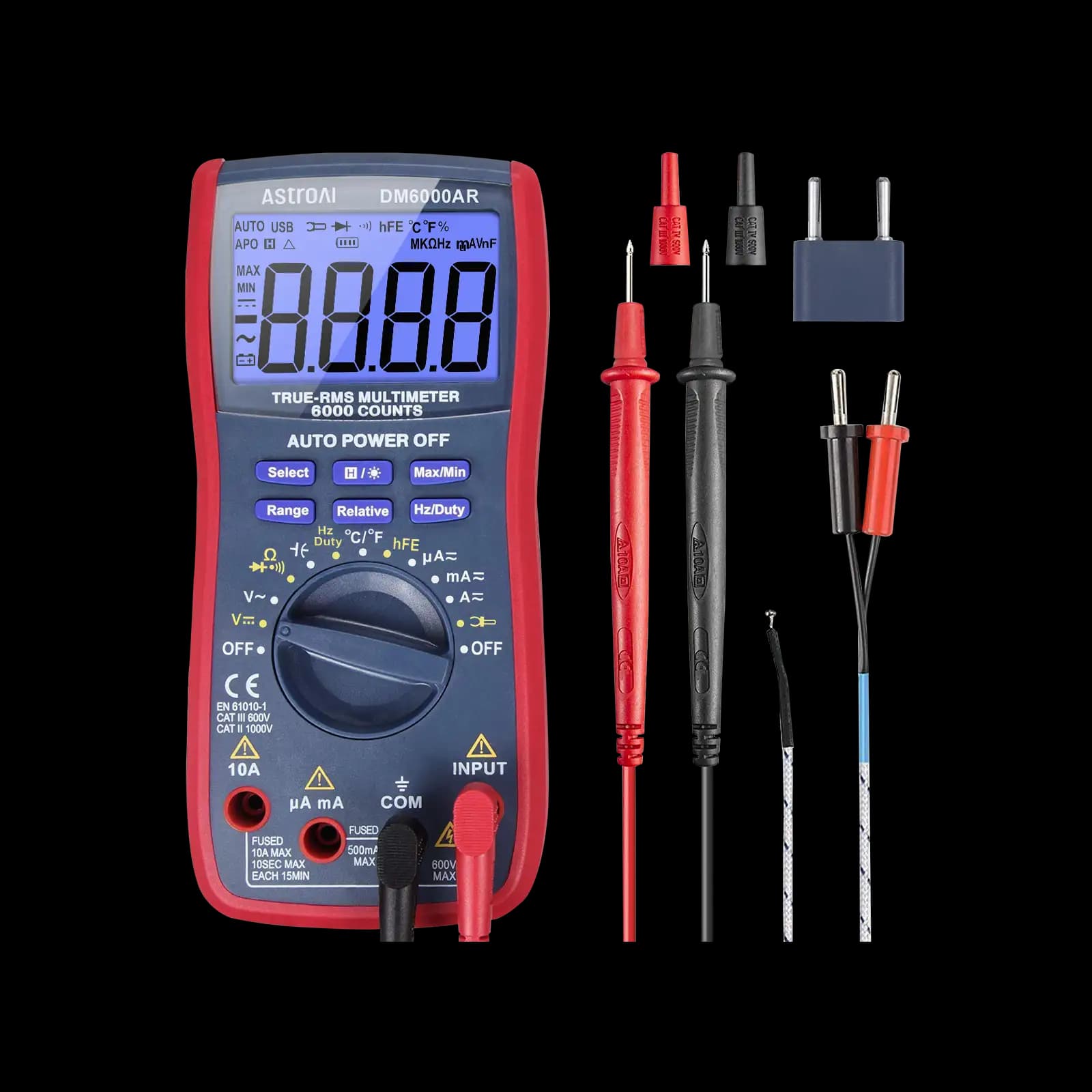
AstroAI DM6000AR
The go-to recommendation for Arduino and Raspberry Pi tinkering — cheap enough not to worry about.
Best for:Microcontroller & electronics projects
This is the meter you'll see recommended most often for Arduino, Raspberry Pi, and general electronics tinkering — True RMS and 6,000-count resolution give it more precision than its price suggests, with both auto and manual ranging on tap.
Why it fits: For learning on Arduino, Raspberry Pi and battery projects, it gives True RMS, 6,000 counts, auto and manual ranging, temperature and capacitance at a low price. AstroAI states no CAT rating, so keep it to low-voltage electronics.
- Accuracy
- True RMS, 6,000-count
- Safety rating
- Not stated by AstroAI
- Auto-ranging
- Yes
- Best for
- Microcontroller & electronics projects
Reasons to buy
- +Very affordable for True RMS + 6,000-count resolution
- +6,000-count display resolves small changes
- +Both auto and manual ranging available
Reasons to avoid
- −Build and included leads reflect the budget price point
- −No CAT rating stated by AstroAI, so keep it to low-voltage electronics, not panels
Extech EX330
A genuinely pocket-sized meter with a non-contact voltage detector built in.
Best for:Quick checks, pocket carry
The EX330 is a mini auto-ranging meter (147 × 76 × 42 mm, 260 g) with a built-in non-contact voltage (NCV) detector for a fast first check before you even connect leads, plus Type K temperature, capacitance, frequency and duty cycle. Extech doesn't list it as True RMS, unlike its True RMS models, so treat AC readings on distorted waveforms with caution.
Why it fits: Pocket-sized at 260 g with NCV, temperature and a CAT III 600V rating, it is handy for occasional household checks. Extech doesn't list it as True RMS and its 4,000-count display is coarser, which places it near the end.
- Accuracy
- Auto-ranging (True RMS not stated)
- Safety rating
- CAT III 600V
- Auto-ranging
- Yes
- Best for
- Quick checks, pocket carry
Reasons to buy
- +Genuinely pocket-sized
- +Built-in non-contact voltage detector
- +Low price for a name-brand meter
Reasons to avoid
- −Extech doesn't list it as True RMS, so don't rely on it for distorted waveforms
- −4,000-count display, coarser than 6,000-count meters
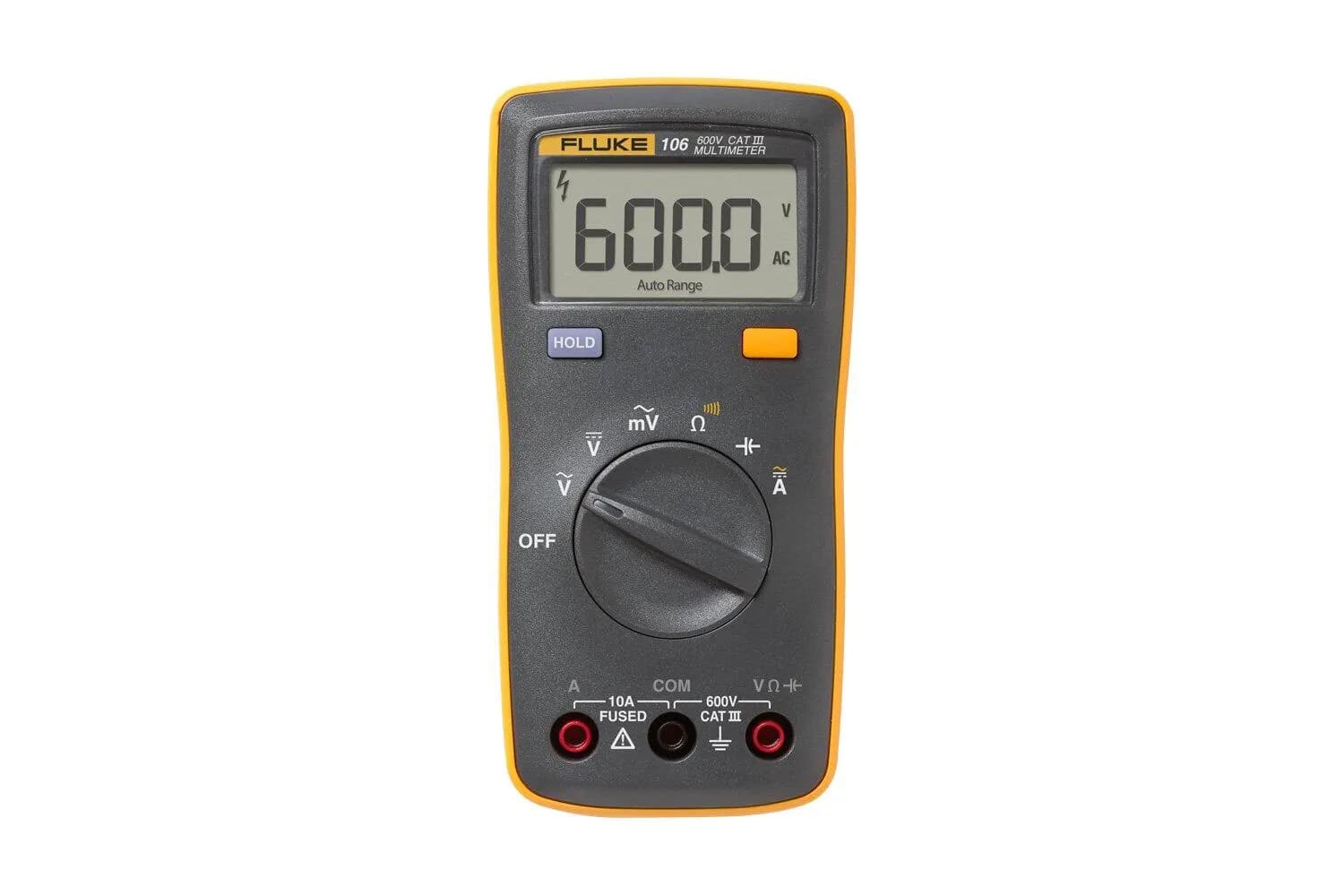
Fluke 106
The 107's palm-sized body for less, without diode test, frequency or duty cycle.
Best for:A small, cheap backup meter
The 106 is the 107's simpler sibling: the same 142 × 69 × 28 mm, 200 g body, CAT III 600V rating and 6,000-count display, with 4A and 10A current ranges, resistance to 40 MΩ, capacitance to 1,000 µF, continuity and data hold. It drops the 107's diode test, frequency and duty cycle, has no mA or µA ranges, and Fluke positions it for work where True RMS isn't needed.
Why it fits: The simplest dial here, a 200 g palm-sized body and a CAT III 600V rating make it hard to get wrong. It is not True RMS and drops diode test, frequency and small current ranges, so it suits only basic battery, outlet and continuity checks.
- Accuracy
- Average-responding (not True RMS)
- Safety rating
- CAT III 600V
- Auto-ranging
- Yes
- Best for
- A small, cheap backup meter
Reasons to buy
- +Palm-sized: 200 g
- +6,000-count display
- +4A and 10A current ranges
Reasons to avoid
- −Not True RMS
- −No diode test, frequency, mA or µA ranges
Before you buy
Buying advice
Decide where you will use it first
If you will check household outlets, light fixtures or appliance circuits, choose CAT III 600V or better: the MM460S, KM602, MM420, HT118A, UT139C or Fluke 115. If your first projects are batteries, toys, cars and microcontroller boards, the KM200s and DM6000AR are cheaper and perfectly capable, as long as they stay away from panels.
Let the meter guide the leads
Most beginner accidents with a multimeter happen when the red lead is left in the amps jack and then touched across a voltage. Klein's Lead-Alert and KAIWEETS's lit jacks make that mistake visible. Smart mode on the MM460S and KM602 goes further by choosing the measurement for you. Those features rank highly here because they prevent real damage.
Don't pay for functions you can't name yet
Capacitance, duty cycle, temperature and µA ranges are useful, but a beginner rarely needs them in the first months. Pick a meter with the basics done well and an honest safety rating. If a specific hobby later calls for a feature, our use-case guides will point you to the right step-up model.
Learn three measurements before anything else
DC voltage on a battery, resistance on a resistor and continuity on a fuse teach you how the meter, the dial and the leads behave. Once those are second nature, move on to AC outlet voltage and then current. Our step-by-step guides below cover each one with any of these meters.
Methodology
How we chose
We considered only meters that their maker or official listing describes as auto-ranging, then ranked them for a first-time owner: features that prevent mistakes (Smart mode, lead guidance) first, then a documented safety rating suited to household work, then the measurement range and value for the price. Specs come from maker manuals, product pages and official listings; the ranking is desk research, and only the Fluke 115 carries our Hands-on Tested badge.
Picks marked "Hands-on Tested" have been bought and tested by us; the rest are desk research. A pick only carries that badge once we have actually bought and tested that unit. More on how we research.
Questions
Frequently asked questions
What is the best multimeter for a beginner?+
The Klein Tools MM460S, which combines Smart mode (it senses what the leads are touching and picks the function for you) with Lead-Alert, a warning when the leads are in the wrong jacks — the single most common beginner mistake. It's also CAT III 600V rated, so it's safe on household outlets and panels, not just low-voltage electronics.
What should a first multimeter actually have?+
Auto-ranging first, so you only choose the quantity and the meter finds the range. Next, a CAT III 600V rating if you will ever test household outlets, a backlight, and clear markings for which jack the red lead goes in. True RMS and non-contact voltage are worthwhile extras. Temperature, capacitance and µA ranges matter later, once you know what you work on.
What is the difference between auto-ranging and manual ranging?+
A manual meter makes you select a range such as 20 V or 200 V before measuring, and shows OL if you pick one that is too low. An auto-ranging meter switches range by itself, so the dial only needs the function. It is easier and quicker for beginners. Some meters, such as the UT139C and DM6000AR, also let you lock a range manually once you are comfortable.
Is a more expensive multimeter worth it for a beginner?+
Not usually. The meters ranked highest here are mid-priced models with features that make learning easier, such as Smart mode and jack lights. A premium meter like the Fluke 115 earns its place through durability and our Hands-on Tested badge, not because it is easier. If you are not sure you will keep at it, start cheaper and upgrade once you know what you measure.
What does Smart mode on a multimeter do?+
On the Klein MM460S and KAIWEETS KM602, Smart mode looks at what the leads are touching and chooses between AC or DC voltage, resistance and continuity on its own. That removes the step beginners most often get wrong. Smart mode doesn't cover current, and both meters also work as conventional auto-ranging meters when you leave Smart mode.
Can a beginner safely test a wall outlet with a multimeter?+
Yes, with a meter rated at least CAT II 600V (CAT III 600V is better), leads in good condition, and the red lead in the voltage jack, never the amps jack. Set the meter to AC volts, hold the probes by their guards and insert them into the slots one at a time. Avoid opening panels or breaker boxes until you have proper training.
Why is the Fluke 106 ranked last if it is a Fluke?+
It is simple to use and carries a CAT III 600V rating, but it is not True RMS, has no diode test, frequency, mA or µA ranges, and costs more than meters ranked above it that do more. It suits someone who only checks batteries, outlets and continuity and values a small, tough body above extra functions.


