COMPARISON · OSCILLOSCOPES
Rigol DS1054Z vs FNIRSI DSO152
Rigol DS1054Z vs FNIRSI DSO152 is really a question about what kind of first oscilloscope you need. The Rigol is a 4-channel, 50MHz, 1 GSa/s bench scope with a 7-inch display. The FNIRSI is a pocket-sized, single-channel scope with 200kHz of bandwidth and 2.5 MSa/s. They are not rivals at the same job: one is a full bench instrument, the other a low-cost way to see slow waveforms.
By the OhmSavvy Research Team ·
Disclosure: OhmSavvy earns a commission from qualifying Amazon purchases made through these links, at no extra cost to you. How we're funded.
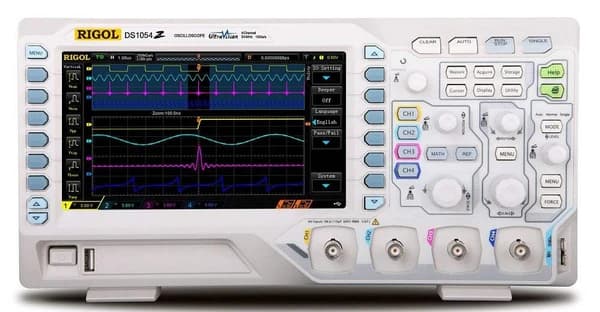
Rigol DS1054Z
4.8★★★★★The default beginner oscilloscope recommendation for years, and still worth it.
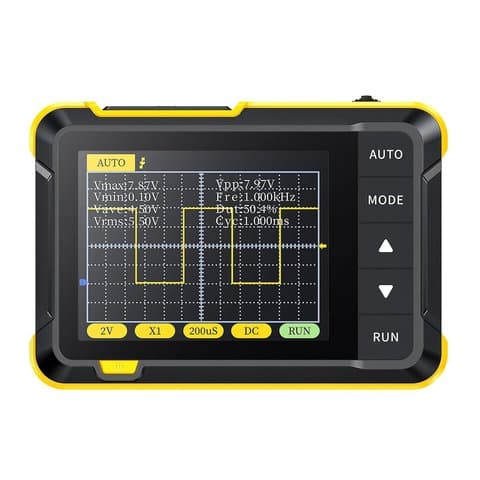
FNIRSI DSO152
4.1★★★★☆A genuinely pocket-sized scope for quick diagnostics — not a bench replacement.
Specs side by side
| Rigol DS1054Z | FNIRSI DSO152 | |
|---|---|---|
| Rating | 4.8★★★★★ | 4.1★★★★☆ |
| Bandwidth | 50MHz | 200kHz |
| Channels | 4 | 1 |
| Sample rate | 1 GSa/s | 2.5 MSa/s |
| Best for | Hobbyists, students, general electronics | Basic diagnostics, learning the fundamentals |
| Form factor | Benchtop | Pocket-sized |
| Comfortable signal range (3–5× rule) | Up to roughly 10–17MHz | Up to roughly 40–65kHz |
Specs checked against manufacturer documentation and official Amazon listings. Rigol DS1054Z is hands-on tested by OhmSavvy; the FNIRSI DSO152 assessment is desk research. How we research.
Key differences
- →Bandwidth: 50MHz on the Rigol against 200kHz on the FNIRSI, a 250-fold gap. By the 3–5× rule the Rigol is comfortable to about 10–17MHz; the FNIRSI to about 40–65kHz.
- →Sample rate: 1 GSa/s on the Rigol with one channel (250 MSa/s per channel with three or four on) against 2.5 MSa/s on the FNIRSI. Even with all four Rigol channels running, that is 100 times faster.
- →Channels: 4 against 1. The FNIRSI cannot show two signals together, so timing between signals and input-versus-output checks are out.
- →Form factor: the Rigol is a benchtop instrument with a 7-inch display; the FNIRSI is pocket-sized.
- →The Rigol carries our Hands-on Tested badge; the FNIRSI assessment is desk research based on its published specs.
- →The FNIRSI is the far cheaper way in; the Rigol costs several times more but is the scope most beginners grow into rather than out of.
Spec by spec
Most comparisons between scopes argue over a factor of two. Here the gaps are measured in hundreds, so the bandwidth and sample rate charts use a log scale; on a linear scale the FNIRSI's bar would be too thin to see. Every number comes from each maker's published specs.
Bars use a logarithmic scale: each step is ten times the last.
Bars use a logarithmic scale: each step is ten times the last.
Bars use a logarithmic scale: each step is ten times the last.
Sample rate and bandwidth line up sensibly on both. At its 200kHz limit the FNIRSI still takes 12.5 samples per cycle (2.5 MSa/s ÷ 200kHz), and the Rigol takes 20 per cycle at 50MHz on one channel, or 5 with all four channels on. Both stay well clear of the Nyquist minimum of two samples per cycle. For what these figures mean, see what oscilloscope bandwidth is and what GSa/s means.
Which should you buy?
| If you are… | Pick | Why |
|---|---|---|
| Curious whether you'll use a scope at all | FNIRSI DSO152 | The cheapest way to see a waveform; low stakes if it sits in a drawer |
| Learning sine, square and audio waveforms | FNIRSI DSO152 | 200kHz covers the audio band with room to spare |
| Debugging Arduino or microcontroller projects | Rigol DS1054Z | I2C, SPI and fast edges need far more than 200kHz |
| Comparing input and output, or clock and data | Rigol DS1054Z | 4 channels; the FNIRSI has only 1 |
| Checking switching power supplies | Rigol DS1054Z | Switching frequencies often sit beyond the FNIRSI's comfortable range |
| A student or hobbyist buying one scope for years | Rigol DS1054Z | 50MHz and 4 channels cover most beginner and intermediate work |
| Wanting a grab-and-go scope beside a bench scope | FNIRSI DSO152 | Pocket-sized, for quick checks away from the bench |
What each one can and can't measure
A scope's bandwidth is the frequency at which a sine wave is shown about 3 dB low, roughly 70% of its true amplitude. To see a signal's shape accurately, the usual rule of thumb is a scope with 3–5 times the signal's frequency, and more for square waves, because their sharp edges are built from harmonics well above the fundamental. Applied to these two scopes, that rule draws very different boundaries.
FNIRSI DSO152: audio and slower
With 200kHz of bandwidth, the DSO152 is comfortable up to roughly 40–65kHz. That covers the whole audio band (up to about 20kHz), so you can check whether an amplifier output is clipping, see the ripple on a linear supply at mains-related frequencies, watch a slow sensor output change, or confirm a low-frequency PWM pin is actually toggling. Its limits arrive quickly after that. A 100kHz I2C clock is already past its comfortable range and its edges will look rounded; SPI clocks in the megahertz and most switching regulators are out of reach. And with one channel, it can't show cause and effect side by side, which is how much real debugging gets done.
Rigol DS1054Z: general electronics
At 50MHz the DS1054Z is comfortable on signals up to roughly 10–17MHz. That takes in microcontroller GPIO, UART, I2C and SPI at typical hobby speeds, PWM motor drives, most switching supplies and everything the FNIRSI can show. Four channels let you watch a clock, data line, chip select and output together. Where it runs short is RF and very fast digital edges, the cases its own review flags as modest; for those, a 100MHz scope such as the Siglent SDS1104X-E gives more headroom.
Why a slow scope rounds a fast edge
Mains and high voltage
Buying both, or one after the other
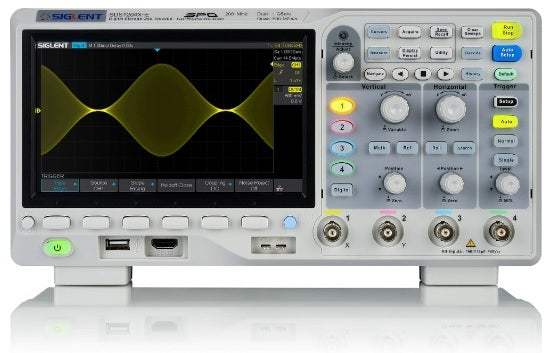
These two don't replace each other, so owning both is sensible. A common path is to start with the FNIRSI, learn what a waveform looks like and how timebase and volts-per-division work, and step up to a bench scope once you run into its single channel or 200kHz ceiling. If you already know you'll be debugging microcontroller projects, skipping straight to the Rigol avoids buying a tool you'll outgrow within weeks. For other bench options, see Rigol DS1054Z vs Hantek DSO2D10, FNIRSI DSO152 vs Hantek DSO2D10, FNIRSI DSO152 vs Siglent SDS1104X-E and Hantek DSO2D10 vs Siglent SDS1104X-E, or the oscilloscope buying guide.
Choose the Rigol DS1054Z if…
- ✓You want one scope that covers microcontroller, digital and audio work for years
- ✓You need to compare signals: input against output, or clock against data
- ✓Your signals run above a few tens of kilohertz, such as I2C, SPI or switching supplies
- ✓You'd rather buy the hands-on tested pick in this pairing
Choose the FNIRSI DSO152 if…
- ✓You want to find out cheaply whether you'll use a scope at all
- ✓Your signals are audio-range or slower and one channel is enough
- ✓You want a scope small enough to carry in a pocket or tool bag
The bottom line
For most people buying a first oscilloscope to build and debug circuits, the Rigol DS1054Z is the better buy: 250 times the bandwidth, four channels instead of one, and enough headroom for microcontroller and power-supply work for years. The FNIRSI DSO152 earns its place as a pocket-sized, very cheap way to learn what waveforms look like and check audio-range signals, or as a grab-and-go companion to a bench scope, not as a substitute for one.
Frequently asked questions
Is the FNIRSI DSO152 good enough as a first oscilloscope?+
For learning waveform basics, yes. Its 200kHz bandwidth and 2.5 MSa/s handle audio-range and other slow signals, and the low price makes it a cheap way to find out whether you will use a scope. If you plan to debug microcontroller or digital circuits, its single channel and bandwidth limit will stop you quickly, and the Rigol DS1054Z is the better first buy.
Can the FNIRSI DSO152 check Arduino signals?+
Only the slow ones. It can confirm a low-frequency PWM output or a slow sensor signal is present. A 100kHz I2C clock is past its comfortable range of roughly 40–65kHz, SPI clocks are far beyond it, and with one channel it cannot show clock and data together. For Arduino debugging, the 50MHz, 4-channel Rigol DS1054Z is the practical tool.
How much faster is the Rigol DS1054Z than the FNIRSI DSO152?+
Its bandwidth is 250 times higher: 50MHz against 200kHz. Its sample rate is 400 times higher with one channel on, 1 GSa/s against 2.5 MSa/s, and still 100 times higher at 250 MSa/s per channel with three or four channels running. It also has four input channels to the FNIRSI's one.
Should I buy the FNIRSI DSO152 first and upgrade to the Rigol later?+
It is a reasonable path if you are unsure you will use a scope; the FNIRSI costs little and teaches the basics. If you already know you will work on microcontroller, digital or power-supply projects, buy the Rigol DS1054Z directly. You would hit the FNIRSI's single channel and 200kHz limit almost immediately, and it would end up as a backup tool.
Does the Rigol DS1054Z lose sample rate with four channels on?+
Yes. Rigol's datasheet gives 1 GSa/s with a single channel and 250 MSa/s per channel with three or four channels on. That is still 5 samples per cycle at the 50MHz bandwidth limit, comfortably above the Nyquist minimum, and 100 times the FNIRSI DSO152's 2.5 MSa/s.
Related