Disclosure: OhmSavvy earns a commission from qualifying Amazon purchases made through the links below, at no extra cost to you. How we're funded.
At a glance
Our top picks

OWON HDS2202S
A battery handheld that combines a 200 MHz two-channel scope, a 20,000-count multimeter and a 25 MHz generator.
Check price on Amazon →Why we picked it ↓
Hantek 1008B
An eight-channel, 12-bit USB scope for slow automotive and sensor signals, run from a Windows PC.
Check price on Amazon →Why we picked it ↓
PicoScope 2206B
A pocket-sized 50 MHz USB scope with 32 MS of memory and a built-in AWG, run from PicoScope 7 on your PC.
Check price on Amazon →Why we picked it ↓Also great
- 4Hantek 2D72Check pricePrice →Best 3-in-1 Handheld4.3★★★★☆
- 5
 OWON HDS272SCheck pricePrice →Best 70 MHz 3-in-1 Handheld4.2★★★★☆
- 6
 FNIRSI 1013D PlusCheck pricePrice →Best Touchscreen Tablet Scope4.1★★★★☆
- 7
 HANMATEK HO52Check pricePrice →Best Budget Handheld + Meter4.1★★★★☆
- 8
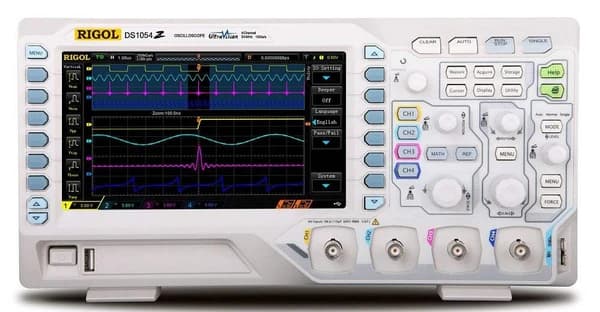 Rigol DS1054ZCheck pricePrice →Best Overall4.8★★★★★
- 9
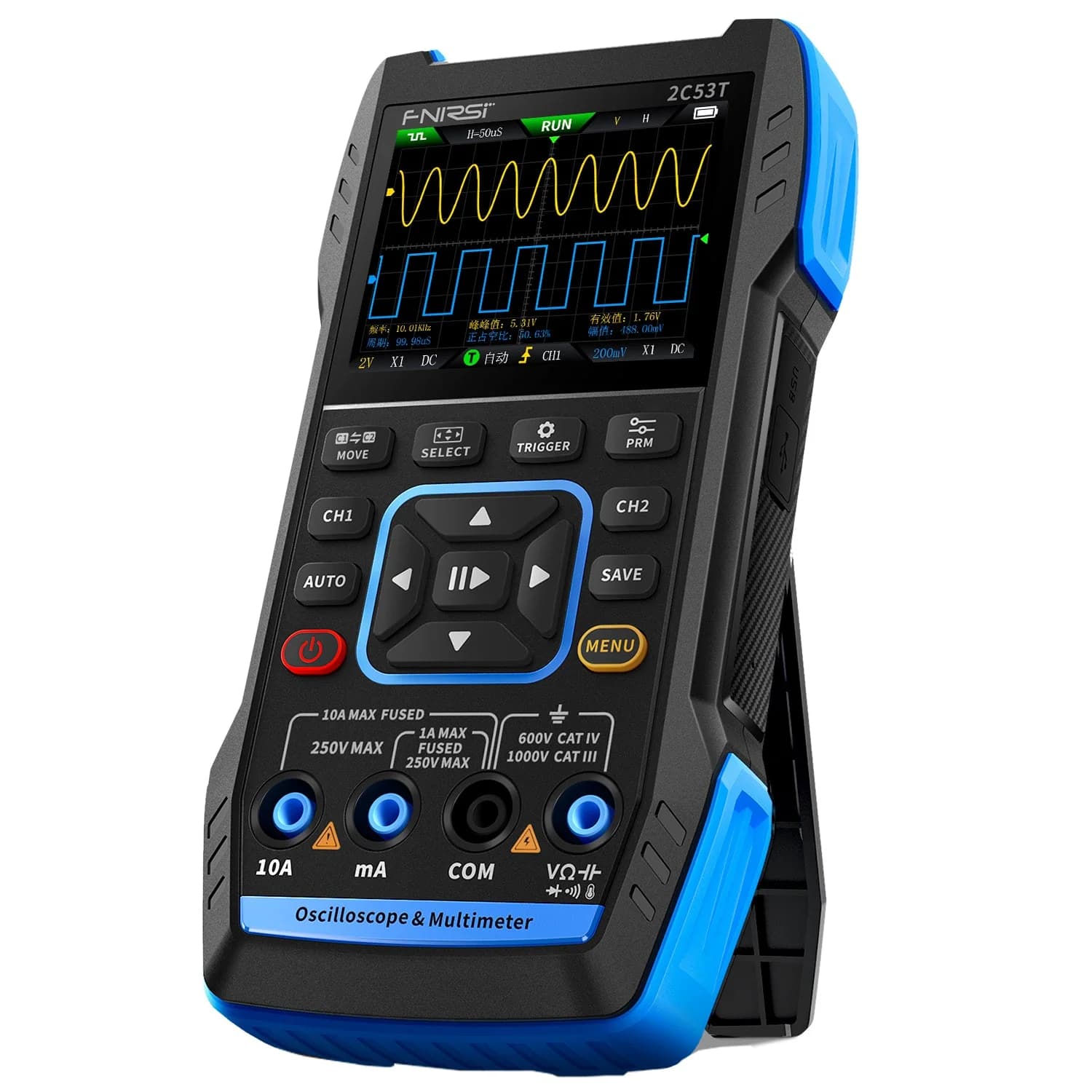 FNIRSI 2C53TCheck pricePrice →Best Budget Handheld 3-in-14.1★★★★☆
- 10
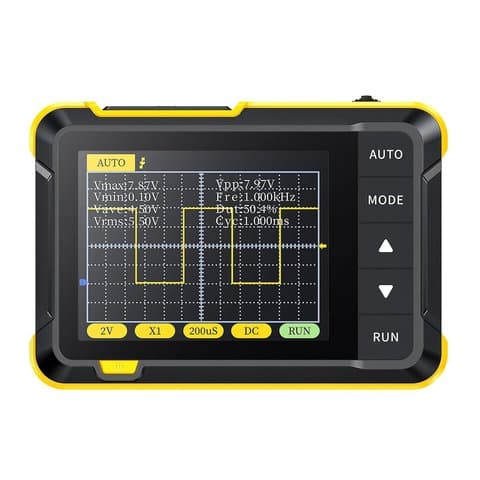 FNIRSI DSO152Check pricePrice →Best Budget4.1★★★★☆
Quick shopping
Compare at a glance
Swipe sideways on mobile to see every spec.
| Model | Award | Rating | Bandwidth | Channels | Sample rate | |
|---|---|---|---|---|---|---|
 #1OWON HDS2202S | Best 3-in-1 Handheld | 4.3★★★★☆ | 200MHz | 2 | 1 GSa/s | Check price → |
 #2Hantek 1008B | Best 8-Channel Automotive USB Scope | 3.9★★★★☆ | 100kHz (per manual) | 8 | 2.4 MSa/s (1 ch) | Check price → |
 #3PicoScope 2206B | Best Deep-Memory USB Scope | 4.4★★★★☆ | 50MHz | 2 | 500 MS/s (1 ch); 250 MS/s (2 ch) | Check price → |
| #4Hantek 2D72 | Best 3-in-1 Handheld | 4.3★★★★☆ | 70MHz | 2 | 250 MSa/s (1 ch); 125 MSa/s (2 ch) | Check price → |
| #5OWON HDS272S | Best 70 MHz 3-in-1 Handheld | 4.2★★★★☆ | 70MHz | 2 | 250 MSa/s (1 ch); 125 MSa/s (2 ch) | Check price → |
| #6FNIRSI 1013D Plus | Best Touchscreen Tablet Scope | 4.1★★★★☆ | 100MHz | 2 | 1 GSa/s | Check price → |
| #7HANMATEK HO52 | Best Budget Handheld + Meter | 4.1★★★★☆ | 50MHz | 2 | 250 MSa/s (1 ch); 125 MSa/s (2 ch) | Check price → |
| #8Rigol DS1054Z✓ Tested | Best Overall | 4.8★★★★★ | 50MHz | 4 | 1 GSa/s | Check price → |
| #9FNIRSI 2C53T | Best Budget Handheld 3-in-1 | 4.1★★★★☆ | 50MHz | 2 | 250 MSa/s | Check price → |
| #10FNIRSI DSO152 | Best Budget | 4.1★★★★☆ | 200kHz | 1 | 2.5 MSa/s | Check price → |
In depth
Detailed reviews
OWON HDS2202S
A battery handheld that combines a 200 MHz two-channel scope, a 20,000-count multimeter and a 25 MHz generator.
Best for:Field work that needs a scope, meter and signal source in one
The HDS2202S is a handheld with three instruments: a two-channel, 200 MHz, 1 GSa/s, 8-bit oscilloscope with an 8K record length and 10,000 waveforms per second; a 20,000-count multimeter (1000 V DC, 750 V AC, 10 A); and a single-channel generator (sine to 25 MHz, square, pulse and arbitrary to 5 MHz). It has a 3.5-inch LCD, runs 3 to 6 hours on an 18650 battery and charges over USB-C. OWON doesn't state the per-channel sample rate with both channels on or the screen resolution.
Why it fits: It ranks first because it combines two 200 MHz channels, a 20,000-count meter and a 25 MHz signal source on an 18650 battery, so one tool covers voltage drop tests, sensor waveforms and a bus check without mains. The limit is its 8K record, which is short for a full cranking capture at a fast timebase.
- Bandwidth
- 200MHz
- Channels
- 2
- Sample rate
- 1 GSa/s
- Best for
- Field work that needs a scope, meter and signal source in one
Reasons to buy
- +Scope, multimeter and generator in one handheld
- +200 MHz on two channels
- +Battery-powered with USB-C charging
Reasons to avoid
- −Small 3.5-inch screen
- −8K record length
Hantek 1008B
An eight-channel, 12-bit USB scope for slow automotive and sensor signals, run from a Windows PC.
Best for:Automotive sensor and actuator diagnostics on a laptop
The 1008B is a USB-powered PC oscilloscope with eight analog channels and 12-bit resolution, made for automotive diagnostics. Hantek lists 2.4 MSa/s with one channel on, 4K points of memory, 1 MΩ DC-coupled inputs rated to 400 V peak and, in its manual, 100 kHz bandwidth. It also has an eight-channel LVTTL square-wave generator up to 250 kHz that can simulate crankshaft and camshaft signals, plus FFT, math and over 80 automotive test functions in its Windows software. It has no screen of its own, and Hantek doesn't state the per-channel rate with all eight channels on.
Why it fits: Eight 12-bit channels, a crank and cam simulator and more than 80 built-in automotive test routines make it the most automotive-specific option here, so it takes second place. Its 100 kHz bandwidth and 4K memory rule out CAN waveform quality checks, and it needs a Windows laptop.
- Bandwidth
- 100kHz (per manual)
- Channels
- 8
- Sample rate
- 2.4 MSa/s (1 ch)
- Best for
- Automotive sensor and actuator diagnostics on a laptop
Reasons to buy
- +Eight channels at 12-bit
- +Built-in automotive test functions and signal simulator
- +USB-powered
Reasons to avoid
- −Very low bandwidth and sample rate for electronics work
- −Needs a Windows PC; no screen of its own
PicoScope 2206B
A pocket-sized 50 MHz USB scope with 32 MS of memory and a built-in AWG, run from PicoScope 7 on your PC.
Best for:Laptop users who want deep memory and solid PC software
The PicoScope 2206B is a two-channel USB oscilloscope with no screen of its own: 50 MHz, 500 MS/s with one channel (250 MS/s with two), 8-bit with resolution enhancement to 12-bit, and a 32 MS buffer. It includes a function generator and AWG (up to 1 MHz, 20 MS/s, 12-bit), is powered over USB, measures 130 × 104 × 18.8 mm and weighs under 0.2 kg. Everything is controlled from Pico's PicoScope 7 software on a PC.
Why it fits: Its 32 MS buffer (250 MS when streaming) captures a long drive or cranking event in detail, and it is the only pick here that decodes CAN and LIN. It sits third because its inputs top out at plus or minus 20 V, so higher-voltage actuator signals need an attenuator, and it is useless without a laptop.
- Bandwidth
- 50MHz
- Channels
- 2
- Sample rate
- 500 MS/s (1 ch); 250 MS/s (2 ch)
- Best for
- Laptop users who want deep memory and solid PC software
Reasons to buy
- +32 MS buffer memory
- +Built-in function generator and AWG
- +USB-powered and very light
Reasons to avoid
- −No built-in screen: needs a PC
- −50 MHz bandwidth
Hantek 2D72
A handheld oscilloscope, multimeter and signal generator in one: 70 MHz, two channels, battery powered.
Best for:Field service and portable kits
The 2D72 combines a 70 MHz, two-channel oscilloscope (250 MSa/s on one channel), a 4,000-count multimeter and a one-channel signal generator (sine to 25 MHz) in a 624 g handheld with a stand and USB-C charging. The trade-offs are a 2.8-inch 320 × 240 screen and very short record length: 6K samples on one channel, 3K per channel with two. Hantek's site and the Amazon listing disagree on whether batteries are included.
Why it fits: Packing a 70 MHz scope, a meter and a 25 MHz generator into a 624 g handheld with a stand and USB-C charging, it suits a toolbox kit. Its 2.8-inch screen and 6K record (3K per channel with both on) keep it below the OWON, and the meter is only 4,000 counts.
- Bandwidth
- 70MHz
- Channels
- 2
- Sample rate
- 250 MSa/s (1 ch); 125 MSa/s (2 ch)
- Best for
- Field service and portable kits
Reasons to buy
- +Scope, multimeter and generator in one handheld
- +Sine output to 25 MHz
- +Battery powered with USB-C charging
Reasons to avoid
- −Small 2.8-inch screen
- −Record length only 6K samples
- −Battery inclusion differs between Hantek and the listing
OWON HDS272S
A two-channel 70 MHz handheld with a 20,000-count meter and a 25 MHz signal generator.
Best for:Portable work that needs a scope, meter and signal source
OWON's HDS272S combines a two-channel, 70 MHz, 8-bit oscilloscope (250 MSa/s with one channel, 125 MSa/s with two, 8K record length) with a 20,000-count true-RMS multimeter and a single-channel generator (sine to 25 MHz, square and pulse to 5 MHz, 14-bit, up to 2.5 Vpp into 50 Ω). It has a 3.5-inch 320 × 240 screen, runs 3 to 6 hours on two 18650 cells and charges over USB-C, including from a power bank.
Why it fits: It shares the HDS2202S body, 20,000-count meter and 25 MHz generator, so the workflow is identical. The drop to 70 MHz and 250 MSa/s barely matters for engine signals; it ranks lower only because the 2202S does the same job with more headroom.
- Bandwidth
- 70MHz
- Channels
- 2
- Sample rate
- 250 MSa/s (1 ch); 125 MSa/s (2 ch)
- Best for
- Portable work that needs a scope, meter and signal source
Reasons to buy
- +Scope, multimeter and generator in one
- +USB-C charging, works from a power bank
- +Fold-out stand
Reasons to avoid
- −Small 3.5-inch screen
- −8K record length
FNIRSI 1013D Plus
A battery-powered tablet oscilloscope with a 7-inch touchscreen, sold with a 100X high-voltage probe.
Best for:Portable two-channel work with a large touchscreen
The 1013D Plus is FNIRSI's 1013D tablet scope bundled with a P4100 100X probe: two channels, 100 MHz (FNIRSI notes 5 MHz with a 1X probe), 1 GSa/s and a 7-inch 800 × 480 capacitive touchscreen. It runs about 4 hours from a 6000 mAh battery, charges over USB-C and can be used while charging. FNIRSI lists FFT, Lissajous and roll modes and 1 GB of storage for screenshots and waveforms. It has no signal generator, and FNIRSI doesn't state its ADC resolution, its sample rate with both channels on, or what its "240 Kbit" memory figure means in points.
Why it fits: The 7-inch touchscreen is far easier to read from the driver's seat than a 3.5-inch handheld, and the bundled 100X probe extends its range for high-voltage primary work. FNIRSI does not clearly state its memory depth, and there is no meter or generator.
- Bandwidth
- 100MHz
- Channels
- 2
- Sample rate
- 1 GSa/s
- Best for
- Portable two-channel work with a large touchscreen
Reasons to buy
- +7-inch touchscreen in a battery-powered tablet
- +Includes a 100X high-voltage probe
- +Usable while charging over USB-C
Reasons to avoid
- −No signal generator
- −ADC resolution and memory depth not clearly stated
HANMATEK HO52
A low-cost two-channel 50 MHz handheld scope with a built-in 20,000-count multimeter.
Best for:Field checks that need a scope and a meter on a budget
The HO52 is a battery handheld with a two-channel, 50 MHz oscilloscope (250 MSa/s with one channel, 125 MSa/s with two; 8K points of memory on one channel, 4K on two) and a 20,000-count true-RMS multimeter rated to 1000 V DC, 750 V AC and 10 A. It has a 3.5-inch 320 × 240 screen, runs about 4 hours on two 2200 mAh cells and charges from 5 V over USB. It has no signal generator (that is the HO52S), and HANMATEK doesn't state its ADC resolution.
Why it fits: It gives you a two-channel 50 MHz scope and a 20,000-count true-RMS meter in a case laid out much like the OWON handhelds. You give up the signal generator, and the record drops to 4K points per channel with both channels on.
- Bandwidth
- 50MHz
- Channels
- 2
- Sample rate
- 250 MSa/s (1 ch); 125 MSa/s (2 ch)
- Best for
- Field checks that need a scope and a meter on a budget
Reasons to buy
- +Scope and 20,000-count multimeter in one
- +Two channels in a handheld
- +Battery-powered with USB charging
Reasons to avoid
- −No signal generator
- −Short 8K record length and a small screen
Rigol DS1054Z
The default beginner oscilloscope recommendation for years, and still worth it.
Best for:Hobbyists, students, general electronics
The DS1054Z has been the default recommendation for beginner oscilloscopes for years, and for good reason — 4 channels and 50MHz of bandwidth at a genuinely approachable price.
Why it fits: Four channels and up to 24 Mpts of memory make it the strongest timing tool on paper, and it carries our Hands-on Tested badge. It ranks eighth because it is a mains-powered bench scope without CAN decoding, which makes it awkward next to a running car.
- Bandwidth
- 50MHz
- Channels
- 4
- Sample rate
- 1 GSa/s
- Best for
- Hobbyists, students, general electronics
Reasons to buy
- +4 channels at this price is rare
- +Large, clear 7-inch display
- +Strong community support and documentation
Reasons to avoid
- −Menu navigation has a learning curve
- −Bandwidth is modest for RF work
FNIRSI 2C53T
A low-cost two-channel handheld scope with a 19,999-count True RMS multimeter and a basic generator.
Best for:Beginners who want a meter and scope in one
The 2C53T pairs a 50 MHz, two-channel scope at 250 MS/s with a 19,999-count True RMS multimeter (to 1000V DC and 750V AC) and a simple function generator to 50 kHz, in a 300 g handheld with a 3,000 mAh battery. The scope side is basic: 1 Kpts record depth, a 2.8-inch 320 × 240 screen and a ±400V input limit, and FNIRSI doesn't state its vertical resolution. Its multimeter is stronger than the Hantek 2D72's; its scope and generator are weaker.
Why it fits: Its 19,999-count true-RMS meter is good, and the two 50 MHz channels handle basic crank and cam checks. The 1K-point record is the shortest on this list, so slow events lose detail quickly.
- Bandwidth
- 50MHz
- Channels
- 2
- Sample rate
- 250 MSa/s
- Best for
- Beginners who want a meter and scope in one
Reasons to buy
- +19,999-count True RMS multimeter built in
- +Light: 300 g
- +Built-in 3,000 mAh battery
Reasons to avoid
- −1 Kpts record depth
- −Generator tops out at 50 kHz
- −Vertical resolution not stated
FNIRSI DSO152
A genuinely pocket-sized scope for quick diagnostics — not a bench replacement.
Best for:Basic diagnostics, learning the fundamentals
A genuinely pocket-sized oscilloscope for basic signal checking — not a replacement for a bench scope, but a surprisingly capable tool for quick diagnostics on the go.
Why it fits: It fits in a pocket and confirms that a single sensor is producing a signal, which is sometimes all you need. One channel and 200 kHz bandwidth mean no sensor correlation and no bus work, so it is a last-place backup rather than a diagnostic scope.
- Bandwidth
- 200kHz
- Channels
- 1
- Sample rate
- 2.5 MSa/s
- Best for
- Basic diagnostics, learning the fundamentals
Reasons to buy
- +Extremely affordable entry point
- +Genuinely pocket-sized
- +Good for learning basic waveform concepts
Reasons to avoid
- −Single channel limits comparison work
- −Bandwidth too low for anything beyond basic/audio-range signals
Before you buy
Buying advice
Decide where the scope will live
If it rides in a toolbox and gets used in driveways, buy a battery handheld: the OWON HDS2202S, Hantek 2D72 or HANMATEK HO52. If a laptop already sits on your cart, a USB scope such as the PicoScope 2206B or Hantek 1008B gives you a bigger display and saved captures for the same trip. A bench scope like the DS1054Z only makes sense in a workshop with power at the car.
Buy channels before bandwidth
Engine diagnosis is mostly about relationships in time: does the cam signal line up with the crank pattern, does the injector fire when the module commands it. A second channel is worth more than an extra hundred megahertz. If you plan to check variable valve timing or misfire patterns, four or eight channels save you from swapping leads between runs.
Budget for the right probes and leads
Back-probe pins, piercing clips and long BNC leads matter as much as the scope. Rate every attenuating probe for the voltage you expect, and keep a 100X probe for coil primaries and injector kickback. A secondary ignition pickup is a separate accessory; none of these scopes should ever see secondary voltage directly.
Match memory to the event you are chasing
Short records are fine for a steady idle waveform. Intermittent stalls, cranking current and slow sensor drift need seconds of data at a useful sample rate. That is where the PicoScope's 32 MS and the Rigol's datasheet 24 Mpts pull away from the 1K to 8K handhelds.
Methodology
How we chose
We ranked these ten for vehicle work rather than general electronics: channel count first, then battery or USB power, record length, input voltage limits and CAN or LIN decoding. Every figure comes from the maker's datasheet, manual or official listing; this is desk research, and only the Rigol DS1054Z carries our Hands-on Tested badge.
Picks marked "Hands-on Tested" have been bought and tested by us; the rest are desk research. A pick only carries that badge once we have actually bought and tested that unit. More on how we research.
Questions
Frequently asked questions
Do I need an oscilloscope for car diagnostics, or is a multimeter enough?+
A multimeter averages. It can tell you a crank sensor produces some AC voltage, but not that one tooth is missing, that an injector's pintle hump is absent or that a CAN line has a glitch. Whenever a signal changes faster than a meter updates, which covers most sensors and actuators, the scope shows the fault and the meter hides it.
How much bandwidth does an automotive oscilloscope need?+
Less than electronics work. Crank, cam, wheel-speed and injector signals live in the hertz-to-kilohertz range, so even the Hantek 1008B's 100 kHz copes. CAN buses run at hundreds of kilobits per second, so 20 MHz or more gives clean edges when you want to judge bus waveform quality. Record length and channel count matter more than headline megahertz here.
Can I use a handheld oscilloscope to test ignition coils?+
Primary-side checks are possible with a suitably rated attenuating probe and a scope whose input limit you respect; the OWON and HANMATEK handhelds list a 400 V input limit. Secondary voltage runs to many kilovolts and must never touch a scope probe. It is read through a dedicated capacitive pickup designed for that job.
Is a PC-based USB scope practical in a garage?+
Yes, if you already carry a laptop. The PicoScope 2206B and Hantek 1008B draw power from USB, weigh little and use the laptop's big screen and storage. The downsides are setup time, a cable between car and computer, and the fact that the 1008B software runs on Windows only, while PicoScope 7 also runs on macOS and Linux.
How many channels do I need for automotive work?+
Two is the practical minimum, because most diagnosis compares one signal with another, such as crankshaft position against camshaft position. Four lets you add an injector and an ignition trigger to the same screen. The Hantek 1008B's eight channels suit whole-engine timing checks, though each channel is slow compared with the other scopes here.
Can these oscilloscopes read CAN bus traffic?+
Any two-channel scope here can show CAN high and CAN low voltage levels, which is enough to spot a shorted or open line. Decoding the frames into IDs and data is a different job: of these ten, only the PicoScope 2206B lists CAN, LIN and FlexRay decoding in its software. The Rigol DS1054Z decodes UART, I2C and SPI, but not CAN.