COMPARISON · OSCILLOSCOPES
Rigol DHO804 vs Rigol DS1054Z
Rigol DHO804 vs Rigol DS1054Z is old favorite against new generation. Both are four-channel Rigol scopes for hobbyists and students. The DHO804 moves to 12-bit vertical resolution, 70 MHz, a 1024 × 600 touchscreen and USB-C power; the DS1054Z keeps the familiar 8-bit, 50 MHz platform with optional serial decoding and a large community behind it.
By the OhmSavvy Research Team ·
Disclosure: OhmSavvy earns a commission from qualifying Amazon purchases made through these links, at no extra cost to you. How we're funded.
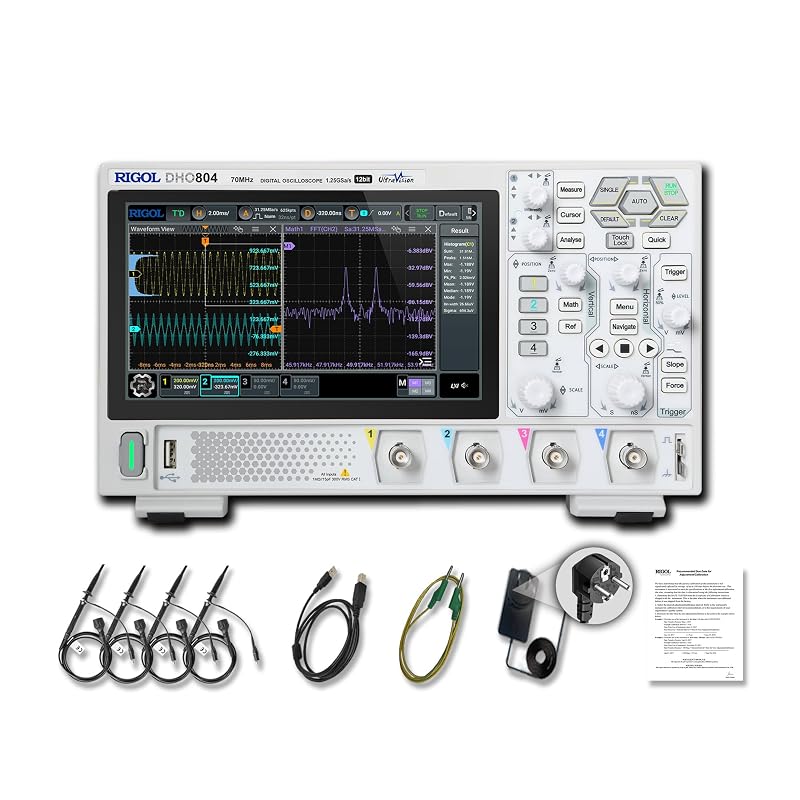
Rigol DHO804
4.8★★★★★Four channels, 12-bit resolution and a 7-inch touchscreen in a compact body that runs from USB-C power.
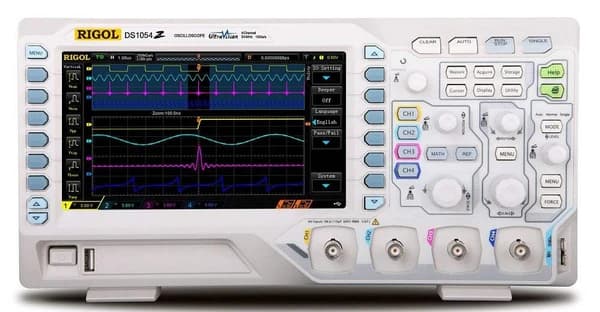
Rigol DS1054Z
4.8★★★★★The default beginner oscilloscope recommendation for years, and still worth it.
Specs side by side
| Rigol DHO804 | Rigol DS1054Z | |
|---|---|---|
| Rating | 4.8★★★★★ | 4.8★★★★★ |
| Bandwidth | 70MHz | 50MHz |
| Channels | 4 | 4 |
| Sample rate | 1.25 GSa/s (1 ch); 312.5 MSa/s (4 ch) | 1 GSa/s |
| Best for | Hobbyists who want 12-bit detail and a touchscreen | Hobbyists, students, general electronics |
| Vertical resolution | 12-bit | 8-bit (DS1000Z datasheet) |
| Rise time | 5 ns typical | 7 ns calculated |
| Sample rate, 1 / 2 / 4 channels | 1.25 GSa/s / 625 MSa/s / 312.5 MSa/s | 1 GSa/s / 500 MSa/s / 250 MSa/s |
| Memory depth | 25 Mpts (1 ch); 5 Mpts (4 ch) | 12 Mpts standard; 24 Mpts optional |
| Waveform rate | 30,000 wfms/s; 1,000,000 in UltraAcquire | 30,000 wfms/s |
| Hardware recording | Up to 500,000 frames | Up to 60,000 frames |
| Vertical scale | 500 µV/div (magnified) to 10 V/div | 1 mV/div to 10 V/div |
| Display | 7-inch 1024 × 600 touchscreen | 7-inch 800 × 480 |
| Serial decoding | Standard: UART, I2C, SPI, CAN, parallel | Optional: RS232/UART, I2C, SPI |
| Video out / power | HDMI; USB-C, 15 V 3 A | No HDMI; mains powered |
| Size / weight | 265 × 162 × 77 mm, 1.78 kg | 313 × 161 × 122 mm, 3.2 kg |
| Max input (1 MΩ) | CAT I 300 Vrms | CAT I 300 Vrms |
| Generator / logic | None | None |
Specs checked against manufacturer documentation and official Amazon listings. Both products hands-on tested by OhmSavvy. How we research.
Key differences
- →The DHO804 is a 12-bit scope; Rigol's DS1000Z datasheet lists 8 bits for the DS1054Z's analog channels, so the DHO804 has 16 times as many vertical levels.
- →The DHO804 has 70 MHz of bandwidth and a 5 ns rise time against the DS1054Z's 50 MHz and 7 ns.
- →With all four channels running, the DHO804 samples at 312.5 MSa/s per channel against 250 MSa/s.
- →Serial decoding is standard on the DHO804 and optional on the DS1000Z series.
- →The DHO804 adds a capacitive touchscreen, HDMI output and USB-C power, and weighs 1.78 kg against the DS1054Z's 3.2 kg.
- →Both list 30,000 waveforms per second in normal mode; the DHO804's UltraAcquire mode raises that to 1,000,000.
- →Both scopes carry our Hands-on Tested badge.
At a glance
Same channel count
Four analog channels on both, no logic channels, no generator.
DHO804 extra: 12 bits
4,096 vertical levels against 256 on the DS1054Z.
DHO804 extra: speed
70 MHz, 5 ns rise time, 312.5 MSa/s with four channels on.
DHO804 extra: decoding
UART, I2C, SPI, CAN and parallel included.
DS1054Z strength
Physical controls and years of tutorials written around it.
Verdict
New buyers: DHO804. Following a course built on it: DS1054Z.
Rigol DHO804 vs DS1054Z spec by spec
Both scopes share one sample-rate budget across their channels, so the figure that matters for four-channel work is the per-channel rate with everything switched on. Rigol's datasheets put the DHO804 ahead on every axis it publishes, from bandwidth to recording depth, with the normal-mode waveform rate the one tie.
Bars use a logarithmic scale: each step is ten times the last.
Record time follows from memory divided by sample rate. With one channel on, the DHO804 holds 25 Mpts at 1.25 GSa/s, which is 20 ms of signal at full speed; a standard DS1054Z holds 12 Mpts at 1 GSa/s, or 12 ms. With all four channels on, the DHO804 keeps 5 Mpts at 312.5 MSa/s, which is 16 ms per channel.
What 12 bits buys you
An oscilloscope's converter splits the screen's vertical span into equal steps. Eight bits gives 256 steps, twelve gives 4,096. At 10 mV/div across eight divisions, the screen spans 80 mV, so the DS1054Z resolves about 0.31 mV per step and the DHO804 about 0.02 mV. That is the arithmetic; real noise sets the floor you can actually see.
| ADC resolution | Vertical levels | Step at 10 mV/div (80 mV span) | Step at 1 V/div (8 V span) |
|---|---|---|---|
| 8-bit (DS1054Z) | 256 | ≈ 0.31 mV | ≈ 31 mV |
| 12-bit (DHO804) | 4,096 | ≈ 0.02 mV | ≈ 2 mV |
When the extra bits help
Rigol DHO804 vs DS1054Z: which should you buy?
| You are… | Better fit | Why |
|---|---|---|
| Buying a first scope today | Rigol DHO804 | More bandwidth, 12 bits and decoding included |
| Debugging I2C, SPI or CAN | Rigol DHO804 | Decoding is standard; it's an option on the DS1000Z |
| Checking power-supply ripple | Rigol DHO804 | 16× finer vertical steps on small AC signals |
| Following a course built on the DS1054Z | Rigol DS1054Z | Menus and screenshots match what you'll see |
| Prefer knobs to a touchscreen | Rigol DS1054Z | Conventional front panel |
| Teaching or presenting | Rigol DHO804 | HDMI out to a monitor or projector |
| Portable bench or field work | Rigol DHO804 | 1.78 kg and runs from USB-C power |
Use cases in practice
For Arduino and Raspberry Pi work, the deciding factor is usually serial decoding. Watching a UART or I2C bus as text rather than counting edges saves time, and on the DHO804 it costs nothing extra. Our guide to diagnosing a UART problem with an oscilloscope shows the workflow.
For audio and analog circuits, 12 bits and the extra rise-time margin make the DHO804 the cleaner tool. A 5 ns rise time against 7 ns matters little on audio itself, but helps on the switching edges of class-D amplifiers and buck converters. The DS1054Z still does the job; it just draws a coarser trace when you zoom in.
The DS1054Z's real advantage is familiarity. Its menus, screenshots and quirks fill a decade of forum threads and course notes, which helps if you learn by following along. Read our Rigol DS1054Z review for the full picture, or compare the two-channel DHO802 against the DS1054Z.
Safety: neither scope is for direct mains measurement
Choose the Rigol DHO804 if…
- ✓You want 12-bit resolution to see small signals riding on larger ones
- ✓You want a touchscreen, HDMI output and serial decoding included
- ✓You want a compact scope that can run from a USB-C power source
Choose the Rigol DS1054Z if…
- ✓You want the scope most tutorials and forums are written around
- ✓50 MHz is enough for your microcontroller and audio work
- ✓You prefer physical knobs and menus to a touchscreen
Neither if…
You need to probe mains wiring directly: both datasheets cap the input at CAT I 300 Vrms, which rules out mains, and the DS1054Z's probe ground ties to earth through its power cord, so clipping it to a live point shorts it — use a rated differential probe for mains or switch-mode primaries, and leave panel work to a licensed electrician.
The bottom line
For a new purchase, the DHO804 is the stronger scope: 12-bit resolution, more bandwidth, a faster four-channel sample rate, standard decoding and a modern touchscreen in a lighter body. The DS1054Z still makes sense if you want the most documented beginner scope and 50 MHz covers your work.
Frequently asked questions
Is the DHO804 a replacement for the DS1054Z?+
Rigol sells both. The DHO804 is a newer platform with 12-bit resolution, a 1024 × 600 touchscreen and standard decoding, while the DS1054Z remains in stock on Rigol's North American site. Treat the DHO804 as the modern alternative rather than a direct successor; the DS1054Z is still a capable four-channel scope.
Does the DHO804 have a built-in signal generator?+
No. Rigol's DHO800 specifications list no built-in generator or digital channels, and neither does the DS1054Z. If you need a generator in the same box, look at a model with one, or pair either scope with a separate function generator for filter and amplifier testing.
Which has more memory, the DHO804 or the DS1054Z?+
With one channel on, the DHO804 reaches 25 Mpts against the DS1054Z's 12 Mpts standard (24 Mpts optional). With all four channels on, the DHO804 drops to 5 Mpts, which still holds 16 ms at its 312.5 MSa/s four-channel rate. Rigol's 1000Z page doesn't break down the standard memory per channel count.
Can the DHO804 run from a battery?+
Rigol says it takes USB-C power at 15 V and 3 A, with a 45 W maximum, so it can run from a portable power source that supplies that profile. The DS1054Z is a conventional mains-powered benchtop. Check that a power bank supports 15 V output before relying on it in the field.
Is the DS1054Z 8-bit or 12-bit?+
8-bit. Rigol's DS1000Z datasheet lists 8 bits of vertical resolution for the analog channels, and a High Resolution acquisition mode that averages samples to reach up to 12 bits on repetitive signals. The DHO804 is 12-bit natively, which helps on single-shot captures and small signals where averaging isn't possible.
Related