COMPARISON · OSCILLOSCOPES
Rigol DHO802 vs Rigol DS1054Z
Rigol DHO802 vs Rigol DS1054Z sets two Rigol generations against each other, and they pull in opposite directions. The DHO802 is the newer design: 70 MHz, 12-bit resolution, a 1024 × 600 touchscreen and standard serial decoding including CAN, but only two channels. The DS1054Z is the long-running beginner favorite at 50 MHz, and it has twice the inputs: four channels, which matters more than any other spec if you watch several signals at once.
By the OhmSavvy Research Team ·
Disclosure: OhmSavvy earns a commission from qualifying Amazon purchases made through these links, at no extra cost to you. How we're funded.

Rigol DHO802
4.6★★★★★The two-channel DHO800: 12-bit resolution, a 7-inch touchscreen and USB-C power for a lower price than the four-channel DHO804.
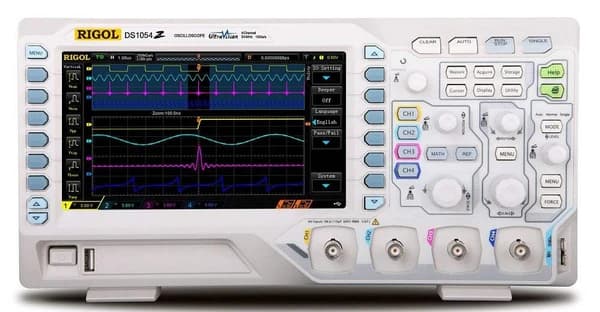
Rigol DS1054Z
4.8★★★★★The default beginner oscilloscope recommendation for years, and still worth it.
Specs side by side
| Rigol DHO802 | Rigol DS1054Z | |
|---|---|---|
| Rating | 4.6★★★★★ | 4.8★★★★★ |
| Bandwidth | 70MHz | 50MHz |
| Channels | 2 | 4 |
| Sample rate | 1.25 GSa/s (1 ch); 625 MSa/s (2 ch) | 1 GSa/s |
| Best for | Two-channel work that benefits from 12-bit detail | Hobbyists, students, general electronics |
| Sample rate, all channels on | 625 MSa/s per channel (2 on) | 250 MSa/s per channel (3 or 4 on) |
| Display | 7-inch 1024 × 600 capacitive touchscreen | 7-inch 800 × 480 (WVGA) |
| Vertical resolution | 12-bit | 8-bit |
| Memory | 25 Mpts (1 ch); 10 Mpts (2 ch) | 12 Mpts standard, 24 Mpts optional (Rigol sources differ) |
| Serial decoding | Standard: parallel, UART, I2C, SPI, CAN | Parallel, RS232/UART, I2C, SPI; listed as an option |
| Power input | USB-C, 15 V | 100–240 V AC, 50 W max |
Specs checked against manufacturer documentation and official Amazon listings. Rigol DS1054Z is hands-on tested by OhmSavvy; the Rigol DHO802 assessment is desk research. How we research.
Key differences
- →Channels: the DS1054Z has four inputs, the DHO802 two. This is the one area where the older scope clearly leads.
- →Bandwidth: 70 MHz on the DHO802 against 50 MHz on the DS1054Z.
- →Sample rate: 1.25 GSa/s on one channel and 625 MSa/s each with both on for the DHO802; 1 GSa/s on one channel and 250 MSa/s each with three or four on for the DS1054Z.
- →Resolution: 12-bit on the DHO802 against 8-bit on the DS1054Z, per Rigol's datasheets.
- →Memory: 25 Mpts on one DHO802 channel (10 Mpts on two). Rigol's sources differ on the DS1054Z: its DS1000Z product page says 12 Mpts standard with 24 Mpts optional, while the 2020 datasheet lists 24 Mpts (12 Mpts on two channels, 6 Mpts on three or four).
- →Decoding: parallel, UART, I2C, SPI and CAN are standard on the DHO802. The DS1000Z datasheet lists parallel, RS232/UART, I2C and SPI decoding (no CAN), and Rigol's product page describes bus trigger and decode as an option.
- →Both use a 7-inch screen. The DHO802's is a 1024 × 600 capacitive touchscreen with HDMI and LAN, and it runs from a USB-C 15 V supply; the DS1054Z's is 800 × 480, with LAN but no HDMI listed, and it runs from 100–240 V AC.
- →The DS1054Z carries our Hands-on Tested badge; the DHO802 assessment is desk research from Rigol's datasheet.
Spec by spec
On paper the DHO802 wins every speed figure and the DS1054Z wins the input count. DHO802 figures come from our verified pick data; DS1054Z figures come from Rigol's DS1000Z datasheet and product page, which disagree on standard memory and whether decoding is included, so we show both.
Bars use a logarithmic scale: each step is ten times the last.
| DHO802 | DS1054Z | |
|---|---|---|
| Vertical resolution | 12-bit | 8-bit |
| Memory depth | 25 Mpts (1 ch); 10 Mpts (2 ch) | 12 Mpts std, 24 Mpts opt. (datasheet: 24 Mpts) |
| Serial decoding | Standard: parallel, UART, I2C, SPI, CAN | Parallel, UART, I2C, SPI (option per product page) |
| Screen | 7-inch, 1024 × 600, touch | 7-inch, 800 × 480 |
| HDMI / LAN | Yes / Yes | None listed / Yes |
| Power input | USB-C, 15 V | 100–240 V AC, 50 W max |
| Signal generator | None | None (only DS1000Z -S models) |
Which should you buy?
Start from the number of signals you need to see together, because that is the one thing you can't work around later. If two is always enough, almost every other line favors the DHO802. If you regularly need three or four, the DS1054Z is the only one of the pair that can do it.
| Buyer or job | Pick | Reason from the data |
|---|---|---|
| Full SPI bus: SCK, MOSI, MISO and chip select | Rigol DS1054Z | Four inputs; the DHO802 can show only two of the four lines |
| Power-up order of three or more supply rails | Rigol DS1054Z | Four channels capture every rail on one trigger |
| First scope, learning from online tutorials | Rigol DS1054Z | Strong community support and documentation |
| Arduino UART or I2C debugging | Rigol DHO802 | Decoding is standard; Rigol's product page lists DS1054Z decoding as an option |
| CAN bus on a vehicle or robot project | Rigol DHO802 | CAN decoding is standard; the DS1054Z's decode list has no CAN |
| Bench supply ripple, audio, slow sensors | Rigol DHO802 | 12-bit resolution resolves small changes |
| Long single-shot captures | Rigol DHO802 | 25 Mpts against 12 Mpts standard (24 Mpts with Rigol's option) |
| Clocks in the 10 to 20 MHz range | Rigol DHO802 | 70 MHz gives more margin than 50 MHz |
| Showing a trace on a monitor or projector | Rigol DHO802 | HDMI output |
What each scope can and can't measure
A scope's rated bandwidth is the sine-wave frequency at which the displayed amplitude has fallen by 3 dB, to about 70% of the real value. The usual rule of thumb asks for three to five times the frequency of the signal you want to see clearly. That puts the DS1054Z's comfortable range at roughly 10 to 17 MHz and the DHO802's at roughly 14 to 23 MHz. An Arduino Uno's 16 MHz crystal is a useful test case: on the DS1054Z it sits at the very top of that band, so its frequency reads correctly but its edges look soft; on the DHO802 it is inside the band with a little room left. Our guide to oscilloscope bandwidth explains the roll-off in more detail.
Edge speed follows the same logic. A common approximation for the fastest rise time a scope can display is 0.35 divided by its bandwidth, which works out to about 7 ns for 50 MHz and 5 ns for 70 MHz. The exact figure depends on the front-end design, so treat these as estimates. Either is fine for I2C, UART, PWM and most hobby SPI; neither is meant for RF or fast memory buses.
Sample rate is where channel count costs you. With all four DS1054Z channels on, each gets 250 MSa/s, or five samples per cycle of a 50 MHz sine. The DHO802 keeps 625 MSa/s on each of its two channels, close to nine samples per cycle at 70 MHz. Both stay well above the Nyquist minimum of two, but more samples per cycle give a cleaner-looking trace without relying on interpolation. Read what GSa/s means for how the shared sample-rate budget works.
Resolution matters for a different class of signal. A 12-bit converter splits the vertical range into 4,096 steps, so a few tens of millivolts of ripple on a 12 V rail or a slowly drifting thermistor voltage stays smooth when you zoom in. Rigol lists the DS1054Z as 8-bit, or 256 steps, so the DHO802 resolves changes 16 times finer. For logic signals that only ever sit high or low, extra bits change little.
Neither scope can make a test signal: Rigol lists no generator for the DHO802, and in the DS1000Z family only the -S models have the built-in 25 MHz source; the DS1054Z doesn't. To test a filter or amplifier you'll need a separate source with either.
Count your signals first
Mains and high-voltage work
If you like the DHO802 but need four inputs, the DHO804 shares its platform; see Rigol DHO804 vs Rigol DS1054Z. For the wider field, read the beginner oscilloscope roundup, the oscilloscope buying guide and our Rigol DS1054Z review.
Choose the Rigol DHO802 if…
- ✓Two signals at a time covers your work: clock and data, input and output, PWM and its filtered result
- ✓You want 12-bit resolution for supply ripple, audio and slow sensor outputs
- ✓You want UART, I2C, SPI, CAN and parallel decoding with nothing extra to buy
- ✓You want HDMI, LAN and a compact unit that takes a USB-C 15 V supply
Choose the Rigol DS1054Z if…
- ✓You need three or four signals lined up in time, such as a full SPI bus or a power-up sequence
- ✓Your signals stay below roughly 10 to 17 MHz, where 50 MHz is enough
- ✓You learn best from the large pool of tutorials and forum answers written around this scope
- ✓You want the model in this pair that carries our Hands-on Tested badge
Neither if…
You need to feed a test signal into a filter or amplifier: Rigol lists no built-in generator for the DHO802, and in the DS1000Z family only the -S models have one, not the plain DS1054Z — either way you'll need a separate signal source.
The bottom line
If two channels cover what you measure, the Rigol DHO802 is the more capable scope: 70 MHz, 12-bit resolution against 8-bit, 25 Mpts of memory, standard serial decoding including CAN and a sharper 1024 × 600 touchscreen. If you need to watch three or four signals together, or want the most documented beginner scope and the one we have hands-on tested, the Rigol DS1054Z remains the practical choice.
Frequently asked questions
Is the Rigol DHO802 better than the DS1054Z?+
On speed and features, yes: 70 MHz against 50 MHz, 1.25 GSa/s against 1 GSa/s on one channel, 12-bit resolution against 8-bit, standard decoding including CAN, and a touchscreen. It has only two channels, though, so for work that needs three or four signals at once the DS1054Z is the better tool.
Are two channels enough, or do I need the DS1054Z's four?+
Two cover most beginner tasks: a clock with its data line, a PWM pin with its filtered output, or a circuit's input with its output. Four become necessary for a full SPI bus with chip select, several supply rails powering up in order, or stepper and motor driver phases viewed together.
Does the DS1054Z have 12-bit resolution like the DHO802?+
No. Rigol's DS1000Z datasheet lists 8-bit vertical resolution for the analog channels, or 256 levels, with up to 12 bits only in its high-resolution acquisition mode. The DHO802 is specified by Rigol as 12-bit, giving 4,096 vertical levels.
Which has the faster sample rate with every channel switched on?+
The DHO802. With both of its channels on it samples at 625 MSa/s each, while the DS1054Z drops to 250 MSa/s each with three or four channels on. Per channel, that is two and a half times the rate, though the DS1054Z is covering twice as many signals.
Should I get the DHO802 or the four-channel DHO804 instead?+
If you like the DHO802's resolution and touchscreen but need four inputs, the DHO804 is the same 70 MHz, 12-bit platform with four channels, at a higher price. Its per-channel rate falls to 312.5 MSa/s with all four on. Our DHO804 vs DS1054Z comparison covers that pairing.
Related