Disclosure: OhmSavvy earns a commission from qualifying Amazon purchases made through the links below, at no extra cost to you. How we're funded.
At a glance
Our top picks
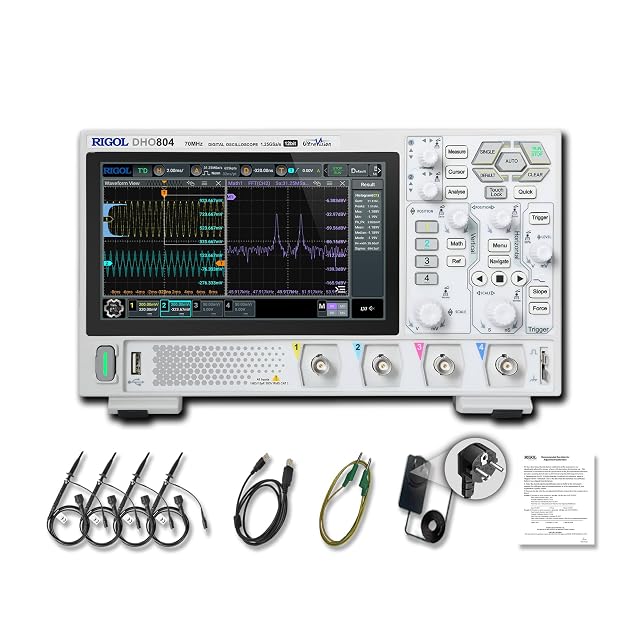
Rigol DHO804
Four channels, 12-bit resolution and a 7-inch touchscreen in a compact body that runs from USB-C power.
Check price on Amazon →Why we picked it ↓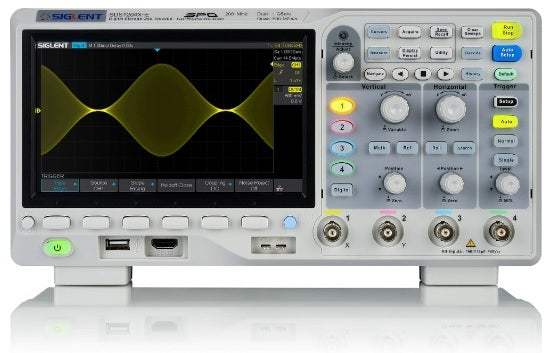
Siglent SDS1104X-E
More bandwidth and a better UI than the Rigol, for projects that will get more demanding.
Check price on Amazon →Why we picked it ↓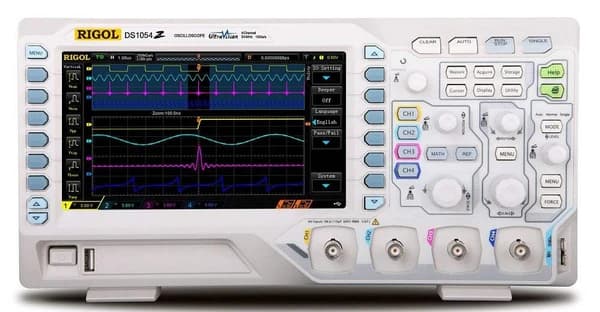
Rigol DS1054Z
The default beginner oscilloscope recommendation for years, and still worth it.
Check price on Amazon →Why we picked it ↓Also great
- 4
 Rigol DHO802Check pricePrice →Best 2-Channel 12-bit4.6★★★★★
- 5
 Hantek DSO2D10Check pricePrice →Best Compact Bench Option4.3★★★★☆
- 6
 Hantek DSO2C10Check pricePrice →Best Budget 2-Channel Decoder4.3★★★★☆
- 7
 PicoScope 2204ACheck pricePrice →Best Compact USB Scope4.3★★★★☆
- 8
 FNIRSI 1014DCheck pricePrice →Best Budget Scope + Generator4.3★★★★☆
- 9
 MINIWARE DS213Check pricePrice →Best Pocket Mixed-Signal Scope4.0★★★★☆
- 10
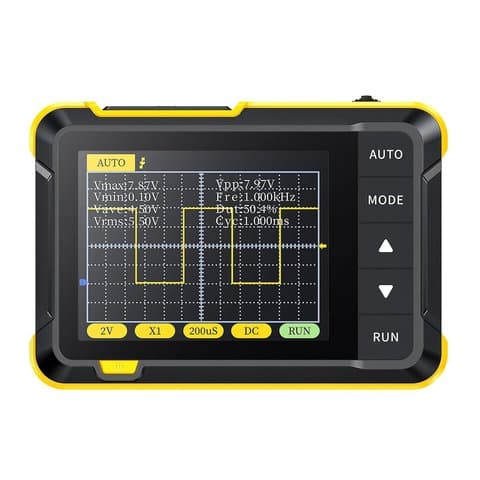 FNIRSI DSO152Check pricePrice →Best Budget4.1★★★★☆
Quick shopping
Compare at a glance
Swipe sideways on mobile to see every spec.
| Model | Award | Rating | Bandwidth | Channels | Sample rate | |
|---|---|---|---|---|---|---|
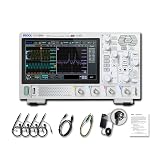 #1Rigol DHO804✓ Tested | Best 12-bit Upgrade | 4.8★★★★★ | 70MHz | 4 | 1.25 GSa/s (1 ch); 312.5 MSa/s (4 ch) | Check price → |
| #2Siglent SDS1104X-E✓ Tested | Best for Growing Into | 4.8★★★★★ | 100MHz | 4 | 1 GSa/s | Check price → |
| #3Rigol DS1054Z✓ Tested | Best Overall | 4.8★★★★★ | 50MHz | 4 | 1 GSa/s | Check price → |
| #4Rigol DHO802 | Best 2-Channel 12-bit | 4.6★★★★★ | 70MHz | 2 | 1.25 GSa/s (1 ch); 625 MSa/s (2 ch) | Check price → |
| #5Hantek DSO2D10 | Best Compact Bench Option | 4.3★★★★☆ | 100MHz | 2 | 1 GSa/s | Check price → |
| #6Hantek DSO2C10 | Best Budget 2-Channel Decoder | 4.3★★★★☆ | 100MHz | 2 | 1 GSa/s (1 ch); 500 MSa/s (2 ch) | Check price → |
| #7PicoScope 2204A | Best Compact USB Scope | 4.3★★★★☆ | 10MHz | 2 | 100 MS/s (1 ch); 50 MS/s (2 ch) | Check price → |
| #8FNIRSI 1014D | Best Budget Scope + Generator | 4.3★★★★☆ | 100MHz | 2 | 1 GSa/s | Check price → |
| #9MINIWARE DS213 | Best Pocket Mixed-Signal Scope | 4.0★★★★☆ | 15MHz (per Amazon listing) | 2 analog + 2 digital | 100 MSa/s | Check price → |
| #10FNIRSI DSO152 | Best Budget | 4.1★★★★☆ | 200kHz | 1 | 2.5 MSa/s | Check price → |
In depth
Detailed reviews
Rigol DHO804
Four channels, 12-bit resolution and a 7-inch touchscreen in a compact body that runs from USB-C power.
Best for:Hobbyists who want 12-bit detail and a touchscreen
The DHO804 brings 12-bit vertical resolution to a beginner budget: 70 MHz, four channels, up to 1.25 GSa/s and 25 Mpts with one channel on, a 7-inch 1024 × 600 capacitive touchscreen, HDMI output and serial decoding of UART, I2C, SPI, CAN and parallel buses. It is powered over USB-C, so it can run from a portable power source. There is no built-in signal generator or logic channels, and sample rate and memory fall as you enable more channels (312.5 MSa/s and 5 Mpts with all four on).
Why it fits: Ranked first because it covers a full SPI bus (clock, MOSI, MISO and chip select) on four channels and decodes UART, I2C, SPI and CAN as listed by Rigol. The 12-bit converter shows small ripple on a 3.3 V rail more clearly than an 8-bit scope, and it carries our Hands-on Tested badge; the limit is 312.5 MSa/s per channel once all four inputs are on.
- Bandwidth
- 70MHz
- Channels
- 4
- Sample rate
- 1.25 GSa/s (1 ch); 312.5 MSa/s (4 ch)
- Best for
- Hobbyists who want 12-bit detail and a touchscreen
Reasons to buy
- +12-bit vertical resolution
- +7-inch 1024 × 600 touchscreen and HDMI out
- +USB-C powered, compact body
Reasons to avoid
- −No built-in signal generator or logic channels
- −Per-channel sample rate drops to 312.5 MSa/s with four channels on
Siglent SDS1104X-E
More bandwidth and a better UI than the Rigol, for projects that will get more demanding.
Best for:Intermediate hobbyists, future-proofing
Double the Rigol's bandwidth (100MHz vs 50MHz) and twice its per-channel sample rate with three or four channels on (500 MSa/s vs 250 MSa/s), with a well-regarded user interface. A strong pick for anyone who expects their projects to get more demanding over time.
Why it fits: Second place goes to the scope whose serial trigger and decode for I2C, SPI, UART, CAN and LIN Siglent lists as a free standard feature, with 100 MHz of bandwidth for faster ESP32 clocks. It also carries our Hands-on Tested badge. It sits below the DHO804 only because it is 8-bit and needs mains power on the bench.
- Bandwidth
- 100MHz
- Channels
- 4
- Sample rate
- 1 GSa/s
- Best for
- Intermediate hobbyists, future-proofing
Reasons to buy
- +Higher bandwidth headroom than entry-level scopes
- +Well-regarded, intuitive UI
- +Strong value at the 100MHz tier
Reasons to avoid
- −Pricier than the Rigol DS1054Z
- −Overkill for pure beginners
Rigol DS1054Z
The default beginner oscilloscope recommendation for years, and still worth it.
Best for:Hobbyists, students, general electronics
The DS1054Z has been the default recommendation for beginner oscilloscopes for years, and for good reason — 4 channels and 50MHz of bandwidth at a genuinely approachable price.
Why it fits: Four 50 MHz channels remain plenty for 16 MHz AVR boards and typical sensor buses, and this one carries our Hands-on Tested badge. It ranks third because Rigol's own sources disagree on decoding: the datasheet lists UART, I2C, SPI and parallel decode, while the product page calls bus decoding an option, so check what your unit ships with.
- Bandwidth
- 50MHz
- Channels
- 4
- Sample rate
- 1 GSa/s
- Best for
- Hobbyists, students, general electronics
Reasons to buy
- +4 channels at this price is rare
- +Large, clear 7-inch display
- +Strong community support and documentation
Reasons to avoid
- −Menu navigation has a learning curve
- −Bandwidth is modest for RF work
Rigol DHO802
The two-channel DHO800: 12-bit resolution, a 7-inch touchscreen and USB-C power for a lower price than the four-channel DHO804.
Best for:Two-channel work that benefits from 12-bit detail
The DHO802 is the two-channel model of Rigol's DHO800 series: 70 MHz, 12-bit vertical resolution, 1.25 GSa/s with one channel on (625 MSa/s with both) and 25 Mpts of memory on one channel (10 Mpts on both). It has a 7-inch 1024 × 600 capacitive touchscreen, HDMI output, LAN and standard decoding of parallel, UART, I2C, SPI and CAN, and it runs from a USB-C 15 V supply. There is no built-in signal generator and no logic channels.
Why it fits: The two-channel DHO800 keeps the 12-bit converter, touchscreen and UART, I2C, SPI and CAN decoding, which is everything an I2C or UART job needs. Two inputs fall short for a four-wire SPI capture, which is why it trails the four-channel scopes.
- Bandwidth
- 70MHz
- Channels
- 2
- Sample rate
- 1.25 GSa/s (1 ch); 625 MSa/s (2 ch)
- Best for
- Two-channel work that benefits from 12-bit detail
Reasons to buy
- +12-bit vertical resolution
- +7-inch 1024 × 600 touchscreen with HDMI out
- +Standard serial decoding (UART, I2C, SPI, CAN)
Reasons to avoid
- −Two channels only
- −No built-in signal generator or logic channels
Hantek DSO2D10
An oscilloscope and waveform generator in one unit — practical for space-limited benches.
Best for:Space-limited benches, combined testing
Combines an oscilloscope and waveform generator in one compact unit — a practical two-in-one for hobbyists who don't have bench space for separate instruments.
Why it fits: A good fit for sensor projects because the built-in 25 MHz generator can stand in for an encoder, a clock or a PWM source while you test your sketch, and Hantek lists UART, I2C, SPI, CAN and LIN decode. Two channels and an 8-bit converter keep it in fifth.
- Bandwidth
- 100MHz
- Channels
- 2
- Sample rate
- 1 GSa/s
- Best for
- Space-limited benches, combined testing
Reasons to buy
- +Built-in waveform generator saves bench space
- +Solid 100MHz bandwidth for the price
- +Compact footprint
Reasons to avoid
- −Only 2 channels, vs. 4 on the Rigol and Siglent
- −The built-in generator is single-channel (25 MHz)
Hantek DSO2C10
The DSO2D10 without the signal generator: two 100 MHz channels with deep memory and serial decoding.
Best for:Low-cost serial-bus debugging on two channels
Hantek's DSO2C10 is a two-channel, 100 MHz benchtop with 1 GSa/s on one channel (500 MSa/s on both), 8-bit resolution with a high-resolution mode up to 12-bit, 8 Mpts of memory on one channel (4 Mpts on two) and a 7-inch 800 × 480 display. Hantek lists UART, LIN, CAN, SPI and I2C triggering and decoding and 32 automatic measurements. Its spec table shows no signal generator for this model, even though the front panel shares the DSO2D10's WAVE GEN labels. It runs on mains power and weighs 1.9 kg.
Why it fits: The same 100 MHz decoding bench scope as the DSO2D10 minus the generator, so it suits makers who already own a signal source or only need to read buses. With 8 Mpts on one channel it can hold a long UART exchange, but it still has only two inputs.
- Bandwidth
- 100MHz
- Channels
- 2
- Sample rate
- 1 GSa/s (1 ch); 500 MSa/s (2 ch)
- Best for
- Low-cost serial-bus debugging on two channels
Reasons to buy
- +UART, I2C, SPI, CAN and LIN decoding
- +8 Mpts of memory on one channel
- +100 MHz at a budget price
Reasons to avoid
- −No signal generator (unlike the DSO2D10)
- −8-bit converter
PicoScope 2204A
A pocket USB scope with Pico's polished software: serial decoding, spectrum analysis and a built-in generator.
Best for:Laptop users, audio and slow digital buses
The 2204A is a two-channel, 10 MHz USB oscilloscope that uses your computer's screen through PicoScope 7 software on Windows, macOS or Linux. It samples at 100 MS/s on one channel (50 MS/s on two), has 8 kS of capture memory but can stream up to 100 MS over USB, and adds a function generator and AWG to 100 kHz, serial protocol decoding, a spectrum analyzer, mask testing and math channels. Its 10 MHz bandwidth limits it to audio, sensors and slower digital buses.
Why it fits: Its strength for microcontroller work is the PicoScope 7 software: serial decoding, math channels and a spectrum view on the laptop already running your IDE. The 10 MHz bandwidth is fine for I2C and UART, but square-edged SPI at several MHz will look rounded, hence seventh.
- Bandwidth
- 10MHz
- Channels
- 2
- Sample rate
- 100 MS/s (1 ch); 50 MS/s (2 ch)
- Best for
- Laptop users, audio and slow digital buses
Reasons to buy
- +Polished PicoScope 7 software on Windows, macOS and Linux
- +Serial decoding, spectrum analyzer and mask testing
- +USB powered, under 0.2 kg
Reasons to avoid
- −Only 10 MHz bandwidth
- −8 kS capture memory (streaming aside)
- −Needs a computer to use
FNIRSI 1014D
A two-channel 100 MHz benchtop with a built-in signal generator at an entry-level price.
Best for:Budget benches that need a scope and a signal source
The 1014D pairs a two-channel, 100 MHz, 1 GSa/s, 8-bit oscilloscope with a 7-inch 800 × 480 screen and a built-in single-channel DDS generator (sine up to 10 MHz, other waveforms up to 2 MHz, 2.5 Vpp). FNIRSI lists FFT, X-Y mode, roll mode and USB export, and the Amazon kit includes two 1X/10X probes plus a 100X high-voltage probe. It runs from a 5 V adapter. FNIRSI quotes its memory as "240Kbit" and does not state the per-channel sample rate with both channels on.
Why it fits: Gives a budget builder two 100 MHz channels, a 7-inch screen and a DDS generator for feeding test signals into an analog input. FNIRSI lists no serial decoding, so reading an I2C conversation means counting bits by eye, which drops it to eighth.
- Bandwidth
- 100MHz
- Channels
- 2
- Sample rate
- 1 GSa/s
- Best for
- Budget benches that need a scope and a signal source
Reasons to buy
- +Built-in DDS signal generator
- +100 MHz, two channels and a 7-inch screen
- +Kit includes a 100X high-voltage probe
Reasons to avoid
- −Short, loosely specified memory ("240Kbit")
- −Per-channel sample rate with both channels on not stated
MINIWARE DS213
A 129 g pocket scope with two analog and two digital channels plus a built-in signal generator.
Best for:A pocket scope with logic inputs and a signal source
The DS213 packs two analog channels and two digital channels into a 99.5 × 58.5 × 13.5 mm, 129 g case with a 1000 mAh battery. Miniware lists 100 MSa/s real-time sampling, an 8-bit converter, 4K points per channel, an 8 MB built-in USB disk for saved waveforms, and a generator with square waves to 8 MHz and sine, triangle and sawtooth to 20 MHz at 3 Vpp. The Amazon listing gives 15 MHz bandwidth and a 3-inch 320 × 240 screen. Miniware doesn't state the per-channel sample rate with several channels on.
Why it fits: The only pick with digital inputs besides its two analog channels, in a 129 g case you can leave next to the breadboard. Miniware lists edge, pulse and logic triggers and a ±40 Vpp limit with a 1X probe, but 15 MHz bandwidth (per the Amazon listing), a 3-inch screen and no listed decoding keep it ninth.
- Bandwidth
- 15MHz (per Amazon listing)
- Channels
- 2 analog + 2 digital
- Sample rate
- 100 MSa/s
- Best for
- A pocket scope with logic inputs and a signal source
Reasons to buy
- +Two analog plus two digital channels
- +Built-in signal generator
- +Very small and light (129 g)
Reasons to avoid
- −Small 3-inch screen
- −Bandwidth stated only on the Amazon listing
FNIRSI DSO152
A genuinely pocket-sized scope for quick diagnostics — not a bench replacement.
Best for:Basic diagnostics, learning the fundamentals
A genuinely pocket-sized oscilloscope for basic signal checking — not a replacement for a bench scope, but a surprisingly capable tool for quick diagnostics on the go.
Why it fits: Enough to confirm that a pin toggles, that a servo pulse arrives, or that a PWM duty cycle is roughly right. With one channel at 200 kHz it cannot show a clock against data or resolve I2C at 400 kHz, so it ranks last for board-level debugging.
- Bandwidth
- 200kHz
- Channels
- 1
- Sample rate
- 2.5 MSa/s
- Best for
- Basic diagnostics, learning the fundamentals
Reasons to buy
- +Extremely affordable entry point
- +Genuinely pocket-sized
- +Good for learning basic waveform concepts
Reasons to avoid
- −Single channel limits comparison work
- −Bandwidth too low for anything beyond basic/audio-range signals
Before you buy
Buying advice
Count the wires on the bus you debug most
The channel count you need follows directly from your protocols. UART needs one channel per direction, I2C needs two (SDA and SCL), and a full SPI capture needs four (clock, MOSI, MISO and chip select). If SPI displays, SD cards or radio modules are in your projects, a four-channel scope such as the DHO804, SDS1104X-E or DS1054Z saves you from capturing the bus in pieces. If you mostly read sensors over I2C, two channels are enough and the DHO802 or a Hantek DSO2000 model will do the job.
Treat serial decoding as a requirement, not an extra
Decoding turns a row of square waves into readable bytes, addresses and ACK bits on screen. Without it you count edges and convert binary by hand, which works once and becomes tedious fast. Every scope in our top six lists UART, I2C and SPI decoding from its maker, though Rigol's sources conflict on whether the DS1054Z includes it as standard. The FNIRSI 1014D, MINIWARE DS213 and FNIRSI DSO152 list no decoding at all.
Do not overspend on bandwidth
A 16 MHz AVR board, a 400 kHz I2C bus and a 115,200 baud serial port are slow by oscilloscope standards. Bandwidth matters mainly when you push SPI into the tens of MHz on an ESP32 or want to see ringing on fast edges. A 50 to 100 MHz scope covers nearly all maker work; the money is better spent on channels, decoding and memory depth. Our bandwidth explainer covers the rule of thumb for square-wave edges.
Look at memory depth for long captures
Debugging often means catching one bad byte in a long burst of traffic. A scope with millions of points can capture a whole transaction at a high sample rate and let you zoom in afterwards. The Rigol DHO models list 25 Mpts on one channel and the Hantek DSO2000 models 8 Mpts, while the PicoScope 2204A has 8 kS of capture memory (it can stream more over USB) and the handhelds hold a few thousand points.
Know when you need a generator or logic inputs
A built-in signal generator, as on the Hantek DSO2D10, FNIRSI 1014D and MINIWARE DS213, lets you feed a known waveform into an ADC pin or simulate a sensor while your code runs. Logic inputs, which only the DS213 has here, add extra digital lines without using analog channels. Neither is essential, but both shorten bench time on sensor-heavy projects.
Methodology
How we chose
We ranked these ten on what microcontroller debugging needs: channels for the buses you probe, maker-listed I2C, SPI and UART decoding, memory depth and a bench-friendly size, with bandwidth weighed last. It is desk research against manufacturer specifications and official listings; only the Rigol DHO804, Siglent SDS1104X-E and Rigol DS1054Z carry our Hands-on Tested badge.
Picks marked "Hands-on Tested" have been bought and tested by us; the rest are desk research. A pick only carries that badge once we have actually bought and tested that unit. More on how we research.
Questions
Frequently asked questions
What bandwidth do I actually need for Arduino work?+
Less than most buyers expect. Classic Arduino boards run at 16 MHz, and the buses you probe most often, such as I2C at 100 or 400 kHz, UART and PWM, are far slower. A 50 MHz scope like the Rigol DS1054Z shows these with clean edges. Consider 70 to 100 MHz if you run fast SPI on an ESP32 or want to see edge ringing in detail.
Is a pocket scope like the FNIRSI DSO152 enough for Arduino debugging?+
For quick checks, yes: confirming a pin toggles, measuring a PWM frequency or seeing a servo pulse. Its single 200 kHz channel is the limit. You cannot compare a clock with its data line, and a 400 kHz I2C bus is beyond its bandwidth. If you debug communication between chips, a two- or four-channel bench scope with decoding is the better tool.
Should I buy a logic analyzer or an oscilloscope for Arduino projects?+
A logic analyzer shows only ones and zeros, while an oscilloscope also shows voltage levels, slow edges, noise and ringing, which is where many hardware faults hide. A scope with serial decoding covers most of what a cheap logic analyzer does for I2C, SPI and UART. If you need many digital lines at once, the DS213's two logic inputs or a dedicated analyzer can complement a scope.
How many oscilloscope channels do I need to debug SPI?+
A full SPI capture uses four signals: clock, MOSI, MISO and chip select. A four-channel scope such as the Rigol DHO804, Siglent SDS1104X-E or Rigol DS1054Z can show all of them together and decode the bytes. With two channels you can still watch clock and one data line, then move a probe to check the other, but you lose the complete picture of each transaction.
Can a USB oscilloscope like the PicoScope 2204A work with an Arduino?+
Yes. It is powered from your computer, sits beside the board and runs PicoScope 7 on Windows, macOS or Linux, including serial decoding. Its 10 MHz bandwidth suits I2C, UART, PWM and analog sensors. The trade-offs are that it needs a computer every time and that fast SPI edges will appear rounded at that bandwidth.
Where should I clip the oscilloscope ground on an Arduino or ESP32 board?+
Clip it to the board's GND pin, never to a signal or supply pin. On a mains-powered bench scope the ground clip connects to earth, so touching it to anything other than the circuit's ground can short that point. Keep the ground lead short for clean edges, and use the 10X probe setting for most digital signals to reduce loading.
