Disclosure: OhmSavvy earns a commission from qualifying Amazon purchases made through the links below, at no extra cost to you. How we're funded.
At a glance
Our top picks

KAIWEETS HT118A
True RMS, CAT III 1000V and µA current with NCV and temperature at a low price.
Check price on Amazon →Why we picked it ↓
Klein Tools MM420
Klein's everyday True RMS, auto-ranging meter: µA to 10 A, temperature and capacitance, rated CAT III 600V.
Check price on Amazon →Why we picked it ↓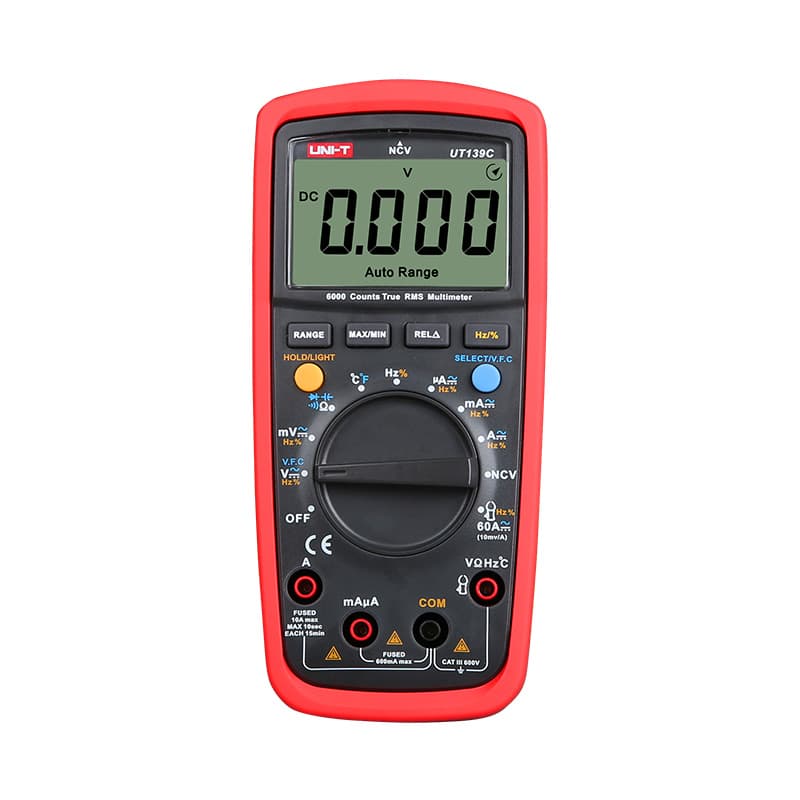
UNI-T UT139C
True RMS and auto-ranging at a price that undercuts most of this list.
Check price on Amazon →Why we picked it ↓Also great
- 4
 Fluke 117Check pricePrice →Best Overall4.8★★★★★
- 5
 Klein Tools MM460SCheck pricePrice →Best Smart-Mode Klein4.4★★★★☆
- 6
 Klein Tools MM450Check pricePrice →Best Slim True RMS4.5★★★★★
- 7Extech EX330Check pricePrice →Best Compact4.2★★★★☆
- 8
 Fluke 107Check pricePrice →Best Pocket Fluke4.3★★★★☆
- 9
 KAIWEETS KM200sCheck pricePrice →Best Budget4.5★★★★★
- 10
 Klein Tools MM325Check pricePrice →Best Basic Manual-Ranging4.1★★★★☆
Quick shopping
Compare at a glance
Swipe sideways on mobile to see every spec.
| Model | Award | Rating | Accuracy | Safety rating | Auto-ranging | |
|---|---|---|---|---|---|---|
 #1KAIWEETS HT118A | Best Low-Cost True RMS | 4.4★★★★☆ | True RMS, 6,000-count | CAT III 1000V / CAT IV 600V | Yes | Check price → |
 #2Klein Tools MM420 | Best Budget Klein True RMS | 4.5★★★★★ | True RMS, 4,000-count | CAT III 600V | Yes (manual RANGE button) | Check price → |
| #3UNI-T UT139C | Best Value Auto-Ranging | 4.4★★★★☆ | True RMS, 6,000-count | CAT III 600V | Yes | Check price → |
| #4Fluke 117✓ Tested | Best Overall | 4.8★★★★★ | True RMS | CAT III 600V | Yes | Check price → |
| #5Klein Tools MM460S | Best Smart-Mode Klein | 4.4★★★★☆ | True RMS, 4,000-count | CAT III 600V | Yes, plus Smart mode | Check price → |
| #6Klein Tools MM450 | Best Slim True RMS | 4.5★★★★★ | True RMS | CAT III 600V | Yes | Check price → |
| Best Compact | 4.2★★★★☆ | Auto-ranging (True RMS not stated) | CAT III 600V | Yes | Check price → | |
| #8Fluke 107 | Best Pocket Fluke | 4.3★★★★☆ | Average-responding (not True RMS) | CAT III 600V | Yes (per display) | Check price → |
| #9KAIWEETS KM200s | Best Budget | 4.5★★★★★ | True RMS | CAT II 600V | Yes | Check price → |
| #10Klein Tools MM325 | Best Basic Manual-Ranging | 4.1★★★★☆ | Not True RMS (2,000-count) | CAT III 600V | No (manual ranging) | Check price → |
In depth
Detailed reviews
KAIWEETS HT118A
True RMS, CAT III 1000V and µA current with NCV and temperature at a low price.
Best for:Budget all-rounder for home, car and hobby
The HT118A is a 6,000-count, auto-ranging True RMS meter with an analog bar. KAIWEETS's manual rates it CAT III 1000V / CAT IV 600V for up to 1000V DC and 750V AC, and current runs from a 600 µA range (0.1 µA) to 10 A. It also measures resistance to 60 MΩ, capacitance, frequency to 10 MHz, duty cycle and temperature, and adds NCV, a Live-wire test, Min/Max, jack lights, a flashlight and a kickstand. KAIWEETS gives a 3-year warranty. Its own product page lists 600V AC/DC, which disagrees with the manual and the meter face.
Why it fits: It covers more household jobs than anything else on this list: NCV and a Live-wire test for outlets, temperature for appliances, µA to 10 A for electronics, plus jack lights, a flashlight and a kickstand. KAIWEETS's manual rates it CAT III 1000V / CAT IV 600V and gives a 3-year warranty. Its product page lists a lower maximum voltage than the manual, and the body is bulky.
- Accuracy
- True RMS, 6,000-count
- Safety rating
- CAT III 1000V / CAT IV 600V
- Auto-ranging
- Yes
- Best for
- Budget all-rounder for home, car and hobby
Reasons to buy
- +µA, mA and 10 A ranges
- +NCV, temperature and Min/Max included
- +3-year warranty
Reasons to avoid
- −Maker's product page and manual disagree on max voltage
- −Bulky compared with slim meters
Klein Tools MM420
Klein's everyday True RMS, auto-ranging meter: µA to 10 A, temperature and capacitance, rated CAT III 600V.
Best for:Home electrical, HVAC and appliance work
The MM420 is a 4,000-count, True RMS, auto-ranging meter rated CAT III 600V. It measures AC/DC current from a 400.0 µA range (0.1 µA resolution) up to 10 A, resistance to 50 MΩ, capacitance to 400 µF, frequency to 50 kHz and temperature from -40 to 1832°F with the included thermocouple. Lead-Alert lights show which jacks to use, it has Min/Max, a backlight and a 2 m drop rating. There's no LoZ mode or NCV, and Klein rates it for indoor use only.
Why it fits: A True RMS CAT III 600V meter with Lead-Alert lights, temperature from -40 to 1832°F with the included thermocouple, capacitance to 400 µF and a 2 m drop rating, which suits appliance repairs and furnace controls. Klein rates it for indoor use and leaves out NCV, so pair it with a voltage pen if you open boxes.
- Accuracy
- True RMS, 4,000-count
- Safety rating
- CAT III 600V
- Auto-ranging
- Yes (manual RANGE button)
- Best for
- Home electrical, HVAC and appliance work
Reasons to buy
- +µA, mA and 10 A ranges on AC and DC
- +Temperature, capacitance and frequency included
- +Lead-Alert jack lights help beginners
Reasons to avoid
- −No LoZ mode or non-contact voltage detection
- −CAT III 600V only, not for service-entrance work
UNI-T UT139C
True RMS and auto-ranging at a price that undercuts most of this list.
Best for:Budget-conscious buyers who still want True RMS
UNI-T's UT139C packs True RMS accuracy, a 6,000-count display, and both auto and manual ranging into one of the more affordable meters here — a strong value pick if you don't need a specific brand name.
Why it fits: True RMS, a 6,000-count display, NCV and CAT III 600V make it a capable outlet-and-electronics meter at a modest price, with manual ranging available when auto-ranging hunts. UNI-T isn't as established in the US as Klein or Fluke and the build is adequate rather than rugged, which is fine for a meter that lives in a drawer.
- Accuracy
- True RMS, 6,000-count
- Safety rating
- CAT III 600V
- Auto-ranging
- Yes
- Best for
- Budget-conscious buyers who still want True RMS
Reasons to buy
- +True RMS at a budget price
- +Both auto and manual ranging
- +Non-contact voltage detection included
Reasons to avoid
- −Less established brand recognition than Fluke/Klein
- −Build quality is adequate, not rugged
Fluke 117
The meter working electricians actually buy with their own money, not just the one brands push.
Best for:Electricians, serious hobbyists
The Fluke 117 is the meter most working electricians reach for. True RMS readings, non-contact voltage detection, and a CAT III 600V rating make it reliable in real electrical panels, not just hobby projects.
Why it fits: Homeowners who swap fixtures, switches and receptacles benefit from its LoZ mode, which tells a disconnected wire's induced voltage from a real supply, and from its built-in NCV and AutoVolt. It carries our Hands-on Tested badge. For checking batteries and fuses a few times a year it is far more meter than you need, which keeps it mid-table here.
- Accuracy
- True RMS
- Safety rating
- CAT III 600V
- Auto-ranging
- Yes
- Best for
- Electricians, serious hobbyists
Reasons to buy
- +Trusted, well-documented reliability
- +Non-contact voltage (NCV) detection built in
- +Durable enough for daily field use
Reasons to avoid
- −Premium price for casual hobbyists
- −No Bluetooth/app connectivity
Klein Tools MM460S
A True RMS Klein whose Smart mode picks AC/DC voltage, resistance or continuity for you, a gentle start for beginners.
Best for:Beginners and quick household checks
In Smart mode the MM460S works out whether you're measuring AC or DC voltage, resistance or continuity without turning the dial (the minimum voltage it detects there is 0.8V). Outside Smart mode it is a regular auto-ranging True RMS meter. It reads current from a 400.0 µA range up to 10 A, resistance to 50 MΩ, capacitance to 4,000 µF and temperature to 1832°F. The 4,000-count reverse-contrast display is backlit, it's rated CAT III 600V with a 2 m drop rating, and Lead-Alert gives visual and audible warnings for wrong lead placement. There's no LoZ or NCV, and it is for indoor use.
Why it fits: Smart mode decides between AC or DC voltage, resistance and continuity on its own, so an occasional user can't land on the wrong setting, and Lead-Alert warns about a misplaced lead. It reads temperature to 1832°F and has a backlit reverse-contrast display. There's no NCV and Klein rates it for indoor use only.
- Accuracy
- True RMS, 4,000-count
- Safety rating
- CAT III 600V
- Auto-ranging
- Yes, plus Smart mode
- Best for
- Beginners and quick household checks
Reasons to buy
- +Smart mode auto-detects V, Ω and continuity
- +µA to 10 A plus temperature and capacitance
- +Backlit reverse-contrast display
Reasons to avoid
- −CAT III 600V only
- −No LoZ or non-contact voltage detection
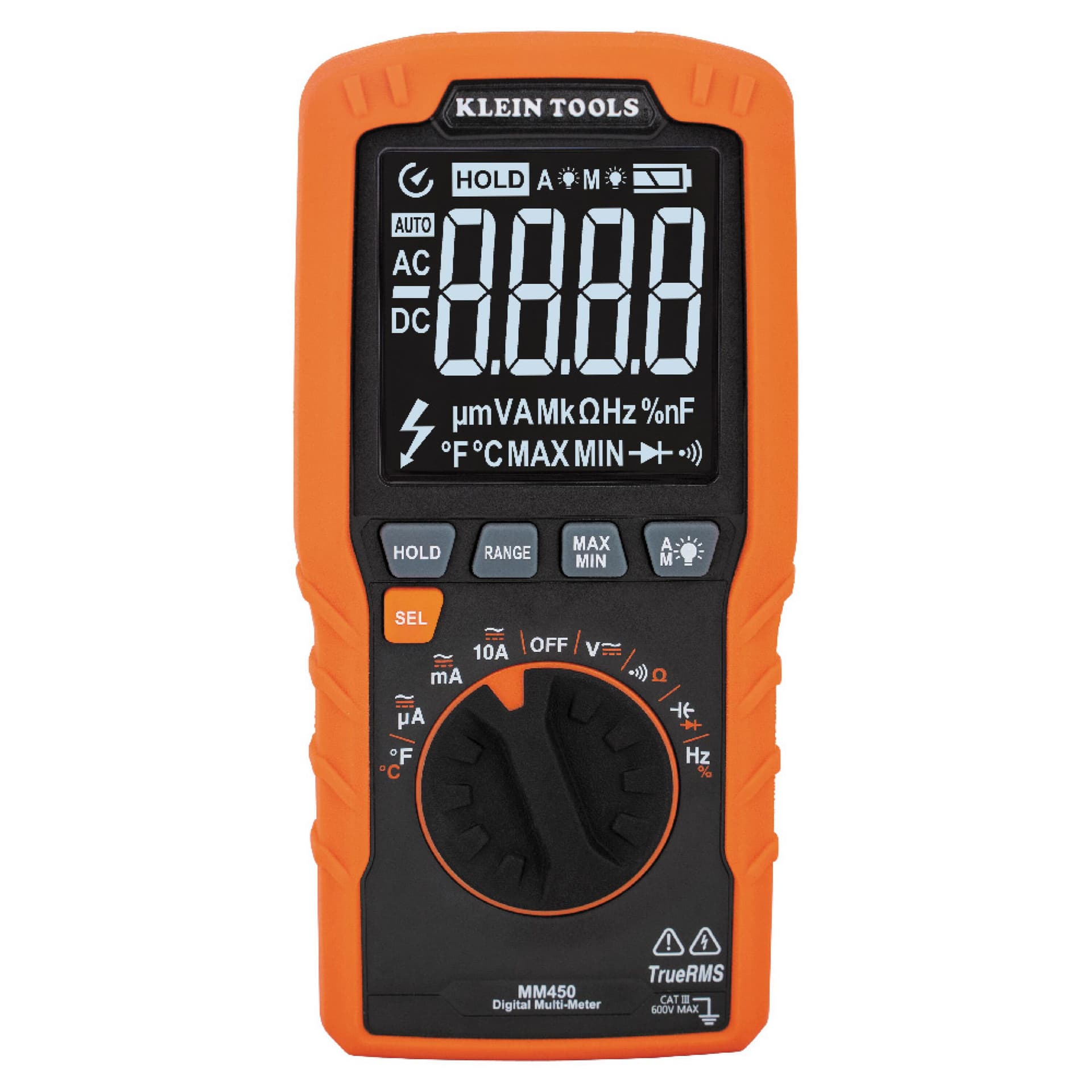
Klein Tools MM450
A slim, current Klein True RMS meter with a reverse-contrast display and wide temperature range, rated CAT III 600V.
Best for:Home electrical, appliance and HVAC work
The MM450 is Klein's current slim True RMS meter: CAT III 600V, auto-ranging, with a reverse-contrast 4,000-count display that adjusts its own backlight, Lead-Alert lights that show where the test leads belong, and temperature from −40°F to 1832°F. At 258 g and 2.8 cm thick it carries easily, and it is drop-rated to 2 m. It lacks a low-impedance mode and NCV, so it suits home electrical and appliance work more than panel troubleshooting.
Why it fits: At 258 g and 2.8 cm thick it is the slimmest True RMS meter here, with Lead-Alert lights, a self-adjusting reverse-contrast display and temperature from −40°F to 1832°F. It is CAT III 600V (the CAT IV figure on some listings refers to the leads) and has no NCV or LoZ, so it suits appliance and thermostat work best.
- Accuracy
- True RMS
- Safety rating
- CAT III 600V
- Auto-ranging
- Yes
- Best for
- Home electrical, appliance and HVAC work
Reasons to buy
- +Slim 2.8 cm body and 258 g
- +Lead-Alert lights guide test lead placement
- +Temperature from −40°F to 1832°F
Reasons to avoid
- −CAT III 600V only (the CAT IV figure on listings is the leads)
- −No low-impedance mode or NCV
- −4,000-count display
Extech EX330
A genuinely pocket-sized meter with a non-contact voltage detector built in.
Best for:Quick checks, pocket carry
The EX330 is a mini auto-ranging meter (147 × 76 × 42 mm, 260 g) with a built-in non-contact voltage (NCV) detector for a fast first check before you even connect leads, plus Type K temperature, capacitance, frequency and duty cycle. Extech doesn't list it as True RMS, unlike its True RMS models, so treat AC readings on distorted waveforms with caution.
Why it fits: Small at 147 × 76 × 42 mm and 260 g, with built-in NCV, Type K temperature, capacitance, frequency and duty cycle, it fits a junk drawer or glovebox. Extech doesn't list it as True RMS and the display is 4,000-count, so it is a quick-check meter rather than one for dimmers or variable-speed loads.
- Accuracy
- Auto-ranging (True RMS not stated)
- Safety rating
- CAT III 600V
- Auto-ranging
- Yes
- Best for
- Quick checks, pocket carry
Reasons to buy
- +Genuinely pocket-sized
- +Built-in non-contact voltage detector
- +Low price for a name-brand meter
Reasons to avoid
- −Extech doesn't list it as True RMS, so don't rely on it for distorted waveforms
- −4,000-count display, coarser than 6,000-count meters
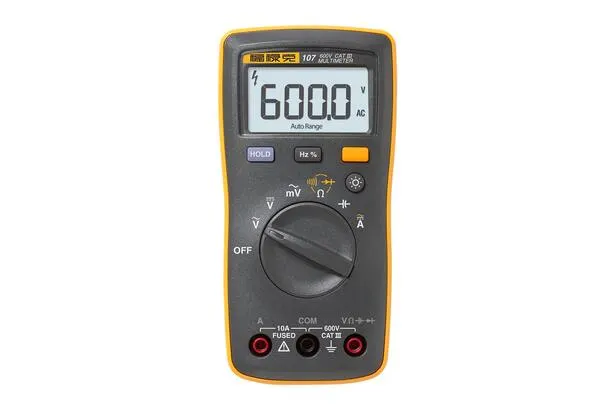
Fluke 107
A palm-sized Fluke with CAT III 600V and a 6,000-count display, but not True RMS.
Best for:A compact second meter, home and auto checks
The Fluke 107 is a 200 g, palm-sized meter rated CAT III 600V, with a 6,000-count backlit display, capacitance, frequency and duty cycle, and a 1 m drop rating. Fluke states plainly that it is not True RMS, so on variable-speed drives and electronic loads its AC readings are less trustworthy than a 115 or 117. It suits a glovebox or toolbag second meter, or anyone who mostly checks batteries, outlets and continuity.
Why it fits: A palm-sized 200 g Fluke with CAT III 600V, a 6,000-count backlit display, capacitance and a 1 m drop rating. It handles outlets, batteries and continuity without fuss. Fluke states it is not True RMS, and it has no temperature, LoZ or NCV, so it is best as a simple, durable household meter.
- Accuracy
- Average-responding (not True RMS)
- Safety rating
- CAT III 600V
- Auto-ranging
- Yes (per display)
- Best for
- A compact second meter, home and auto checks
Reasons to buy
- +Palm-sized: 142 × 69 × 28 mm, 200 g
- +6,000-count backlit display
- +Capacitance, frequency and duty cycle
Reasons to avoid
- −Not True RMS
- −No temperature, low-impedance mode or NCV
KAIWEETS KM200s
Covers the fundamentals of the Fluke at under half the price — the sensible first meter.
Best for:Home use, beginners
For under half the price of the Fluke, the KM200s covers the fundamentals well: auto-ranging, True RMS, and a non-contact voltage detector. A sensible first meter for home and hobby use.
Why it fits: The cheapest way into a True RMS auto-ranging meter with NCV and a backlight, and enough for batteries, extension cords, holiday lights and plug-in appliances. Its CAT II 600V rating puts it below the others for anything wired into the wall, so keep it away from the panel and fixed wiring.
- Accuracy
- True RMS
- Safety rating
- CAT II 600V
- Auto-ranging
- Yes
- Best for
- Home use, beginners
Reasons to buy
- +Excellent value for the feature set
- +Backlit display for low-light use
- +Smart auto-ranging simplifies readings
Reasons to avoid
- −Build quality isn't field-tool grade
- −CAT II rating means it's not meant for service-panel work
Klein Tools MM325
A low-cost Klein for checking outlets, batteries and continuity, as long as you're happy picking ranges yourself.
Best for:Basic household and battery checks
The MM325 is a manual-ranging, 2,000-count meter rated CAT III 600V. It reads AC/DC voltage to 600V, DC current from a 200 µA range up to 10 A, and resistance to 2 MΩ, and it has diode, continuity and a 1.5V/9V battery test. Lead-Alert lights, a backlight and a 2 m drop rating come from Klein's pricier meters. Klein doesn't claim True RMS for it, it can't measure AC current, and you have to choose each range on the dial.
Why it fits: The lowest-cost meter here still brings CAT III 600V, Lead-Alert lights, a backlight and a dedicated 1.5V/9V battery-test position, which is handy for a drawer full of household cells. It is manual-ranging, 2,000-count and not claimed as True RMS, and it can't measure AC current or temperature.
- Accuracy
- Not True RMS (2,000-count)
- Safety rating
- CAT III 600V
- Auto-ranging
- No (manual ranging)
- Best for
- Basic household and battery checks
Reasons to buy
- +Low cost from a major tool brand
- +Battery test for 1.5V and 9V cells
- +Lead-Alert lights and backlit display
Reasons to avoid
- −Manual ranging and not True RMS
- −No AC current, capacitance or temperature
Before you buy
Buying advice
List the five jobs you actually do
Most homes need a meter for the same handful of tasks: checking a dead receptacle, testing batteries, proving a fuse, checking a thermostat or doorbell transformer and diagnosing an appliance element. Look down the household jobs table above and pick the cheapest meter that covers all of yours with an appropriate safety rating. Extra functions only add dial positions to get wrong.
Treat NCV as a convenience, not a guarantee
A non-contact detector is quick for finding which cable is live or whether a receptacle has power. It can stay silent on a live conductor in metal conduit, inside armored cable or when the meter's own battery is low. Before you touch anything, confirm with the test leads on a meter you have just checked on a known live outlet.
Store it so it works next year
A meter that lives in a drawer suffers more from a leaking battery than from wear. Take the batteries out if it will sit for months, coil the leads loosely so the insulation doesn't crack, and keep the spare fuse ratings from the manual somewhere you can find them. A rechargeable or auto-off meter avoids a lot of flat-battery surprises.
Know where DIY ends
A multimeter tells you what is happening; it doesn't make the repair safe. Replacing a receptacle or switch on a de-energized circuit is a common homeowner job in many areas. Panel work, new circuits, aluminum wiring and anything involving the utility side usually is not. If readings don't make sense or a fault keeps returning, a licensed electrician is the next step.
Methodology
How we chose
We ranked meters for homeowners and DIYers who measure a few times a year. A safety rating suitable for fixed household wiring came first, then non-contact voltage, ease of use for an occasional user, the range of household jobs covered (outlets, batteries, fuses, appliance elements, temperature) and value. Specs come from maker manuals, product pages and official listings; the Fluke 117 carries our Hands-on Tested badge, and the rest are ranked by desk research.
Picks marked "Hands-on Tested" have been bought and tested by us; the rest are desk research. A pick only carries that badge once we have actually bought and tested that unit. More on how we research.
Questions
Frequently asked questions
What multimeter setting do I use to test a wall outlet at home?+
Set the dial to AC volts, shown as V with a wavy line (or V~), and plug the red lead into the V jack, never the A or mA jack. Insert one probe into each slot while holding the guards. On a US 120V receptacle you should see roughly 114 to 126 volts. A reading near zero points to a tripped breaker, GFCI or loose connection.
Can I use a multimeter to find out why a breaker keeps tripping?+
A multimeter helps you narrow it down. With the power off, a resistance check between hot and neutral or ground on an unplugged circuit can reveal a short, and checking appliances one at a time can find a faulty element or motor. Measuring the actual load current needs a clamp meter. Repeated trips, burning smells or warm breakers mean it's time to call an electrician.
Is it safe for a homeowner to use a multimeter on household wiring?+
Checking receptacles and plug-in appliances with a meter rated CAT III 600V or better is a reasonable homeowner job if the leads are undamaged and you keep your fingers behind the probe guards. Opening the panel, working on the service side or testing 240V appliance circuits carries more risk, and many areas require a licensed electrician for that work. When in doubt, leave it to a professional.
How do I know if my home multimeter is still accurate?+
A quick sanity check is to measure a fresh AA battery, which should read a little above 1.5V, and touch the probes together on the ohms range, which should read close to zero. Comparing a receptacle reading with a second meter also helps. If readings drift or jump, check the leads and battery first. Formal calibration is rarely worth it for occasional household use.
Do I need a True RMS multimeter for home use?+
For checking outlets, batteries and fuses, an average-responding meter such as the Fluke 107 or Klein MM325 reads correctly, because household mains is close to a clean sine wave. True RMS matters when you measure current or voltage on dimmers, variable-speed appliances, LED drivers or inverters, where waveforms are distorted. Most meters ranked near the top here are True RMS, so you don't have to choose.


