COMPARISON · OSCILLOSCOPES
Hantek DSO2D15 vs FNIRSI 1014D
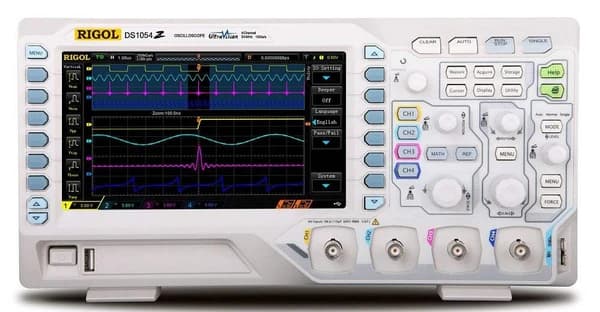
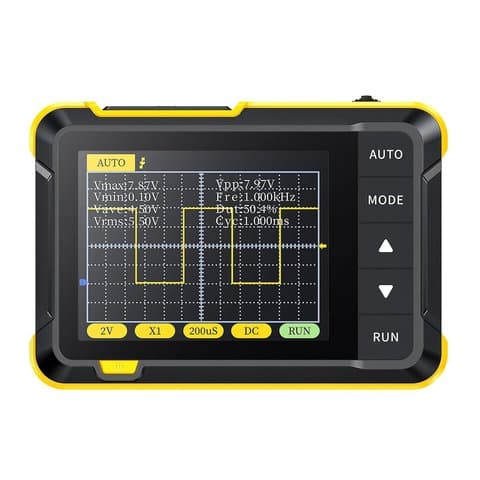
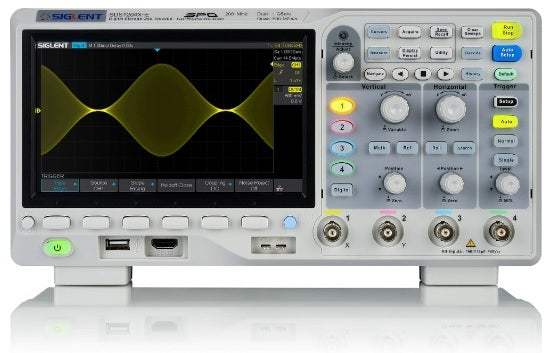
Hantek DSO2D15 vs FNIRSI 1014D puts two benchtops that each carry a built-in generator side by side. Both have two channels, a 1 GSa/s peak rate, an 8-bit converter and a 7-inch 800 × 480 screen. The Hantek goes further on almost every published figure: 150 MHz against 100 MHz, 8 Mpts of memory, UART to LIN decoding, and a generator reaching 25 MHz at up to 7 Vpp.
By the OhmSavvy Research Team ·
Disclosure: OhmSavvy earns a commission from qualifying Amazon purchases made through these links, at no extra cost to you. How we're funded.

Hantek DSO2D15
4.4★★★★☆The 150 MHz version of Hantek's DSO2000 bench scope, with a 25 MHz generator and serial decoding.

FNIRSI 1014D
4.3★★★★☆A two-channel 100 MHz benchtop with a built-in signal generator at an entry-level price.
Specs side by side
| Hantek DSO2D15 | FNIRSI 1014D | |
|---|---|---|
| Rating | 4.4★★★★☆ | 4.3★★★★☆ |
| Bandwidth | 150MHz | 100MHz |
| Channels | 2 | 2 |
| Sample rate | 1 GSa/s (1 ch); 500 MSa/s (2 ch) | 1 GSa/s |
| Best for | A budget bench that wants extra bandwidth and a signal source | Budget benches that need a scope and a signal source |
| Vertical resolution | 8-bit (12-bit high-resolution mode) | 8-bit |
| Memory | 8 Mpts (1 ch); 4 Mpts (2 ch) | Quoted by FNIRSI as "240Kbit" |
| Display | 7-inch 800 × 480 | 7-inch 800 × 480 |
| Built-in generator | 1 ch, sine to 25 MHz, square and arbitrary to 10 MHz, up to 7 Vpp | 1 ch DDS, sine to 10 MHz, other waves to 2 MHz, 2.5 Vpp |
| Serial trigger and decode | UART, I2C, SPI, CAN, LIN | None listed by FNIRSI |
| Automatic measurements | 32, with statistics | 12 |
| Rise time (maker) | 2.4 ns typical | Under 3 ns |
| Power | Mains, 100–240 VAC, under 30 W | 5 V adapter |
Specs checked against manufacturer documentation and official Amazon listings. Desk research, not bench testing. How we research.
Key differences
- →Bandwidth: 150 MHz on the DSO2D15 against 100 MHz on the 1014D. Hantek quotes a 2.4 ns typical rise time; FNIRSI says under 3 ns.
- →Sample rate: both peak at 1 GSa/s. Hantek states 500 MSa/s per channel with two on; FNIRSI doesn't say what the 1014D does with both channels running.
- →Memory: Hantek publishes 8 Mpts on one channel and 4 Mpts on two. FNIRSI writes only "240Kbit", with no point count.
- →Generator: the DSO2D15's reaches 25 MHz sine and 10 MHz square or arbitrary at up to 7 Vpp into high impedance, with burst and modulation. The 1014D's gives sine to 10 MHz, other waves to 2 MHz, at 2.5 Vpp.
- →Decoding: Hantek lists UART, I2C, SPI, CAN and LIN triggering and decoding. FNIRSI lists none for the 1014D.
- →Measurement tools: 32 automatic measurements with statistics, two DVMs and a 6-digit hardware counter on the Hantek; 12 automatic parameters on the FNIRSI.
- →Power and weight: the DSO2D15 runs on mains; Hantek says 1900 g, but Amazon lists 5.5 lb, a conflict we can't resolve. The 1014D runs from a 5 V adapter and Amazon lists 3.46 lb.
Spec by spec
The two share a screen size, a converter width and a peak sample rate, so the charts below concentrate on the published numbers that differ. Hantek's figures come from its DSO2000 series table and FNIRSI's from the 1014D specification table.
Bars use a logarithmic scale: each step is ten times the last.
With both channels on, the DSO2D15 still takes about three samples per cycle at its full 150 MHz rating and fifty per cycle of a 10 MHz clock, above the Nyquist minimum of two. We can't do the same sum for the 1014D because FNIRSI doesn't publish the shared rate. See what GSa/s means for why the per-channel number is the one that counts.
Memory: how long each scope can look
Memory decides how much time fits in one capture at a fast sample rate, and it is where this pair differs most. At 1 GSa/s the DSO2D15's 8 Mpts holds 8 ms of signal; with both channels at 500 MSa/s, 4 Mpts each still covers 8 ms. That is enough to catch a complete CAN frame, a whole I2C transaction at 100 kHz, or several cycles of a 1 kHz PWM signal with every edge sampled at full speed.
FNIRSI writes the 1014D's memory as "240Kbit". Read it generously as 240,000 points and the scope holds 0.24 ms at 1 GSa/s, about a thirtieth of the Hantek's window. If it really means bits at 8 bits per sample, the window is shorter still. Either way, on a long timebase the 1014D must lower its sample rate to fit, which is when narrow glitches disappear between samples.
Capture time = memory ÷ sample rate
What each can and can't measure
Rated bandwidth is where a sine has already lost 3 dB, so apply a three-to-five-times margin: the DSO2D15 suits signals up to roughly 30 to 50 MHz and the 1014D up to roughly 20 to 33 MHz. Both clear Arduino and ESP32 PWM, audio, hobby SPI and most buck-converter switching. The Hantek's margin pays off on fast logic edges and higher-speed SPI clocks, where you want to judge edge shape rather than just count transitions. Our explainer on oscilloscope bandwidth covers the rule.
Decoding is the bigger practical gap for anyone working on cars, robots or sensor boards. With CAN or LIN decoding, the DSO2D15 can trigger on a message and print its contents under the trace, so a body-module fault becomes a list of frames instead of a screen of square waves. On the 1014D you would capture the same bus and work out the bits by hand, within its shorter memory window.
The generators split along similar lines. A 7 Vpp swing lets the Hantek stand in for a 5 V logic clock or a sensor output when testing a microcontroller input, and burst mode can send a fixed number of pulses. The 1014D's 2.5 Vpp source, with 1 Hz frequency steps, is better matched to driving op-amp and filter inputs, where small signals are the point.
| Limit | DSO2D15 | 1014D |
|---|---|---|
| Comfortable signal range | ~30–50 MHz | ~20–33 MHz |
| Capture at full rate | 8 ms (8 Mpts) | ≤0.24 ms if 240k points |
| Bus decoding | UART, I2C, SPI, CAN, LIN | None listed |
| Generator for 5 V logic | Yes, up to 7 Vpp | No, 2.5 Vpp |
| Automatic measurements | 32 with statistics | 12 |
Mains-powered means earth-referenced
Which should you buy?
| Buyer or job | Pick | Why |
|---|---|---|
| Car electronics and CAN or LIN networks | Hantek DSO2D15 | Bus trigger and decode with 8 ms full-rate captures |
| Microcontroller boards with I2C or SPI sensors | Hantek DSO2D15 | Decoded bytes on screen, 32 automatic measurements |
| Simulating 5 V sensor or clock signals | Hantek DSO2D15 | Generator swings up to 7 Vpp, 10 MHz square |
| Audio and filter experiments | FNIRSI 1014D | 2.5 Vpp sine with 1 Hz steps suits small analog inputs |
| High-voltage probing out of the box | FNIRSI 1014D | Kit adds a 100X probe to two 1X/10X probes |
| Syncing to an external pulse | FNIRSI 1014D | FNIRSI lists a 0–40 V external trigger input |
| Fast logic edges | Hantek DSO2D15 | 150 MHz and 2.4 ns rise time |
The DSO2D15 shares Hantek's DSO2000 series table with the 100 MHz DSO2D10, covered in our Hantek DSO2D10 review. For the wider field, see the best beginner oscilloscopes and the oscilloscope buying guide. The 1014D also meets FNIRSI's battery tablet in FNIRSI 1013D Plus vs 1014D and Hantek's generator-free model in Hantek DSO2C10 vs FNIRSI 1014D.
Choose the Hantek DSO2D15 if…
- ✓You debug UART, I2C, SPI, CAN or LIN traffic and want the bytes decoded on screen
- ✓You want long captures: 8 Mpts on one channel or 4 Mpts each on two
- ✓Your generator has to swing a full 5 V logic level or reach past 10 MHz
- ✓You want every spec published, including the two-channel sample rate
Choose the FNIRSI 1014D if…
- ✓Your work is analog: filters, audio and sensor stages well below 20 MHz
- ✓You want a kit with two 1X/10X probes and a 100X probe already in the box
- ✓You prefer a scope that runs from a 5 V adapter rather than a mains cord
- ✓You want an external trigger input, listed by FNIRSI at 0 to 40 V
Neither if…
You need to clip a ground lead onto a live conductor: both are mains-powered and earth-referenced, and while Hantek rates the DSO2D15 CAT II 300V, FNIRSI gives no CAT rating at all for the 1014D's 400V 10X figure — line-side work needs a differential probe or an isolated setup either way.
The bottom line
The Hantek DSO2D15 is the stronger instrument on published specs: 150 MHz, a stated 500 MSa/s per channel with both on, 8 Mpts of memory, five serial decoders and a 25 MHz, 7 Vpp generator. Choose it for digital, automotive and microcontroller work. The FNIRSI 1014D makes sense for analog and audio experiments below about 20 MHz, where its 2.5 Vpp source, 5 V adapter power and 100X probe kit cover what you need.
Frequently asked questions
Is 150 MHz on the Hantek DSO2D15 worth it over the FNIRSI 1014D's 100 MHz?+
Only if you look at fast edges or signals above about 20 MHz. By the three-to-five-times rule the DSO2D15 handles signals to roughly 30 to 50 MHz and the 1014D to roughly 20 to 33 MHz. For PWM, audio and slow serial buses both are enough; the memory and decoding gaps matter more.
Can the FNIRSI 1014D decode CAN or I2C like the Hantek DSO2D15?+
FNIRSI lists no serial decoding for the 1014D. Hantek lists UART, I2C, SPI, CAN and LIN triggering and decoding on the DSO2D15, so it can trigger on bus traffic and show the decoded bytes. On the 1014D you would read the bits from the waveform yourself.
Which has the better built-in signal generator?+
The DSO2D15 on every published figure: sine to 25 MHz, square and arbitrary to 10 MHz, up to 7 Vpp into high impedance, plus burst and modulation. The 1014D gives sine to 10 MHz, other waveforms to 2 MHz and a custom wave to 1 MHz at 2.5 Vpp, with 1 Hz frequency resolution.
Why does the DSO2D15's sample rate drop with two channels on?+
Hantek's 1 GSa/s converter is shared, so each channel gets 500 MSa/s when both run, and memory splits from 8 Mpts to 4 Mpts each. That is common on two-channel budget scopes. FNIRSI doesn't publish the 1014D's two-channel rate, so you can't assume it keeps 1 GSa/s per channel.
How much does the Hantek DSO2D15 weigh compared with the 1014D?+
The sources disagree for the Hantek. Hantek's own spec table says 1900 g, while Hantek's plain DSO2D15 Amazon listing gives an item weight of 5.5 lb and a net weight of 2900 g in its product description. The 1014D's Amazon listing says 3.46 lb. Either way, both are desk instruments; the DSO2D15 needs a mains socket and the 1014D a 5 V adapter.
Related