COMPARISON · OSCILLOSCOPES
Rigol DHO814 vs DHO804: Compare Channels and Features
The DHO814 and DHO804 are the same Rigol DHO800-series scope — four channels, 12-bit resolution, a 7-inch 1024 × 600 touchscreen, HDMI out and serial decoding — at two different bandwidth tiers. There's no channel-count trade-off here like there is between other Rigol models; the only question is whether you need the extra bandwidth.
By the OhmSavvy Research Team ·
Disclosure: OhmSavvy earns a commission from qualifying Amazon purchases made through these links, at no extra cost to you. How we're funded.

Rigol DHO814
4.6★★★★★Four channels, 12-bit resolution and a touchscreen, one step up from the DHO804 in bandwidth.
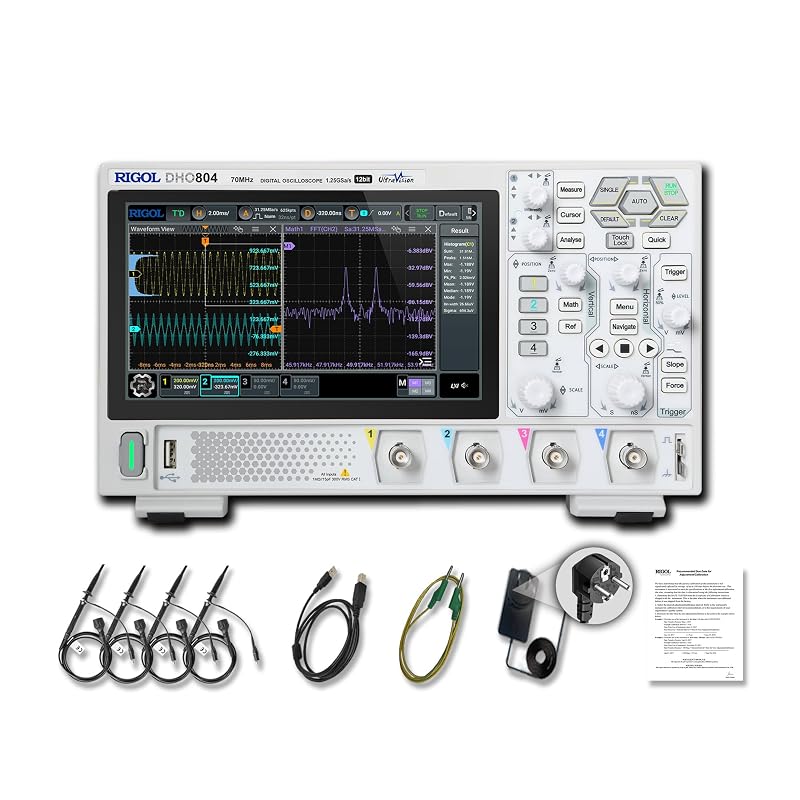
Rigol DHO804
4.8★★★★★Four channels, 12-bit resolution and a 7-inch touchscreen in a compact body that runs from USB-C power.
Specs side by side
| Rigol DHO814 | Rigol DHO804 | |
|---|---|---|
| Rating | 4.6★★★★★ | 4.8★★★★★ |
| Bandwidth | 100MHz | 70MHz |
| Channels | 4 | 4 |
| Sample rate | 1.25 GSa/s | 1.25 GSa/s (1 ch); 312.5 MSa/s (4 ch) |
| Best for | Four-channel work that wants more bandwidth than the DHO804 | Hobbyists who want 12-bit detail and a touchscreen |
| Bandwidth | 100MHz | 70MHz |
| Channels | 4 | 4 |
| Vertical resolution | 12-bit | 12-bit |
| Sample rate, 1 channel | 1.25 GSa/s | 1.25 GSa/s |
| Sample rate, 4 channels | Not stated by Rigol at this tier | 312.5 MSa/s |
| Memory depth | 25 Mpts | 25 Mpts (1 ch); 5 Mpts (4 ch) |
| Waveform capture rate | Up to 1 Mwfms/s (UltraAcquire) | Up to 1 Mwfms/s (UltraAcquire, series figure) |
| Display | 7-inch touchscreen, 1024 × 600 | 7-inch touchscreen, 1024 × 600 |
| Serial decode | Not called out in this Pick's sourcing | UART, I2C, SPI, CAN, parallel |
| Interfaces | USB, LAN, HDMI (series standard) | USB, LAN, HDMI (series standard) |
| Power | USB-C (series-level, per Rigol) | USB-C |
| Hands-on tested by OhmSavvy | No | Yes |
Specs checked against manufacturer documentation and official Amazon listings. Rigol DHO804 is hands-on tested by OhmSavvy; the Rigol DHO814 assessment is desk research. How we research.
Key differences
- →Bandwidth is the headline difference: 100 MHz on the DHO814 against 70 MHz on the DHO804 — about 43% more headroom.
- →Both share the identical four-channel, 12-bit, 7-inch 1024 × 600 touchscreen DHO800 platform and the same 1.25 GSa/s single-channel peak sample rate.
- →The DHO804's four-channel sample rate (312.5 MSa/s) and memory-depth-with-all-channels-on figure (5 Mpts) are documented; the DHO814's equivalent figures aren't stated at the same level of detail in this Pick's sourcing.
- →Rigol's DHO800 series page gives both models the same USB-C power input, USB/LAN/HDMI outputs and up to 1 Mwfms/s capture rate. The DHO804 also lists UART/I2C/SPI/CAN/parallel decoding; Rigol's page doesn't itemize decoding for the DHO814, so that isn't separately confirmed here.
- →The DHO804 carries OhmSavvy's Hands-on Tested badge; the DHO814 hasn't been bought and tested in-house yet.
Spec by spec
Strip away the shared platform and the comparison reduces to one number: bandwidth. Everything else that both Picks document — channel count, resolution, single-channel sample rate, screen — is identical.
Because both scopes share the same four channels and 12-bit converter, the decision doesn't involve any of the usual channel-count or resolution trade-offs — it's purely about how much of a safety margin you want above your fastest signal. See our bandwidth explainer for why the rated figure isn't the same as the usable one.
What 30 MHz of extra bandwidth looks like
A bandwidth rating is the frequency where a scope already shows a sine wave at about 70.7% of its true amplitude. Below that point the displayed amplitude falls off gradually, so the useful question is how much each model shaves off the signals you actually measure. The curves below use the textbook single-pole model to compare the two tiers; real front ends are often flatter in the passband, so treat it as an illustration of the trend rather than a measured response.
The other way to read the same difference is rise time. A common approximation is rise time ≈ 0.35 ÷ bandwidth, which gives about 5 ns for a 70 MHz front end and about 3.5 ns for 100 MHz. A scope can't show an edge faster than its own rise time, so if you measure a logic edge of a few nanoseconds the DHO804 will stretch it more than the DHO814 does. For audio, sensors and slow buses, both curves sit near 100% and the difference disappears.
Rigol DHO814 vs DHO804: which bandwidth tier fits?
Since the platform is identical, this comparison is simpler than most on this site — it comes down to matching the bandwidth to your actual signals, not to a feature trade-off.
If your signals climb into the tens of megahertz: the DHO814
By the usual three-to-five-times rule of thumb, a 70 MHz scope displays signals up to roughly 14–23 MHz accurately, while a 100 MHz scope extends that to about 20–33 MHz. If your work regularly approaches or exceeds the lower end of that range — faster SPI buses, RF-adjacent signals, switching power supply ringing — the DHO814's extra bandwidth buys real margin rather than a number on a spec sheet.
If you're mostly below a few tens of megahertz: the DHO804
Audio circuits, most control logic, I2C and many SPI implementations, and general hobbyist electronics rarely approach 70 MHz, let alone 100 MHz. For that kind of work the DHO804 delivers the same four-channel touchscreen experience for less money, and the documented 312.5 MSa/s four-channel rate and 5 Mpts memory figure give you a clearer picture of what to expect with every channel running.
When a platform is shared, buy on bandwidth margin, not on spec-sheet anxiety
Which should you buy?
| Buyer or job | Better fit | Why |
|---|---|---|
| Signals in the tens of megahertz or faster | Rigol DHO814 | 100 MHz keeps real accuracy where 70 MHz starts to compress |
| Audio, control logic, low-speed buses | Rigol DHO804 | 70 MHz already covers the signal with plenty of margin |
| Want documented 4-channel sample rate and memory | Rigol DHO804 | 312.5 MSa/s and 5 Mpts at 4 channels are both stated |
| Buying once, want headroom against future projects | Rigol DHO814 | More bandwidth to grow into without a second purchase |
| Tightest budget on this platform | Rigol DHO804 | Same 4-channel touchscreen platform for less |
| Want the most proven, hands-on verified pick | Rigol DHO804 | Carries OhmSavvy's Hands-on Tested badge |
Want a 100 MHz, four-channel scope at a lower price point without the DHO800's touchscreen? See how the Rigol DS1102Z-E compares against the DS1054Z. The beginner oscilloscope roundup ranks both DHO800 models, and the oscilloscope buying guide explains every spec from scratch.
Same accessories, same learning curve
Choose the Rigol DHO814 if…
- ✓Your signals run up into the tens of megahertz and you want real headroom
- ✓You measure fast edges, where a higher bandwidth keeps displayed rise times closer to the truth
- ✓You're buying once and want to avoid outgrowing the bandwidth later
- ✓Budget allows the step up from the DHO804
Choose the Rigol DHO804 if…
- ✓Your signals are mostly audio, control logic or low-speed digital buses
- ✓You want the same four-channel touchscreen platform for less money
- ✓70 MHz already covers everything you currently work on
- ✓You'd rather save the difference for probes or accessories
The bottom line
The Rigol DHO814 and DHO804 are the same four-channel, 12-bit, touchscreen platform at two bandwidth tiers. Choose the DHO814 if your signals run into the tens of megahertz or you want headroom to grow into; choose the DHO804 if your work stays below that range and you'd rather save the difference — it also carries OhmSavvy's Hands-on Tested badge, while the DHO814 doesn't yet.
Frequently asked questions
Is the Rigol DHO814 just a higher-bandwidth DHO804?+
Functionally, yes — both share the same four-channel, 12-bit, 7-inch touchscreen DHO800 platform. The documented difference is bandwidth: 100 MHz on the DHO814 against 70 MHz on the DHO804, plus some four-channel sample-rate and memory figures that are more fully published for the DHO804 in this Pick's sourcing.
Do the DHO814 and DHO804 use the same probes and accessories?+
Yes. As members of the same DHO800 series, they share the same probe connector type and general accessory ecosystem.
Which one should a beginner buy?+
If you don't yet know whether you'll need more than 70 MHz, the DHO804 is the more conservative, better-value starting point on this platform. Buy the DHO814 only if you already have a specific reason to expect faster signals.
Does either DHO800 model have a built-in signal generator?+
No — neither the DHO814 nor the DHO804 includes a built-in generator in this Pick's sourcing. If you want a generator built in, look at a model like the FNIRSI 1014D instead.
Which one has OhmSavvy actually tested?+
The Rigol DHO804 carries our Hands-on Tested badge — it's been bought and used in-house. The DHO814 hasn't been tested hands-on yet, so its rating reflects published specifications only.
Related