COMPARISON · OSCILLOSCOPES
Siglent SDS1104X-E vs Rigol DHO802 for Arduino
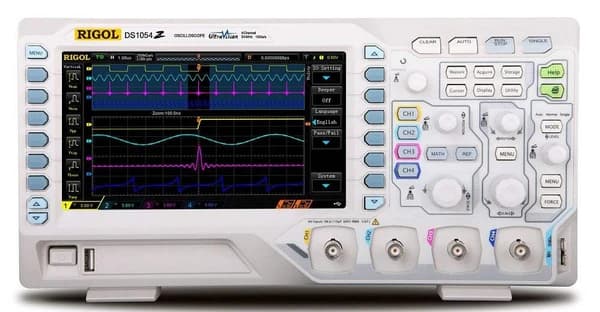
For Arduino work, the Siglent SDS1104X-E vs Rigol DHO802 choice is four channels against two better-equipped ones. The Siglent gives you four 100 MHz inputs and keeps 500 MSa/s on each with all of them running. The Rigol has only two inputs at 70 MHz, but adds 12-bit resolution, 25 Mpts of memory, a 1024 × 600 touchscreen and USB-C power. Both decode UART, I2C, SPI and CAN as standard.
By the OhmSavvy Research Team ·
Disclosure: OhmSavvy earns a commission from qualifying Amazon purchases made through these links, at no extra cost to you. How we're funded.
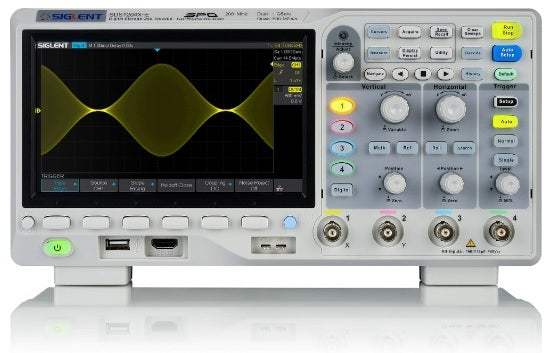
Siglent SDS1104X-E
4.8★★★★★More bandwidth and a better UI than the Rigol, for projects that will get more demanding.

Rigol DHO802
4.6★★★★★The two-channel DHO800: 12-bit resolution, a 7-inch touchscreen and USB-C power for a lower price than the four-channel DHO804.
Specs side by side
| Siglent SDS1104X-E | Rigol DHO802 | |
|---|---|---|
| Rating | 4.8★★★★★ | 4.6★★★★★ |
| Bandwidth | 100MHz | 70MHz |
| Channels | 4 | 2 |
| Sample rate | 1 GSa/s | 1.25 GSa/s (1 ch); 625 MSa/s (2 ch) |
| Best for | Intermediate hobbyists, future-proofing | Two-channel work that benefits from 12-bit detail |
| Sample rate, all channels on | 500 MSa/s per channel (4 ch) | 625 MSa/s per channel (2 ch) |
| Vertical resolution | 8-bit | 12-bit |
| Memory | 14 Mpts (1 ch per pair); 7 Mpts (all on) | 25 Mpts (1 ch); 10 Mpts (2 ch) |
| Serial decoding | Standard: I2C, SPI, UART/RS232, CAN, LIN | Standard: parallel, UART, I2C, SPI, CAN |
| Display | 7-inch 800 × 480 TFT-LCD | 7-inch 1024 × 600 capacitive touchscreen |
Specs checked against manufacturer documentation and official Amazon listings. Siglent SDS1104X-E is hands-on tested by OhmSavvy; the Rigol DHO802 assessment is desk research. How we research.
Key differences
- →Channels: the SDS1104X-E has four, the DHO802 two. On Arduino projects this is the difference you notice first.
- →Bandwidth: 100 MHz on the Siglent against 70 MHz on the Rigol. Both are far above typical Arduino signal speeds.
- →Sample rate with every channel in use: 500 MSa/s on each of the Siglent's four, 625 MSa/s on each of the Rigol's two. With one channel on, the DHO802 reaches 1.25 GSa/s and the Siglent 1 GSa/s.
- →Decoding is standard on both: Siglent includes I2C, SPI, UART/RS232, CAN and LIN; Rigol includes UART, I2C, SPI, CAN and parallel.
- →Resolution and memory: the DHO802 is 12-bit and holds 25 Mpts with one channel on (10 Mpts with two). Siglent lists the SDS1104X-E as 8-bit with 14 Mpts per channel (7 Mpts with all four on).
- →The Rigol adds a 1024 × 600 touchscreen, HDMI output and USB-C 15 V power; the Siglent has a 7-inch 800 × 480 screen, runs from 100–240 V AC and also has LAN.
- →The SDS1104X-E carries our Hands-on Tested badge; the Rigol DHO802 assessment is desk research against maker specifications.
Spec by spec
The headline numbers point in opposite directions. The Siglent has more inputs and more bandwidth; the Rigol samples faster on one channel and keeps a higher per-channel rate once every input is busy, because it only splits its budget two ways instead of four.
| SDS1104X-E | DHO802 | |
|---|---|---|
| Serial decoding | I2C, SPI, UART, CAN, LIN | UART, I2C, SPI, CAN, parallel |
| Vertical resolution | 8-bit | 12-bit |
| Memory | 14 Mpts / 7 Mpts | 25 Mpts / 10 Mpts |
| Screen | 800 × 480 | 1024 × 600 touch |
| Power | 100–240 V AC | USB-C, 15 V |
Siglent's figures come from its SDS1000X-E series page and data sheet, which list serial trigger and decode as standard. Memory is shared per channel pair, so the SDS1104X-E has 14 Mpts on a channel when its partner is off and 7 Mpts each with all four running.
Siglent SDS1104X-E vs Rigol DHO802 for Arduino
Arduino projects are slow by oscilloscope standards. An Uno's analogWrite PWM runs at a few hundred hertz to about 1 kHz, servo pulses repeat at around 50 Hz, I2C usually clocks at 100 or 400 kHz, and hardware SPI on a 16 MHz board tops out at 8 MHz. Either scope shows every one of those cleanly, so speed is not the question. The questions are how many pins you need to see together and how much help you want reading what is on them.
SPI is where the channel count bites. A full transaction has four lines: clock, chip select, MOSI and MISO. On the SDS1104X-E all four sit on one screen under one trigger, so you can see whether chip select drops before the first clock edge and which device is answering. On the DHO802 you choose two, typically SCK and MOSI, and repeat the capture to check the others. The same applies to driving three servos or comparing several PWM outputs: four inputs let you check their timing against each other directly.
Decoding doesn't separate them. Siglent includes I2C, SPI, UART/RS232, CAN and LIN decoding free on the SDS1104X-E, and Rigol lists UART, I2C, SPI, CAN and parallel as standard on the DHO802, so on either scope a Serial.print at 115200 baud or an I2C sensor read appears as bytes and addresses, not just square waves you count by hand. Two channels are enough for most of that work: UART needs one line per direction and I2C only SDA and SCL. Where the Rigol pulls ahead is the analog side: its 12-bit converter against the Siglent's 8-bit helps with a potentiometer, thermistor or microphone feeding an analog pin, or the ripple on a 5 V rail from a USB supply. Its 25 Mpts (against 14 Mpts) also holds a longer serial capture.
| Arduino signal | Typical speed | Lines to watch | Better fit |
|---|---|---|---|
| analogWrite PWM (Uno) | About 490 Hz or 980 Hz | 1 per output | Either; Siglent for 3–4 outputs at once |
| Hobby servo control | About 50 Hz frame | 1 per servo | Siglent when timing several servos |
| UART / Serial monitor | 9,600–115,200 baud | TX and RX | Either: both decode UART as standard |
| I2C sensor or OLED | 100 or 400 kHz | SDA and SCL | Either: two channels and standard decoding |
| SPI display or SD card | Up to 8 MHz on a 16 MHz board | SCK, CS, MOSI, MISO | Siglent: all four lines at once |
| Analog sensor output | Slow, small changes | 1 | Rigol: 12-bit resolution |
Speeds are typical defaults for an Arduino Uno and common libraries; your board and code may differ.
Which should you buy?
| Buyer or job | Better fit | Why |
|---|---|---|
| Student following an Arduino course | Either | Both decode UART and I2C as standard; pick on channels or screen |
| Maker building SPI displays, SD loggers or LED drivers | Siglent SDS1104X-E | Four channels show the whole SPI bus in one capture |
| Robotics with several servos or motor drivers | Siglent SDS1104X-E | Compare up to four control signals on one trigger |
| Sensor and analog-input projects | Rigol DHO802 | 12-bit against 8-bit resolves small voltage changes |
| Plans to move on to faster boards | Siglent SDS1104X-E | 100 MHz against 70 MHz of rated bandwidth |
| Small desk, laptop-style setup | Rigol DHO802 | USB-C power, HDMI out and a touchscreen |
What each one can and can't measure
A scope's rated bandwidth is where a sine wave has already lost 3 dB of amplitude, so it is a limit, not a working range. The usual rule of thumb asks for three to five times your fastest signal: about 20–33 MHz for the 100 MHz Siglent and 14–23 MHz for the 70 MHz Rigol. Every Arduino signal in the table above fits inside both. The 16 MHz crystal on an Uno sits inside the Rigol's range and comfortably inside the Siglent's. Our oscilloscope bandwidth explainer covers why the margin matters.
Where the gap does show is on edges. A digital pin switching between 0 and 5 V can change in a few nanoseconds, depending on the chip and load, and a rough estimate of the fastest rise time a scope can display is 0.35 divided by its bandwidth: about 3.5 ns on the Siglent and 5 ns on the Rigol. If you measure ringing or overshoot on a fast edge, the SDS1104X-E shows a little more of it. For checking whether a bus works, the difference rarely matters.
Sample rate is generous on both. At 500 MSa/s, each Siglent channel takes 62 samples in every period of an 8 MHz SPI clock; at 625 MSa/s the Rigol takes 78. Nyquist sets the floor at two samples per cycle, so both are far beyond it for Arduino work. The DHO802's 25 Mpts of memory (10 Mpts with both channels on) lets it hold a longer stretch of serial traffic at a high sample rate than the Siglent's 14 Mpts (7 Mpts per channel with all four on). Our guide to what GSa/s means explains how sample rate and memory trade off.
The limits are different for each scope. The DHO802 can't show more than two signals together and has no built-in generator or logic channels, so an eight-bit parallel bus needs a separate logic analyzer. The SDS1104X-E is 8-bit, so small analog changes resolve more coarsely, and its screen is a non-touch 800 × 480. Siglent sells 16 digital channels and a USB signal generator for the four-channel model only as paid options.
Count the pins before the megahertz
Arduino projects that switch mains
For a wider field, see the best oscilloscope for Arduino projects, the beginner oscilloscope roundup, the oscilloscope buying guide, our Siglent SDS1104X-E review and the two-channel matchup in Rigol DHO802 vs Hantek DSO2D10.
Choose the Siglent SDS1104X-E if…
- ✓Your sketches drive SPI devices and you want SCK, MOSI, MISO and chip select on screen together
- ✓You want 100 MHz of headroom for faster boards and logic edges later on
- ✓You watch three or four pins at once, such as several PWM outputs or a sensor's power and signal lines
Choose the Rigol DHO802 if…
- ✓Most of your debugging is one serial bus at a time, and two channels with deeper memory suit you
- ✓You read analog sensor outputs or supply ripple where 12-bit detail helps
- ✓You want a touchscreen, HDMI out to a monitor and USB-C power on a small desk
The bottom line
For Arduino work that involves SPI peripherals, several servos or more than two signals at once, the Siglent SDS1104X-E is the better buy: four channels, 100 MHz and 500 MSa/s on each channel with all four running. Both decode UART, I2C and SPI as standard, so if your projects are mostly one serial bus or analog sensors at a time, the Rigol DHO802 does more with its two channels: 12-bit resolution, 25 Mpts of memory, a 1024 × 600 touchscreen and USB-C power.
Frequently asked questions
Is the Siglent SDS1104X-E or the Rigol DHO802 better for Arduino?+
It depends on how many signals you watch at once. For SPI buses, multiple servos or several PWM outputs, the SDS1104X-E's four channels are the bigger advantage. Both decode UART, I2C and SPI as standard, so for one-bus debugging and analog sensors the DHO802's 12-bit resolution, deeper memory and touchscreen make its two channels more useful.
Is 70 MHz enough bandwidth for Arduino projects?+
Yes for typical Arduino signals. By the 3–5x rule, 70 MHz suits signals up to roughly 14–23 MHz, and an Uno's PWM, I2C, UART and 8 MHz maximum hardware SPI clock are all below that. The Siglent's 100 MHz mainly helps with very fast edges and faster boards later.
Can I decode Arduino serial data on the Rigol DHO802?+
Yes. Rigol lists parallel, UART, I2C, SPI and CAN decoding as standard on the DHO802, so Serial output and I2C transactions can be shown as decoded bytes rather than raw square waves. With two channels you can decode UART TX and RX, or I2C's SDA and SCL, together. The SDS1104X-E also decodes I2C, SPI, UART, CAN and LIN as standard.
Do I need four channels to debug SPI on an Arduino?+
Not always. Two channels on clock and one data line confirm that a transfer is happening. To check chip select timing and both data directions in a single capture you need four, which the SDS1104X-E has and the DHO802 doesn't. With two you repeat captures on different line pairs.
Which samples faster, the SDS1104X-E or the DHO802?+
With one channel on, the DHO802 at 1.25 GSa/s against the Siglent's 1 GSa/s. With both of its channels on the Rigol keeps 625 MSa/s each, while the Siglent keeps 500 MSa/s each with all four on. For Arduino signals both rates are far more than needed.
Related