COMPARISON · OSCILLOSCOPES
Hantek DSO2C10 vs DSO2D15: Which Should You Buy?
The DSO2C10 and DSO2D15 share the same Hantek DSO2000-series chassis, 7-inch display, serial decoding and memory architecture. Two things separate them: bandwidth (100 MHz against 150 MHz) and whether a built-in signal generator is on board at all. That second difference matters more than the bandwidth gap for most buyers.
By the OhmSavvy Research Team ·
Disclosure: OhmSavvy earns a commission from qualifying Amazon purchases made through these links, at no extra cost to you. How we're funded.
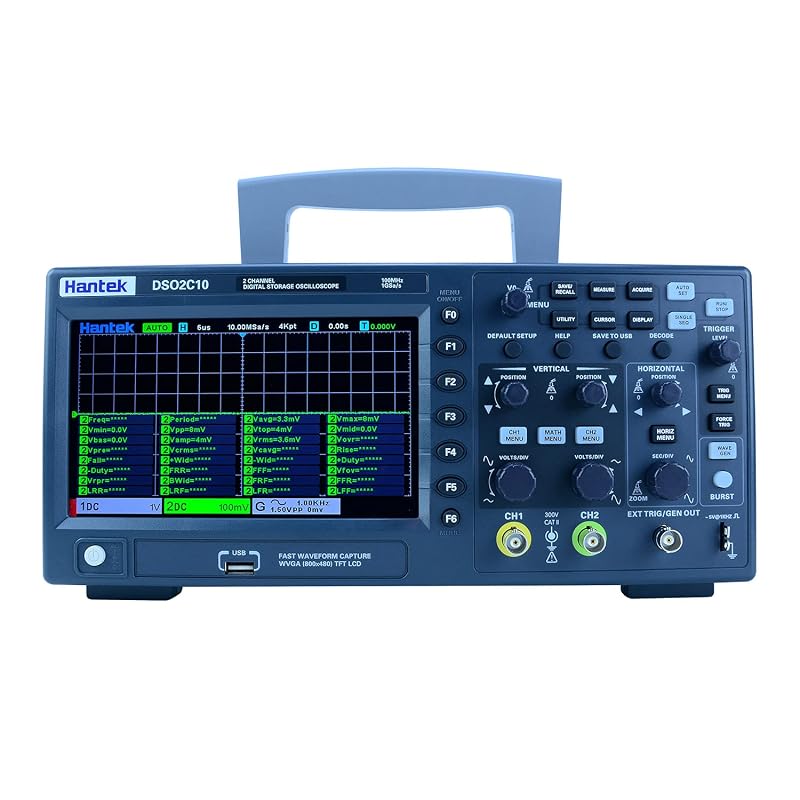
Hantek DSO2C10
4.3★★★★☆The DSO2D10 without the signal generator: two 100 MHz channels with deep memory and serial decoding.

Hantek DSO2D15
4.4★★★★☆The 150 MHz version of Hantek's DSO2000 bench scope, with a 25 MHz generator and serial decoding.
Specs side by side
| Hantek DSO2C10 | Hantek DSO2D15 | |
|---|---|---|
| Rating | 4.3★★★★☆ | 4.4★★★★☆ |
| Bandwidth | 100MHz | 150MHz |
| Channels | 2 | 2 |
| Sample rate | 1 GSa/s (1 ch); 500 MSa/s (2 ch) | 1 GSa/s (1 ch); 500 MSa/s (2 ch) |
| Best for | Low-cost serial-bus debugging on two channels | A budget bench that wants extra bandwidth and a signal source |
| Bandwidth | 100MHz | 150MHz |
| Channels | 2 | 2 |
| Sample rate, 1 channel | 1 GSa/s | 1 GSa/s |
| Sample rate, 2 channels | 500 MSa/s | 500 MSa/s |
| Memory depth | 8 Mpts (1 ch); 4 Mpts (2 ch) | 8 Mpts (1 ch); 4 Mpts (2 ch) |
| Vertical resolution | 8-bit; high-res mode to 12-bit | 8-bit; high-res mode to 12-bit |
| Built-in signal generator | None (per Hantek's spec table) | 1-ch, 25MHz sine / 10MHz square or arbitrary, 200 MSa/s, 12-bit |
| Serial decode | UART, I2C, SPI, CAN, LIN | UART, I2C, SPI, CAN, LIN |
| Display | 7-inch, 800 × 480 | 7-inch, 800 × 480 |
| Rise time | Not separately stated for this model | 2.4 ns |
Specs checked against manufacturer documentation and official Amazon listings. Desk research, not bench testing. How we research.
Key differences
- →Signal generator: the DSO2D15 has a built-in one-channel DDS generator; Hantek's spec table lists none for the DSO2C10, even though both front panels carry the same WAVE GEN / GEN OUT labels — go by the spec, not the panel.
- →Bandwidth: 150 MHz on the DSO2D15 against 100 MHz on the DSO2C10, a 50% increase.
- →Everything else that both Picks document — sample rate, memory depth, vertical resolution, serial decoding, display — is identical between them.
- →This listing for the DSO2D15 bundles a P4100 100X probe; the DSO2C10's listing doesn't include one.
Spec by spec
Most of the DSO2000-series spec sheet is identical between these two models. The chart below isolates the two numbers that actually differ: bandwidth and generator output.
Sample rate, memory depth and resolution are a wash — both scopes hit 1 GSa/s on one channel, 500 MSa/s on two, and the same 8/4 Mpts memory split. Neither number should factor into your decision here.
How the built-in generator changes a test setup
The classic two-channel job is a stimulus-and-response test: feed a known signal into an amplifier, filter or sensor interface, put channel 1 on the input and channel 2 on the output, and read gain, phase shift or distortion straight off the screen. Both Hantek scopes have the two channels for that. What differs is where the stimulus comes from.
With the DSO2D15 the whole loop lives in one instrument: one menu sets the frequency and amplitude, and the scope already knows what it is sending. On the DSO2C10 the same test works fine, but you need a second instrument, a second power outlet and a second set of controls, and the generator's own limits become part of the measurement. If you already own a function generator, the DSO2C10 plus that generator covers everything the DSO2D15 does here. If you don't, the gap is real, and it's worth reading our walkthrough on comparing input and output signals to see how often this kind of test comes up.
Keep the DSO2D15 generator's ceiling in mind: 25 MHz for sine and 10 MHz for square or arbitrary waveforms, at 200 MSa/s and 12-bit. That is plenty for audio, sensor and most analog-filter work, but it won't stand in for a fast clock source: at 200 MSa/s a 10 MHz square wave gets only 20 output samples per period, so expect softer edges than a dedicated pulse generator would give.
Hantek DSO2C10 vs DSO2D15: which should you buy?
Because the platforms are otherwise identical, this decision comes down to two independent questions: do you need a built-in generator, and does your work need more than 100 MHz of bandwidth?
If you need to drive a circuit, not just observe it: the DSO2D15
Filters, amplifiers and analog stages don't produce their own test signal — you have to feed them one. The DSO2D15's built-in generator (25 MHz sine, 10 MHz square or arbitrary) does that from the same box, letting you put the input on one channel and the output on the other without reaching for separate equipment.
If you already have a generator, or don't need one: the DSO2C10
Digital debugging — reading decoded UART, I2C, SPI, CAN or LIN traffic — doesn't need a signal source; the signals already exist on the bus. For that kind of work the DSO2C10 delivers the identical decoding, memory and sample-rate capability as the DSO2D15 for less money, with 100 MHz comfortably covering most digital and low-RF signals.
A 50% bandwidth increase matters less than a missing generator
Which should you buy?
| Buyer or job | Better fit | Why |
|---|---|---|
| Analog circuits, filters, amplifiers you need to drive | Hantek DSO2D15 | Built-in 25 MHz generator feeds the circuit under test |
| Digital bus debugging (UART, I2C, SPI, CAN, LIN) | Hantek DSO2C10 | Identical decoding for less money; no generator needed |
| Signals approaching 100-150 MHz | Hantek DSO2D15 | 150 MHz gives real headroom where the DSO2C10 compresses |
| Already own a bench signal generator | Hantek DSO2C10 | No reason to pay for a second one built in |
| Want a probe included in the box | Hantek DSO2D15 | This listing bundles a P4100 100X probe |
Want the DSO2D15 against a different FNIRSI alternative? See Hantek DSO2D15 vs FNIRSI 1014D. For the DSO2C10 against a generator-equipped FNIRSI, see Hantek DSO2C10 vs FNIRSI 1014D. The beginner oscilloscope roundup ranks both, and the oscilloscope buying guide explains every spec from scratch.
Same panel labels, different spec sheets
Choose the Hantek DSO2C10 if…
- ✓You already own a separate signal generator, or don't need one
- ✓100 MHz is comfortably above your fastest signals
- ✓You want to spend less for the same decoding and memory architecture
- ✓Your work is mostly observing existing signals, not creating test stimuli
Choose the Hantek DSO2D15 if…
- ✓You want a built-in generator so you don't need separate test equipment
- ✓Your signals run faster and 150 MHz gives you real headroom over the DSO2C10's 100 MHz
- ✓You want to test filters, amplifiers or analog stages by driving them yourself
- ✓You're buying one scope to cover both observing and generating signals
The bottom line
The Hantek DSO2C10 and DSO2D15 share the same platform, memory and decoding — the real decision is whether you need the DSO2D15's built-in 25 MHz generator, not the bandwidth difference. Buy the DSO2D15 if you need to drive circuits yourself; buy the DSO2C10 if you're mainly debugging digital signals and already have (or don't need) a separate generator.
Frequently asked questions
Is the Hantek DSO2D15 strictly better than the DSO2C10?+
It has more bandwidth (150 MHz vs 100 MHz) and a built-in generator the DSO2C10 lacks, so it's more capable — but it also costs more. If you don't need a generator and 100 MHz covers your signals, the DSO2C10 gets you the same decoding and memory for less.
Does the Hantek DSO2C10 really have no signal generator?+
Correct, per Hantek's own specification table — even though its front panel carries the same WAVE GEN and GEN OUT labels as the DSO2D15, which does have one. This is a documented quirk of the shared DSO2000 chassis design: go by the spec sheet, not the panel markings.
Do the DSO2C10 and DSO2D15 use the same probes?+
Yes, both are part of Hantek's DSO2000 series and use the same probe connector and general accessory ecosystem. The DSO2D15 listing on this site bundles an extra P4100 100X probe.
How much more bandwidth does the DSO2D15 actually give you?+
By the usual three-to-five-times usable-bandwidth rule, the DSO2C10's 100 MHz rating displays signals accurately up to roughly 20-33 MHz, while the DSO2D15's 150 MHz extends that to about 30-50 MHz. It's a real but moderate increase — smaller in practice than the 50% headline number suggests.
Can I use the DSO2D15's generator to test a filter or amplifier?+
Yes, that is its main job. Connect GEN OUT to the circuit input, put channel 1 on that input and channel 2 on the output, then step the generator frequency and compare amplitudes. The sine output reaches 25 MHz, so audio stages, sensor front ends and most hobby-level analog filters are well within range. On the DSO2C10 you'd need a separate generator for the same test.
Related