COMPARISON · OSCILLOSCOPES
FNIRSI DSO-TC3 vs FNIRSI DSO152
FNIRSI DSO-TC3 vs FNIRSI DSO152 is a choice between two single-channel pocket scopes from the same maker, aimed at people learning what a waveform looks like. The DSO152 is a plain oscilloscope: 200kHz of bandwidth and 2.5 MSa/s. The DSO-TC3 raises that to 500kHz and 10 MSa/s and adds a component tester and a 6-waveform signal generator, on a 2.4-inch screen with a built-in rechargeable battery.
By the OhmSavvy Research Team ·
Disclosure: OhmSavvy earns a commission from qualifying Amazon purchases made through these links, at no extra cost to you. How we're funded.

FNIRSI DSO-TC3
4.1★★★★☆A battery-powered pocket scope, component tester and signal generator in one small box.
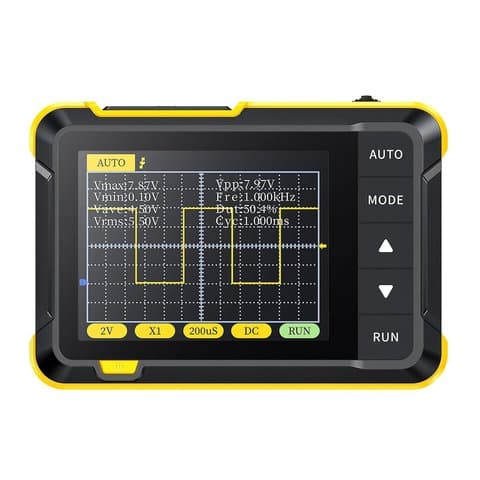
FNIRSI DSO152
4.1★★★★☆A genuinely pocket-sized scope for quick diagnostics — not a bench replacement.
Specs side by side
| FNIRSI DSO-TC3 | FNIRSI DSO152 | |
|---|---|---|
| Rating | 4.1★★★★☆ | 4.1★★★★☆ |
| Bandwidth | 500kHz | 200kHz |
| Channels | 1 | 1 |
| Sample rate | 10 MSa/s | 2.5 MSa/s |
| Best for | Beginners who want a scope, component tester and generator in one | Basic diagnostics, learning the fundamentals |
| Form factor | Pocket-sized, fold-out stand | Pocket-sized |
| Comfortable signal range (3–5× rule) | Up to roughly 100–170kHz | Up to roughly 40–65kHz |
| Signal generator | Sine, square, pulse, triangle, ramp 1–100 kHz at 0–3.3 V, plus DC | Not in our verified data |
| Component tester ranges | C 25 pF–100 mF, R 0.01 Ω–50 MΩ, L 10 µH–1,000 mH | Not in our verified data |
| Max test voltage | 400 V (per FNIRSI) | Not in our verified data |
| Size / weight | 79 × 103 × 31 mm, 250 g | Not in our verified data |
Specs checked against manufacturer documentation and official Amazon listings. Desk research, not bench testing. How we research.
Key differences
- →Bandwidth: 500kHz on the DSO-TC3 against 200kHz on the DSO152, 2.5 times more. By the 3–5× rule that moves the comfortable ceiling from roughly 40–65kHz to roughly 100–170kHz.
- →Sample rate: 10 MSa/s against 2.5 MSa/s, four times faster, so the DSO-TC3 takes 20 samples per cycle at its bandwidth limit against 12.5 on the DSO152.
- →The DSO-TC3 adds a component tester (transistors, MOSFETs, diodes, capacitance, resistance, inductance) and a 6-waveform signal generator up to 100kHz. Neither function is in our verified data for the DSO152.
- →Both have one input channel, so neither can show two signals side by side.
- →FNIRSI states the DSO-TC3's 2.4-inch screen, built-in rechargeable battery and USB-C charging. Our verified DSO152 data does not state its screen size or power source, so we can't compare those directly.
- →FNIRSI does not state the DSO-TC3's ADC resolution or memory depth, and neither appears in our DSO152 data either.
Spec by spec
These two are far closer than a pocket scope and a bench scope, so the charts use a linear scale. The gaps are real but modest: 2.5 times the bandwidth and 4 times the sample rate. Every number comes from the maker's published specs in our beginner roundup; the last chart is derived from them.
| Function | FNIRSI DSO-TC3 | FNIRSI DSO152 |
|---|---|---|
| Oscilloscope | 1 channel, 500kHz, 10 MSa/s | 1 channel, 200kHz, 2.5 MSa/s |
| Component tester | Yes: transistors, MOSFETs, diodes, C, R, L | Not in our verified data |
| Signal generator | Yes: 6 waveforms, up to 100kHz | Not in our verified data |
| Screen | 2.4-inch | Not stated in our verified data |
| Power | Built-in rechargeable battery, USB-C charging | Not stated in our verified data |
| ADC resolution / memory depth | Not stated by FNIRSI | Not stated in our verified data |
For what bandwidth and sample rate actually mean on screen, see what oscilloscope bandwidth is and what GSa/s means. The same ideas apply at MSa/s, just a thousand times slower.
Which is better for beginners?
For most beginners the DSO-TC3 is the better learning tool, and the reason isn't its extra bandwidth. It is the built-in signal generator. When you first use a scope, the hardest part is often having something sensible to look at. With the DSO-TC3 you can generate a waveform of a known shape and frequency, feed it into the scope input, and practice setting the timebase, the volts per division and the trigger until the trace sits still. Because you know what the answer should be, every mistake in your settings shows up straight away. The DSO152 can teach the same controls, but only if you already have a circuit or a separate generator producing a signal.
The component tester is the second beginner advantage. Sorting out which leg of a transistor is which, checking whether a salvaged capacitor is still within its value, or confirming a diode's direction are everyday jobs when you start building circuits, and the DSO-TC3 covers them in the same box. FNIRSI lists wide ranges, capacitance from 25 pF to 100 mF, resistance from 0.01 Ω to 50 MΩ and inductance from 10 µH to 1,000 mH, but doesn't state the tester's accuracy, so treat it as a sorting and sanity-check tool rather than a precision instrument.
The DSO152 makes more sense when you want the simplest possible scope and nothing else. Its data calls it an extremely affordable entry point, and for a beginner who mostly wants to watch audio signals or a slow PWM pin, its 200kHz is enough. Its review covers that role in more detail: FNIRSI DSO152 review.
Neither one is a bench scope
Which should you buy?
| If you are… | Pick | Why |
|---|---|---|
| A complete beginner learning scope controls | FNIRSI DSO-TC3 | Its built-in generator gives you known signals to practice on |
| Building your first circuits from parts | FNIRSI DSO-TC3 | The component tester checks transistors, diodes, capacitors and more |
| Watching audio signals only | FNIRSI DSO152 | 200kHz covers the audio band; it is the simpler scope-only tool |
| Checking signals between about 40kHz and 100kHz | FNIRSI DSO-TC3 | Its 500kHz bandwidth keeps that range within the 3–5× rule |
| Spending as little as possible to try a scope | FNIRSI DSO152 | Its verified data calls it an extremely affordable entry point |
| Needing to compare two signals at once | Neither | Both are single-channel; look at a 2- or 4-channel scope |
| Debugging I2C, SPI or fast logic | Neither | Those clocks and edges need megahertz of bandwidth |
What each one can and can't measure
A scope's bandwidth is the frequency at which a sine wave is shown about 3 dB low, roughly 70% of its true amplitude. The usual rule of thumb is to pick a scope with 3–5 times the frequency of the signal you want to see, and more for square waves, whose sharp edges contain harmonics well above the fundamental.
FNIRSI DSO152: audio range and slower
At 200kHz, the DSO152 is comfortable up to roughly 40–65kHz. That covers the audio band (up to about 20kHz), the ripple on a linear power supply, slow sensor outputs and low-frequency PWM. A square wave of a few kilohertz will look square; one at 50kHz will already show softened edges.
FNIRSI DSO-TC3: a little further
At 500kHz, the DSO-TC3 is comfortable up to roughly 100–170kHz. That takes in everything the DSO152 can show, plus higher-frequency PWM and ultrasonic signals around 40kHz with more margin. A 100kHz I2C clock sits right at the edge of its comfortable range: you can see that it is toggling, but don't trust its edge shape. Megahertz SPI clocks, most switching regulators and fast logic are beyond both scopes.
How rounded the edges get
The model makes the 3–5× rule visible. At 100 kHz the DSO-TC3's trace reaches the top within about a seventh of each half-cycle and then sits flat, so the waveform still reads as a square wave. The DSO152 spends about a third of each half-cycle climbing, which turns the same signal into something closer to a shark fin. Drop the signal to 20 kHz, inside the DSO152's comfortable range, and each half-cycle stretches to 25 µs; its 1.75 µs edge then takes only 7% of that, and both scopes draw a convincing square wave.
Mains and high voltage
Where to go next
If either pocket scope leaves you wanting a second channel or more bandwidth, the next step is a bench scope. See Rigol DS1054Z vs FNIRSI DSO152, FNIRSI DSO152 vs Hantek DSO2D10, FNIRSI DSO152 vs Siglent SDS1104X-E and FNIRSI 1014D vs FNIRSI DSO-TC3, or start from the oscilloscope buying guide.
Choose the FNIRSI DSO-TC3 if…
- ✓You want a signal generator to feed known waveforms into the scope while you learn
- ✓You also want to identify and check transistors, MOSFETs, diodes, capacitors, resistors and inductors
- ✓Your signals reach past the audio band, toward 100kHz
- ✓You want a stated built-in rechargeable battery with USB-C charging
Choose the FNIRSI DSO152 if…
- ✓You only want a scope, as the simplest and most affordable way to see a waveform
- ✓Your signals are audio-range or slower
- ✓You already own a signal source and a component tester, or don't need them
Neither if…
Neither if your work is microcontroller or digital-bus debugging: both are single-channel entry scopes, so you need a multi-channel bench scope like the Rigol DS1054Z instead.
The bottom line
For a beginner, the FNIRSI DSO-TC3 is the better buy of the two: 2.5 times the bandwidth, four times the sample rate, and a signal generator and component tester that make learning faster. The FNIRSI DSO152 still makes sense as the simplest, most affordable scope-only way to see audio-range waveforms. Neither replaces a multi-channel bench scope for microcontroller or digital work.
Frequently asked questions
Is the FNIRSI DSO-TC3 better than the DSO152 for a beginner?+
For most beginners, yes. Its 500kHz bandwidth and 10 MSa/s beat the DSO152's 200kHz and 2.5 MSa/s, and its built-in signal generator gives you known waveforms to practice scope controls on. The DSO152 is the simpler scope-only choice if you only want to watch audio-range signals.
Does the FNIRSI DSO152 have a signal generator or component tester?+
Neither appears in our verified DSO152 data, which describes it as a pocket-sized single-channel scope. The DSO-TC3 is the one with both: a 6-waveform generator up to 100kHz and a tester for transistors, MOSFETs, diodes, capacitance, resistance and inductance.
Can either FNIRSI pocket scope show two signals at once?+
No. The DSO-TC3 and the DSO152 each have a single input channel, so you can't compare an input with an output or a clock with a data line. For that you need a two-channel scope such as the FNIRSI 1014D or a four-channel bench scope.
Can the FNIRSI DSO-TC3 check I2C or Arduino signals?+
Only roughly. A 100kHz I2C clock sits at the edge of the DSO-TC3's comfortable range of about 100–170kHz, so you can confirm activity but not trust the edge shape. Faster I2C modes, SPI and most microcontroller timing work need a bench scope with megahertz of bandwidth and at least two channels.
What does FNIRSI not state about the DSO-TC3?+
FNIRSI does not state the DSO-TC3's ADC resolution or memory depth. Those affect how fine vertical detail looks and how long a stretch of signal you can capture at full sample rate, so we can't compare them against other scopes. Our verified DSO152 data doesn't state either figure.
Related