COMPARISON · OSCILLOSCOPES
MINIWARE DS213 vs FNIRSI DSO152
MINIWARE DS213 vs FNIRSI DSO152 compares two battery scopes that each fit in a shirt pocket but sit in different classes. The DS213 is a small mixed-signal instrument: two analog channels, two digital channels, 100 MSa/s and a built-in signal generator, with a 15 MHz bandwidth that only its Amazon listing states. The DSO152 is a single-channel 200kHz scope at 2.5 MSa/s, built to be the simplest way to see a waveform.
By the OhmSavvy Research Team ·
Disclosure: OhmSavvy earns a commission from qualifying Amazon purchases made through these links, at no extra cost to you. How we're funded.

MINIWARE DS213
4.0★★★★☆A 129 g pocket scope with two analog and two digital channels plus a built-in signal generator.
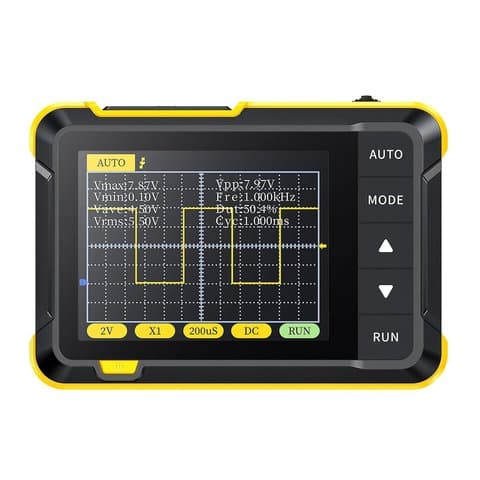
FNIRSI DSO152
4.1★★★★☆A genuinely pocket-sized scope for quick diagnostics — not a bench replacement.
Specs side by side
| MINIWARE DS213 | FNIRSI DSO152 | |
|---|---|---|
| Rating | 4.0★★★★☆ | 4.1★★★★☆ |
| Bandwidth | 15MHz (per Amazon listing) | 200kHz |
| Channels | 2 analog + 2 digital | 1 |
| Sample rate | 100 MSa/s | 2.5 MSa/s |
| Best for | A pocket scope with logic inputs and a signal source | Basic diagnostics, learning the fundamentals |
| Display | 3-inch, 320 × 240 (per Amazon listing) | 2.8-inch, 320 × 240 |
| Signal generator | Square to 8 MHz; sine, triangle, sawtooth to 20 MHz; 3 Vpp | None |
| Triggers | Edge, pulse, logic; Auto, Normal, Single, Slow | Auto, Normal, Single |
| Input coupling | AC/DC | AC/DC |
| Vertical range (x1 probe) | 10 mV/div to 10 V/div | 10mV/div to 20V/div |
| Maximum input | 40 Vpp (x1), 400 Vpp (x10) | 40V (x1), 400V (x10) |
| Battery | 1000 mAh; runtime not stated by Miniware | 1000mAh, about 4 hours; USB-C charging |
| Size and weight | 99.5 × 58.5 × 13.5 mm, 129 g | 99 × 68.3 × 19.5 mm, 100 g |
| Comfortable signal range (3–5× rule) | Up to roughly 3–5 MHz | Up to roughly 40–65kHz |
Specs checked against manufacturer documentation and official Amazon listings. Desk research, not bench testing. How we research.
Key differences
- →Inputs: the DS213 has two analog and two digital channels; the DSO152 has one analog channel.
- →Bandwidth: 15 MHz on the DS213 against 200kHz on the DSO152, 75 times higher. Miniware's own page doesn't state the DS213's bandwidth; the figure comes from its Amazon listing.
- →Sample rate: 100 MSa/s on the DS213 against 2.5 MSa/s, 40 times faster. Miniware doesn't say how the rate divides with several channels on.
- →Generator: the DS213 can output square waves to 8 MHz and sine, triangle and sawtooth waves to 20 MHz, in fixed steps; the DSO152 has no output.
- →Triggering: Miniware lists edge, pulse and logic triggers for the DS213; FNIRSI lists Auto, Normal and Single trigger modes for the DSO152.
- →Size: the DS213 is thinner (13.5 mm against 19.5 mm) and narrower, but at 129 g it weighs more than the 100 g DSO152.
- →Sources: Miniware's website is offline, so the DS213's specs come from an archived copy of its product page plus its Amazon listing. FNIRSI publishes the DSO152's specs on a live page.
- →Neither carries our Hands-on Tested badge; both assessments are desk research from published specs.
Spec by spec
On paper the DS213 is the more capable instrument by a wide margin, so the speed charts use a log scale. The physical charts are closer, and they don't all favor the same unit: the DS213 is slimmer, the DSO152 is lighter.
Bars use a logarithmic scale: each step is ten times the last.
Bars use a logarithmic scale: each step is ten times the last.
The sample-rate-to-bandwidth ratio is healthy on both: about 6.7 samples per cycle at the DS213's 15 MHz and 12.5 at the DSO152's 200kHz. In practice the DS213 draws a clean shape on signals up to a few MHz, and the DSO152 on signals up to a few tens of kHz. If you are unsure how the two specs relate, read what oscilloscope bandwidth means and what GSa/s means.
Which should you buy?
| Buyer or job | Pick | One-line reason |
|---|---|---|
| Testing an RC filter or small amplifier away from the bench | MINIWARE DS213 | Its generator drives the circuit while CH A and CH B show input and output |
| First look at waveforms for a student | FNIRSI DSO152 | One channel, three trigger modes and a short menu to learn |
| Checking that a UART TX line toggles while watching a supply rail | MINIWARE DS213 | A digital channel for the logic line, an analog channel for the rail |
| Watching a slow sensor output over minutes | FNIRSI DSO152 | FNIRSI lists a timebase up to 50s/div |
| Looking at a 1 MHz clock or an SPI clock line | MINIWARE DS213 | Inside its range; five times past the DSO152's bandwidth |
| Checking audio for clipping or a speaker line for hum | Either | Both cover audio; the DSO152 is the simpler tool for it |
| Saving captures to a computer for a report | MINIWARE DS213 | 8 MB built-in USB disk stores BMP, BUF and CSV files |
What each one can and can't measure
Rated bandwidth is the frequency at which a sine wave shows about 30% smaller than it is. To see a waveform at close to its true size, buy three to five times its frequency, and more for square waves, whose shape depends on harmonics well above the fundamental.
MINIWARE DS213: a small mixed-signal kit
Taking the listed 15 MHz at face value, the DS213 suits signals up to about 3–5 MHz: microcontroller clocks at the low end, PWM, UART, I2C at 100kHz or 400kHz, audio and most hobby sensor outputs. Two analog channels let you measure delay or gain between two points, and the two digital channels add logic lines without spending an analog input, which suits a chip-select line against a data line. Logic triggering helps isolate one state of those lines; Miniware doesn't list protocol decoding, so you read the bits yourself. The limits are its 3-inch screen for four traces, 4K points per channel, which keeps long captures coarse, and specs you can't check on a live maker page.
FNIRSI DSO152: one slow channel, kept simple
At 200kHz, the DSO152 is comfortable up to roughly 40–65kHz. That covers sound, mains-derived signals on a transformer secondary, servo pulses, slow PWM and the ripple on a linear supply, which AC coupling and 10mV/div make easy to enlarge. Its 20V/div top range, twice the DS213's 10 V/div with a x1 probe, fits a large signal on screen at a glance, and its slowest timebase of 50s/div lets a drifting sensor crawl across the display. It can't compare two signals, has no logic inputs or output, and a 100kHz I2C clock is already past its comfortable range.
That hookup is the clearest way to see the gap between the two. With the DS213, set the generator to one of its fixed sine steps, read the amplitude on A and B, then step to the next frequency; the ratio of the two traces is the filter's gain at that point. The DSO152 can only show one of those nodes, and it needs an outside source to drive the circuit in the first place.
A generator faster than its own scope
Battery scopes and high voltage
The trust question with the DS213
The DS213 is the stronger instrument on every figure Miniware publishes, but you buy it with less paperwork behind it. Miniware's site is offline, so its specs come from an archived copy of the official product page, and the two numbers most buyers look at first, bandwidth and screen size, appear only on the Amazon listing. The DSO152's numbers are all on FNIRSI's live page. If you need the DS213's extra channels and generator, that gap is a reasonable trade; if you only need to see one slow waveform, the DSO152 does that with every figure on its maker's page.
The DSO152 has more rivals compared on FNIRSI DSO-TC3 vs FNIRSI DSO152, OWON HDS2202S vs FNIRSI DSO152 and FNIRSI DSO152 vs Hantek 6022BE. For handhelds with bigger screens, see HANMATEK HO52 vs OWON HDS272S; for the step to a bench scope, see Rigol DS1054Z vs FNIRSI DSO152, the beginner oscilloscope picks and the buying guide.
Choose the MINIWARE DS213 if…
- ✓You want to compare two analog signals, such as a filter's input and output, on a pocket instrument
- ✓You need to watch logic lines alongside an analog trace, using the two digital channels
- ✓You want a signal source in the same case to drive the circuit you are measuring
- ✓Your signals reach into the hundreds of kHz or low MHz
Choose the FNIRSI DSO152 if…
- ✓You want the most basic, lowest-cost way to see what a signal looks like
- ✓One channel is enough and your signals stay in the audio range or slower
- ✓You prefer specs you can check on the maker's live product page
- ✓You want USB-C charging and a battery FNIRSI rates for about 4 hours
Neither if…
You need to probe mains or another earth-referenced point: both run on battery with no CAT rating listed by either maker, and the 400 V x10-probe figures are input ranges, not safety ratings — use a differential probe or a properly rated instrument instead.
The bottom line
The MINIWARE DS213 is the better pocket instrument if you need more than one trace: two analog and two digital channels, 100 MSa/s and a built-in generator, though its 15 MHz bandwidth and screen size are stated only on Amazon. The FNIRSI DSO152 is the better pick for a first, simple look at slow signals: one channel, 200kHz, specs published on FNIRSI's live page and USB-C charging.
Frequently asked questions
Is the MINIWARE DS213 a logic analyzer?+
Partly. Besides its two analog channels it has two digital channels and Miniware lists a logic trigger, so you can watch two logic lines next to analog traces. That is far fewer lines than a dedicated logic analyzer, and Miniware doesn't list protocol decoding, so you read serial data from the waveform yourself. The FNIRSI DSO152 has no digital inputs.
What bandwidth does the MINIWARE DS213 have?+
Its Amazon listing gives 15 MHz. Miniware's own product page, now available only as an archived copy because the maker's site is offline, lists 100 MSa/s sampling but no bandwidth figure. Treat 15 MHz as the seller's stated figure. Even with some margin, it is many times the FNIRSI DSO152's 200kHz.
Can the DS213's signal generator test its own inputs?+
Yes, within limits. You can feed its output into CH A to see a known square or sine wave, a useful check that probes and settings are right. But Miniware lists sine output up to 20 MHz, above the 15 MHz bandwidth on the Amazon listing, so the highest settings will display smaller than they are. Frequencies come in fixed steps at 3 Vpp.
Which pocket scope is better for a complete beginner?+
The FNIRSI DSO152, if you mainly want to learn what waveforms look like. One channel and three trigger modes keep the menus short, and slow signals are where beginners usually start. Pick the DS213 if you already know you will compare two signals or look at logic lines, since the DSO152 can't grow into those jobs.
Which one is smaller to carry?+
They are almost the same length, about 99 mm. The DS213 is narrower and slimmer at 58.5 mm wide and 13.5 mm thick, against 68.3 mm and 19.5 mm for the DSO152. The DSO152 is lighter, 100 g against 129 g. Both fit a shirt pocket, so choose on channels and speed rather than size.
Related