REVIEW · OSCILLOSCOPES
Siglent SDS1104X-E Review
More bandwidth and a better UI than the Rigol, for projects that will get more demanding.
By the OhmSavvy Research Team ·
| Model | Siglent SDS1104X-E |
|---|---|
| Bandwidth | 100MHz |
| Channels | 4 |
| Sample rate | 1 GSa/s |
| Best for | Intermediate hobbyists who expect their projects to grow |
| Review status | Hands-on tested by OhmSavvy |
Disclosure: OhmSavvy earns a commission from qualifying Amazon purchases made through these links, at no extra cost to you. How we're funded.
The verdict
Double the Rigol's bandwidth (100MHz vs 50MHz) and twice its per-channel sample rate with three or four channels on (500 MSa/s vs 250 MSa/s), with a well-regarded user interface. A strong pick for anyone who expects their projects to get more demanding over time.
Consider it if
- ✓You need more than 50MHz of bandwidth headroom
- ✓You want four channels for multi-signal timing work
- ✓You value an intuitive interface
- ✓You debug I2C, SPI, UART, CAN or LIN buses and want decoding included rather than sold as an option
- ✓You chase rare glitches, where a fast waveform capture rate raises the odds of seeing them
Skip it if
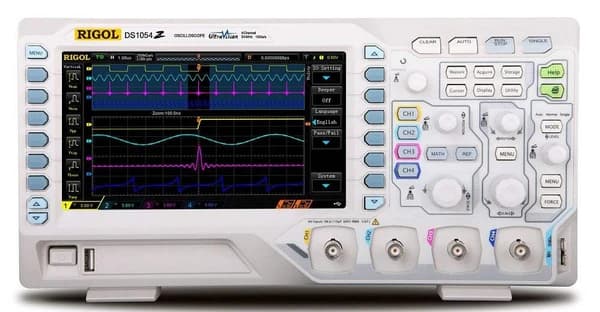
- ✕You're a complete beginner: the Rigol DS1054Z covers learning for less
- ✕Budget is your deciding factor
- ✕You need more than 8-bit vertical resolution for small signals riding on large ones, such as power-rail ripple measured in detail
The trade-off: It costs more than the Rigol DS1054Z. For that you get double the bandwidth and a better-regarded interface, at the same channel count and maximum sample rate (with a higher per-channel rate when three or four channels are on), plus standard serial decoding that includes CAN and LIN. That's worth it if any of those things is a genuine priority for you.
Key specifications
- Bandwidth
- 100MHz
- Channels
- 4
- Sample rate
- 1 GSa/s
- Best for
- Intermediate hobbyists, future-proofing
Checked against the manufacturer's official product page or datasheet and the official Amazon listing when this model was added to our guide.
Strengths and limitations
Reasons to buy
- +Higher bandwidth headroom than entry-level scopes
- +Well-regarded, intuitive UI
- +Strong value at the 100MHz tier
Reasons to avoid
- −Pricier than the Rigol DS1054Z
- −Overkill for pure beginners
Performance assessment
Bandwidth
100MHz is double the Rigol DS1054Z's 50MHz. By the 3–5× rule of thumb, it's comfortable on signals up to roughly 20–33MHz, which covers many hobby microcontroller clocks and serial buses.
Channels, sample rate, and interface
Four channels at a 1 GSa/s maximum, the same peak as the Rigol, but 500 MSa/s per channel with all four on versus the Rigol's 250 MSa/s, plus an interface that's widely regarded as intuitive.
What the interface actually gets you
An intuitive interface isn't a cosmetic nicety on an instrument you'll reach for dozens of times a session. It's the difference between adjusting a trigger or timebase in a couple of button presses versus hunting through nested menus mid-task. For someone learning to use a scope, a layout that matches your intuition means more time spent actually reading the waveform in front of you and less time fighting the instrument to display it correctly in the first place.
Memory depth: how long a capture really lasts
Siglent lists 7 Mpts per channel, or 14 Mpts when channels are interleaved. Memory sets how long the scope can record before it has to lower its sample rate. The arithmetic is simple: 14 million points at 1 GSa/s fills in 14 ms, and 7 million points at 500 MSa/s also covers 14 ms. That's long enough to hold several complete UART bytes or a burst of SPI traffic at full resolution, then zoom in on one edge. Rigol's own sources disagree on the DS1054Z (12 Mpts standard on its product page, 24 Mpts in the data sheet), so on memory alone the Rigol is the deeper scope.
Waveform capture rate and glitch hunting
Siglent quotes 100,000 waveforms per second in normal mode and 400,000 in sequence mode, against up to 30,000 in Rigol's DS1000Z data sheet. Every scope spends time between captures processing and drawing, and anything that happens in that gap is missed. A faster capture rate shrinks the blind time, so an intermittent runt pulse or a once-in-a-thousand glitch is more likely to land on screen, especially with persistence turned on.
Serial decoding included
I2C, SPI, UART/RS232, CAN and LIN triggering and decoding come as standard, according to Siglent. For Arduino and embedded work that means you can trigger on a specific I2C address or UART byte and read the decoded values under the waveform without buying a license. CAN and LIN make it relevant to automotive and industrial bus work too, which the Rigol's decode list (Parallel, RS232/UART, I2C and SPI) doesn't cover.
Screen, analysis and expansion
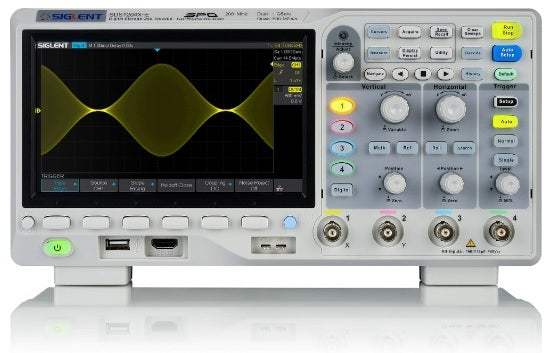
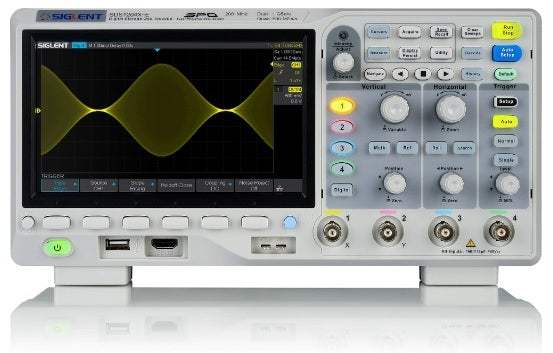
The 7-inch, 800 × 480 display is the same size and resolution as the Rigol's. Siglent's data sheet lists 38 automatic measurements, a 1 Mpts FFT and hardware pass/fail testing. On the four-channel models, a 16-channel logic analyzer (MSO) and a USB waveform generator are available as options, so the scope can grow into mixed-signal work later. There's no HDMI output listed, and the instrument draws up to 50 W from a 100–240 V AC supply.
Hands-on, and what we haven't published
Our owner bought and uses this scope, which is why it carries the Hands-on Tested badge. We haven't published bench measurements from it yet, so every number on this page comes from Siglent's or Rigol's own published specifications rather than our measurements. When we add test results, they'll appear here with the method used.
Limitations
Its ADC is 8-bit, so it resolves 256 vertical levels across the screen, the same as most scopes in this class. Small ripple riding on a large DC rail needs AC coupling or a higher-resolution scope to see clearly. Rigol lists more memory for the DS1054Z, the logic channels and generator cost extra, and 100MHz still isn't enough for fast edges on modern high-speed digital designs.
Alternatives to consider
Where to buy the Siglent SDS1104X-E
We link to the official Amazon listing. Prices change often, so check the current price at the retailer before you buy.
Frequently asked questions
Siglent SDS1104X-E or Rigol DS1054Z?+
Both have 4 channels and 1 GSa/s. The Siglent doubles bandwidth to 100MHz, includes CAN and LIN decoding as standard and is often praised for its interface; the Rigol costs less and lists more memory. If your signals stay well under 10MHz and you don't need bus decoding, the Rigol is the sensible saving.
Is 100MHz overkill for a beginner?+
For learning the basics, usually yes. It makes sense if you expect to work with faster digital signals as your projects develop.
What am I actually paying the premium for over the Rigol, given the specs look similar otherwise?+
Mainly two things: 100MHz bandwidth rated from the factory, double the Rigol's 50MHz, and an interface that's consistently rated easier to pick up. Standard CAN and LIN decoding and a faster capture rate come with it. Channel count and maximum sample rate are the same, so if none of that matters to your work, the premium buys you comparatively little.
Does 100MHz of bandwidth translate to a specific real-world benefit for hobby projects?+
By the 3-5x rule of thumb, 100MHz gives you comfortable, accurate readings on signals up to roughly 20-33MHz, double the Rigol's effective range. In practice that covers faster microcontroller clocks, certain serial communication buses, and digital signals that would start to look visibly distorted on a 50MHz scope. If your current projects stay well under that ceiling, the extra headroom is insurance against outgrowing the instrument rather than something you'll notice day to day.
Does the Siglent SDS1104X-E decode CAN bus?+
Yes. Siglent lists I2C, SPI, UART/RS232, CAN and LIN serial triggering and decoding as standard on the SDS1000X-E series, so there's no license to buy. That makes it useful for checking automotive or industrial CAN traffic on a bench, though for long captures of busy networks a dedicated CAN adapter and software is often the easier tool.
Can the SDS1104X-E work as a logic analyzer?+
Only with an option. Siglent offers a 16-channel MSO add-on for the four-channel SDS1000X-E models, which adds digital inputs alongside the four analog channels. Out of the box it has four analog channels only, which is still enough to decode an I2C or SPI bus directly from the analog inputs using the standard decode feature.
Related
Siglent SDS1104X-E
4.8★★★★★