COMPARISON · OSCILLOSCOPES
FNIRSI DSO152 vs Hantek 6022BE
FNIRSI DSO152 vs Hantek 6022BE pits two of the cheapest ways to own an oscilloscope against each other, and they solve the problem in opposite ways. The DSO152 is a complete pocket instrument: one channel, 200kHz, 2.5 MSa/s, a 2.8-inch screen and a battery. The 6022BE has no screen or battery at all: it is a two-channel, 20 MHz, 48 MS/s box that draws power from a Windows PC over USB and shows its traces in Hantek's software.
By the OhmSavvy Research Team ·
Disclosure: OhmSavvy earns a commission from qualifying Amazon purchases made through these links, at no extra cost to you. How we're funded.
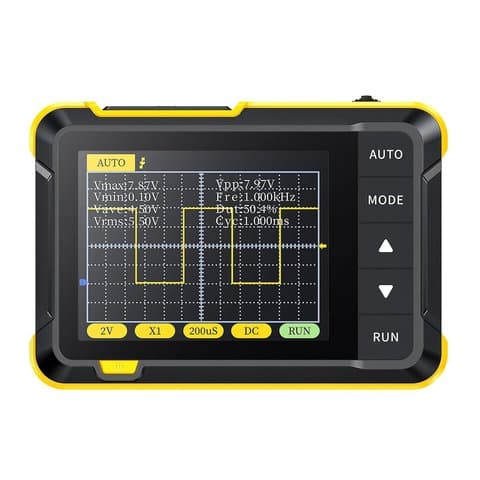
FNIRSI DSO152
4.1★★★★☆A genuinely pocket-sized scope for quick diagnostics — not a bench replacement.

Hantek 6022BE
4.0★★★★☆A very low-cost two-channel 20 MHz USB oscilloscope for learning on a Windows PC.
Specs side by side
| FNIRSI DSO152 | Hantek 6022BE | |
|---|---|---|
| Rating | 4.1★★★★☆ | 4.0★★★★☆ |
| Bandwidth | 200kHz | 20MHz |
| Channels | 1 | 2 |
| Sample rate | 2.5 MSa/s | 48 MS/s (max) |
| Best for | Basic diagnostics, learning the fundamentals | Learning scope basics on a Windows laptop for very little money |
| Display | Built-in 2.8-inch, 320 × 240 | None: Hantek software on a Windows PC |
| Power | 1000mAh battery, about 4 hours; USB-C charging | USB 2.0 bus power from the PC |
| Input coupling | AC/DC | DC only |
| Vertical range | 10mV/div to 20V/div | 20 mV/div to 5 V/div |
| Trigger modes | Auto, Normal, Single | Auto, Normal, Single; rising or falling edge |
| Size | 99 × 68.3 × 19.5 mm, 100 g | 205 × 120 × 35 mm (weight not stated by Hantek) |
| Comfortable signal range (3–5× rule) | Up to roughly 40–65kHz | Up to roughly 4–7 MHz |
Specs checked against manufacturer documentation and official Amazon listings. Desk research, not bench testing. How we research.
Key differences
- →Screen and power: the DSO152 has its own 2.8-inch display and a battery rated for about 4 hours; the 6022BE has neither and runs only when plugged into a computer.
- →Bandwidth: 20 MHz on the Hantek against 200kHz on the FNIRSI, 100 times higher.
- →Sample rate: 48 MS/s maximum on the 6022BE against 2.5 MSa/s, about 19 times faster. Hantek doesn't state the rate per channel with both channels running.
- →Channels: two on the Hantek, one on the FNIRSI.
- →Coupling: FNIRSI lists AC and DC coupling; Hantek lists DC coupling only for the 6022BE.
- →Software: Hantek lists Windows versions only, so the 6022BE needs a Windows PC. The DSO152 needs nothing else to show a trace.
- →Analysis: Hantek lists X-Y mode, FFT, add/subtract/multiply/divide math and cursors for the 6022BE.
- →Neither carries our Hands-on Tested badge; both assessments are desk research from the makers' published specs.
Spec by spec
On speed the 6022BE is ahead by one to two orders of magnitude, so the first two charts use a log scale. The other two show what you trade for that speed: a box twice as long that must stay tethered to a computer, and a sample rate that sits unusually close to its own bandwidth.
Bars use a logarithmic scale: each step is ten times the last.
Bars use a logarithmic scale: each step is ten times the last.
The third chart is the one that changes how you should read the 6022BE's headline. At 48 MS/s it takes 2.4 samples per cycle of a 20 MHz sine, barely past the theoretical minimum, so the trace at that frequency is mostly reconstruction. For a waveform whose shape you can trust without heavy interpolation, ten or so samples per cycle is a common working target, which puts the 6022BE's practical ceiling near 5 MHz on one channel, and possibly lower with both on since Hantek doesn't give that figure. That still leaves it about 100 times above the DSO152 in usable range. See what GSa/s means for the sampling side and what oscilloscope bandwidth means for the −3 dB side.
Which should you buy?
| Buyer or job | Pick | One-line reason |
|---|---|---|
| Working in a car, on a ladder or anywhere without a laptop | FNIRSI DSO152 | Own screen and a battery rated for about 4 hours |
| Mac or Linux user | FNIRSI DSO152 | Hantek lists Windows software only for the 6022BE |
| Comparing an amplifier's input and output | Hantek 6022BE | Two channels; the DSO152 has one |
| Looking at a 1 MHz crystal or a 500kHz switching node | Hantek 6022BE | Inside its range; far past the DSO152's 200kHz |
| Checking ripple on a 12V or 5V rail | FNIRSI DSO152 | AC coupling removes the DC level; the 6022BE is DC-coupled only |
| Plotting a Lissajous figure or phase between two signals | Hantek 6022BE | Hantek lists X-Y mode; it needs two channels |
| Saving traces for a report or a forum question | Hantek 6022BE | The waveform is already on the computer, ready to capture |
What each one can and can't measure
A scope's bandwidth rating is the frequency where a sine wave shows about 30% smaller than it really is. The rule of thumb is to buy three to five times the highest frequency you care about, and more for square waves, because their sharp edges contain harmonics well above the fundamental.
FNIRSI DSO152: slow signals, anywhere
Its 200kHz front end is comfortable up to roughly 40–65kHz. That includes everything a person can hear, the output of temperature, light and pressure sensors, servo pulses, LED dimming PWM and the ripple on a linear power supply. AC coupling is the quiet advantage here: switch it on and a 12V rail's DC disappears, leaving only the ripple, which at 10mV/div can be scaled to fill the 2.8-inch screen. The limits are speed and count. A 100kHz I2C clock is already past its comfortable range, and anything at megahertz rates will be rounded or missed. One channel means no timing between two events, and with 10µs/div as its fastest timebase, the shortest pulses it can spread across the screen are tens of microseconds long.
Hantek 6022BE: faster and two-channel, but tethered
By the bandwidth rule the 6022BE suits signals up to roughly 4–7 MHz, and the sample-rate limit above puts the sensible ceiling for waveform shape near the bottom of that band. That still covers a 9600-baud or 115200-baud UART line, a 100kHz or 400kHz I2C bus, an Arduino's PWM outputs and many switching regulators. Two channels let you trigger on one signal and watch another, and Hantek's X-Y mode and FFT run on a laptop screen far larger than any pocket scope's. The catches are practical. It is DC-coupled only, so a small ripple on a large DC rail is hard to examine at a sensitive setting; its most sensitive range is 20 mV/div, against 10mV/div on the FNIRSI; and Hantek doesn't clearly state its memory depth. It also does nothing without a Windows computer beside it.
Why DC-only coupling matters for ripple
USB scopes and ground
Pocket screen or laptop screen
The bigger question behind this pair is where you look at the waveform. The DSO152 puts a 320 × 240 picture in your hand: small, but always on, ready after one press of AUTO and usable in a car's footwell or behind a cabinet. The 6022BE borrows your laptop's display, which gives far more room for two traces, cursors and an FFT, and makes screenshots trivial. In return you carry a 205 × 120 × 35 mm box, two probes and a laptop, and you need a free USB port.
For a learner, both are low-stakes ways to start. Buy the DSO152 if you want to grab it and look; buy the 6022BE if you already sit at a Windows laptop and want two channels and a hundred times the bandwidth. Other PC-scope options are compared on OWON VDS1022I vs Hantek 6022BE and PicoScope 2206B vs Hantek 6022BE, and a 3-in-1 handheld on OWON HDS2202S vs FNIRSI DSO152. If neither is enough, the Rigol DS1054Z vs Hantek 6022BE page covers the step to a bench scope, and the buying guide explains each spec.
Choose the FNIRSI DSO152 if…
- ✓You want to measure away from a computer, on battery, with the waveform on the device itself
- ✓You need AC coupling to look at ripple or a small signal riding on a DC level
- ✓You use a Mac, Linux or a tablet rather than a Windows PC
- ✓Your signals stay in the audio range or slower
Choose the Hantek 6022BE if…
- ✓You always work next to a Windows laptop and want two channels for the lowest outlay
- ✓You need to compare two signals, such as an input and an output or a clock and its data
- ✓Your signals run into the hundreds of kHz or low MHz, past the DSO152's ceiling
- ✓You want X-Y mode, FFT and math on a big screen
The bottom line
If you work at a Windows laptop and your signals go beyond audio, the Hantek 6022BE gives two channels and 100 times the bandwidth for very little money, though it is DC-coupled only and useless away from the computer. The FNIRSI DSO152 is the better pick if you want a self-contained, battery-powered scope with AC coupling, use a Mac or Linux machine, or mostly look at slow signals.
Frequently asked questions
Does the Hantek 6022BE work without a computer?+
No. The 6022BE has no screen, controls or battery. It draws power over USB 2.0 and shows its traces in Hantek's software, which Hantek lists for Windows versions only. The FNIRSI DSO152 is the self-contained option of these two: it has a 2.8-inch screen and a 1000mAh battery rated for about 4 hours.
Can I use the Hantek 6022BE on a Mac?+
Hantek lists Windows 10, 8, 7, NT, XP and Vista for the 6022BE and no macOS or Linux software, so plan on a Windows PC. If you only have a Mac, a tablet or no computer at the bench, the FNIRSI DSO152 needs nothing else to display a waveform.
Is 48 MS/s enough for a 20 MHz scope?+
It is enough to detect a 20 MHz signal but not to draw its shape well. 48 MS/s gives 2.4 samples per cycle at 20 MHz, just above the Nyquist minimum of 2. Aiming for about ten samples per cycle puts the 6022BE's realistic limit for waveform shape near 5 MHz, still far beyond the DSO152's 200kHz.
Which is better for checking power supply ripple?+
The FNIRSI DSO152, for supplies with low-frequency ripple. FNIRSI lists AC coupling and a 10mV/div setting, so the DC level can be blocked and the ripple enlarged. Hantek lists DC coupling only for the 6022BE, which keeps the rail's DC voltage in the trace. For switching-supply ripple at hundreds of kHz, the DSO152's bandwidth is too low.
Which is the better first oscilloscope for a beginner?+
It depends on where you'll use it. At a Windows laptop the 6022BE teaches more, because two channels let you compare signals and 20 MHz covers typical Arduino work. Away from a computer, or on a Mac, the DSO152 is the simpler start: switch it on, press AUTO and the waveform appears on its own screen.
Related