COMPARISON · OSCILLOSCOPES
Rigol DS1054Z vs Hantek 6022BE for Beginners
Rigol DS1054Z vs Hantek 6022BE is the classic first-scope dilemma: spend more on a real bench instrument, or start with a cheap USB box. The Rigol has four channels, 50MHz, 1 GSa/s and a 7-inch screen, and carries our Hands-on Tested badge. The Hantek is a two-channel, 20MHz, 48 MS/s PC oscilloscope with no screen, powered by USB and run from Hantek's Windows software.
By the OhmSavvy Research Team ·
Disclosure: OhmSavvy earns a commission from qualifying Amazon purchases made through these links, at no extra cost to you. How we're funded.
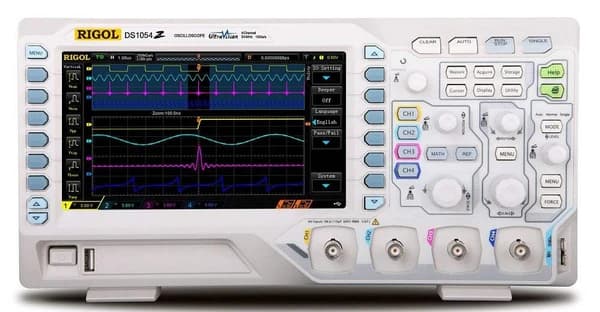
Rigol DS1054Z
4.8★★★★★The default beginner oscilloscope recommendation for years, and still worth it.

Hantek 6022BE
4.0★★★★☆A very low-cost two-channel 20 MHz USB oscilloscope for learning on a Windows PC.
Specs side by side
| Rigol DS1054Z | Hantek 6022BE | |
|---|---|---|
| Rating | 4.8★★★★★ | 4.0★★★★☆ |
| Bandwidth | 50MHz | 20MHz |
| Channels | 4 | 2 |
| Sample rate | 1 GSa/s | 48 MS/s (max) |
| Best for | Hobbyists, students, general electronics | Learning scope basics on a Windows laptop for very little money |
| Display | Built-in 7-inch, 800 × 480 | None: uses Hantek's Windows software |
| Power | 100–240 V AC, 50 W max | USB 2.0 bus power |
| Sample rate, 2 channels on | 500 MSa/s | Not stated by Hantek |
| ADC resolution | 8-bit (12-bit high-resolution mode) | 8-bit |
| Memory depth | Rigol conflicts: 12M standard / 24M optional (product page), 24 Mpts (datasheet) | 1M buffer listed, not clearly assigned to this model |
| Serial decoding | Parallel, UART/RS232, I2C, SPI (option per product page; no option label in datasheet) | Not stated by Hantek |
| Signal generator | None | None |
| Computer connection | USB host/device and LAN | USB 2.0 (required to operate) |
Specs checked against manufacturer documentation and official Amazon listings. Rigol DS1054Z is hands-on tested by OhmSavvy; the Hantek 6022BE assessment is desk research. How we research.
Key differences
- →The DS1054Z is a standalone instrument with a 7-inch screen and front-panel controls; the 6022BE has neither and only works while connected to a Windows PC running Hantek's software.
- →Channels: four on the Rigol against two on the Hantek, so a chip select, clock and two data lines fit on one Rigol screen.
- →Bandwidth is 50MHz against 20MHz, and the Rigol samples at 1 GSa/s on one channel (250 MSa/s with all four on) against the Hantek's 48 MS/s maximum.
- →Rigol's datasheet lists UART, I2C, SPI and parallel decoding (its product page calls bus decoding an option); Hantek doesn't state any decoding for the 6022BE.
- →The Hantek runs from USB bus power and fits in a drawer at 205 × 120 × 35 mm; the Rigol is a mains-powered benchtop unit drawing up to 50 W.
- →Neither has a built-in signal generator, so you'll need your circuit, a microcontroller or a separate generator as the signal source.
Spec by spec
On every headline figure the Rigol leads: 2.5 times the bandwidth, twice the channels, and a sample rate that stays well ahead even when all four of its channels share it. Hantek publishes only a single maximum sample rate for the 6022BE, so the chart below can't show what it drops to with both channels active.
Bars use a logarithmic scale: each step is ten times the last.
The 6022BE's real ceiling is lower than its bandwidth suggests: at 48 MS/s a 7MHz signal gets fewer than seven samples per cycle, so its shape is mostly guesswork by the software. Our explainers on oscilloscope bandwidth and sample rate in GSa/s walk through why both numbers matter.
The arithmetic behind the diagram: one cycle of 7 MHz lasts about 143 ns. At 48 MS/s the Hantek takes a sample every 20.8 ns, so roughly 6.9 samples fall on each cycle, and they land at different points of the wave on each cycle. At 250 MSa/s the Rigol samples every 4 ns, about 36 times per cycle, and that is its worst case with all four channels running. Sine interpolation can rebuild a clean sine from a handful of points, but a square wave or a ringing edge has detail between those points that no software can recover.
Rigol DS1054Z vs Hantek 6022BE for beginners
A beginner's first months with a scope are about a few core skills: setting volts per division and time per division, getting a stable trigger, and reading frequency, period and amplitude off the screen. Both of these scopes can teach that. The difference is how it feels. On the DS1054Z every one of those settings has a physical control, so turning the timebase knob and watching the trace stretch builds an intuition that carries over to most bench scopes in college labs and workplaces. On the 6022BE the same settings live in drop-down menus in Hantek's software, which works but puts a mouse between you and the signal.
Money is the case for the Hantek. It is a very low-cost scope, and since it borrows your laptop's screen and USB power there is nothing else to buy. If you are not yet sure electronics will stick as a hobby, that is a reasonable way to find out. The catch is that beginners tend to outgrow it quickly: the first time you want to watch SPI chip select, clock and data together, or look at the switching edge of a buck converter, two channels and 48 MS/s run out.
The DS1054Z costs more but is the pick beginners are least likely to replace. Its four channels, 50MHz and 7-inch screen cover nearly everything in a hobby workshop short of RF, and it has strong community support and documentation. Our DS1054Z review notes the menus take some learning; that is the price of its feature set, and a learning curve you only climb once.
Check your computer before buying the 6022BE
What each scope can measure in a beginner's projects
| Beginner task | Hantek 6022BE | Rigol DS1054Z |
|---|---|---|
| Arduino PWM on an LED or motor pin (around 490 Hz to 1 kHz) | Yes, with room to spare | Yes |
| Servo control pulses (50 Hz, 1–2 ms wide) | Yes | Yes |
| UART at 115,200 baud | Yes; read bits by eye | Yes; decoding listed by Rigol (option status conflicts) |
| I2C at 100 or 400 kHz, clock and data together | Yes, two channels is exactly enough | Yes, with two channels spare |
| SPI at several MHz with chip select, clock, MOSI, MISO | Two lines at a time, coarse edges | All four lines in one capture |
| Ringing on a fast logic edge | No: 20MHz and 48 MS/s smear edges faster than about 20 ns | Edges down to roughly 7 ns (0.35 ÷ 50MHz, an approximation) |
The pattern is clear. For signals in the audio and low-kHz range the 6022BE does the job, and two channels let you compare an input with an output or a clock with its data. Once signals reach the MHz range or you need more than two at once, the Rigol is the one that keeps up. By the 3–5x rule the DS1054Z is comfortable to roughly 10–17MHz, which covers most microcontroller buses and many small switching regulators. For hands-on practice, try measuring PWM duty cycle and setting up a trigger on whichever scope you choose.
Keep both scopes off mains wiring
Which should you buy?
| Your situation | Pick | Reason |
|---|---|---|
| Student or hobbyist with a dedicated desk | Rigol DS1054Z | Self-contained, four channels, physical controls to learn on |
| Curious first-timer on the smallest budget | Hantek 6022BE | Very low cost; your Windows laptop does the rest |
| Mac or Chromebook owner | Rigol DS1054Z | Hantek lists only Windows software for the 6022BE |
| Learning serial buses beyond basic UART | Rigol DS1054Z | Four channels, 50MHz and listed I2C/SPI decoding |
| Needs a scope that packs into a laptop bag | Hantek 6022BE | 205 × 120 × 35 mm and powered over USB |
| Wants to avoid upgrading within a year | Rigol DS1054Z | 2.5x the bandwidth, twice the channels |
Other first-scope matchups worth reading: the Rigol against another PC scope in Rigol DS1054Z vs OWON VDS1022I, against a pocket scope in Rigol DS1054Z vs FNIRSI DSO152, and the 6022BE against a bench Hantek in Hantek 6022BE vs Hantek DSO2D10. The best beginner oscilloscopes roundup and the oscilloscope buying guide put both in wider context.
Choose the Rigol DS1054Z if…
- ✓You are setting up a permanent electronics bench and want a scope that switches on and works
- ✓You expect to move past Arduino basics into SPI, motor drivers or switching regulators
- ✓You want four channels so a whole bus fits in one capture
- ✓You want the pick in this pairing that carries our Hands-on Tested badge
Choose the Hantek 6022BE if…
- ✓You want to find out whether you enjoy scope work before spending bench-scope money
- ✓You already have a Windows laptop and no spare desk space
- ✓Your projects are audio, hobby PWM, servo pulses and slow serial links
Neither if…
You need to measure a floating or mains-referenced point without extra care: the DS1054Z's probe ground ties to mains earth and Hantek doesn't list USB isolation for the 6022BE, so either one needs a differential probe for that job, not just a pick between these two.
The bottom line
For most beginners the Rigol DS1054Z is the better first oscilloscope: four channels, 50MHz, a sample rate many times higher and a screen and knobs of its own, so it grows with you from blinking LEDs to SPI buses. The Hantek 6022BE is a sensible toe in the water only if budget comes first, you work on a Windows laptop and your signals stay in the audio-to-low-MHz range.
Frequently asked questions
Is the Hantek 6022BE good enough for a complete beginner?+
For learning the basics, yes. It shows two channels at up to 20MHz and lets you practice timebase, volts per division and edge triggering on Arduino PWM, servo pulses and UART. Its limits appear as soon as projects involve MHz signals, more than two lines at once, or small ripple on a DC rail.
Does the Rigol DS1054Z need a computer to work?+
No. It is a complete benchtop instrument with a 7-inch 800 × 480 display and its own controls, powered from the mains. Its USB and LAN ports are there for saving screenshots or remote control, not for basic use. The Hantek 6022BE, by contrast, can't do anything without a Windows PC.
Can the Hantek 6022BE run on a Mac?+
Hantek's product page lists its software for Windows versions only, the newest being Windows 10, so a Mac isn't a supported option. If you don't own a Windows computer, a standalone scope such as the Rigol DS1054Z avoids the problem entirely.
Does the DS1054Z decode I2C and SPI as standard?+
Rigol's own sources disagree. The DS1000Z datasheet lists parallel, UART/RS232, I2C and SPI decoding without marking it optional, while Rigol's product page describes bus triggering and decoding as options. Check the listing or unit you buy. Hantek doesn't state any protocol decoding for the 6022BE.
Has OhmSavvy tested either scope?+
The Rigol DS1054Z carries our Hands-on Tested badge. The Hantek 6022BE assessment is desk research based on Hantek's published specifications, so everything said about it on this page comes from those figures rather than our own measurements.
Related