COMPARISON · OSCILLOSCOPES
FNIRSI 2C53T vs FNIRSI 1014D
FNIRSI 2C53T vs FNIRSI 1014D is a choice between two shapes of instrument from the same maker. The 2C53T is a 300 g battery handheld that folds a 50 MHz two-channel scope, a 19,999-count True RMS multimeter and a 50 kHz generator into one box. The 1014D is a 100 MHz, 1 GSa/s two-channel benchtop with a 7-inch screen and a DDS generator reaching 10 MHz. Where you work, and on what, decides it.
By the OhmSavvy Research Team ·
Disclosure: OhmSavvy earns a commission from qualifying Amazon purchases made through these links, at no extra cost to you. How we're funded.
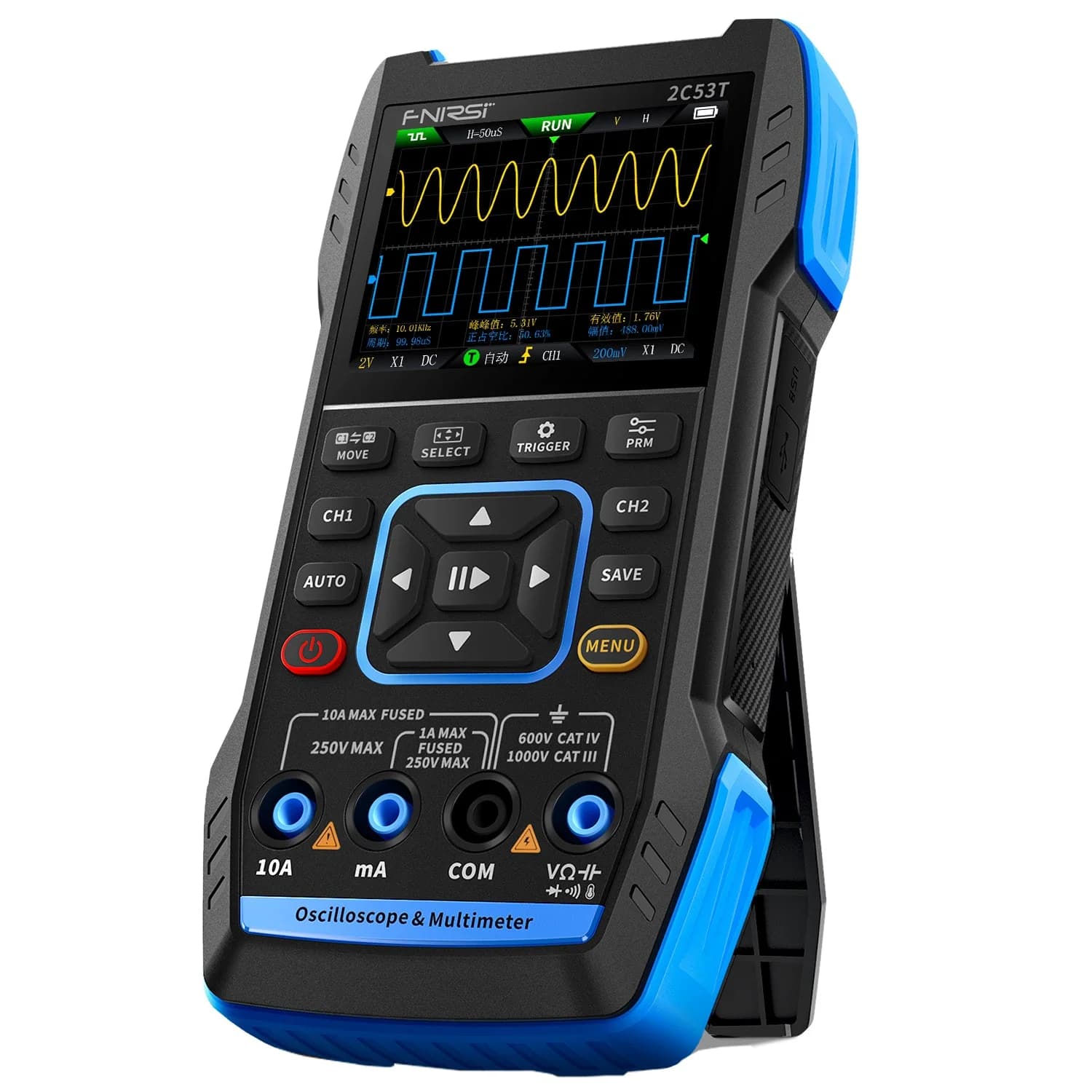
FNIRSI 2C53T
4.1★★★★☆A low-cost two-channel handheld scope with a 19,999-count True RMS multimeter and a basic generator.

FNIRSI 1014D
4.3★★★★☆A two-channel 100 MHz benchtop with a built-in signal generator at an entry-level price.
Specs side by side
| FNIRSI 2C53T | FNIRSI 1014D | |
|---|---|---|
| Rating | 4.1★★★★☆ | 4.3★★★★☆ |
| Bandwidth | 50MHz | 100MHz |
| Channels | 2 | 2 |
| Sample rate | 250 MSa/s | 1 GSa/s |
| Best for | Beginners who want a meter and scope in one | Budget benches that need a scope and a signal source |
| Form factor | Handheld, 167 × 89 × 35 mm | Benchtop, 310 × 145 × 70 mm |
| Weight | 300 g | 3.46 lb (about 1.6 kg, Amazon listing) |
| Power | Built-in 3,000 mAh battery, USB-C 5 V/1 A charging | 5 V adapter; no battery stated |
| Display | 2.8-inch, 320 × 240 | 7-inch, 800 × 480 |
| Record length | 1 Kpts | Quoted by FNIRSI as "240Kbit" |
| Vertical resolution | Not stated by FNIRSI | 8-bit |
| Signal generator | 13 waveforms, up to 50 kHz, 0–3 V | 1-ch DDS: sine to 10 MHz, other waveforms to 2 MHz, 2.5 Vpp |
| Multimeter | 19,999 counts, True RMS; 1000 V DC, 750 V AC, 9.999 A | None |
| Scope analysis | FFT, 8 math operations, X-Y, roll, cursors, persistence | FFT, X-Y, roll, 12 automatic parameters |
Specs checked against manufacturer documentation and official Amazon listings. Desk research, not bench testing. How we research.
Key differences
- →Form factor first: the 2C53T is a 300 g handheld on a 3,000 mAh battery; the 1014D is a benchtop that runs from a 5 V adapter and weighs 3.46 lb per its Amazon listing.
- →Bandwidth and sampling: 100 MHz and 1 GSa/s on the 1014D against 50 MHz and 250 MSa/s on the 2C53T, so the bench model has twice the bandwidth and four times the sample rate.
- →Only the 2C53T has a multimeter: 19,999 counts, True RMS, up to 1000 V DC, 750 V AC and 9.999 A.
- →The 1014D's generator reaches 10 MHz on sine and 2 MHz on other waveforms; the 2C53T's 13 waveforms stop at 50 kHz.
- →Screen: 7-inch 800 × 480 on the 1014D, five times the pixels of the 2C53T's 2.8-inch 320 × 240.
- →Record length: FNIRSI states 1 Kpts for the 2C53T; for the 1014D it gives only "240Kbit", which isn't directly comparable.
- →Neither carries our Hands-on Tested badge. The 1014D rates 4.3 in our roundup and the 2C53T 4.1.
Spec by spec
On paper the 1014D wins every scope figure, which is what you would expect when one product spends its whole case on an oscilloscope and the other splits a pocket-sized box three ways. The charts show how big each gap is. All figures are FNIRSI's, except the 1014D's weight, which comes from its Amazon listing.
Bars use a logarithmic scale: each step is ten times the last.
Each scope pairs its converter sensibly with its front end. The 2C53T takes five samples per cycle of a 50 MHz sine and the 1014D ten per cycle of a 100 MHz sine, both above the Nyquist minimum of two. The trouble for the handheld is not its peak rate but how long it can keep that rate up, which the next section works through. If sample rate is new to you, read what GSa/s means first.
Handheld or benchtop: what each is for
Think about where the circuit lives. A bench scope is the right tool when the board comes to you: it sits on the desk beside the soldering iron, the probes stay clipped on, and a big screen lets you study a waveform for minutes. A handheld is right when you go to the circuit: under a dashboard, inside a washing machine, at a solar inverter on a wall, or at a control cabinet where there is no free socket for an adapter.
The 2C53T: a meter that can also draw waveforms
Most field fault-finding starts with a multimeter, and that is the 2C53T's strongest section. FNIRSI rates it at 19,999 counts with True RMS, voltage ranges to 1000 V DC and 750 V AC, current to 9.999 A, resistance to 19.999 MΩ and capacitance to 99.99 mF, plus temperature, diode and continuity. When a reading looks odd, you switch to scope mode on the same tool to see whether a rail is noisy, a sensor signal drops out or a PWM drive is present at all. The 167 × 89 × 35 mm body, 3,000 mAh cell and USB-C charging make it something you can leave in a tool bag. FNIRSI quotes up to 6 hours, which it labels a laboratory theoretical maximum.
The 1014D: a scope that can also feed the circuit
The 1014D gives up the meter and the battery for a better scope and a better signal source. On a desk, the 7-inch 800 × 480 screen shows two traces with room for measurements, and the DDS generator lets you inject a sine up to 10 MHz, or square and other shapes up to 2 MHz, at up to 2.5 Vpp. That is enough to sweep an audio or low-RF filter, stand in for a missing clock, or practice triggering on a signal whose frequency you already know. FNIRSI also lists 1 GB of internal storage for 1,000 screenshots and 1,000 waveforms, which helps when you are comparing a board before and after a repair.
The diagram is the practical difference in one view. Everything the 2C53T does comes out of a single sealed box, so there is no cable to trail across a workshop floor and nothing to plug in before a quick check. The 1014D stays tethered: the adapter has to reach a socket, and any USB lead you add for saving captures to a computer joins the same ground. That tether is harmless on a hobby bench and simply part of how a benchtop works, but it is why the Callout below matters more for the desk model.
Why 1 Kpts limits a handheld on slow timebases
What each can and can't measure
Rated bandwidth is where a sine has already lost 3 dB, about 30% of its amplitude, so keep the signals you care about well below it. With the usual three-to-five-times margin, the 2C53T is comfortable up to roughly 10–17 MHz and the 1014D up to roughly 20–33 MHz. Both cover the everyday list: mains-frequency signals through a suitable probe, audio, PWM from a motor driver, UART, 100 kHz and 400 kHz I2C, and the switching node of a typical small buck converter. Our bandwidth explainer covers why the margin matters.
The differences show at the edges. Using the common 0.35 ÷ bandwidth estimate, the fastest rise time each front end can show is about 7 ns on the 2C53T and 3.5 ns on the 1014D (FNIRSI lists the 1014D's as under 3 ns). If you are judging overshoot on a fast logic edge or a gate drive, the benchtop gives the more honest picture. If you only need to know that a 10 kHz PWM signal exists and what its duty cycle is, either will do. On the generator side the 2C53T's 50 kHz ceiling is fine for audio tests and slow control signals but cannot stand in for a 1 MHz clock; the 1014D can.
| Task | FNIRSI 2C53T | FNIRSI 1014D |
|---|---|---|
| Comfortable signal range (3–5x rule) | ~10–17 MHz | ~20–33 MHz |
| Fastest displayable rise time (0.35 ÷ BW) | ~7 ns | ~3.5 ns |
| Test signal up to | 50 kHz, 13 waveforms | 10 MHz sine; 2 MHz other waveforms |
| Voltage, current, resistance, capacitance | Yes, 19,999-count True RMS meter | No meter |
| Highest scope input FNIRSI quotes | ±400 V | 40 V (1X probe); 400 V (10X probe) |
| Runs away from a socket | Yes, 3,000 mAh battery | No battery stated |
One kit detail: FNIRSI's own store sells the 2C53T as a standard package with one 10X probe or a full set with two, so check what a listing includes if you want to use both channels at once. The 1014D's Amazon kit includes two 1X/10X probes plus a P4100 100X high-voltage probe.
Mains and high-voltage work
Which should you buy?
| Buyer or job | Better fit | Why |
|---|---|---|
| Car, appliance or HVAC fault-finding on site | FNIRSI 2C53T | Battery handheld with a True RMS meter built in |
| Desk-based electronics hobby, first scope | FNIRSI 1014D | 100 MHz, 7-inch screen and a generator to practice on |
| Testing filters and amplifiers above audio | FNIRSI 1014D | Sine output to 10 MHz against 50 kHz |
| One tool for voltage, current and a quick waveform look | FNIRSI 2C53T | Meter and scope share one 300 g case |
| Fast logic edges and MHz clocks | FNIRSI 1014D | Twice the bandwidth, four times the sample rate |
| Audio and slow sensor signals in a small bag | FNIRSI 2C53T | 50 MHz and a 50 kHz generator cover audio comfortably |
| Comparing boards before and after a repair | FNIRSI 1014D | 1 GB storage for 1,000 screenshots and 1,000 waveforms |
If the handheld appeals but you want more from the scope, the Hantek 2D72 vs FNIRSI 2C53T comparison weighs a stronger handheld scope against the 2C53T's better meter. If the benchtop appeals, see Hantek DSO2C10 vs FNIRSI 1014D for a decoder-equipped rival, Rigol DHO804 vs FNIRSI 1014D for a four-channel 12-bit alternative, and FNIRSI 1014D vs DSO-TC3 for FNIRSI's pocket tester. The beginner oscilloscope roundup and buying guide cover the rest of the field, and oscilloscope vs multimeter explains when a meter alone is enough.
Choose the FNIRSI 2C53T if…
- ✓Your work moves around: a car, an appliance on the floor, a machine on site
- ✓You want a True RMS multimeter and a scope in one tool rather than two
- ✓Your signals are slow: sensor outputs, audio, low-frequency PWM, battery and supply behavior
- ✓Battery power and USB-C charging matter more than screen size
Choose the FNIRSI 1014D if…
- ✓You build and debug circuits at a desk and the scope can stay plugged in
- ✓You need a test signal above 50 kHz, such as a 1 MHz sine for a filter or a clock stand-in
- ✓Fast digital edges and megahertz signals are part of your projects
- ✓You want a 7-inch screen and a kit with a 100X high-voltage probe included
Neither if…
You need a CAT-rated, isolated instrument for mains-referenced work: FNIRSI gives no CAT safety rating for either model, and on the 1014D the probe ground also ties to whatever its adapter and USB lead are plugged into.
The bottom line
Pick by where you work. The FNIRSI 2C53T is the better buy if you fault-find away from a bench and want a True RMS multimeter first, with a 50 MHz scope and a 50 kHz generator as backup, all on a battery. The FNIRSI 1014D is the better buy for desk-based electronics: twice the bandwidth, four times the sample rate, a 7-inch screen and a generator that reaches 10 MHz, at the cost of portability and a built-in meter.
Frequently asked questions
Is the FNIRSI 2C53T a replacement for a benchtop scope like the 1014D?+
Not for bench electronics. The 2C53T has half the bandwidth, a quarter of the sample rate, a 1 Kpts record and a 2.8-inch screen. It replaces a multimeter plus a basic scope for field work. If you build and debug circuits at a desk, the 1014D's 100 MHz, 7-inch screen and 10 MHz generator suit that work better.
Does the FNIRSI 1014D have a multimeter or a battery?+
No to both in FNIRSI's specifications. The 1014D is an oscilloscope with a built-in DDS signal generator and runs from a 5 V adapter; FNIRSI states no battery. The 2C53T is the one with a 19,999-count True RMS multimeter and a built-in 3,000 mAh battery charged over USB-C.
Which FNIRSI has the better signal generator?+
The 1014D. Its single DDS channel outputs sine up to 10 MHz and other waveforms up to 2 MHz at 2.5 Vpp. The 2C53T offers 13 waveforms with adjustable amplitude to 3 V and duty cycle, but only up to 50 kHz, which suits audio and slow control signals rather than clocks or RF filters.
How long does the FNIRSI 2C53T run on battery?+
FNIRSI quotes a standby time of up to 6 hours from the built-in 3,000 mAh lithium battery and labels that figure a laboratory theoretical maximum, so expect less in heavy use. It charges over USB-C at 5 V and 1 A, so a power bank can top it up in the field.
Can the FNIRSI 2C53T measure higher voltages than the 1014D?+
FNIRSI quotes ±400 V for the 2C53T's scope input and 40 V with the 1014D's 1X probe or 400 V with its 10X probe, and the 1014D kit adds a 100X probe. The 2C53T's meter reads up to 1000 V DC and 750 V AC. No CAT rating is given on either spec page, so take great care near mains.
Related