COMPARISON · OSCILLOSCOPES
Hantek DSO2C10 vs Hantek DSO2D10
Hantek DSO2C10 vs Hantek DSO2D10 is not really a contest between two scopes. Hantek lists both in one DSO2000 series table with the same 100 MHz bandwidth, two channels, 1 GSa/s, 8 Mpts of memory and serial decoding. The single row that differs is the waveform generator: the DSO2D10 has a one-channel 25 MHz output, the DSO2C10 has none. So the question is whether you will use a built-in signal source.
By the OhmSavvy Research Team ·
Disclosure: OhmSavvy earns a commission from qualifying Amazon purchases made through these links, at no extra cost to you. How we're funded.
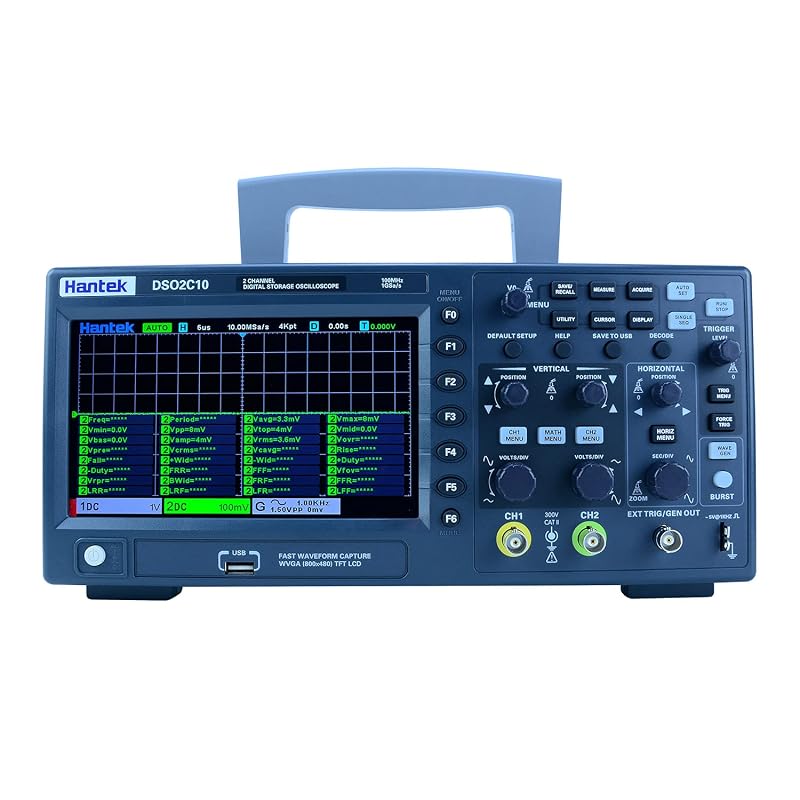
Hantek DSO2C10
4.3★★★★☆The DSO2D10 without the signal generator: two 100 MHz channels with deep memory and serial decoding.

Hantek DSO2D10
4.3★★★★☆An oscilloscope and waveform generator in one unit — practical for space-limited benches.
Specs side by side
| Hantek DSO2C10 | Hantek DSO2D10 | |
|---|---|---|
| Rating | 4.3★★★★☆ | 4.3★★★★☆ |
| Bandwidth | 100MHz | 100MHz |
| Channels | 2 | 2 |
| Sample rate | 1 GSa/s (1 ch); 500 MSa/s (2 ch) | 1 GSa/s |
| Best for | Low-cost serial-bus debugging on two channels | Space-limited benches, combined testing |
| Built-in generator | None | 1 channel, up to 25 MHz, 200 MSa/s, 12-bit |
| Generator waveforms | Not applicable | Sine, square, ramp, exponential, noise, DC; 4 arbitrary slots (4 KSa each) |
| Generator output | Not applicable | 10 mV–7 Vpp (high impedance); 5 mV–3.5 Vpp (50 Ω) |
| Memory depth | 8 Mpts (1 ch); 4 Mpts (2 ch) | 8 Mpts (1 ch); 4 Mpts (2 ch) |
| Vertical resolution | 8-bit; high-res mode up to 12-bit | 8-bit; high-res mode up to 12-bit |
| Serial trigger and decode | UART/RS232, I2C, SPI, CAN, LIN | UART/RS232, I2C, SPI, CAN, LIN |
| Display | 7-inch, 800 × 480 | 7-inch, 800 × 480 |
| Power | Mains, under 30 W | Mains, under 30 W |
Specs checked against manufacturer documentation and official Amazon listings. Desk research, not bench testing. How we research.
Key differences
- →The DSO2D10 adds a one-channel waveform generator: up to 25 MHz, 200 MSa/s, 12-bit, with four arbitrary waveform slots. Hantek's table shows no generator on the DSO2C10.
- →Everything on the scope side matches in Hantek's series table: 100 MHz, two channels, 1 GSa/s on one channel and 500 MSa/s on two, 8 Mpts on one channel and 4 Mpts on two.
- →Both list UART/RS232, I2C, SPI, CAN and LIN triggering and decoding, so the cheaper model gives up nothing for digital bus work.
- →The DSO2C10's front panel still carries WAVE GEN and GEN OUT labels shared with the D model, but Hantek's spec table lists no generator for it, so don't buy it expecting one.
- →Both carry a 4.3 rating in our roundup; neither has our Hands-on Tested badge.
Spec by spec
Because Hantek publishes both models in a single column-by-column table, this is one of the cleanest comparisons we can make: any figure not listed per model applies to the whole series. The first two charts therefore describe both scopes at once. The last two show the one place they part company.
| Generator spec | DSO2D10 |
|---|---|
| Max output, high impedance | 7 Vpp |
| Max output, 50 Ω | 3.5 Vpp |
| DC offset | ±3.5 V high-Z; ±1.75 V into 50 Ω |
| Arbitrary length | 4 KSa per waveform |
Which should you buy?
Since the scope halves are the same, sort your likely jobs by one question: does the circuit make its own signal, or do you have to supply one?
| Buyer or job | Better fit | Why |
|---|---|---|
| Decoding I2C, SPI or UART on a running project | Hantek DSO2C10 | Same decoding; the circuit supplies the signal |
| CAN or LIN on a car or robot | Hantek DSO2C10 | Same CAN and LIN decode, no generator needed |
| Checking an RC or active filter's response | Hantek DSO2D10 | Generator supplies the input sine while the scope watches both sides |
| Finding where an amplifier starts to clip | Hantek DSO2D10 | Turn up the generator amplitude until the output flattens |
| Simulating a sensor or PWM input to firmware | Hantek DSO2D10 | Square, ramp and arbitrary shapes from one box |
| Bench already has a function generator | Hantek DSO2C10 | A second source adds little |
| Power-supply ripple and startup checks | Either | Two channels and 100 MHz on both |
Do you actually need the generator?
A large share of scope work is passive observation. You clip onto a node and look at what is already there: the clock on a microcontroller, the data on an I2C line, the ripple on a 5 V rail, a PWM signal driving a motor. For that, a generator is idle hardware. The DSO2C10 is listed with the same decoding (UART/RS232, I2C, SPI, CAN, LIN) and the same 8 Mpts memory, which is what makes it the budget decoder in our roundup.
The generator earns its place when the circuit can't test itself. A filter, an amplifier, a comparator or an analog sensor input only reveals its behavior when you feed it a known signal. With the DSO2D10 you set a sine at, say, 1 kHz, connect the output to the circuit's input and channel 1, put channel 2 on the output, then step the frequency up and watch the ratio change. Swap to a square wave to see how a stage handles edges, or load one of the four arbitrary slots to mimic a sensor pulse your firmware has to recognize. Note that this uses both scope channels: the generator adds a source, not an input.
Why 25 MHz is a sensible ceiling
High impedance vs 50 Ω
Sampling is shared the same way on both. With one channel on, 1 GSa/s gives ten samples per cycle of a 100 MHz sine; with both on, 500 MSa/s still gives five, well above the Nyquist minimum of two. That leaves both models comfortable on the generator's full range and on typical hobby buses. For how the GSa/s figure relates to what you see, read what GSa/s means.
One thing to watch for when buying the DSO2C10: the front panel is shared with the D model, so WAVE GEN, BURST and GEN OUT markings are still printed on it. Hantek's own table shows a dash in the generator row for this model. Treat any listing text that promises waveform output on the DSO2C10 with suspicion and go by Hantek's specification.
Mains-referenced circuits
More on these two and their rivals
Our Hantek DSO2D10 review covers the generator model in depth; the DSO2C10 is ranked in the beginner oscilloscope roundup. If two channels feel tight, see Hantek DSO2D10 vs Siglent SDS1104X-E or the four-channel scope with a two-channel generator in Rigol DS1104Z-S Plus vs Siglent SDS1104X-E. For a PC-based alternative, read Hantek 6022BE vs Hantek DSO2D10, and start with the oscilloscope buying guide if the specs are new to you.
Choose the Hantek DSO2C10 if…
- ✓You mainly look at signals a circuit already produces: buses, clocks, PWM and supply rails
- ✓You already own a function generator, or a microcontroller board can make the test signals you need
- ✓You want Hantek's serial decoding and 8 Mpts memory without paying for an output you won't use
Choose the Hantek DSO2D10 if…
- ✓You test filters, amplifiers or sensor inputs and need a known signal to feed in
- ✓Your bench has room for one instrument, not a scope and a separate generator
- ✓You want custom test shapes from the four arbitrary waveform slots
The bottom line
Hantek's own table shows these are the same two-channel, 100 MHz scope with the same memory and decoding; only the DSO2D10 adds a 25 MHz single-channel generator. Buy the DSO2D10 if you test filters, amplifiers or sensor inputs and have no separate signal source. Buy the DSO2C10 if your work is mostly watching and decoding signals a circuit already produces, or you already own a generator.
Frequently asked questions
Is the Hantek DSO2C10 the same oscilloscope as the DSO2D10?+
On the scope side, yes. Hantek's DSO2000 series table gives both 100 MHz, two channels, 1 GSa/s on one channel, 8 Mpts of memory and the same serial decoding. The only row that differs is the waveform generator, which the DSO2D10 has and the DSO2C10 does not.
Why does the DSO2C10 have WAVE GEN buttons if it has no generator?+
The two models share a front panel, so the DSO2C10 still carries WAVE GEN, BURST and GEN OUT markings. Hantek's specification table shows a dash in the generator row for the DSO2C10, so go by that and assume it has no signal output, whatever some listing text suggests.
What can the Hantek DSO2D10's built-in generator produce?+
One channel up to 25 MHz at 200 MSa/s and 12-bit, with sine, square, ramp, exponential, noise and DC waveforms plus four arbitrary waveform slots of 4 KSa each. Hantek quotes an output of 10 mV to 7 Vpp into high impedance, or 5 mV to 3.5 Vpp into 50 ohms.
Can the cheaper DSO2C10 decode I2C, SPI and CAN?+
Yes. Hantek lists UART/RS232, I2C, SPI, CAN and LIN triggering and decoding for the whole DSO2000 series, including the DSO2C10. Skipping the generator does not cost you any bus-debugging features, which is why the DSO2C10 is our budget two-channel decoder pick.
Does the generator on the DSO2D10 use up one of the scope channels?+
No, it is a separate output, but it doesn't add an input either. In a typical stimulus test you connect the generator to the circuit, watch the input on channel 1 and the output on channel 2, which leaves no spare channel for a third signal.
Related