Disclosure: OhmSavvy earns a commission from qualifying Amazon purchases made through the links below, at no extra cost to you. How we're funded.
At a glance
Our top picks

Rigol DHO914S
The DHO914 plus a built-in 25 MHz signal generator and Bode plot, for a one-box home lab.
Check price on Amazon →Why we picked it ↓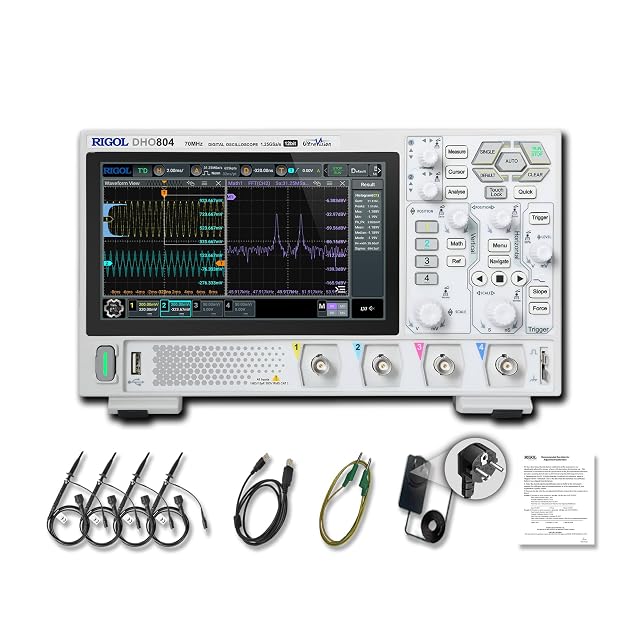
Rigol DHO804
Four channels, 12-bit resolution and a 7-inch touchscreen in a compact body that runs from USB-C power.
Check price on Amazon →Why we picked it ↓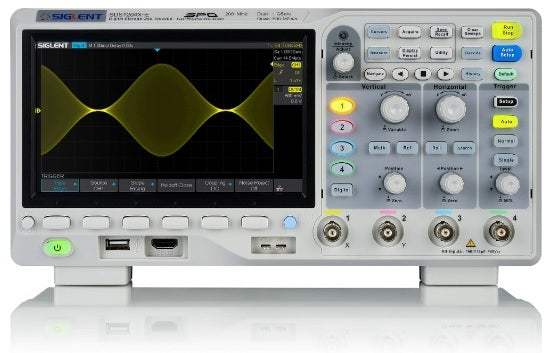
Siglent SDS1104X-E
More bandwidth and a better UI than the Rigol, for projects that will get more demanding.
Check price on Amazon →Why we picked it ↓Also great
- 4
 Rigol DHO914Check pricePrice →Best 125 MHz 12-bit4.6★★★★★
- 5
 Rigol DS1104Z-S PlusCheck pricePrice →Best 4-Channel Scope + Generator4.5★★★★★
- 6
 Rigol DS1054ZCheck pricePrice →Best Overall4.8★★★★★
- 7
 Siglent SDS1202X-ECheck pricePrice →Best 200MHz Value4.5★★★★★
- 8
 Hantek DSO2D15Check pricePrice →Best 150 MHz Budget Bench4.4★★★★☆
- 9
 Rigol DHO802Check pricePrice →Best 2-Channel 12-bit4.6★★★★★
- 10
 Hantek DSO2D10Check pricePrice →Best Compact Bench Option4.3★★★★☆
Quick shopping
Compare at a glance
Swipe sideways on mobile to see every spec.
| Model | Award | Rating | Bandwidth | Channels | Sample rate | |
|---|---|---|---|---|---|---|
 #1Rigol DHO914S | Best 12-bit Scope + Generator | 4.6★★★★★ | 125MHz | 4 + 16 digital (probe sold separately) | 1.25 GSa/s (1 ch); 312.5 MSa/s (4 ch) | Check price → |
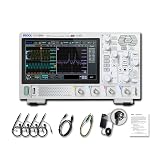 #2Rigol DHO804✓ Tested | Best 12-bit Upgrade | 4.8★★★★★ | 70MHz | 4 | 1.25 GSa/s (1 ch); 312.5 MSa/s (4 ch) | Check price → |
| #3Siglent SDS1104X-E✓ Tested | Best for Growing Into | 4.8★★★★★ | 100MHz | 4 | 1 GSa/s | Check price → |
| #4Rigol DHO914 | Best 125 MHz 12-bit | 4.6★★★★★ | 125MHz | 4 + 16 digital (probe sold separately) | 1.25 GSa/s (1 ch); 312.5 MSa/s (4 ch) | Check price → |
| #5Rigol DS1104Z-S Plus | Best 4-Channel Scope + Generator | 4.5★★★★★ | 100MHz | 4 | 1 GSa/s (1 ch); 250 MSa/s (4 ch) | Check price → |
| #6Rigol DS1054Z✓ Tested | Best Overall | 4.8★★★★★ | 50MHz | 4 | 1 GSa/s | Check price → |
| #7Siglent SDS1202X-E | Best 200MHz Value | 4.5★★★★★ | 200MHz | 2 | 1 GSa/s (1 ch); 500 MSa/s (2 ch) | Check price → |
| #8Hantek DSO2D15 | Best 150 MHz Budget Bench | 4.4★★★★☆ | 150MHz | 2 | 1 GSa/s (1 ch); 500 MSa/s (2 ch) | Check price → |
| #9Rigol DHO802 | Best 2-Channel 12-bit | 4.6★★★★★ | 70MHz | 2 | 1.25 GSa/s (1 ch); 625 MSa/s (2 ch) | Check price → |
| #10Hantek DSO2D10 | Best Compact Bench Option | 4.3★★★★☆ | 100MHz | 2 | 1 GSa/s | Check price → |
In depth
Detailed reviews
Rigol DHO914S
The DHO914 plus a built-in 25 MHz signal generator and Bode plot, for a one-box home lab.
Best for:A home lab that wants scope, logic and signal source in one
The DHO914S has everything in the DHO914 (four 12-bit channels at 125 MHz, 1.25 GSa/s, up to 50 Mpts, 16 digital channels with the separate PLA2216 probe, standard serial decoding, a 7-inch 1024 × 600 touchscreen and USB-C power) and adds a single-channel 25 MHz arbitrary/function generator. Rigol lists sine to 25 MHz, square to 15 MHz, ramp to 150 kHz and arbitrary waveforms to 10 MHz at 156 MSa/s and 14-bit, plus a Bode plot function that uses the generator to sweep a circuit's frequency response.
Why it fits: Top of the list because one box covers almost every home-lab job: four 12-bit channels at 125 MHz, up to 50 Mpts, 16 digital inputs once you add the PLA2216 probe, and a 25 MHz generator with Bode plot for checking filters and amplifiers. Its limits are that the logic probe is sold separately and that it costs more than the otherwise identical DHO914.
- Bandwidth
- 125MHz
- Channels
- 4 + 16 digital (probe sold separately)
- Sample rate
- 1.25 GSa/s (1 ch); 312.5 MSa/s (4 ch)
- Best for
- A home lab that wants scope, logic and signal source in one
Reasons to buy
- +Built-in 25 MHz generator with Bode plot
- +12-bit resolution and 50 Mpts of memory
- +16 digital channels and standard decoding
Reasons to avoid
- −Logic probe (PLA2216) sold separately
- −Costs more than the DHO914
Rigol DHO804
Four channels, 12-bit resolution and a 7-inch touchscreen in a compact body that runs from USB-C power.
Best for:Hobbyists who want 12-bit detail and a touchscreen
The DHO804 brings 12-bit vertical resolution to a beginner budget: 70 MHz, four channels, up to 1.25 GSa/s and 25 Mpts with one channel on, a 7-inch 1024 × 600 capacitive touchscreen, HDMI output and serial decoding of UART, I2C, SPI, CAN and parallel buses. It is powered over USB-C, so it can run from a portable power source. There is no built-in signal generator or logic channels, and sample rate and memory fall as you enable more channels (312.5 MSa/s and 5 Mpts with all four on).
Why it fits: The sensible center of a hobby bench: four channels, 12-bit resolution, a 7-inch touchscreen and USB-C power in a compact body, and it carries our Hands-on Tested badge. It drops to second because it stops at 70 MHz and has neither a generator nor logic inputs.
- Bandwidth
- 70MHz
- Channels
- 4
- Sample rate
- 1.25 GSa/s (1 ch); 312.5 MSa/s (4 ch)
- Best for
- Hobbyists who want 12-bit detail and a touchscreen
Reasons to buy
- +12-bit vertical resolution
- +7-inch 1024 × 600 touchscreen and HDMI out
- +USB-C powered, compact body
Reasons to avoid
- −No built-in signal generator or logic channels
- −Per-channel sample rate drops to 312.5 MSa/s with four channels on
Siglent SDS1104X-E
More bandwidth and a better UI than the Rigol, for projects that will get more demanding.
Best for:Intermediate hobbyists, future-proofing
Double the Rigol's bandwidth (100MHz vs 50MHz) and twice its per-channel sample rate with three or four channels on (500 MSa/s vs 250 MSa/s), with a well-regarded user interface. A strong pick for anyone who expects their projects to get more demanding over time.
Why it fits: Four 100 MHz channels, a 100,000 wfm/s update rate and free serial decoding make it a strong all-rounder that also carries our Hands-on Tested badge. It is 8-bit, and its MSO and AWG upgrades are paid options, which places it just behind the two 12-bit Rigols.
- Bandwidth
- 100MHz
- Channels
- 4
- Sample rate
- 1 GSa/s
- Best for
- Intermediate hobbyists, future-proofing
Reasons to buy
- +Higher bandwidth headroom than entry-level scopes
- +Well-regarded, intuitive UI
- +Strong value at the 100MHz tier
Reasons to avoid
- −Pricier than the Rigol DS1054Z
- −Overkill for pure beginners
Rigol DHO914
Four 12-bit channels at 125 MHz with 16 logic inputs built in, in a compact USB-C powered body.
Best for:Mixed analog and logic debugging on a small bench
The DHO914 is a four-channel, 125 MHz, 12-bit scope: 1.25 GSa/s on one channel (625 MSa/s on two, 312.5 MSa/s on three or four) and 50 Mpts of memory on one channel (25 Mpts on two, 10 Mpts on three or four). Rigol lists a 7-inch 1024 × 600 multi-touch screen, HDMI and LAN, standard parallel, UART, I2C, SPI, CAN and LIN decoding, and 16 digital channels that need the separately sold PLA2216 logic probe. It runs from a USB-C 15 V supply and weighs 1.78 kg. There is no built-in signal generator; that is the DHO914S.
Why it fits: Everything in the DHO914S except the generator and Bode plot, so it suits a lab that already owns a function generator. The 125 MHz bandwidth, 50 Mpts memory and 16-channel logic support (probe sold separately) outclass the DHO804, but buying a separate signal source later can cost more than choosing the S model now.
- Bandwidth
- 125MHz
- Channels
- 4 + 16 digital (probe sold separately)
- Sample rate
- 1.25 GSa/s (1 ch); 312.5 MSa/s (4 ch)
- Best for
- Mixed analog and logic debugging on a small bench
Reasons to buy
- +12-bit resolution and 50 Mpts of memory
- +16 digital channels built in
- +Standard decoding including CAN and LIN
Reasons to avoid
- −Logic probe (PLA2216) sold separately
- −No built-in signal generator
Rigol DS1104Z-S Plus
A four-channel 100 MHz classic with a two-channel 25 MHz signal generator built in.
Best for:Four-channel work that also needs two signal sources
The DS1104Z-S Plus is the 100 MHz, generator-equipped member of Rigol's DS1000Z family: four channels, 1 GSa/s on one channel (500 MSa/s on two, 250 MSa/s on three or four), 8-bit, a 7-inch 800 × 480 display and up to 30,000 waveforms per second. Its built-in generator has two 25 MHz channels at 200 MSa/s and 14-bit. Rigol's sources disagree on memory (24 Mpts standard in the datasheet, 12 Mpts standard with 24 Mpts optional on the series page), and the series page lists serial decoding as an option. It can be upgraded to 16 logic channels with the RPL1116 kit, sold separately, and runs on mains power.
Why it fits: The only pick with a two-channel 25 MHz generator, useful for driving a circuit with two related signals, plus four 100 MHz inputs and an upgrade path to 16 logic channels via the RPL1116 kit. It ranks fifth because it is 8-bit with an 800 × 480 screen, and Rigol's sources disagree on its standard memory and decoding.
- Bandwidth
- 100MHz
- Channels
- 4
- Sample rate
- 1 GSa/s (1 ch); 250 MSa/s (4 ch)
- Best for
- Four-channel work that also needs two signal sources
Reasons to buy
- +Two-channel 25 MHz signal generator built in
- +Four channels at 100 MHz
- +Upgradable to 16 logic channels
Reasons to avoid
- −8-bit with a lower-resolution 800 × 480 screen
- −Rigol's memory and decoding details conflict between sources
Rigol DS1054Z
The default beginner oscilloscope recommendation for years, and still worth it.
Best for:Hobbyists, students, general electronics
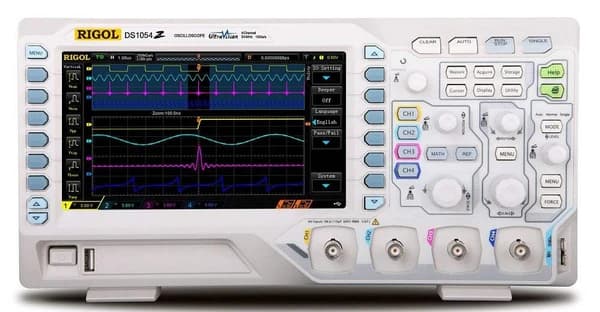
The DS1054Z has been the default recommendation for beginner oscilloscopes for years, and for good reason — 4 channels and 50MHz of bandwidth at a genuinely approachable price.
Why it fits: Four 50 MHz channels still cover audio, power and microcontroller work in a typical home lab, and this scope carries our Hands-on Tested badge. Its lower bandwidth, 8-bit converter and the conflict between Rigol's datasheet and product page over memory and decoding place it sixth.
- Bandwidth
- 50MHz
- Channels
- 4
- Sample rate
- 1 GSa/s
- Best for
- Hobbyists, students, general electronics
Reasons to buy
- +4 channels at this price is rare
- +Large, clear 7-inch display
- +Strong community support and documentation
Reasons to avoid
- −Menu navigation has a learning curve
- −Bandwidth is modest for RF work
Siglent SDS1202X-E
200 MHz on two channels with a fast 100,000 wfm/s update rate and standard serial decoding.
Best for:Faster digital and switching work on two channels
The SDS1202X-E is the two-channel member of Siglent's X-E line with 200 MHz bandwidth: 1 GSa/s with one channel (500 MSa/s each with two), 14 Mpts of memory on one channel, 100,000 waveforms per second (400,000 in sequence mode), a 7-inch 800 × 480 display and standard I2C, SPI, UART, CAN and LIN trigger and decode. The MSO, AWG module, Bode plot and Wi-Fi options belong to the four-channel models, so don't count on them here.
Why it fits: The pick for a lab leaning toward faster digital and switching circuits: 200 MHz, a 100,000 wfm/s update rate and standard I2C, SPI, UART, CAN and LIN decode. Only two channels, and no MSO or AWG option on this model, make it a specialist rather than a general bench scope.
- Bandwidth
- 200MHz
- Channels
- 2
- Sample rate
- 1 GSa/s (1 ch); 500 MSa/s (2 ch)
- Best for
- Faster digital and switching work on two channels
Reasons to buy
- +200 MHz bandwidth
- +100,000 wfm/s update rate
- +Serial trigger and decode as standard
Reasons to avoid
- −Only 2 channels
- −No MSO, AWG or Bode plot (four-channel models only)
- −Memory halves to 7 Mpts per channel with both on
Hantek DSO2D15
The 150 MHz version of Hantek's DSO2000 bench scope, with a 25 MHz generator and serial decoding.
Best for:A budget bench that wants extra bandwidth and a signal source
The DSO2D15 is a two-channel, 150 MHz benchtop (2.4 ns rise time) with 1 GSa/s on one channel and 500 MSa/s on two, 8-bit resolution with a 12-bit high-resolution mode, 8 Mpts of memory on one channel (4 Mpts on two) and a 7-inch 800 × 480 display. Its built-in generator reaches 25 MHz sine and 10 MHz square or arbitrary at 200 MSa/s and 12-bit. Hantek lists UART, I2C, SPI, CAN and LIN triggering and decoding and 32 automatic measurements. It runs on mains power. This listing bundles a P4100 100X probe.
Why it fits: A budget path to 150 MHz with a 25 MHz generator and UART, I2C, SPI, CAN and LIN decoding on the same bench. It is 8-bit (with a 12-bit high-resolution mode) and two-channel, so it cannot match the four-channel picks for comparing several points in a circuit.
- Bandwidth
- 150MHz
- Channels
- 2
- Sample rate
- 1 GSa/s (1 ch); 500 MSa/s (2 ch)
- Best for
- A budget bench that wants extra bandwidth and a signal source
Reasons to buy
- +150 MHz bandwidth
- +Built-in 25 MHz signal generator
- +UART, I2C, SPI, CAN and LIN decoding
Reasons to avoid
- −8-bit converter
- −Two channels only
Rigol DHO802
The two-channel DHO800: 12-bit resolution, a 7-inch touchscreen and USB-C power for a lower price than the four-channel DHO804.
Best for:Two-channel work that benefits from 12-bit detail
The DHO802 is the two-channel model of Rigol's DHO800 series: 70 MHz, 12-bit vertical resolution, 1.25 GSa/s with one channel on (625 MSa/s with both) and 25 Mpts of memory on one channel (10 Mpts on both). It has a 7-inch 1024 × 600 capacitive touchscreen, HDMI output, LAN and standard decoding of parallel, UART, I2C, SPI and CAN, and it runs from a USB-C 15 V supply. There is no built-in signal generator and no logic channels.
Why it fits: Keeps the DHO800 strengths, 12-bit resolution, 25 Mpts and a 1024 × 600 touchscreen, at two channels for a smaller budget. Two inputs are enough for input-versus-output checks, but a varied home lab will hit that ceiling sooner than with the DHO804.
- Bandwidth
- 70MHz
- Channels
- 2
- Sample rate
- 1.25 GSa/s (1 ch); 625 MSa/s (2 ch)
- Best for
- Two-channel work that benefits from 12-bit detail
Reasons to buy
- +12-bit vertical resolution
- +7-inch 1024 × 600 touchscreen with HDMI out
- +Standard serial decoding (UART, I2C, SPI, CAN)
Reasons to avoid
- −Two channels only
- −No built-in signal generator or logic channels
Hantek DSO2D10
An oscilloscope and waveform generator in one unit — practical for space-limited benches.
Best for:Space-limited benches, combined testing
Combines an oscilloscope and waveform generator in one compact unit — a practical two-in-one for hobbyists who don't have bench space for separate instruments.
Why it fits: The entry ticket on this list: 100 MHz, a 25 MHz generator and Hantek-listed serial decoding in one compact mains-powered scope. Two 8-bit channels and 8 Mpts of memory make it the first one a growing lab would outgrow, which is why it ranks tenth.
- Bandwidth
- 100MHz
- Channels
- 2
- Sample rate
- 1 GSa/s
- Best for
- Space-limited benches, combined testing
Reasons to buy
- +Built-in waveform generator saves bench space
- +Solid 100MHz bandwidth for the price
- +Compact footprint
Reasons to avoid
- −Only 2 channels, vs. 4 on the Rigol and Siglent
- −The built-in generator is single-channel (25 MHz)
Before you buy
Buying advice
Buy channels before bandwidth
A home lab sees varied work: an audio amplifier one weekend, a switching regulator the next, then a microcontroller bus. Four channels let you watch input, output, a supply rail and a trigger signal together, which is often how a fault finally reveals itself. Six of our ten picks have four analog channels. Most hobby circuits sit well inside 70 to 100 MHz, so extra channels usually pay off before extra bandwidth does.
Decide whether 12-bit matters to your projects
The Rigol DHO800 and DHO900 models digitise at 12 bits, giving sixteen times finer vertical steps than an 8-bit converter. That shows up when you look at small ripple on a supply rail, low-level audio or noise riding on a larger signal. If your work is mostly digital timing, an 8-bit scope such as the Siglent SDS1104X-E or a Hantek DSO2000 model serves you well and the difference matters less.
Count the instruments a built-in generator replaces
A signal source turns a scope into a test station: feed a sine wave into a filter, sweep an amplifier, or fake a sensor input. The DHO914S, DS1104Z-S Plus, DSO2D15 and DSO2D10 have one built in, and the DHO914S adds a Bode plot function that sweeps a circuit's frequency response automatically. If bench space or budget is tight, a combined unit avoids buying a separate function generator later.
Plan for logic channels if you build digital projects
Mixed-signal capability lets you watch a parallel bus or several GPIO lines alongside analog signals. The DHO914 and DHO914S include 16 digital channels that need the PLA2216 probe, the DS1104Z-S Plus can be upgraded with the RPL1116 kit, and Siglent sells an MSO option for the four-channel SDS1104X-E. None of these probes is in the box, so add the cost when you compare.
Mind the bench: power, screen and footprint
The Rigol DHO models run from a USB-C 15 V supply and are compact enough for a shelf-mounted bench; their 1024 × 600 touchscreens have more pixels than the 800 × 480 displays on the older Rigol, Siglent and Hantek designs. Mains-powered scopes are bulkier but need no external adapter. Whatever you choose, learn to compensate your probes before taking measurements you rely on.
Methodology
How we chose
We ranked these ten for a general-purpose hobby bench: four channels, vertical resolution, memory depth, built-in generators and logic upgrade paths, with bandwidth judged against typical home-lab circuits rather than maximized. This is desk research against each maker's specifications and the official Amazon listings; only the Rigol DHO804, Siglent SDS1104X-E and Rigol DS1054Z carry our Hands-on Tested badge.
Picks marked "Hands-on Tested" have been bought and tested by us; the rest are desk research. A pick only carries that badge once we have actually bought and tested that unit. More on how we research.
Questions
Frequently asked questions
Is a 4-channel scope worth it for a home lab, or is 2 enough?+
For a general home lab, four channels are worth it. Varied projects regularly need more than two signals at once, such as a clock against data, an input against an output plus the supply rail, or a full SPI bus. Two-channel scopes like the Siglent SDS1202X-E or Rigol DHO802 make sense when bandwidth or budget matters more and your work rarely involves more than two related signals.
Should I buy the higher-bandwidth option now or upgrade later?+
Match bandwidth to the fastest signals you expect within a few years, not the fastest you can imagine. Audio, power supplies and microcontroller buses sit comfortably within 70 to 100 MHz. If faster digital logic or switching edges are on your roadmap, a 125 MHz DHO914 or 200 MHz SDS1202X-E avoids a second purchase. Otherwise, spend the difference on channels, memory or a generator.
Is a 12-bit oscilloscope worth it for a hobbyist?+
It is worth it if you measure small details on larger signals: power-supply ripple, audio distortion, sensor noise. Twelve bits give 4,096 vertical levels against 256 for an 8-bit converter, so fine detail is not lost in quantisation steps. Rigol's DHO800 and DHO900 scopes offer this at hobby prices. For mainly digital timing work, an 8-bit scope is still entirely adequate.
Do I need an oscilloscope with a built-in signal generator?+
Not strictly, but it is convenient. A generator lets you test filters, amplifiers and sensor inputs with a known waveform, and the DHO914S can use its generator for automatic Bode plots. If you already own a function generator, a scope without one, such as the DHO914 or DHO804, puts the money into the scope itself. If you own neither, a combined unit saves bench space.
What memory depth should a home lab oscilloscope have?+
Several million points is a sensible floor. Deep memory lets the scope keep a high sample rate on long time bases, so you can capture a full power-up sequence or a burst of serial traffic and zoom in without blurring. Our picks range from 8 Mpts on the Hantek DSO2000 models to 50 Mpts on the Rigol DHO900 models with one channel enabled.
Can I measure mains voltage with a bench oscilloscope?+
Not directly with standard probes. The ground clip on a mains-powered bench scope connects to earth, so clipping it onto a mains-referenced point creates a short circuit. Mains measurements need a differential probe or an isolation approach rated for the job. Learn on low-voltage circuits first, and treat anything connected to the wall outlet as a separate, safety-rated task.