Disclosure: OhmSavvy earns a commission from qualifying Amazon purchases made through the links below, at no extra cost to you. How we're funded.
At a glance
Our top picks

Fluke 88V
Fluke's top automotive meter: CAT IV 600V, 0.1% DC accuracy, 250 µs peak capture and a lifetime warranty.
Check price on Amazon →Why we picked it ↓
Innova 3340
A proper engine-analyzer meter (RPM, dwell, duty cycle, pulse width, temperature) with the inductive pickup in the box.
Check price on Amazon →Why we picked it ↓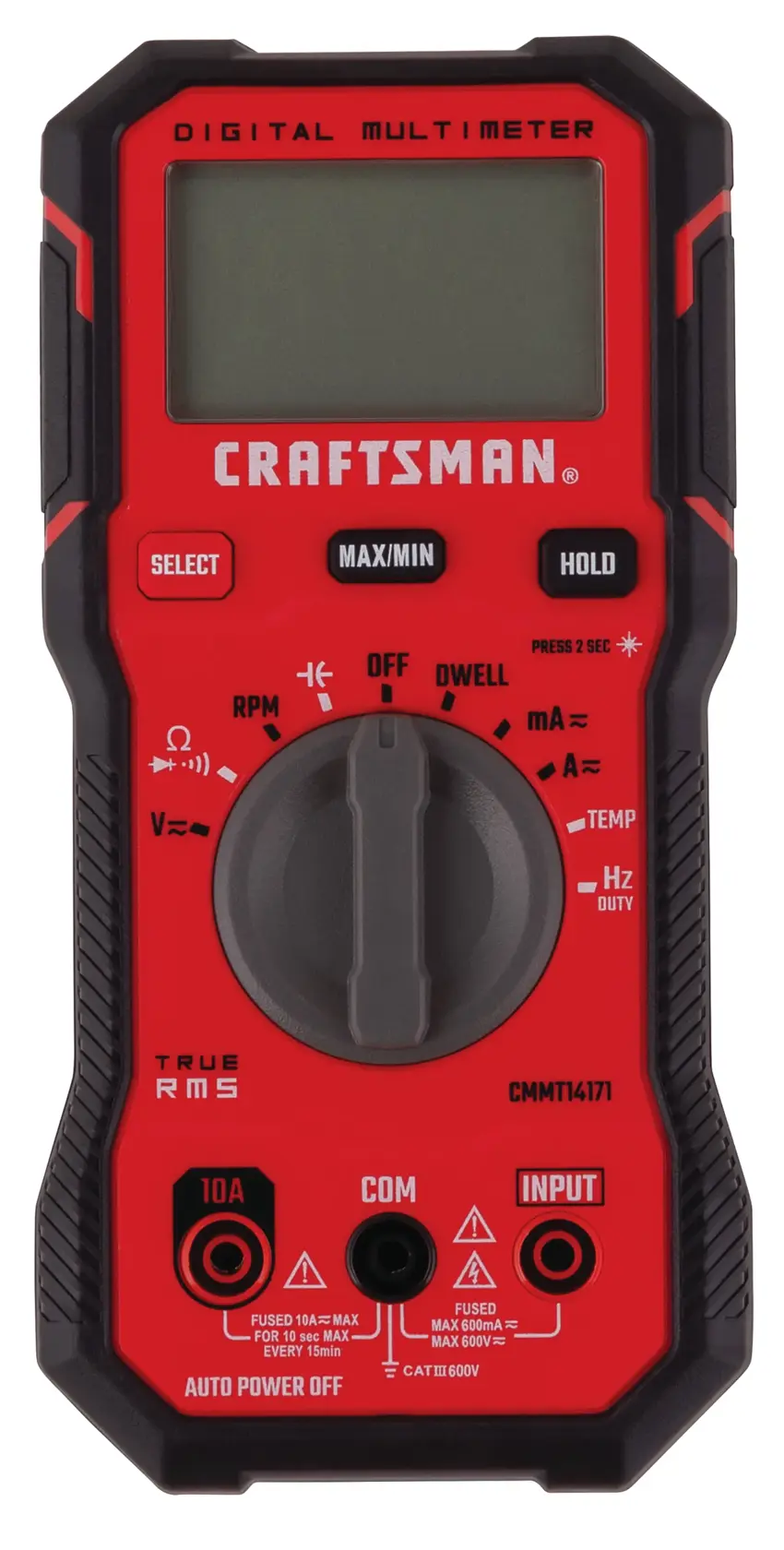
Craftsman CMMT14171
The one pick here built specifically for diagnosing cars, not just household wiring.
Check price on Amazon →Why we picked it ↓Also great
- 4
 Fluke 87VCheck pricePrice →Best for Professionals4.8★★★★★
- 5
 BTMETER BT-770KCheck pricePrice →Best Budget Engine Analyzer4.2★★★★☆
- 6
 Power Probe DM600MAXCheck pricePrice →Most Rugged4.5★★★★★
- 7
 Power Probe DM300AUTOCheck pricePrice →Best Guided Battery & Charging Tests4.3★★★★☆
- 8
 KAIWEETS HT118ACheck pricePrice →Best Low-Cost True RMS4.4★★★★☆
- 9
 Fluke 179Check pricePrice →Best for Industrial Work4.7★★★★★
- 10
 ANENG SZ26Check pricePrice →Cheapest With RPM & Dwell3.9★★★★☆
Quick shopping
Compare at a glance
Swipe sideways on mobile to see every spec.
| Model | Award | Rating | Accuracy | Safety rating | Auto-ranging | |
|---|---|---|---|---|---|---|
 #1Fluke 88V | Best Professional Automotive | 4.7★★★★★ | Average-responding, ±(0.1% + 1) DC | CAT III 1000V / CAT IV 600V | Yes (manual override) | Check price → |
 #2Innova 3340 | Best Value Automotive | 4.5★★★★★ | True RMS not stated | CAT II 600V (marked on meter) | Yes | Check price → |
| #3Craftsman CMMT14171 | Best for Automotive | 4.4★★★★☆ | True RMS | CAT III 600V | Yes | Check price → |
| #4Fluke 87V✓ Tested | Best for Professionals | 4.8★★★★★ | True RMS | CAT III 1000V / CAT IV 600V | Yes | Check price → |
| #5BTMETER BT-770K | Best Budget Engine Analyzer | 4.2★★★★☆ | True RMS | CAT III 1000V (marked on meter) | Yes (manual override) | Check price → |
| #6Power Probe DM600MAX | Most Rugged | 4.5★★★★★ | True RMS, ±(0.03% + 1) DC | CAT III 1000V / CAT IV 600V | Yes | Check price → |
| #7Power Probe DM300AUTO | Best Guided Battery & Charging Tests | 4.3★★★★☆ | True RMS, ±(2% + 3) voltage | CAT III 1000V / CAT IV 600V | Yes | Check price → |
| #8KAIWEETS HT118A | Best Low-Cost True RMS | 4.4★★★★☆ | True RMS, 6,000-count | CAT III 1000V / CAT IV 600V | Yes | Check price → |
| #9Fluke 179 | Best for Industrial Work | 4.7★★★★★ | True RMS | CAT III 1000V / CAT IV 600V | Yes (manual override) | Check price → |
| #10ANENG SZ26 | Cheapest With RPM & Dwell | 3.9★★★★☆ | True RMS not stated | CAT III 600V / CAT II 1000V | No (manual) | Check price → |
In depth
Detailed reviews
Fluke 88V
Fluke's top automotive meter: CAT IV 600V, 0.1% DC accuracy, 250 µs peak capture and a lifetime warranty.
Best for:Professional and hybrid-vehicle work
The 88V adds the automotive functions to Fluke's 80-series core: millisecond pulse width for injectors, duty cycle to 99.9%, RPM with an inductive pickup and temperature with a probe. Min/Max/Average recording with a 250 µs Peak Min/Max catches cranking dips and intermittent dropouts, and it's rated CAT III 1000V / CAT IV 600V, which matters on hybrid systems. Two things to know: it's average-responding, not True RMS, and Fluke lists the inductive pickup and temperature probe as optional for the bare 88V.
Why it fits: First place goes to the meter that combines millisecond pulse width, duty cycle to 99.9%, RPM, temperature and a 250 µs Peak Min/Max with a CAT IV 600V rating and 20 A for 30 seconds. It is not True RMS, and Fluke lists the inductive pickup and temperature probe as optional, so budget for both.
- Accuracy
- Average-responding, ±(0.1% + 1) DC
- Safety rating
- CAT III 1000V / CAT IV 600V
- Auto-ranging
- Yes (manual override)
- Best for
- Professional and hybrid-vehicle work
Reasons to buy
- +250 µs Peak Min/Max catches fast glitches
- +10 A continuous, 20 A for 30 seconds
- +Limited lifetime warranty
Reasons to avoid
- −Not True RMS
- −Expensive, and the RPM pickup and temperature probe are sold separately
Innova 3340
A proper engine-analyzer meter (RPM, dwell, duty cycle, pulse width, temperature) with the inductive pickup in the box.
Best for:DIY engine diagnostics
The Innova 3340 is built for car work: it reads RPM from 0 to 10,000 with the included inductive clamp (conventional, DIS and coil-on-plug), plus dwell, duty cycle, millisecond pulse width, frequency and temperature with the supplied probe. It's auto-ranging with Min/Max and Hold and a 10 MΩ input that's safe around ECUs. Innova doesn't claim True RMS, the meter face shows only CAT II 600V, and the 15 A input is unfused (15-second tests with a 15-minute rest).
Why it fits: It earns second because the inductive RPM clamp and temperature probe come in the box and it adds dwell for older engines, so a DIY owner gets a complete engine-analyzer kit. The face is marked only CAT II 600V and the 15 A input is unfused with 15-second test limits.
- Accuracy
- True RMS not stated
- Safety rating
- CAT II 600V (marked on meter)
- Auto-ranging
- Yes
- Best for
- DIY engine diagnostics
Reasons to buy
- +Inductive RPM pickup and temperature probe included
- +RPM, dwell, duty cycle and pulse width
- +Min/Max and Hold for catching drops
Reasons to avoid
- −Only CAT II 600V: not for household panel work
- −15 A input is unfused and limited to 15-second tests
Craftsman CMMT14171
The one pick here built specifically for diagnosing cars, not just household wiring.
Best for:Automotive diagnostics
Craftsman's CMMT14171 adds RPM, dwell angle, and duty-cycle measurement on top of standard True RMS multimeter functions — the specific toolkit automotive diagnostics actually needs, at a CAT III 600V rating.
Why it fits: RPM, dwell, duty cycle, frequency and temperature on an auto-ranging True RMS meter rated CAT III 600V make it a capable tune-up tool. It ranks below the Innova only because the listing does not say whether an RPM pickup is included and Craftsman publishes no current or Min/Max details.
- Accuracy
- True RMS
- Safety rating
- CAT III 600V
- Auto-ranging
- Yes
- Best for
- Automotive diagnostics
Reasons to buy
- +RPM, dwell, and duty-cycle functions built in
- +Familiar, trusted Craftsman brand
- +Also measures temperature and frequency
Reasons to avoid
- −Automotive functions are wasted if you don't work on cars
- −Not rated for CAT IV panel work
Fluke 87V
The step-up pick for anyone who needs CAT IV protection and high-resolution readings daily.
Best for:Industrial technicians, daily professional use
The 87V is Fluke's industrial-grade step up from the 117 — a 1000V CAT III / 600V CAT IV rating, a 6,000-count main display with a 19,999-count high-resolution mode, and a 32-segment analog bar graph for watching signals change in real time.
Why it fits: It carries our Hands-on Tested badge and brings True RMS, a 19,999-count high-resolution mode, 250 µs Peak Capture, duty cycle and temperature, which makes it superb for chasing sensor and wiring faults. It sits fourth because it lacks the 88V's RPM and injector pulse-width functions.
- Accuracy
- True RMS
- Safety rating
- CAT III 1000V / CAT IV 600V
- Auto-ranging
- Yes
- Best for
- Industrial technicians, daily professional use
Reasons to buy
- +Joint-highest CAT rating in this list (CAT IV 600V / CAT III 1000V)
- +19,999-count high-resolution mode
- +Analog bar graph tracks fast-changing signals
Reasons to avoid
- −Among the most expensive picks here
- −Overkill for casual home use
BTMETER BT-770K
True RMS plus dwell, pulse width, duty cycle and RPM (with an extra clamp) at a budget price.
Best for:Budget engine diagnostics
The BT-770K packs automotive functions into a 6,000-count True RMS meter: dwell for 4/5/6/8 cylinders, 0.1–10 ms injector pulse width, duty cycle, temperature with the included thermocouple, 20 A current, Min/Max with peak hold and NCV, plus a rear magnet and auto backlight for under-hood work. RPM needs BTMETER's BT-705A inductive clamp, which isn't in the box, and the listing gives two different RPM ranges. It's marked CAT III 1000V. All specs come from the Amazon listing because BTMETER has no product page.
Why it fits: Dwell for 4, 5, 6 and 8 cylinders, 0.1 to 10 ms pulse width, duty cycle, a 20 A input and Max/Min with a 1.28 ms peak give it more engine functions than most budget meters, plus a rear magnet for hanging under the hood. RPM needs the BT-705A clamp sold separately, and every spec comes from an Amazon listing that contradicts itself on the RPM range.
- Accuracy
- True RMS
- Safety rating
- CAT III 1000V (marked on meter)
- Auto-ranging
- Yes (manual override)
- Best for
- Budget engine diagnostics
Reasons to buy
- +Dwell, pulse width and duty cycle
- +20 A current and temperature
- +Magnet and auto backlight for under-hood use
Reasons to avoid
- −RPM clamp sold separately
- −Specs come only from the Amazon listing, which contradicts itself in places
Power Probe DM600MAX
An IP67, True RMS shop meter with 0.03% DC accuracy, LoZ, Bluetooth logging and temperature to 1,200 °C.
Best for:Pro techs who need a tough meter
The DM600MAX is a high-end general meter that Power Probe sells to automotive techs. It's IP67 and drop-rated to 4 ft, True RMS, with a 4,000-count (40,000 high-resolution) color screen, DC voltage accuracy as good as ±(0.03% + 1), a 400.0 µA range for parasitic-draw work, LoZ for ghost voltages, frequency and duty cycle to 100 kHz, Min/Max/Average, Peak Hold, 40,000-reading memory and Bluetooth to the Power Probe Link app. It has no RPM or dwell, and the 30 A probe is listed as optional in the manual even though the Amazon listing says it's included.
Why it fits: An IP67 body, a 4 ft drop rating, ±(0.03% + 1) DC accuracy, pulse width, temperature to 1,200 °C and Bluetooth logging suit a busy service bay. With no RPM or dwell it is a premium general meter for technicians rather than an engine analyzer, which is why it sits mid-table.
- Accuracy
- True RMS, ±(0.03% + 1) DC
- Safety rating
- CAT III 1000V / CAT IV 600V
- Auto-ranging
- Yes
- Best for
- Pro techs who need a tough meter
Reasons to buy
- +IP67 and 4 ft drop rating
- +µA range, LoZ and Bluetooth logging
- +Temperature to 1,200 °C with included thermocouple
Reasons to avoid
- −Costs more than most automotive meters
- −No RPM or dwell functions
Power Probe DM300AUTO
An automotive meter that walks you through cranking-voltage and alternator tests and reads current through a fuse without pulling it.
Best for:Battery, starter and alternator checks
The DM300AUTO's guided modes are the selling point: a cranking-voltage test and normal or smart alternator charging tests for 12 V and 24 V systems, each with on-screen pass/fail, plus a fuse-current mode that estimates current through MINI, ATC and MAXI fuses up to 80 A from the voltage drop. It's True RMS, CAT III 1000V / CAT IV 600V, with a 6,000-count color screen and 30 A in-line current with the 30 A probe. The trade-offs are basic: voltage accuracy is ±(2% + 3 digits), there's no RPM, temperature or Min/Max, and it costs a lot more than a regular meter.
Why it fits: Guided cranking-voltage and alternator tests with on-screen pass or fail, plus current estimated across a fuse up to 80 A, speed up no-start and charging diagnosis. Voltage accuracy of ±(2% + 3) and the absence of temperature, RPM and Min/Max keep it out of the top five for wider diagnostic work.
- Accuracy
- True RMS, ±(2% + 3) voltage
- Safety rating
- CAT III 1000V / CAT IV 600V
- Auto-ranging
- Yes
- Best for
- Battery, starter and alternator checks
Reasons to buy
- +Guided cranking and alternator tests with pass/fail
- +Reads current through fuses without removing them
- +30 A in-line current with the 30 A probe
Reasons to avoid
- −Coarse ±2% voltage accuracy for the price
- −No RPM, temperature or Min/Max
KAIWEETS HT118A
True RMS, CAT III 1000V and µA current with NCV and temperature at a low price.
Best for:Budget all-rounder for home, car and hobby
The HT118A is a 6,000-count, auto-ranging True RMS meter with an analog bar. KAIWEETS's manual rates it CAT III 1000V / CAT IV 600V for up to 1000V DC and 750V AC, and current runs from a 600 µA range (0.1 µA) to 10 A. It also measures resistance to 60 MΩ, capacitance, frequency to 10 MHz, duty cycle and temperature, and adds NCV, a Live-wire test, Min/Max, jack lights, a flashlight and a kickstand. KAIWEETS gives a 3-year warranty. Its own product page lists 600V AC/DC, which disagrees with the manual and the meter face.
Why it fits: At a budget price it offers True RMS, duty cycle, temperature, Min/Max/Average and current from 600 µA up to 10 A, enough for most sensor, relay and parasitic-draw jobs. It has no RPM, dwell or pulse width, and KAIWEETS's product page disagrees with its own manual on maximum voltage.
- Accuracy
- True RMS, 6,000-count
- Safety rating
- CAT III 1000V / CAT IV 600V
- Auto-ranging
- Yes
- Best for
- Budget all-rounder for home, car and hobby
Reasons to buy
- +µA, mA and 10 A ranges
- +NCV, temperature and Min/Max included
- +3-year warranty
Reasons to avoid
- −Maker's product page and manual disagree on max voltage
- −Bulky compared with slim meters
Fluke 179
Fluke's do-everything bench-and-field meter: CAT IV 600V, True RMS, temperature and a 6,000-count display with bar graph.
Best for:Industrial maintenance, electronics, HVAC
The Fluke 179 is the full-featured member of Fluke's 170 series: True RMS, CAT III 1000V and CAT IV 600V, a 6,000-count backlit display with an analog bar graph, and temperature measurement with the supplied thermocouple. It adds Min/Max-Average recording and both manual and automatic ranging, so it suits industrial maintenance and electronics work where the 117's electrician-focused extras matter less than range and resolution.
Why it fits: True RMS, a CAT IV 600V rating, Min/Max-Average and a supplied thermocouple make it a dependable meter for vehicle wiring and the shop's mains circuits alike. With no automotive-specific modes and no µA range, it is a general tool that happens to be good on cars.
- Accuracy
- True RMS
- Safety rating
- CAT III 1000V / CAT IV 600V
- Auto-ranging
- Yes (manual override)
- Best for
- Industrial maintenance, electronics, HVAC
Reasons to buy
- +CAT IV 600V for service entrances and outdoor feeds
- +Temperature, capacitance to 10,000 µF and frequency to 100 kHz
- +Min/Max-Average recording and analog bar graph
Reasons to avoid
- −Costs more than the 117 for features many electricians won't use
- −No non-contact voltage detection
ANENG SZ26
An old-school manual-range engine analyzer with RPM and dwell for 4, 6 and 8 cylinders, plus a big probe kit.
Best for:Older carbureted cars and small engines
The SZ26 is a classic engine-analyzer layout: a 1,999-count manual-ranging meter with RPM (500–10,000) and dwell for 4, 6 and 8-cylinder engines, duty cycle, DC/AC voltage, DC current to 10 A, resistance, diode and continuity. It comes with alligator clips, back-probe pins and piercing probes. It has no auto-ranging, AC current, Min/Max or listed True RMS, ANENG doesn't say how RPM is picked up, and the specs come only from the Amazon listing.
Why it fits: RPM and dwell for 4, 6 and 8 cylinders on a very cheap meter with back-probe pins and piercing probes suit points ignitions and small engines. Manual ranging, 1,999 counts, DC-only current and no Min/Max put it last for anything newer.
- Accuracy
- True RMS not stated
- Safety rating
- CAT III 600V / CAT II 1000V
- Auto-ranging
- No (manual)
- Best for
- Older carbureted cars and small engines
Reasons to buy
- +RPM and dwell for 4/6/8 cylinders
- +Big accessory kit with back-probe pins
- +Very low price
Reasons to avoid
- −Manual ranging and only 1,999 counts
- −No AC current or Min/Max
Before you buy
Buying advice
Decide whether you need engine functions or a better general meter
RPM, dwell and pulse width earn their keep on ignition and fuel problems, especially on older or simpler engines. Most electrical faults on a modern car, such as a dead circuit, a high-resistance ground or a drained battery, need only accurate volts, ohms, current and a fast Min/Max. If your work is mainly wiring, a True RMS general meter like the Fluke 87V can serve better than a cheaper meter with more dial positions.
Check what comes in the box
An RPM function is useless without the inductive pickup, and a temperature range needs a thermocouple. Innova ships both with the 3340, Fluke treats both as optional for the 88V, and BTMETER sells the BT-770K's clamp separately. Back-probe pins and alligator leads also matter, because piercing insulation lets moisture into a harness.
Respect the limits of the current input
Read the jack markings before measuring current. The Innova 3340's 15 A input is unfused and limited to 15-second tests with a rest between them, the BT-770K's 20 A jack is rated for 10 seconds, and the Fluke 80-series allows 20 A for up to 30 seconds. Starter motors draw hundreds of amps, so cranking current always needs a clamp, never the meter's jacks.
Match the safety rating to the vehicles you service
On a 12 V or 24 V system a CAT II meter like the Innova 3340 is fine. Hybrid and electric vehicles carry high-voltage DC packs, and the shop's own wiring is mains. For those, choose a meter rated CAT III 1000V or CAT IV 600V, such as the Fluke 88V, Fluke 87V, Fluke 179 or either Power Probe, and use leads with matching ratings.
Methodology
How we chose
We ranked these ten for car and light-truck diagnosis: engine functions first (RPM, dwell, duty cycle, pulse width, temperature), then how fast Min/Max or peak capture works, how much current the jacks accept and the safety rating for hybrid and shop work. Specifications come from maker pages, manuals or official Amazon listings; the ranking is desk research, and only the Fluke 87V carries our Hands-on Tested badge.
Picks marked "Hands-on Tested" have been bought and tested by us; the rest are desk research. A pick only carries that badge once we have actually bought and tested that unit. More on how we research.
Questions
Frequently asked questions
What multimeter features do you need for automotive diagnostics?+
Start with DC volts, ohms, continuity and a 10 A current input, which every meter here has. For engine work add duty cycle for solenoids and mixture controls, millisecond pulse width for injectors, RPM and dwell for ignition checks, and temperature for sensors. A fast Min/Max or peak mode matters more than people expect, because many faults are dropouts lasting a fraction of a second.
Is a True RMS multimeter necessary for car work?+
Mostly no. Nearly all car testing is DC, where True RMS makes no difference. It helps when you read AC ripple from an alternator or the output of wheel-speed and crank sensors, which are not clean sine waves. The Fluke 88V is average-responding yet ranks first here, because its peak capture, pulse width and safety rating matter more for daily diagnosis.
Can a multimeter measure engine RPM?+
Some can, through an inductive clamp around a spark-plug lead or coil wire. The Innova 3340 includes that pickup. The Fluke 88V reads RPM with an inductive pickup that Fluke lists as optional, and the BTMETER BT-770K needs a separately sold BT-705A clamp. The ANENG SZ26 has RPM and dwell positions but its listing does not say how it picks up the signal.
What is dwell and do modern cars still need it?+
Dwell is the angle, in degrees of distributor rotation, during which ignition points stay closed and the coil charges. It mattered for points ignitions and is still useful on classic cars, vintage tractors and some small engines. Coil-on-plug and distributorless systems are better checked with duty cycle, RPM and, for waveform shape, an oscilloscope.
Why does a 10 MΩ input impedance matter on a car?+
Engine computers run sensors on weak signals, often a 5 V reference through high-value resistors. A low-impedance meter draws current from that circuit and pulls the reading down, so a healthy sensor can look faulty. A 10 MΩ input, which Innova and Fluke both specify for the meters here, draws almost nothing and lets you back-probe a live sensor safely.
When should I use an oscilloscope instead of a multimeter on a car?+
Use a scope when the shape of the signal matters: a crank sensor with a missing tooth, a noisy cam signal, injector inductive kick or CAN bus traffic. A multimeter averages or samples a few times a second, so it shows that a signal exists but not whether every pulse is right. Many technicians carry both and start with the meter.

