COMPARISON · OSCILLOSCOPES
Rigol DS1102Z-E vs DS1054Z: Which Fits Your Lab?
Both scopes share Rigol's DS1000Z platform, a 7-inch 800 × 480 display, the same 1 GSa/s acquisition engine and up to 30,000 waveforms per second, so the DS1102Z-E vs DS1054Z choice comes down to one trade-off: two channels at 100 MHz, or four channels at 50 MHz. There's no single right answer. It depends on whether your bench work runs out of inputs or out of headroom first.
By the OhmSavvy Research Team ·
Disclosure: OhmSavvy earns a commission from qualifying Amazon purchases made through these links, at no extra cost to you. How we're funded.

Rigol DS1102Z-E
4.4★★★★☆Rigol's two-channel, 100 MHz benchtop with deep memory, for people who never need a third or fourth channel.
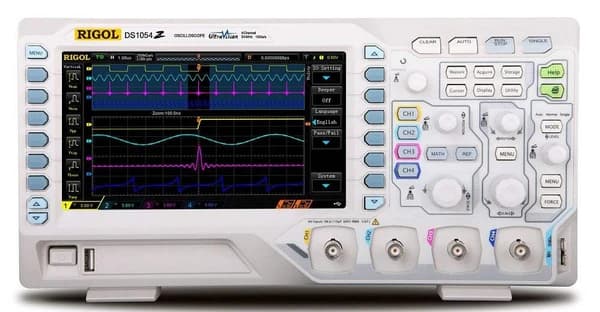
Rigol DS1054Z
4.8★★★★★The default beginner oscilloscope recommendation for years, and still worth it.
Specs side by side
| Rigol DS1102Z-E | Rigol DS1054Z | |
|---|---|---|
| Rating | 4.4★★★★☆ | 4.8★★★★★ |
| Bandwidth | 100MHz | 50MHz |
| Channels | 2 | 4 |
| Sample rate | 1 GSa/s (1 ch); 500 MSa/s (2 ch) | 1 GSa/s |
| Best for | Two-channel debugging, students | Hobbyists, students, general electronics |
| Channels | 2 | 4 |
| Bandwidth | 100MHz | 50MHz |
| Sample rate, 1 channel | 1 GSa/s | 1 GSa/s |
| Sample rate, 2 channels | 500 MSa/s | 500 MSa/s |
| Sample rate, 3–4 channels | n/a (2 channels) | 250 MSa/s |
| Memory depth | 24 Mpts (datasheet); 12M standard (series page) | 24 Mpts (datasheet); 12M standard, 24M optional (product page) |
| Vertical resolution | 8-bit (12-bit High Resolution mode) | 8-bit (12-bit high-res mode) |
| Display | 7-inch, 800 × 480 | 7-inch, 800 × 480 |
| Waveform capture rate | Up to 30,000 wfm/s | Up to 30,000 wfm/s |
| Serial decode | UART, I2C, SPI, parallel (standard) | Parallel, UART/RS232, I2C, SPI (datasheet; product page says option) |
| Built-in generator | None | None |
| Hands-on tested by OhmSavvy | No | Yes |
Specs checked against manufacturer documentation and official Amazon listings. Rigol DS1054Z is hands-on tested by OhmSavvy; the Rigol DS1102Z-E assessment is desk research. How we research.
Key differences
- →Channel count: the DS1054Z has four analog channels against the DS1102Z-E's two, the single biggest practical difference between them.
- →Bandwidth: the DS1102Z-E is rated 100 MHz, double the DS1054Z's 50 MHz, so it keeps more amplitude accuracy and sharper edges on faster signals.
- →Sample rate per channel is identical with one or two channels on (1 GSa/s, then 500 MSa/s each). Only the DS1054Z can switch on a third and fourth channel, which drops each to 250 MSa/s.
- →Memory: Rigol's datasheets give 24 Mpts for both, while its web pages list 12M standard. The conflict is the same for both models, so memory doesn't separate them.
- →Decoding: Rigol lists UART, I2C, SPI and parallel decoding as standard on the DS1102Z-E; for the DS1054Z the datasheet lists the same decoders but the product page calls bus decoding an option.
- →Only the DS1054Z carries OhmSavvy's Hands-on Tested badge; the DS1102Z-E assessment is desk research against Rigol's published specs.
Spec by spec
The two scopes trade channel count for bandwidth almost exactly: the DS1102Z-E has half the channels of the DS1054Z and twice the bandwidth. Display, waveform capture rate, vertical resolution and the acquisition engine itself are the same family hardware, so they don't move the decision.
Read the rise-time chart as a floor: a scope can't draw an edge faster than its own front end responds. A 74HC logic gate switching in a few nanoseconds will look noticeably softer on the DS1054Z than on the DS1102Z-E, while a 1 kHz PWM edge or a UART bit looks the same on both. For what the sample-rate number buys you on screen, see what GSa/s means; for the bandwidth rule itself, see what oscilloscope bandwidth is.
How the two Rigols share their sample rate
Neither scope has a separate converter running at full speed for every input. Rigol quotes 1 GSa/s with one channel on, and that budget is divided as you switch more channels on: 500 MSa/s each for two, and on the DS1054Z, 250 MSa/s each for three or four. The diagram lines the two models up, with the right-hand column showing samples per cycle of a sine at each scope's rated bandwidth (sample rate ÷ bandwidth).
The neat result is that Rigol has balanced both models the same way. Fully loaded, each one samples five times per cycle at its own bandwidth limit, comfortably above the Nyquist minimum of two. The difference is where that limit sits. On the DS1102Z-E it sits at 100 MHz across both inputs; on the DS1054Z it sits at 50 MHz across all four. So a fully loaded DS1054Z isn't starved for samples relative to its bandwidth, and a DS1102Z-E with both channels on doesn't lose its speed advantage. Each scope is internally consistent, and you are simply choosing which axis to spend the hardware on.
Memory works with the sample rate to set how long a capture lasts. Taking Rigol's 24 Mpts datasheet figure, a single channel at 1 GSa/s fills it in 24 ms, long enough to hold a complete burst of serial traffic and still zoom into individual bits. If your unit is configured with the 12M standard depth the web pages mention, that window halves to 12 ms at the same rate. Either way, both models behave the same here.
Rigol DS1102Z-E vs DS1054Z: which fits your lab?
Picking between them starts with one question: how many signals do you actually need to see at once, and how fast do they move?
If you mostly compare two signals: the DS1102Z-E
A lot of bench work is fundamentally a two-signal comparison: an input against an output, a clock against a data line, a trigger against a response. For that kind of work the DS1102Z-E's extra bandwidth matters more than a third or fourth channel would. By the usual 3–5x rule, 100 MHz is comfortable on signals up to roughly 20–33 MHz, which takes in fast SPI clocks, 25 MHz Ethernet reference oscillators and the switching edges of most hobby buck converters. The DS1054Z's comfortable range ends around 10–17 MHz, and edges in that zone start to look rounder than they really are.
If you need more inputs at once: the DS1054Z
Multi-rail power supplies, SPI buses with chip select, clock, MOSI and MISO, or any project where you want to watch three or four points simultaneously make the DS1054Z the more useful tool day to day, even at half the bandwidth. Power-up sequencing is the clearest case: a board with 5 V, 3.3 V, 1.8 V and a reset line needs four traces on one trigger to show whether the rails come up in the right order, and a two-channel scope can only show that in pairs across several captures. Running out of channels mid-debug, and having to disconnect one probe to connect another, is its own kind of friction that extra bandwidth doesn't fix.
Bandwidth and channel count rarely trade off evenly
Serial decoding: check the listing for the DS1054Z
Both scopes can turn a UART, I2C or SPI waveform into readable bytes, which saves counting bits by eye. On the DS1102Z-E, Rigol lists that decoding as standard. On the DS1054Z, Rigol's own documents disagree: the datasheet lists parallel, UART/RS232, I2C and SPI decoding without an option label, while the product page describes bus triggering and decoding as options. If decoding matters to you, confirm what the unit you are buying includes. Remember too that the two-channel DS1102Z-E can only decode a bus whose lines fit on two inputs: I2C (clock and data) fits, but full four-wire SPI does not.
Which should you buy?
| Buyer or job | Better fit | Why |
|---|---|---|
| Two-signal comparisons: input/output, clock/data | Rigol DS1102Z-E | 100 MHz headroom on the signals you're actually watching |
| Multi-rail power supplies or 3–4 point debugging | Rigol DS1054Z | Four channels on one trigger beat two, regardless of bandwidth |
| Signals mostly under a few megahertz | Rigol DS1054Z | 50 MHz is plenty of headroom at that range, with more channels |
| Signals in the tens of megahertz | Rigol DS1102Z-E | Comfortable to roughly 20–33 MHz against roughly 10–17 MHz |
| Four-wire SPI with chip select | Rigol DS1054Z | All four lines in one capture |
| I2C or UART decoding out of the box | Rigol DS1102Z-E | Rigol lists decoding as standard on this model |
| Want the most proven, widely documented pick | Rigol DS1054Z | OhmSavvy's Hands-on Tested pick, years of community support |
Want to see where a Siglent fits against either? The DS1054Z vs Siglent SDS1104X-E page compares the four-channel pick against a four-channel Siglent, and DS1102Z-E vs Siglent SDS1102CML+ covers the two-channel DS1000Z-E against a budget Siglent. The beginner oscilloscope roundup ranks both scopes, and our Rigol DS1054Z review covers the four-channel model in depth.
Mains-powered scopes and ground clips
Choose the Rigol DS1102Z-E if…
- ✓You rarely need more than two channels at once
- ✓Your signals run faster than 10 MHz and you want real headroom above them
- ✓You mostly compare an input against an output, or a clock against data
- ✓You want serial decoding that Rigol lists as standard on this model
Choose the Rigol DS1054Z if…
- ✓You regularly need three or four channels at once, e.g. multi-rail power supplies
- ✓Your signals are mostly below a few megahertz: audio, control logic, low-speed buses
- ✓You want the most channels for the least money as a general bench scope
- ✓You want the pick in this pairing that carries our Hands-on Tested badge
The bottom line
Choose the Rigol DS1102Z-E if your bench work is mostly two-signal comparisons at higher speed: it doubles the bandwidth, keeps 500 MSa/s on both channels and lists serial decoding as standard. Choose the Rigol DS1054Z if you regularly need three or four channels at once and your signals run at a few megahertz or below. Both share the same DS1000Z-family display, capture rate and controls, so the skills carry over either way.
Frequently asked questions
Is the Rigol DS1102Z-E strictly better than the DS1054Z?+
No. It trades two channels for double the bandwidth. The rest of the platform is shared: the same 7-inch 800 × 480 screen, 1 GSa/s peak sample rate and up to 30,000 waveforms per second. The DS1054Z's four channels are more useful for multi-point debugging, while the DS1102Z-E's 100 MHz suits faster, fewer-channel comparisons.
Can I add more channels to the DS1102Z-E later?+
No, the DS1102Z-E is a fixed two-channel scope, and Rigol lists no digital channels for it. If you expect to need three or four channels at any point, the DS1054Z, or a four-channel model with more bandwidth such as the Rigol DHO814, is the safer starting point.
Which one has OhmSavvy actually tested?+
The Rigol DS1054Z carries our Hands-on Tested badge: it has been bought and used in-house. The DS1102Z-E hasn't been tested hands-on yet, so its rating and everything said about it on this page come from Rigol's published specifications.
Does the DS1054Z lose sample rate with all four channels on?+
Yes. Rigol's datasheet gives 1 GSa/s with one channel, 500 MSa/s each with two, and 250 MSa/s each with three or four. That still works out to five samples per cycle at its 50 MHz bandwidth limit, the same ratio the DS1102Z-E reaches with both of its channels on.
Is 100 MHz worth it over 50 MHz for a hobbyist?+
Only if your signals reach the tens of megahertz. Arduino PWM, UART, I2C and most audio work sit far below 10 MHz, where 50 MHz is plenty. Fast SPI, crystal oscillators above about 10 MHz and sharp logic edges benefit from 100 MHz, since the approximate rise-time floor falls from about 7 ns to 3.5 ns.
Which has more memory, the DS1102Z-E or the DS1054Z?+
On paper they match. Rigol's datasheets list 24 Mpts for both families, while its web pages say 12 Mpts standard, with 24 Mpts optional on the DS1054Z. The conflict affects both models equally, so check the listing for the unit you buy rather than choosing between them on memory.
Related