COMPARISON · OSCILLOSCOPES
Hantek 2D72 vs FNIRSI 2C53T
Hantek 2D72 vs FNIRSI 2C53T compares two battery-powered handhelds that each combine a two-channel oscilloscope, a multimeter and a signal generator behind a 2.8-inch 320 × 240 screen. The Hantek has the stronger scope and generator; the FNIRSI has the far better multimeter and weighs half as much.
By the OhmSavvy Research Team ·
Disclosure: OhmSavvy earns a commission from qualifying Amazon purchases made through these links, at no extra cost to you. How we're funded.
Hantek 2D72
4.3★★★★☆A handheld oscilloscope, multimeter and signal generator in one: 70 MHz, two channels, battery powered.
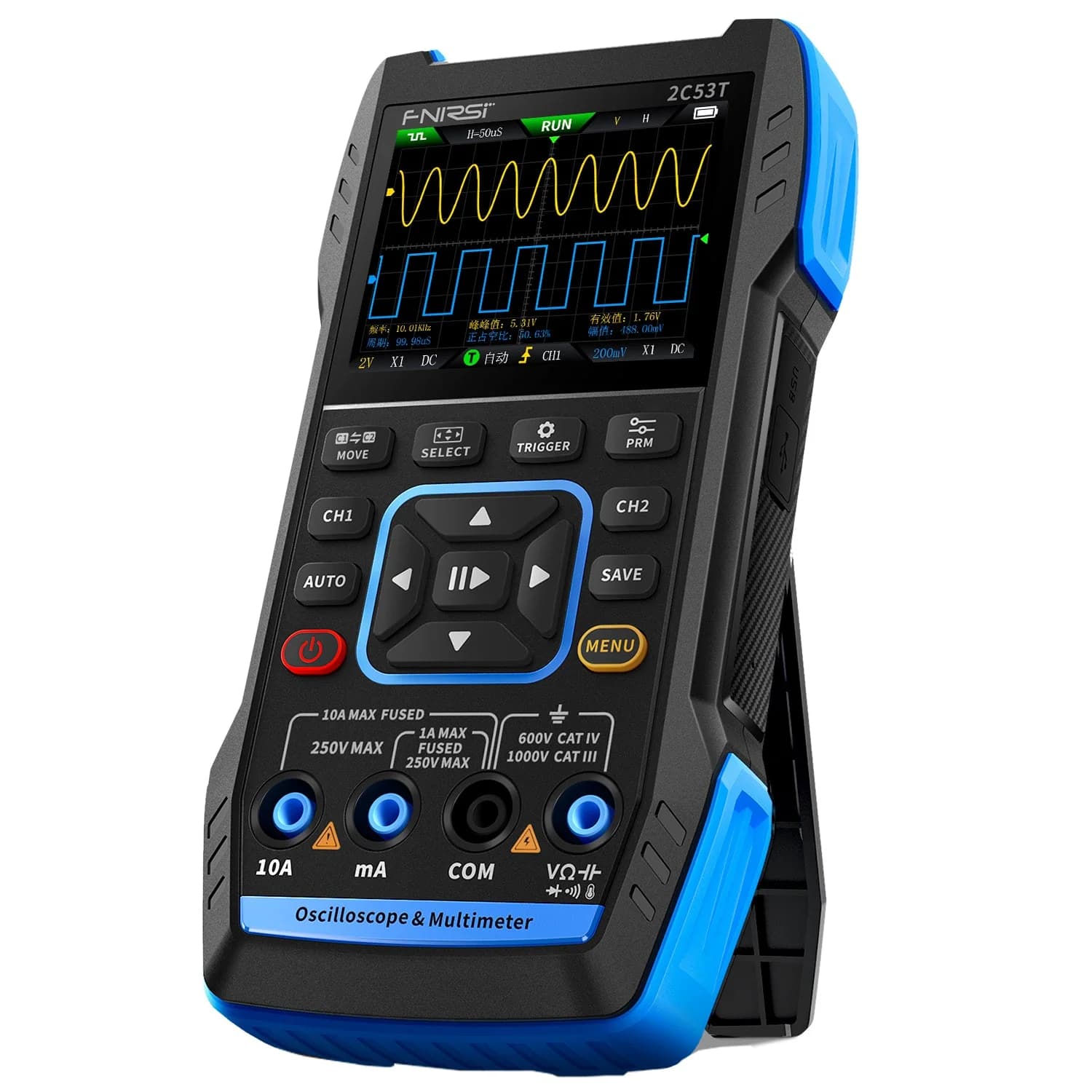
FNIRSI 2C53T
4.1★★★★☆A low-cost two-channel handheld scope with a 19,999-count True RMS multimeter and a basic generator.
Specs side by side
| Hantek 2D72 | FNIRSI 2C53T | |
|---|---|---|
| Rating | 4.3★★★★☆ | 4.1★★★★☆ |
| Bandwidth | 70MHz | 50MHz |
| Channels | 2 | 2 |
| Sample rate | 250 MSa/s (1 ch); 125 MSa/s (2 ch) | 250 MSa/s |
| Best for | Field service and portable kits | Beginners who want a meter and scope in one |
| Sample rate, 2 channels | 125 MSa/s | Not stated separately |
| Record length | 6K (1 ch); 3K per channel (2 ch) | 1 Kpts |
| Vertical resolution | 8-bit | Not stated by FNIRSI |
| Vertical scale | 10 mV/div to 10 V/div | Not stated in the same form |
| Timebase | 5 ns/div to 500 s/div | 10 ns to 20 s |
| Scope max input | 150 Vrms | ±400 V |
| Signal generator | Sine to 25 MHz, square to 10 MHz | 13 waveforms, up to 50 kHz |
| Generator amplitude | 2.5 Vpp into 50 Ω; 5 Vpp high-Z | 0 to 3 V |
| Multimeter | 4,000 counts; 600 V AC/DC; 10 A | 19,999 counts, True RMS; 1000 V DC, 750 V AC; 9.999 A |
| Screen | 2.8-inch, 320 × 240 | 2.8-inch, 320 × 240 |
| Size / weight | 199 × 98 × 40 mm, 624 g | 167 × 89 × 35 mm, 300 g |
| Battery | 2 × 2,600 mAh per Hantek; listing says none included | Built-in 3,000 mAh, up to 6 h |
Specs checked against manufacturer documentation and official Amazon listings. Desk research, not bench testing. How we research.
Key differences
- →The Hantek reaches 70 MHz against the FNIRSI's 50 MHz; both quote 250 MSa/s.
- →The Hantek's generator runs a sine wave to 25 MHz; the FNIRSI's stops at 50 kHz.
- →The FNIRSI's multimeter is 19,999-count True RMS and reads to 1000 V DC; the Hantek's is 4,000-count and stops at 600 V.
- →The Hantek records 6K samples on one channel against the FNIRSI's 1 Kpts.
- →The FNIRSI weighs 300 g against the Hantek's 624 g.
- →Hantek's website lists two 2,600 mAh lithium batteries, while its Amazon listing says the package has none; check before you buy.
At a glance
Same screen
2.8-inch, 320 × 240, two scope channels at 250 MSa/s headline.
Hantek extra: generator
Sine to 25 MHz, 500 times the FNIRSI's 50 kHz ceiling.
Hantek extra: record
6K samples on one channel against 1K.
FNIRSI extra: meter
19,999 counts, True RMS, 1000 V DC.
FNIRSI extra: weight
300 g, under half the Hantek's 624 g.
Verdict
Signals and generator: Hantek. Meter-first field work: FNIRSI.
Hantek 2D72 vs FNIRSI 2C53T spec by spec
These numbers show how differently the makers balanced their 3-in-1 designs. Hantek spent its budget on the scope and generator; FNIRSI on the meter and the battery. Both headline 250 MSa/s, but the Hantek halves to 125 MSa/s per channel with both channels on, and FNIRSI doesn't publish a two-channel figure.
Bars use a logarithmic scale: each step is ten times the last.
Why record length limits both
A scope fills its record across the time on screen, so the real sample rate is record length divided by that time, capped at the headline rate. Short records mean the 250 MSa/s figure only applies on the fastest timebases. The table works it through for one channel.
| Time on screen | Hantek 2D72 (6K) | FNIRSI 2C53T (1K) |
|---|---|---|
| 10 µs | 250 MSa/s (capped) | 100 MSa/s |
| 1 ms | 6 MSa/s | 1 MSa/s |
| 10 ms | 600 kSa/s | 100 kSa/s |
| 100 ms | 60 kSa/s | 10 kSa/s |
At 10 ms on screen, about half a cycle of 50 Hz mains, the FNIRSI samples at about 100 kSa/s, which still draws a 1 kHz tone with 100 points per cycle but can't show a 1 MHz switching edge. The Hantek is six times better there, yet both fall far behind a benchtop with millions of points.
Short records limit handhelds
Hantek 2D72 vs FNIRSI 2C53T: which should you buy?
| Job | Better fit | Why |
|---|---|---|
| Testing filters and amplifiers with a signal | Hantek 2D72 | Generator to 25 MHz, 2.5 Vpp into 50 Ω |
| Electrical and battery measurements | FNIRSI 2C53T | 19,999-count True RMS meter |
| Glancing at a PWM or sensor signal in the field | Either | Both are two-channel at 250 MSa/s |
| Carrying in a small tool bag | FNIRSI 2C53T | 300 g against 624 g |
| Car sensor and injector waveforms | Hantek 2D72 | Longer record holds more of a slow signal |
| Audio tone and speaker checks | Either | Both generators cover the audio band |
| Reading 800 V DC on a solar string | FNIRSI 2C53T | Meter reads to 1000 V DC; the Hantek stops at 600 V |
Use cases in practice
If your day starts with a multimeter, the FNIRSI makes more sense. Its 19,999-count True RMS meter handles distorted waveforms from drives and switching supplies better than an average-responding meter, and its 3,000 mAh battery is built in, so there is nothing to source separately. The scope is a backup for a quick look at a signal rather than a debugging tool.
If your day starts with signals, the Hantek is the better kit. A generator that reaches 25 MHz can sweep a filter or drive an amplifier input, and 70 MHz with a 5 ns rise time shows faster edges than the FNIRSI's 50 MHz. Our guide to measuring an amplifier's bandwidth shows the job where a wide-range generator pays off.
For car work, see our best oscilloscopes for automotive diagnostics, and for another FNIRSI handheld matchup, see OWON HDS272S vs FNIRSI 2C53T.
Safety: check the input limits before probing mains
Choose the Hantek 2D72 if…
- ✓You need a usable signal generator: sine output to 25 MHz
- ✓70 MHz of bandwidth and a 6K record matter more than meter resolution
- ✓You want a fold-out stand for bench use
Choose the FNIRSI 2C53T if…
- ✓The multimeter is your main tool: 19,999 counts and True RMS
- ✓You want the lightest kit at 300 g with a built-in 3,000 mAh battery
- ✓Your scope work stays at audio and low-frequency signals
Neither if…
You need to probe mains voltage directly: the 2D72's scope input is rated only 150 Vrms, below a 120 V outlet's peak, and FNIRSI gives no CAT rating for the 2C53T's ±400 V scope input either — use a meter's rated inputs for mains, not either scope's probes.
The bottom line
Buy the Hantek 2D72 if the scope and signal generator are the point: more bandwidth, a longer record and a generator that reaches 25 MHz. Buy the FNIRSI 2C53T if you mainly want a high-resolution True RMS multimeter with a basic scope attached, in a lighter package.
Frequently asked questions
Which handheld has the better multimeter?+
The FNIRSI 2C53T. FNIRSI lists a 19,999-count True RMS meter that reads to 1000 V DC and 750 V AC, with current to 9.999 A, capacitance and temperature. Hantek lists a 4,000-count meter on the 2D72 with 600 V AC and DC and 10 A ranges, which covers basic checks but resolves about five times fewer steps.
Does the Hantek 2D72 come with batteries?+
Sources disagree. Hantek's site lists two 2,600 mAh lithium cells, while the Hantek-store Amazon listing says the package contains no lithium batteries. Check the listing's package contents before ordering, and buy matching cells if they aren't included. The FNIRSI has its battery built in.
Can either scope measure mains voltage on its scope input?+
Not the Hantek: its scope input is rated 150 Vrms, below the roughly 170 V peak of a 120 V outlet. FNIRSI lists ±400 V on the 2C53T's scope input but no CAT rating. Measure mains on the multimeter inputs instead; our mains frequency guide covers safer ways to view it.
Which is better for audio work?+
Both cover audio frequencies on the scope side, and both generators produce test tones across the audible range. The Hantek's generator goes far beyond audio, to 25 MHz on sine, and its 6K record holds more cycles of a low tone. The FNIRSI's generator reaches 50 kHz, which is still enough for speaker and amplifier checks.
Do they have the same screen?+
Yes, both use a 2.8-inch, 320 × 240 color display. That is small for waveform work, so neither shows fine detail the way a 7-inch benchtop does. The Hantek adds a fold-out stand for bench use, while the FNIRSI is the smaller body at 167 × 89 × 35 mm against 199 × 98 × 40 mm.
Related