COMPARISON · OSCILLOSCOPES
OWON HDS2202S vs FNIRSI DSO152
OWON HDS2202S vs FNIRSI DSO152 is a match between two battery scopes you can carry, built for very different jobs. The OWON packs a two-channel 200 MHz, 1 GSa/s oscilloscope, a 20,000-count multimeter and a 25 MHz signal generator into one handheld. The FNIRSI is a single-channel 200kHz, 2.5 MSa/s pocket scope that weighs 100 g. The right one depends on how fast your signals are and how many tools you want in the bag.
By the OhmSavvy Research Team ·
Disclosure: OhmSavvy earns a commission from qualifying Amazon purchases made through these links, at no extra cost to you. How we're funded.

OWON HDS2202S
4.3★★★★☆A battery handheld that combines a 200 MHz two-channel scope, a 20,000-count multimeter and a 25 MHz generator.
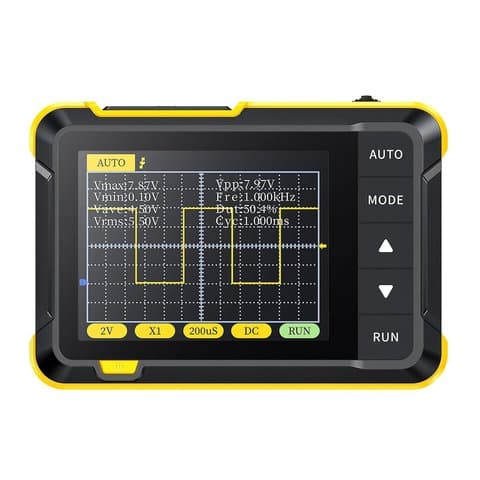
FNIRSI DSO152
4.1★★★★☆A genuinely pocket-sized scope for quick diagnostics — not a bench replacement.
Specs side by side
| OWON HDS2202S | FNIRSI DSO152 | |
|---|---|---|
| Rating | 4.3★★★★☆ | 4.1★★★★☆ |
| Bandwidth | 200MHz | 200kHz |
| Channels | 2 | 1 |
| Sample rate | 1 GSa/s | 2.5 MSa/s |
| Best for | Field work that needs a scope, meter and signal source in one | Basic diagnostics, learning the fundamentals |
| Screen | 3.5-inch color LCD | 2.8-inch, 320 × 240 |
| Battery | 18650 lithium, 3–6 hours | 1000mAh lithium, about 4 hours |
| Charging | USB-C (works from a power bank) | USB-C, 5V/1A |
| Fastest timebase | 2 ns/div | 10µs/div |
| Vertical range | 10 mV/div to 10 V/div | 10mV/div to 20V/div |
| Trigger modes | Edge: Auto, Normal, Single | Auto, Normal, Single |
| Built-in multimeter | 20,000 counts, 1000 V DC / 750 V AC, 10 A | No |
| Built-in generator | Sine to 25 MHz; square, pulse, arbitrary to 5 MHz | No |
Specs checked against manufacturer documentation and official Amazon listings. Desk research, not bench testing. How we research.
Key differences
- →Bandwidth: 200 MHz on the OWON against 200kHz on the FNIRSI, a factor of 1,000. By the 3–5× rule the HDS2202S suits signals up to roughly 40–65 MHz and the DSO152 up to roughly 40–65kHz.
- →Sample rate: OWON gives 1 GSa/s for the HDS2202S against 2.5 MSa/s on the DSO152, 400 times faster. OWON doesn't state the per-channel rate with both channels running.
- →Channels: two on the OWON, one on the FNIRSI, so only the OWON can show a cause and its effect together.
- →The HDS2202S is three instruments: the scope, a 20,000-count multimeter (1000 V DC, 750 V AC, 10 A) and a single-channel generator with sine to 25 MHz. The DSO152 is a scope only.
- →Size: FNIRSI lists the DSO152 at 99 × 68.3 × 19.5 mm and 100 g. OWON doesn't publish a weight for the HDS2202S; its 3.5-inch screen is larger than the FNIRSI's 2.8-inch one.
- →Both run on internal lithium batteries and charge over USB-C: 3–6 hours for the OWON per OWON, about 4 hours for the FNIRSI per FNIRSI.
- →Memory: OWON lists an 8K record length for the HDS2202S, which its own Pick counts as a con.
- →Neither carries our Hands-on Tested badge; both assessments are desk research from the makers' published specs.
Spec by spec
Put side by side, these two handhelds differ by two or three orders of magnitude on every speed figure, so the first three charts use a log scale. The fourth is a plain count of what you get in the box, because that is the other half of the decision: one is a scope, the other is a scope plus two more instruments.
Bars use a logarithmic scale: each step is ten times the last.
Bars use a logarithmic scale: each step is ten times the last.
Bars use a logarithmic scale: each step is ten times the last.
The timebase chart explains the bandwidth gap in practical terms. At its fastest setting the DSO152 spreads 100µs across a typical 10-division screen, so one cycle of a 1 MHz clock would occupy a tenth of a division. The HDS2202S at 2 ns/div shows 20 ns across the screen, enough to look at the edge of a fast logic signal. At the slow end both reach long timebases (50 s/div on the FNIRSI, 1000 s/div on the OWON) for watching a battery voltage sag or a sensor drift. Our guide to oscilloscope bandwidth covers what the −3 dB rating means, and what GSa/s means covers sample rate.
Which should you buy?
| Buyer or job | Pick | One-line reason |
|---|---|---|
| Field technician servicing control boards | OWON HDS2202S | Scope, 20,000-count meter and generator in one battery unit |
| Student curious about waveforms on a small budget | FNIRSI DSO152 | Extremely affordable; one channel and AUTO keep it simple |
| Checking a guitar pedal or speaker line for clipping | Either | Audio sits inside both scopes' comfortable range |
| Probing an SPI or UART bus at a few MHz | OWON HDS2202S | 200 MHz and two channels; 200kHz can't resolve it |
| Testing a filter or amplifier with a known input | OWON HDS2202S | Built-in generator drives the circuit, CH2 watches the output |
| Logging a slow sensor drift over minutes | Either | Timebases reach 50 s/div on the FNIRSI and 1000 s/div on the OWON |
| Keeping a scope in a glovebox or pocket | FNIRSI DSO152 | 99 × 68.3 × 19.5 mm and 100 g per FNIRSI |
| Checking a switching regulator's switch node | OWON HDS2202S | Switching frequencies in the hundreds of kHz are beyond the DSO152 |
What each one can and can't measure
A scope's rated bandwidth is the frequency where a sine wave reads about 3 dB low, around 70% of its true size. To see a signal's amplitude and shape with little distortion, the usual advice is a scope rated at three to five times the signal frequency, and more for square waves with sharp edges. That one rule separates these two handhelds cleanly.
FNIRSI DSO152: the low-frequency world
Divide 200kHz by three to five and the DSO152 is at home below roughly 40–65kHz. That covers the whole audio band, 50 or 60Hz mains-related ripple after a rectifier, the 1kHz square wave FNIRSI uses for probe calibration, hobby servo pulses and the slow PWM that dims an LED strip. Its AC coupling lets you strip off a DC level and look at the small wobble riding on it, and at 10mV/div that wobble can fill the screen. What it can't do is follow anything quick: a 1 MHz crystal, the edges of an I2C clock, or the switch node of a buck converter will be rounded off or missed. With one input, it also can't time one event against another.
OWON HDS2202S: a bench-class front end in your hand
At 200 MHz the HDS2202S is comfortable to roughly 40–65 MHz, which covers microcontroller clocks, the SPI and UART traffic of most hobby and industrial boards, motor-drive PWM and switching regulators. Two channels let you trigger on one line and watch another, and the generator lets you feed a filter a sine sweep or a square wave while CH2 shows the response. The limits are in the details: OWON lists an 8K record length, so long captures at high sample rates are short in time, and OWON lists edge triggering only, with no serial decoding. A 3.5-inch screen is larger than the FNIRSI's but small next to any bench scope.
Samples per cycle at each scope's own limit
One tool or three: what the extra instruments are worth
The HDS2202S's multimeter is a full 20,000-count meter by OWON's figures: voltage to 1000 V DC and 750 V AC, current to 10 A, plus resistance, capacitance, diode and continuity. If you would otherwise carry a separate meter, that removes one tool from the kit. The generator is the more unusual extra in a handheld: sine to 25 MHz, square, pulse and arbitrary waveforms to 5 MHz, from 20 mVpp to 5 Vpp into high impedance. That is enough to stand in for a missing sensor signal, clock a logic chip, or test an amplifier stage on the spot.
The DSO152 offers none of that, and doesn't try to. Its case is that it fits in a shirt pocket, starts showing a waveform after one press of AUTO, and costs little enough to leave in a toolbox. If you already own a decent multimeter and never need to inject a signal, the OWON's extras are worth little to you and the decision comes down to bandwidth and channels alone.
High voltage on handheld scopes
More oscilloscope comparisons
Weighing the DSO152 against other small scopes? See FNIRSI DSO-TC3 vs DSO152 for FNIRSI's scope-plus-tester, or FNIRSI DSO152 vs Hantek 6022BE for a two-channel USB scope at a similar budget. For another handheld with built-in extras, the Hantek 2D72 vs FNIRSI 2C53T page compares two 3-in-1 units. If you are leaning toward a bench scope instead, start with the oscilloscope buying guide and the best beginner oscilloscopes.
Choose the OWON HDS2202S if…
- ✓You service equipment on site and want a scope, a meter and a signal source in one case
- ✓You need to see two signals together, such as a clock and the data line it drives
- ✓Your signals run into the megahertz range: PWM drives, switching regulators, microcontroller buses
- ✓You want to inject a test tone or square wave into a circuit without carrying a separate generator
Choose the FNIRSI DSO152 if…
- ✓You want the smallest, cheapest way to see a waveform, and one channel is enough
- ✓Your signals are audio, sensor outputs, slow PWM or other low-frequency work
- ✓You already own a multimeter and don't need a built-in generator
- ✓You are learning what waveforms look like and want little at stake
Neither if…
You need decoded serial-bus bytes on screen rather than a waveform to read by eye: neither maker lists serial decoding, and the DSO152's 200kHz bandwidth rules out most bus work entirely — a scope with built-in I2C/SPI/UART decode is the right tool for that.
The bottom line
For anyone working on circuits faster than audio, the OWON HDS2202S is the better buy: 1,000 times the bandwidth, two channels, and a multimeter and 25 MHz generator in the same battery handheld. The FNIRSI DSO152 makes sense if your signals stay below roughly 40–65kHz and you want the smallest, cheapest scope that will show them, or a pocket spare alongside a better instrument.
Frequently asked questions
Is the OWON HDS2202S worth it over the FNIRSI DSO152?+
Yes, if you measure anything faster than audio or need two channels. The HDS2202S has 200 MHz against 200kHz, two inputs against one, and adds a 20,000-count multimeter and a 25 MHz generator. If you only look at slow, single signals and want the lowest cost and smallest size, the DSO152 does that job.
Can the FNIRSI DSO152 replace a multimeter like the one built into the HDS2202S?+
No. The DSO152 is an oscilloscope only, and FNIRSI lists no meter functions. It shows voltage against time on screen, but for resistance, continuity, capacitance or current you need a separate meter. The HDS2202S includes a 20,000-count meter rated to 1000 V DC, 750 V AC and 10 A per OWON.
Which has the better battery life?+
On the makers' figures they are close. OWON quotes 3 to 6 hours of continuous use from the HDS2202S's 18650 cell, and FNIRSI quotes about 4 hours from the DSO152's 1000mAh battery. Both charge over USB-C, and OWON says the HDS2202S can run from a power bank.
Can either handheld decode I2C or UART?+
Neither maker lists serial decoding. The DSO152's 200kHz bandwidth also rules out most bus work, since even a 100kHz I2C clock sits beyond its comfortable range. The HDS2202S has the bandwidth to show UART, I2C and SPI waveforms clearly on two channels, but you read the bits by eye rather than having them decoded.
What can I do with the HDS2202S signal generator?+
Feed a known signal into a circuit and watch what comes out. OWON lists sine to 25 MHz and square, pulse and arbitrary waveforms to 5 MHz, 20 mVpp to 5 Vpp. Typical uses are checking a filter's response, clocking a logic chip, or replacing a sensor signal while you troubleshoot the board that reads it.
Related