COMPARISON · OSCILLOSCOPES
Rigol DHO804 vs FNIRSI 1014D for Beginners
Rigol DHO804 vs FNIRSI 1014D for beginners is a question of what you want your first scope to teach you. The Rigol is a 70 MHz, four-channel, 12-bit instrument with a 1024 × 600 touchscreen, deep memory and standard serial decoding, but no signal source. The FNIRSI is a 100 MHz, two-channel, 8-bit scope with a built-in DDS generator and loosely documented memory.
By the OhmSavvy Research Team ·
Disclosure: OhmSavvy earns a commission from qualifying Amazon purchases made through these links, at no extra cost to you. How we're funded.
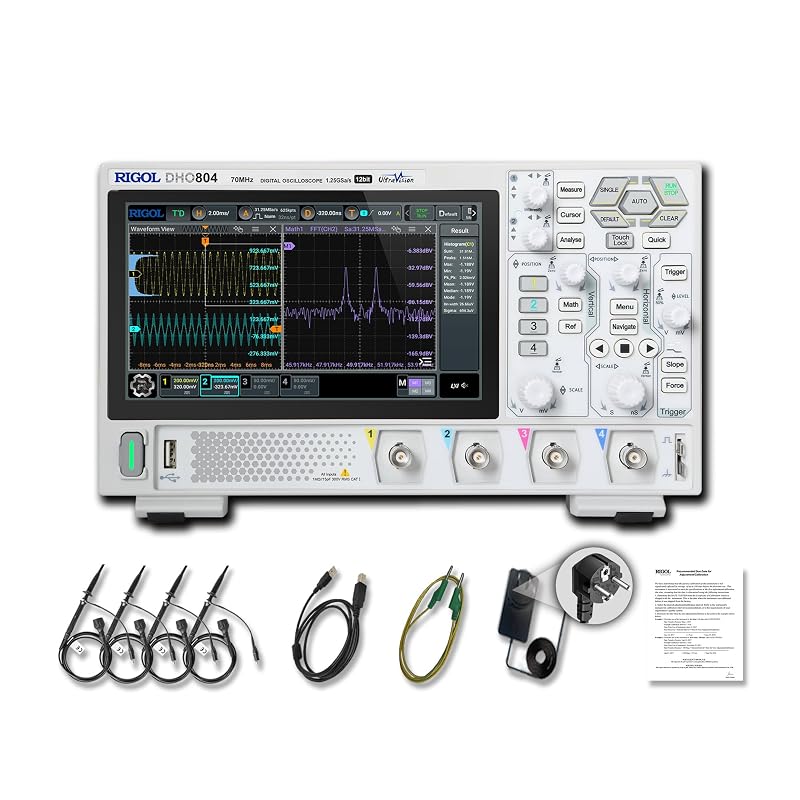
Rigol DHO804
4.8★★★★★Four channels, 12-bit resolution and a 7-inch touchscreen in a compact body that runs from USB-C power.

FNIRSI 1014D
4.3★★★★☆A two-channel 100 MHz benchtop with a built-in signal generator at an entry-level price.
Specs side by side
| Rigol DHO804 | FNIRSI 1014D | |
|---|---|---|
| Rating | 4.8★★★★★ | 4.3★★★★☆ |
| Bandwidth | 70MHz | 100MHz |
| Channels | 4 | 2 |
| Sample rate | 1.25 GSa/s (1 ch); 312.5 MSa/s (4 ch) | 1 GSa/s |
| Best for | Hobbyists who want 12-bit detail and a touchscreen | Budget benches that need a scope and a signal source |
| Vertical resolution | 12-bit | 8-bit |
| Display | 7-inch 1024 × 600 capacitive touchscreen | 7-inch 800 × 480 |
| Memory | 25 Mpts (1 ch); 5 Mpts (4 ch) | Quoted by FNIRSI as "240Kbit" |
| Sample rate, all channels on | 312.5 MSa/s per channel (4 ch) | Not stated by FNIRSI |
| Built-in signal generator | None | 1-ch DDS: sine to 10 MHz, other waveforms to 2 MHz, 2.5 Vpp |
| Power | USB-C | 5 V adapter |
Specs checked against manufacturer documentation and official Amazon listings. Rigol DHO804 is hands-on tested by OhmSavvy; the FNIRSI 1014D assessment is desk research. How we research.
Key differences
- →Channels: four on the DHO804, two on the 1014D. For a beginner this decides whether you can watch a whole bus or just a pair of signals.
- →Vertical resolution: 12-bit on the Rigol (4,096 levels) against 8-bit on the FNIRSI (256 levels).
- →Bandwidth: 100 MHz on the 1014D against 70 MHz on the DHO804. Both are far above what most first projects need.
- →Only the 1014D has a built-in generator: one DDS channel, sine to 10 MHz and other waveforms to 2 MHz at 2.5 Vpp. Rigol lists no generator for the DHO804.
- →Memory: Rigol publishes 25 Mpts with one channel and 5 Mpts with four; FNIRSI quotes only "240Kbit" and doesn't state the per-channel sample rate with both channels on.
- →The DHO804 adds a 1024 × 600 touchscreen, HDMI output, standard serial decoding and USB-C power. FNIRSI lists FFT, X-Y and roll modes and USB export for the 1014D.
- →The DHO804 carries our Hands-on Tested badge; the FNIRSI 1014D is assessed from FNIRSI's specifications and the official Amazon listing.
Spec by spec
Read the headline numbers alone and the FNIRSI looks like the faster scope. Read the rest of the sheet and the Rigol pulls ahead on channels, resolution and documented memory. The four charts below use only the figures each maker publishes, as recorded in our beginner roundup.
Bars use a logarithmic scale: each step is ten times the last.
Bars use a logarithmic scale: each step is ten times the last.
On one channel the two converters are evenly matched for their bandwidths: the DHO804 takes about 18 samples per cycle of a 70 MHz sine and the 1014D 10 per cycle of a 100 MHz sine, both well clear of the Nyquist minimum of two. The gap is in what happens next. Rigol tells you each of four channels gets 312.5 MSa/s; FNIRSI doesn't say what each of its two gets. If samples per second is a new idea, start with what GSa/s means.
Rigol DHO804 vs FNIRSI 1014D for beginners
A first oscilloscope has two jobs. It has to show your own circuits clearly enough that you trust what you see, and it has to help you learn what a correct waveform looks like. These two scopes split those jobs between them.
Learning with known signals: the 1014D's advantage
The fastest way to learn triggering, timebase and volts-per-division is to feed the scope a signal whose shape and frequency you already know. The 1014D makes its own: connect the generator output to channel 1, pick a sine, square or one of FNIRSI's standard waveforms (its spec table and Amazon listing say 14; another part of FNIRSI's page says 12), and practice measuring it. Run the same signal through a simple RC filter to channel 2 and you can see phase shift and attenuation on one screen. A DHO804 owner has to borrow those signals from a microcontroller pin or buy a separate generator.
Seeing real projects clearly: the DHO804's advantage
Once you are debugging your own boards, the bottleneck moves. A typical beginner fault, such as a sensor that answers on I2C only some of the time, involves a clock, a data line and often a supply rail. Four channels show all of them on one trigger, and the DHO804 decodes UART, I2C, SPI, CAN and parallel traffic as standard, so you read bytes rather than counting edges. Our data for the 1014D doesn't list serial decoding. The 25 Mpt memory lets you capture a long burst at a fast timebase and zoom in afterwards; with the 1014D's short "240Kbit" figure you will more often have to choose between a long window and fine detail.
Ease of use
Both have 7-inch screens. The Rigol's is a capacitive touchscreen at 1024 × 600, and it adds HDMI out for a larger monitor, which helps if you are following a course or sharing a bench. The FNIRSI's 800 × 480 panel is the same size at lower resolution. The DHO804 runs from USB-C, so it can sit on a portable power source; the 1014D runs from a 5 V adapter.
What 12 bits buys a beginner
What each one can and can't measure
A scope's rated bandwidth marks where a sine input has already dropped by 3 dB, so readings are only trustworthy well below it. Applying the usual three-to-five-times margin, the DHO804 handles signals up to roughly 14–23 MHz and the 1014D up to roughly 20–33 MHz. Everything a beginner usually builds sits inside both ranges: Arduino and ESP32 PWM, UART at common baud rates, 100 kHz and 400 kHz I2C, hobby-speed SPI, audio amplifiers and the switching frequency of most small buck converters. Our explainer on oscilloscope bandwidth walks through the margin in detail.
The 1014D's extra bandwidth shows up on fast edges. Using the common 0.35 ÷ bandwidth estimate, the fastest rise time each can display is about 5 ns for the DHO804 and 3.5 ns for the 1014D. That matters when you are judging overshoot on a fast logic edge; it rarely matters for a 1 kHz PWM signal whose edges you only need to time.
| Limit | DHO804 | 1014D |
|---|---|---|
| Comfortable signal range | ~14–23 MHz | ~20–33 MHz |
| Signals at once | 4 | 2 |
| Make its own test signal | No | Yes, sine to 10 MHz |
| Long captures at fast timebase | 25 Mpts (1 ch) | "240Kbit" |
| Per-channel rate, all on | 312.5 MSa/s | Not stated |
Mains and high voltage
Which should you buy?
| Buyer or job | Pick | Why |
|---|---|---|
| Complete beginner with no other test gear | FNIRSI 1014D | Built-in generator gives known signals to learn on |
| Arduino or ESP32 projects with I2C or SPI sensors | Rigol DHO804 | Four channels plus standard serial decoding |
| Testing filters, amplifiers and audio stages | FNIRSI 1014D | Generator drives the input while CH2 shows the output |
| Supply ripple and small sensor signals | Rigol DHO804 | 12-bit resolution, 4,096 levels against 256 |
| Long captures of intermittent faults | Rigol DHO804 | 25 Mpts published against a loosely quoted 240Kbit |
| Fastest edges on one or two signals | FNIRSI 1014D | 100 MHz rated against 70 MHz |
| Classroom or shared bench with a monitor | Rigol DHO804 | HDMI output and a 1024 × 600 touchscreen |
For the full field, see the best beginner oscilloscopes and our oscilloscope buying guide. Related match-ups: FNIRSI 1014D vs DSO-TC3 if a pocket tool is also on your list, Rigol DHO804 vs Hantek DSO2D10 for another generator-equipped rival, and DHO804 vs DS1054Z for Rigol's older four-channel model.
Choose the Rigol DHO804 if…
- ✓You want to learn on a scope with fully published specs, including memory and per-channel sample rate
- ✓Your projects involve several signals at once, such as an SPI bus or a set of supply rails
- ✓You want serial decoding of UART, I2C, SPI, CAN and parallel buses from day one
- ✓Fine vertical detail matters: ripple, noise, small sensor outputs
Choose the FNIRSI 1014D if…
- ✓You have no signal generator and want known test signals to practice on
- ✓Two channels cover what you need to see at once
- ✓You want a kit that already includes a 100X high-voltage probe alongside two 1X/10X probes
- ✓You value 100 MHz of rated bandwidth over channel count and vertical resolution
The bottom line
For most beginners who will move quickly from practice signals to real projects, the Rigol DHO804 is the better first scope: four channels, 12-bit resolution, published deep memory, standard serial decoding and a sharper touchscreen. The FNIRSI 1014D is the better buy if you own no other test gear and want a built-in signal source to learn on, and two channels cover your work.
Frequently asked questions
Is the Rigol DHO804 or the FNIRSI 1014D better for a complete beginner?+
It depends on what else you own. With no signal source at all, the 1014D's built-in generator gives you known waveforms to practice triggering and measurement on. If you already have a microcontroller or generator to supply signals, the DHO804's four channels, 12-bit resolution and serial decoding will serve you longer.
Does the FNIRSI 1014D's 100 MHz make it faster than the Rigol DHO804?+
Only in rated bandwidth. The 1014D is rated 100 MHz against 70 MHz, so it shows fast edges a little more faithfully. The DHO804 has the higher single-channel sample rate (1.25 GSa/s against 1 GSa/s), publishes its four-channel rate, and has far deeper documented memory.
Can the Rigol DHO804 generate test signals like the FNIRSI 1014D?+
No. Rigol lists no built-in signal generator or logic channels for the DHO804. The 1014D has a single-channel DDS generator with sine up to 10 MHz and other waveforms up to 2 MHz at 2.5 Vpp. DHO804 owners would add a separate generator or use a microcontroller pin.
How much memory does the FNIRSI 1014D have?+
FNIRSI quotes it only as 240Kbit and doesn't give a per-channel point count, so it can't be compared directly with the DHO804's published 25 Mpts on one channel and 5 Mpts with four. In practice, expect the 1014D to hold shorter captures at fast timebases.
Is 8-bit resolution on the 1014D a problem for learning?+
Not for learning waveform basics: square waves, PWM, clocks and audio signals look fine at 256 levels. It shows up when you zoom into small details such as millivolt ripple on a supply rail, where the DHO804's 12-bit converter draws a smoother, more readable trace.
Related