Disclosure: OhmSavvy earns a commission from qualifying Amazon purchases made through the links below, at no extra cost to you. How we're funded.
At a glance
Our top picks

Fluke 117
The meter working electricians actually buy with their own money, not just the one brands push.
Check price on Amazon →Why we picked it ↓
Klein Tools MM720
CAT IV 600V, 1000V, LoZ and True RMS at a budget price, the most panel-ready meter in this tier.
Check price on Amazon →Why we picked it ↓
Fluke 87V
The step-up pick for anyone who needs CAT IV protection and high-resolution readings daily.
Check price on Amazon →Why we picked it ↓Also great
- 4
 Fluke 179Check pricePrice →Best for Industrial Work4.7★★★★★
- 5
 Brymen BM235Check pricePrice →Best Features for the Money4.6★★★★★
- 6
 Fluke 117/323 KitCheck pricePrice →Best Combo Kit4.6★★★★★
- 7
 Fluke T5-600Check pricePrice →Best Electrical Tester4.4★★★★☆
- 8
 Fluke 323Check pricePrice →Best Fluke Clamp Meter4.7★★★★★
- 9Milwaukee 2235-20Check pricePrice →Best Clamp Meter4.6★★★★★
- 10
 Southwire 16030ACheck pricePrice →Best Waterproof Voltage Checker4.0★★★★☆
Quick shopping
Compare at a glance
Swipe sideways on mobile to see every spec.
| Model | Award | Rating | Accuracy | Safety rating | Auto-ranging | |
|---|---|---|---|---|---|---|
| #1Fluke 117✓ Tested | Best Overall | 4.8★★★★★ | True RMS | CAT III 600V | Yes | Check price → |
 #2Klein Tools MM720 | Best Budget Electrician's Meter | 4.6★★★★★ | True RMS, 6,000-count | CAT IV 600V / CAT III 1000V | Yes (manual RANGE button) | Check price → |
| #3Fluke 87V✓ Tested | Best for Professionals | 4.8★★★★★ | True RMS | CAT III 1000V / CAT IV 600V | Yes | Check price → |
| #4Fluke 179 | Best for Industrial Work | 4.7★★★★★ | True RMS | CAT III 1000V / CAT IV 600V | Yes (manual override) | Check price → |
| #5Brymen BM235 | Best Features for the Money | 4.6★★★★★ | True RMS | CAT III 600V / CAT IV 300V | Yes (manual override) | Check price → |
| #6Fluke 117/323 Kit | Best Combo Kit | 4.6★★★★★ | — | CAT III 600V (both tools) | — | Check price → |
| #7Fluke T5-600 | Best Electrical Tester | 4.4★★★★☆ | Average-responding (not True RMS) | CAT III 600V | Automatic AC/DC voltage selection | Check price → |
| #8Fluke 323 | Best Fluke Clamp Meter | 4.7★★★★★ | True RMS | CAT III 600V / CAT IV 300V | — | Check price → |
| Best Clamp Meter | 4.6★★★★★ | True RMS | CAT III 600V | Not stated by Milwaukee | Check price → | |
| #10Southwire 16030A | Best Waterproof Voltage Checker | 4.0★★★★☆ | True RMS, 4,000-count | CAT IV 600V | Yes (auto-selects AC/DC) | Check price → |
In depth
Detailed reviews
Fluke 117
The meter working electricians actually buy with their own money, not just the one brands push.
Best for:Electricians, serious hobbyists
The Fluke 117 is the meter most working electricians reach for. True RMS readings, non-contact voltage detection, and a CAT III 600V rating make it reliable in real electrical panels, not just hobby projects.
Why it fits: It leads because it puts the three things a service electrician uses every day into one CAT III 600V True RMS body: a LoZ input for phantom voltage, AutoVolt so the meter picks AC or DC on its own, and a built-in non-contact detector. It carries our Hands-on Tested badge. The trade-off is that it stops at CAT III, so it is not the meter for meter-base or service-drop work.
- Accuracy
- True RMS
- Safety rating
- CAT III 600V
- Auto-ranging
- Yes
- Best for
- Electricians, serious hobbyists
Reasons to buy
- +Trusted, well-documented reliability
- +Non-contact voltage (NCV) detection built in
- +Durable enough for daily field use
Reasons to avoid
- −Premium price for casual hobbyists
- −No Bluetooth/app connectivity
Klein Tools MM720
CAT IV 600V, 1000V, LoZ and True RMS at a budget price, the most panel-ready meter in this tier.
Best for:Electricians working panels and feeders
The MM720 is rated CAT IV 600V / CAT III 1000V and measures up to 1000V AC/DC, with a LoZ mode for ghost voltages. It is True RMS, auto-ranging and 6,000-count, and the reverse-contrast display adjusts itself to the light. Current runs from a 600.0 µA range (0.1 µA) to 10 A. It adds 60 MΩ resistance, capacitance to 6,000 µF, temperature to 1832°F, IP42 and a 2 m drop rating, and a carrying pouch comes in the box. Klein lists no NCV.
Why it fits: It is the most panel-ready meter in its class: CAT IV 600V and CAT III 1000V, 1000V AC/DC, LoZ for ghost voltage and True RMS on a 6,000-count reverse-contrast display. IP42 and a 2 m drop rating suit van life, and current runs from a 600.0 µA range to 10 A. Klein lists no NCV, so carry a separate pen tester.
- Accuracy
- True RMS, 6,000-count
- Safety rating
- CAT IV 600V / CAT III 1000V
- Auto-ranging
- Yes (manual RANGE button)
- Best for
- Electricians working panels and feeders
Reasons to buy
- +CAT IV 600V and 1000V AC/DC
- +LoZ mode for ghost voltages
- +IP42, 2 m drop rating and pouch included
Reasons to avoid
- −Priced at the top of the budget tier
- −No non-contact voltage detection
Fluke 87V
The step-up pick for anyone who needs CAT IV protection and high-resolution readings daily.
Best for:Industrial technicians, daily professional use
The 87V is Fluke's industrial-grade step up from the 117 — a 1000V CAT III / 600V CAT IV rating, a 6,000-count main display with a 19,999-count high-resolution mode, and a 32-segment analog bar graph for watching signals change in real time.
Why it fits: It brings CAT IV 600V and CAT III 1000V protection, a 19,999-count high-resolution mode and a fast analog bar graph for watching readings move on motors and controls. It carries our Hands-on Tested badge. For a residential electrician it is more meter than the job needs, which is why the more focused 117 and MM720 rank above it.
- Accuracy
- True RMS
- Safety rating
- CAT III 1000V / CAT IV 600V
- Auto-ranging
- Yes
- Best for
- Industrial technicians, daily professional use
Reasons to buy
- +Joint-highest CAT rating in this list (CAT IV 600V / CAT III 1000V)
- +19,999-count high-resolution mode
- +Analog bar graph tracks fast-changing signals
Reasons to avoid
- −Among the most expensive picks here
- −Overkill for casual home use
Fluke 179
Fluke's do-everything bench-and-field meter: CAT IV 600V, True RMS, temperature and a 6,000-count display with bar graph.
Best for:Industrial maintenance, electronics, HVAC
The Fluke 179 is the full-featured member of Fluke's 170 series: True RMS, CAT III 1000V and CAT IV 600V, a 6,000-count backlit display with an analog bar graph, and temperature measurement with the supplied thermocouple. It adds Min/Max-Average recording and both manual and automatic ranging, so it suits industrial maintenance and electronics work where the 117's electrician-focused extras matter less than range and resolution.
Why it fits: A CAT IV 600V True RMS meter with temperature through the supplied thermocouple, capacitance to 10,000 µF, frequency to 100 kHz and Min/Max-Average recording, with both automatic and manual ranging. It suits maintenance electricians who also check motor temperatures and capacitors. It has no non-contact voltage detection, so it sits behind the meters that combine LoZ with field-friendly extras.
- Accuracy
- True RMS
- Safety rating
- CAT III 1000V / CAT IV 600V
- Auto-ranging
- Yes (manual override)
- Best for
- Industrial maintenance, electronics, HVAC
Reasons to buy
- +CAT IV 600V for service entrances and outdoor feeds
- +Temperature, capacitance to 10,000 µF and frequency to 100 kHz
- +Min/Max-Average recording and analog bar graph
Reasons to avoid
- −Costs more than the 117 for features many electricians won't use
- −No non-contact voltage detection
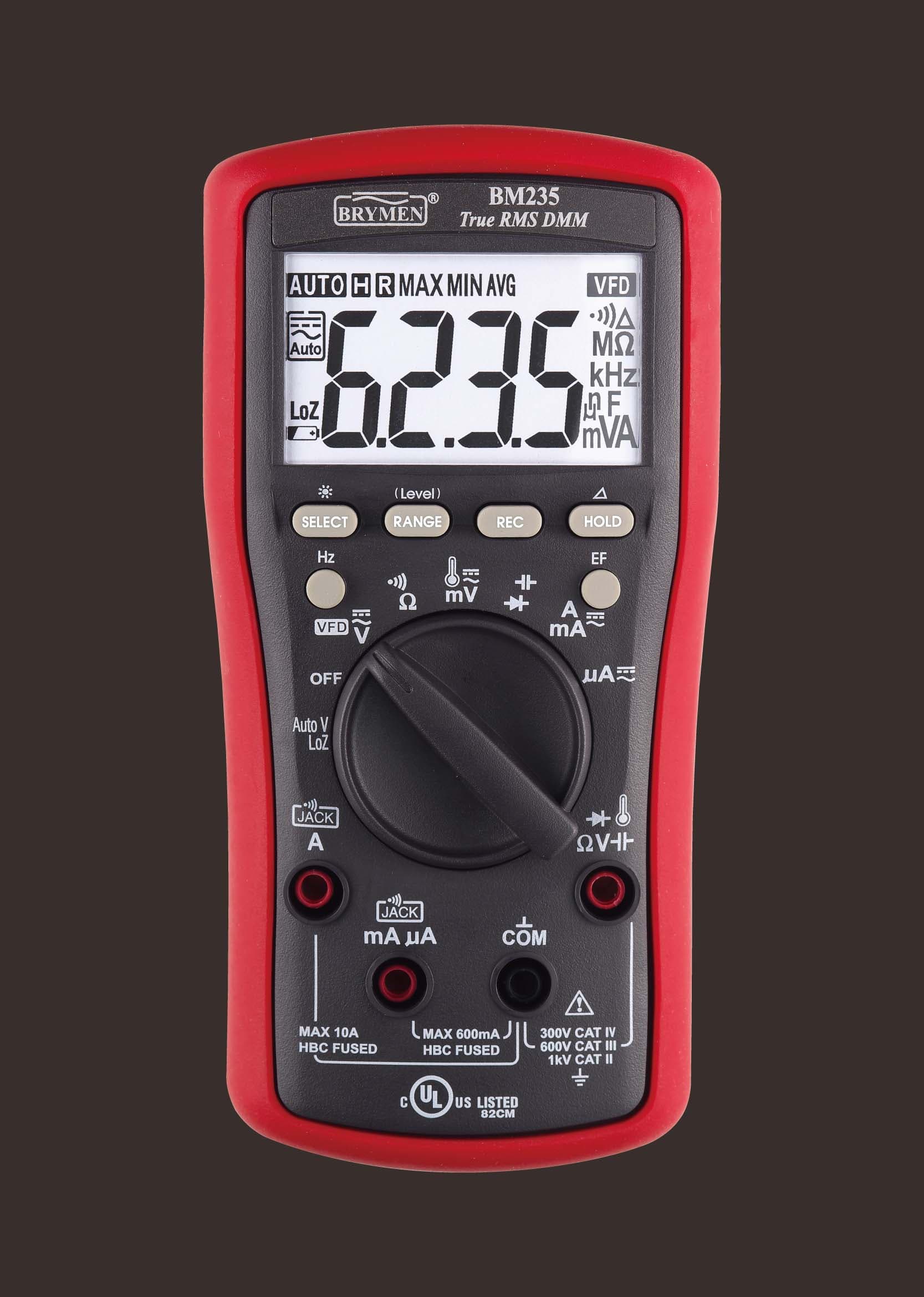
Brymen BM235
True RMS with AutoV LoZ, NCV, VFD mode and temperature: more electrician features than most meters at its price.
Best for:Electricians and enthusiasts who want every feature
Brymen's BM235 packs features usually found on pricier meters: True RMS, a 6,000-count backlit display, AutoV low-impedance voltage, non-contact voltage detection, a VFD mode for variable-speed drives, Type-K temperature, Max/Min/Avg and relative zero, with 1000V-rated HBC fuses. Brymen's catalog and the meter's own markings give CAT III 600V and CAT IV 300V. The US listing is the EEVblog edition, and support runs through Brymen's distributors rather than a big US brand.
Why it fits: For the feature list alone it is hard to beat: AutoV low-impedance voltage, NCV, a VFD mode for variable-speed drives, Type-K temperature and Max/Min/Avg, protected by 1000V-rated HBC fuses. Brymen's catalog and the meter's markings give CAT III 600V but only CAT IV 300V, so it belongs inside the building, and US support runs through distributors rather than a big brand.
- Accuracy
- True RMS
- Safety rating
- CAT III 600V / CAT IV 300V
- Auto-ranging
- Yes (manual override)
- Best for
- Electricians and enthusiasts who want every feature
Reasons to buy
- +AutoV LoZ and NCV built in
- +VFD voltage and frequency mode
- +Max/Min/Avg, relative zero and Type-K temperature
Reasons to avoid
- −CAT IV only to 300V, below the Fluke 179 and Klein MM700
- −Less familiar brand in the US; Amazon listing is the EEVblog edition
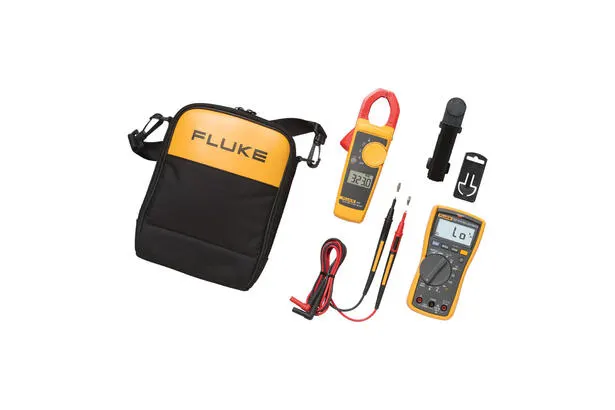
Fluke 117/323 Kit
The Fluke 117 and 323 clamp meter bundled together, covering both general multimeter work and clamp current checks in one purchase.
Best for:Electricians who want both tools in one purchase
This official Fluke bundle pairs the 117 — our Best Overall multimeter pick — with the 323 True RMS clamp meter, covering general electrical troubleshooting and no-disconnect current checks in one kit. It costs more than either tool alone, but less than buying both at full price separately.
Why it fits: This official Fluke bundle pairs the 117 multimeter with the 323 True RMS clamp in a soft case, so a new electrician gets voltage, LoZ and NCV plus 400A AC clamp current in one purchase. Both tools are CAT III 600V. It only makes sense if you need both; anyone who already owns a good meter should buy the clamp alone.
- Includes
- Fluke 117 multimeter + Fluke 323 clamp meter
- Safety rating
- CAT III 600V (both tools)
- Carrying case
- Included soft case
- Best for
- Electricians who want both tools in one purchase
Reasons to buy
- +Covers both general multimeter and clamp current work
- +Official Fluke bundle, not a third-party pairing
- +Includes a carrying case
Reasons to avoid
- −Higher upfront cost than either tool alone
- −No savings if you only need one of the two tools
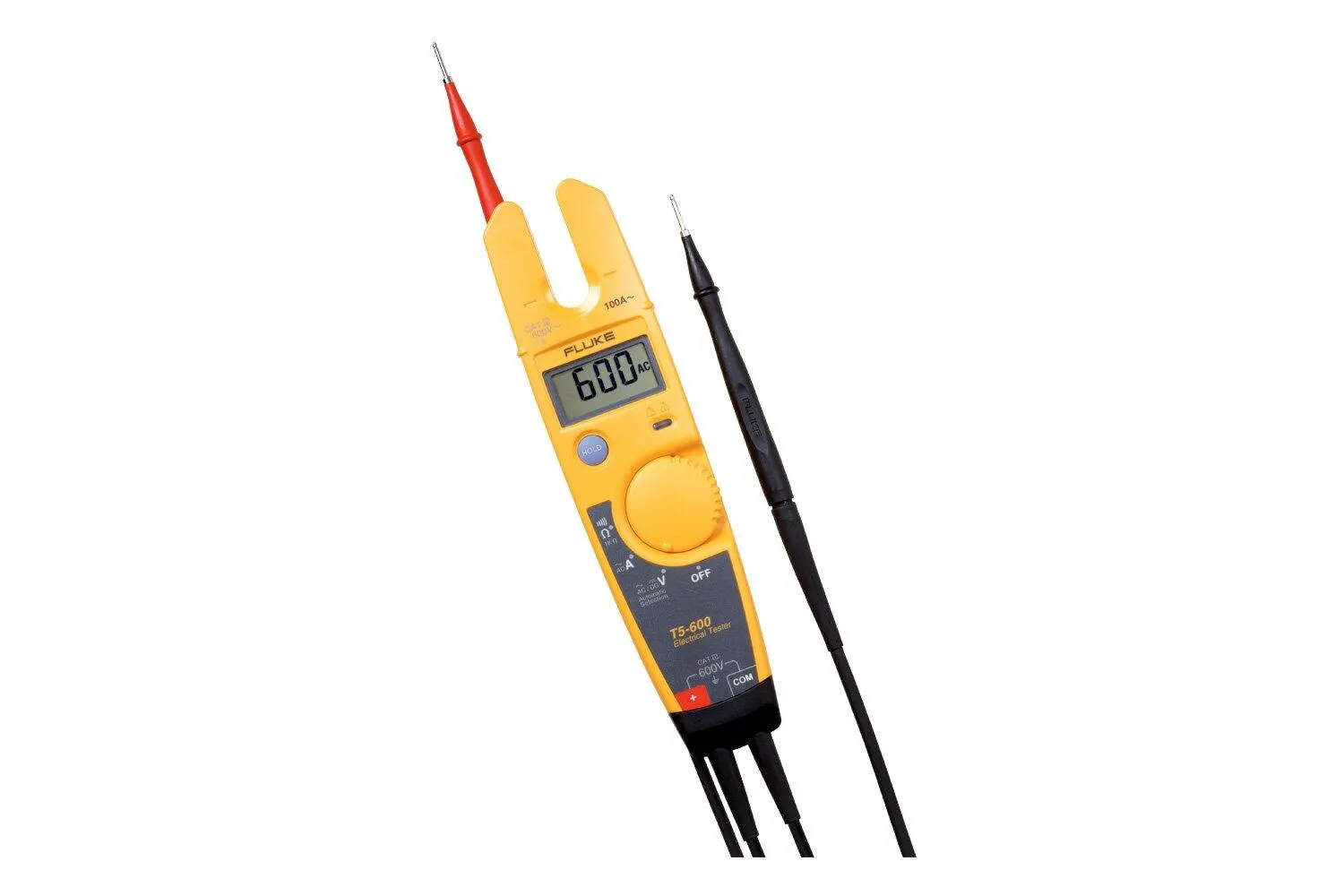
Fluke T5-600
Not a multimeter but an electrician's tester: volts, continuity and up to 100A AC through an open jaw, no leads in the circuit.
Best for:Electricians' quick voltage and current checks
The T5-600 is an electrical tester rather than a multimeter. It reads up to 600V AC or DC with automatic AC/DC selection, resistance to 1,000 Ω, continuity, and up to 100A AC through its OpenJaw current fork, so you can check a load's current without breaking the circuit. It is CAT III 600V, survives a 3 m drop, and stores its probes in the back. It is average-responding rather than True RMS and has no capacitance, frequency, diode or DC current.
Why it fits: It is an electrician's tester, not a full multimeter: automatic AC/DC voltage to 600V, continuity, resistance to 1,000 Ω and up to 100A AC through the OpenJaw fork, with the probes stored in the back and a 3 m drop rating. It is average-responding rather than True RMS and has no capacitance or frequency, so treat it as a quick-check tool alongside a proper meter.
- Accuracy
- Average-responding (not True RMS)
- Safety rating
- CAT III 600V
- Auto-ranging
- Automatic AC/DC voltage selection
- Best for
- Electricians' quick voltage and current checks
Reasons to buy
- +100A AC current through the open jaw, no circuit break
- +Automatic AC/DC voltage selection
- +Survives a 3 m (10 ft) drop
Reasons to avoid
- −Not a full multimeter: no capacitance, frequency or diode test
- −Resistance only to 1,000 Ω
- −AC current only; average-responding
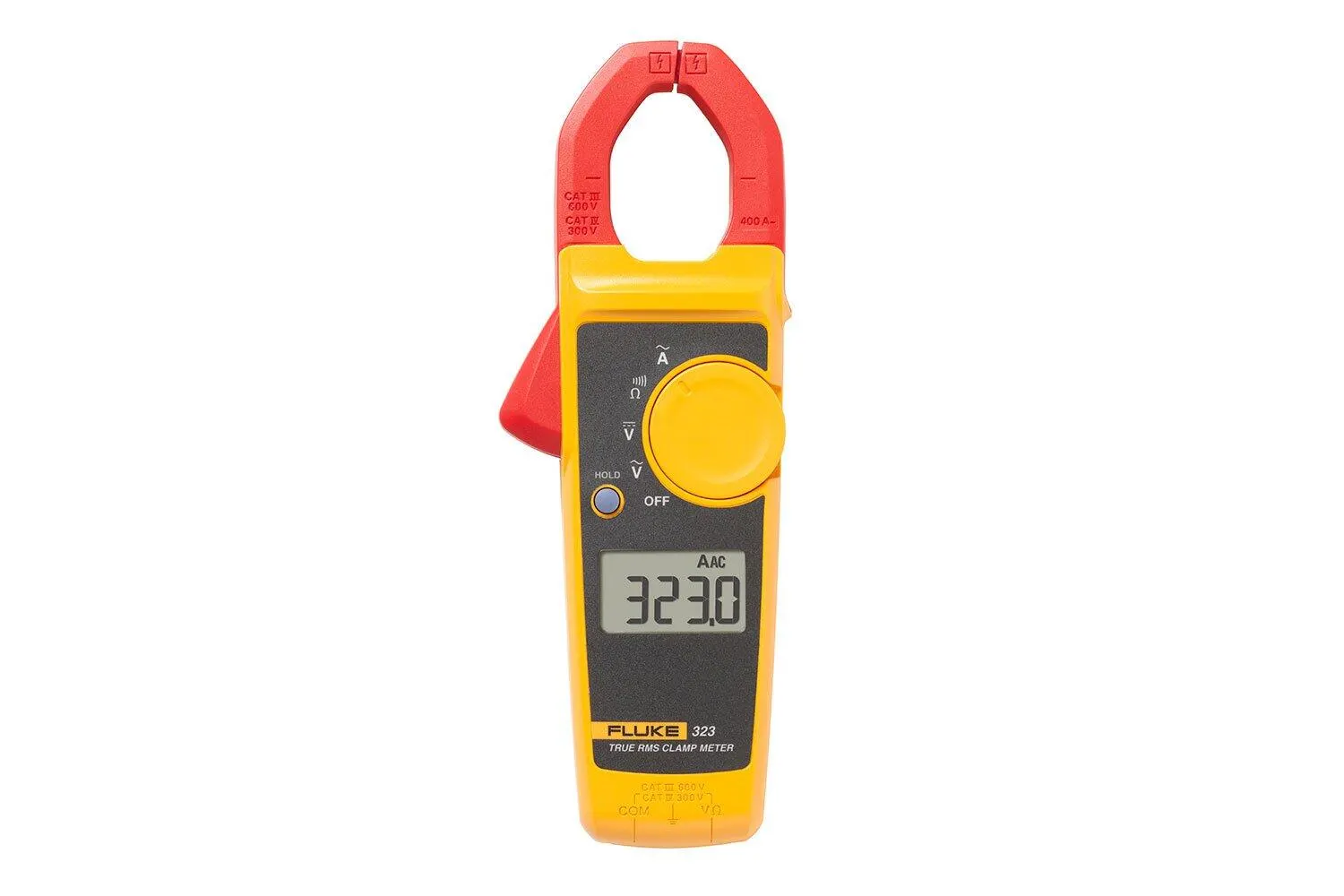
Fluke 323
A True RMS clamp meter for current measurement without breaking a circuit open — a different tool than a standard multimeter, not a replacement for one.
Best for:Fast current checks without breaking the circuit
The Fluke 323 reads AC current up to 400A by clamping around a conductor, with True RMS accuracy on non-sinusoidal loads. It doesn't measure DC current, capacitance, or frequency, and has no backlight or temperature mode — it's built specifically for clamp current work, not as a general-purpose meter. See our clamp meter buying guide for when this matters over a standard multimeter.
Why it fits: A light 265 g True RMS clamp that reads up to 400A AC around a conductor, rated CAT III 600V and CAT IV 300V. It is the natural second tool for someone who already carries a multimeter and wants load current without opening the circuit. It cannot read DC current and has no backlight, temperature or frequency mode.
- Accuracy
- True RMS
- Current range
- Up to 400A AC
- Safety rating
- CAT III 600V / CAT IV 300V
- Best for
- Fast current checks without breaking the circuit
Reasons to buy
- +True RMS accurate on non-sinusoidal AC loads
- +CAT IV 300V rating for front-of-panel work
- +Compact and light at 265g
Reasons to avoid
- −AC current only — no DC current measurement
- −No backlight, temperature, or frequency mode
Milwaukee 2235-20
Skip the test leads entirely for current readings — clamp it on and read.
Best for:Quick current checks without disconnecting wiring
A clamp meter measures current without breaking the circuit open, which is faster and safer for everyday electrical troubleshooting. The 2235-20 covers up to 400A AC with a 1-inch jaw opening and the same CAT III 600V and True RMS fundamentals as a good multimeter.
Why it fits: A True RMS clamp with a 1-inch jaw, 400A AC and 600V AC/DC at CAT III 600V, plus resistance and continuity. For a crew already standardized on Milwaukee tools it slots into the kit easily. Like the 323, it measures AC current only, and Milwaukee doesn't state auto-ranging, so it ranks just behind the Fluke clamp.
- Accuracy
- True RMS
- Safety rating
- CAT III 600V
- Auto-ranging
- Not stated by Milwaukee
- Best for
- Quick current checks without disconnecting wiring
Reasons to buy
- +No need to break the circuit to measure current
- +1-inch jaw fits most residential/commercial wiring
- +Backed by Milwaukee's tool ecosystem and reputation
Reasons to avoid
- −Measures AC current only (400A AC); no DC amps
- −Bulkier than a pocket multimeter
Southwire 16030A
A rugged CAT IV 600V, IP67 voltage-and-continuity meter that picks AC or DC for you, with no current ranges at all.
Best for:Quick voltage and continuity checks on the job
The 16030A is a simplified True RMS meter for electricians who mostly check voltage. One button cycles between voltage, resistance and continuity. In voltage mode it picks AC or DC itself, and in resistance or continuity it switches to voltage if the circuit is live (above 2.6V). It reads to 600V AC/DC on a 4,000-count backlit display and resistance to 400 kΩ, and it adds a 100-600V non-contact detector, a flashlight and Autohold. The housing is IP67 and the rating is CAT IV 600V. It cannot measure current, capacitance or frequency. Southwire gives a two-year warranty.
Why it fits: A deliberately simple CAT IV 600V, IP67 meter for electricians who mostly verify voltage: it picks AC or DC itself, switches to voltage if it finds a live circuit in resistance or continuity mode, and adds a 100–600V NCV and a flashlight. It cannot measure current, capacitance or frequency and resistance stops at 400 kΩ, so it is a rugged companion rather than a main meter.
- Accuracy
- True RMS, 4,000-count
- Safety rating
- CAT IV 600V
- Auto-ranging
- Yes (auto-selects AC/DC)
- Best for
- Quick voltage and continuity checks on the job
Reasons to buy
- +CAT IV 600V and IP67 waterproof housing
- +Automatic AC/DC selection and Autohold
- +Built-in NCV and flashlight
Reasons to avoid
- −No current, capacitance or frequency measurement
- −Resistance tops out at 400 kΩ
Before you buy
Buying advice
Rate the meter for the worst place you will put it
A meter that spends most days on receptacles still has to survive the one day you check a meter base. Transients near the service entrance carry far more energy than those at a branch outlet, which is why CAT IV exists. If your work ever reaches the service side, the MM720, 87V, 179 or 16030A belongs in the bag; if it never does, a CAT III 600V meter like the 117 is enough.
Pair a meter with a clamp instead of buying one tool for everything
Multimeters with 10 A inputs are poor tools for load current on live circuits: you have to open the circuit, the fuse limits you and a mistake with the leads in the amps jack can arc. A clamp like the Fluke 323 or Milwaukee 2235-20, or the open fork on the T5-600, reads current around the conductor instead. Most working electricians end up carrying one of each.
Use LoZ to settle ghost voltage arguments
When a circuit you have switched off still shows 30 or 40 volts on a high-impedance meter, LoZ tells you whether that voltage can drive a load. If the reading collapses under the low-impedance input, it is coupling from a neighboring conductor; if it holds, something is still connected. That saves call-backs and stops you treating a live circuit as dead.
Check the whole measuring system, not just the meter
The CAT rating printed on the meter only holds if the leads, probe tips and fuses match it. Fit probe-tip covers where the code calls for them, replace fuses only with the exact rating listed in the manual, and prove the meter on a known live source before and after every dead test. Those habits matter more than any single feature on this list.
Methodology
How we chose
We ranked tools for licensed and apprentice electricians doing residential, commercial and light industrial work. The highest CAT rating and voltage coverage came first, then LoZ or AutoV for ghost voltage, True RMS, a practical way to read load current, and durability features such as drop and IP ratings. Clamps and testers were included where they solve a daily electrician's job better than a meter. Specs come from maker pages, datasheets and manuals; the Fluke 117 and 87V carry our Hands-on Tested badge, and the rest are ranked by desk research.
Picks marked "Hands-on Tested" have been bought and tested by us; the rest are desk research. A pick only carries that badge once we have actually bought and tested that unit. More on how we research.
Questions
Frequently asked questions
Why do electricians need a LoZ setting on a multimeter?+
Long runs of cable next to energized conductors pick up capacitively coupled voltage, and a high-impedance digital meter can show tens of volts on a wire that is actually dead. A low-impedance (LoZ) input puts a small load across the leads, so that induced voltage collapses toward zero while a genuine supply holds. The Fluke 117, Klein MM720 and Brymen BM235 in this list have it.
Is CAT IV necessary for residential electrical work?+
Inside a house, most work at receptacles, fixtures and the load side of the breaker panel sits in CAT III territory. CAT IV applies at the origin of the installation: the service drop, the meter socket and outdoor feeders before the main disconnect. If you replace meter bases or trace service-entrance faults, choose a CAT IV 600V meter such as the MM720, 87V, 179 or Southwire 16030A.
Should an electrician buy a clamp meter or a multimeter first?+
Most electricians start with a multimeter, because voltage, continuity and resistance cover the majority of service calls, and then add a clamp for load current. If you mostly balance panels or chase overloaded circuits, the clamp may earn its keep sooner. The Fluke 117/323 Kit sidesteps the question by putting both in one case, and the T5-600 combines basic volts with open-jaw amps.
Can a non-contact voltage detector replace testing with leads?+
No. A non-contact detector senses the electric field around an insulated conductor and can miss voltage behind shielding, in metal conduit or on a neutral that is carrying current. Use it to speed up the first sweep, then confirm with the test leads on a meter you have just proved on a known live source, and prove it again afterwards. That live-dead-live routine is what keeps you safe.
Does a multimeter's CAT rating cover the test leads too?+
The system is only as safe as its lowest-rated part. A CAT IV meter used with CAT II leads is a CAT II setup. Check the rating printed on the leads, the probe tips and any clip-on accessories. Klein notes that the CAT IV figure on some MM450 listings applies to the leads alone, while the meter itself is CAT III 600V, which shows why both markings matter.
How often should an electrician replace multimeter test leads?+
There is no fixed interval. Replace them as soon as the insulation is cracked, nicked or melted, the probe shrouds are missing, or the conductor shows through near the plug. A quick check is to measure resistance with the probes shorted; a reading that jumps or climbs well above a fraction of an ohm points to a broken strand. Our lead-testing guide walks through it.
