Disclosure: OhmSavvy earns a commission from qualifying Amazon purchases made through the links below, at no extra cost to you. How we're funded.
At a glance
Our top picks

Hakko FX-888DX
The FX-888D's replacement: the same T18 tips and handpiece, with a 100W station, a proper dial and five presets.
Check price on Amazon →Why we picked it ↓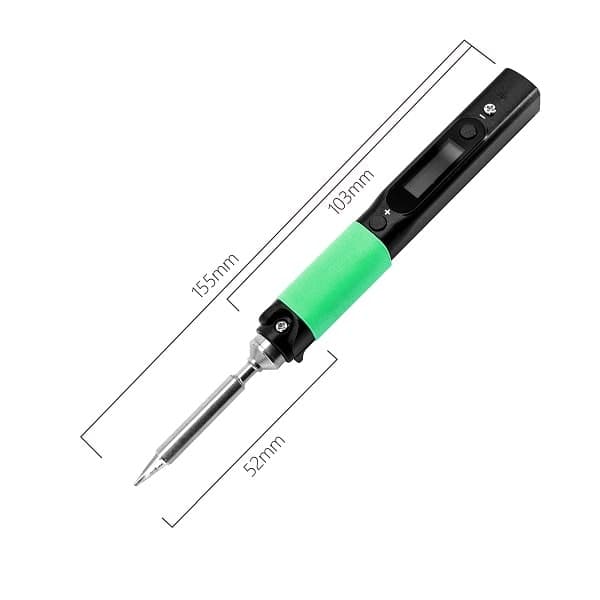
Pinecil V2
USB-C powered and pocket-sized — the rare budget tool that doesn't feel like a compromise.
Check price on Amazon →Why we picked it ↓
YIHUA 939D+
A transformer-based, ESD-safe station with a metal front panel and a detachable iron, at a hobby price.
Check price on Amazon →Why we picked it ↓Also great
- 4
 YIHUA 862BD+Check pricePrice →Best 2-in-1 with Hot Air Rework4.3★★★★☆
- 5
 FNIRSI HS-02ACheck pricePrice →Best High-Power Smart Iron4.4★★★★☆
- 6
 X-Tronic 3020-XTSCheck pricePrice →Best Budget Kit with Long Warranty4.4★★★★☆
- 7
 YIHUA 926 IIICheck pricePrice →Best Budget Station4.3★★★★☆
- 8
 Weller WE1010NACheck pricePrice →Best for Professional Benches4.6★★★★★
- 9
 Hakko FX-601Check pricePrice →Best Stationless Iron4.4★★★★☆
- 10
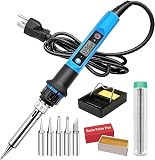 Liouhoum 80W Soldering Iron KitCheck pricePrice →Cheapest Digital Kit4.2★★★★☆
Quick shopping
Compare at a glance
Swipe sideways on mobile to see every spec.
| Model | Award | Rating | Power | Heat-up time | Temperature control | |
|---|---|---|---|---|---|---|
| #1Hakko FX-888DX | Best Overall | 4.7★★★★★ | 100W station (65W iron) | Not stated by Hakko | Digital, closed-loop, 50–480°C | Check price → |
| #2Pinecil V2 | Best Portable | 4.7★★★★★ | Up to 88W at 24V DC; about 60W from 20V USB-C PD | ~12 seconds (with a 20V+ supply) | OLED digital display | Check price → |
 #3YIHUA 939D+ | Best Value ESD-Safe Station | 4.4★★★★☆ | "75W equivalent" (listing; spec table says 120W) | Not stated by YIHUA | PID, LED display, 200–480°C | Check price → |
| #4YIHUA 862BD+ | Best 2-in-1 with Hot Air Rework | 4.3★★★★☆ | 75W iron / 500W hot air (720W total) | — | — | Check price → |
| #5FNIRSI HS-02A | Best High-Power Smart Iron | 4.4★★★★☆ | Up to 100W, USB-C PD/QC 9–20V | 2–3 s tinning (FNIRSI's figures differ) | Digital, color screen, 100–450°C, 3 presets | Check price → |
| #6X-Tronic 3020-XTS | Best Budget Kit with Long Warranty | 4.4★★★★☆ | 75W station (60W iron) | Under 30 s, 200 to 480°C (X-Tronic's listing) | PID, LED display, 200–480°C, ±2°C | Check price → |
| #7YIHUA 926 III | Best Budget Station | 4.3★★★★☆ | 60W per listing (YIHUA site: 130W max, 18W rated) | Not stated by YIHUA | PID, LED display, 90–480°C | Check price → |
| #8Weller WE1010NA | Best for Professional Benches | 4.6★★★★★ | 85W station (70W iron) | ~28 seconds (50–350°C) | Digital, 100–450°C, ESD-safe | Check price → |
| #9Hakko FX-601 | Best Stationless Iron | 4.4★★★★☆ | 67W (120V) | Not stated by Hakko | Dial on handle, closed-loop, 240–540°C | Check price → |
| #10Liouhoum 80W Soldering Iron Kit | Cheapest Digital Kit | 4.2★★★★☆ | 80W, 110–120V | 10 s (listing's claim) | LCD, buttons, 180–480°C | Check price → |
In depth
Detailed reviews
Hakko FX-888DX
The FX-888D's replacement: the same T18 tips and handpiece, with a 100W station, a proper dial and five presets.
Best for:Serious hobbyists, repair benches
Hakko replaced the FX-888D with the FX-888DX. It keeps the FX-8801 handpiece and T18 tips, the 50–480°C range and ±1°C idle stability, but the station rises from 70W to 100W, swaps the old button interface for a push-button rotary dial with a digital °F/°C display, stores five presets and adds a parameter lock against accidental calibration. It is ESD safe and also drives Hakko's tweezers, solder gun and larger irons.
Why it fits: It earns first place for sheer range: a 50–480°C station with ±1°C idle stability, a 65W iron and the T18 tip catalog covers everything from header pins to LED strip pads, and the station can also drive Hakko's tweezers, solder gun and larger irons as projects grow. It is ESD safe with five presets. The trade-offs are a 1.2 kg station and no stated sleep mode.
- Power
- 100W station (65W iron)
- Heat-up time
- Not stated by Hakko
- Temperature control
- Digital, closed-loop, 50–480°C
- Best for
- Serious hobbyists, repair benches
Reasons to buy
- +Same T18 tips as the FX-888D
- +Rotary dial and five temperature presets
- +ESD safe; drives other Hakko handpieces
Reasons to avoid
- −Larger than a portable iron: the station weighs 1.2 kg
- −Counterfeits exist: buy from authorized sellers
- −No stated sleep or standby mode
Pinecil V2
USB-C powered and pocket-sized — the rare budget tool that doesn't feel like a compromise.
Best for:Portability, field repairs
USB-C powered, pocket-sized, and genuinely fast to heat up — the Pinecil V2 is the rare budget tool that doesn't feel like a compromise, making it a favorite for on-the-go repairs.
Why it fits: The most versatile place to solder from: Pine64 rates it up to 88W at 24V, it weighs 28 g with its tip and it runs from USB-C PD chargers or power banks, so the same iron works at the desk, the makerspace or a friend's house. It needs a capable PD supply, there's no stand by default and Pine64 lists no temperature range or ESD rating.
- Power
- Up to 88W at 24V DC; about 60W from 20V USB-C PD
- Heat-up time
- ~12 seconds (with a 20V+ supply)
- Temperature control
- OLED digital display
- Best for
- Portability, field repairs
Reasons to buy
- +Extremely compact and travel-friendly
- +Fast heat-up for its size
- +Powered by any USB-C PD source, even a power bank
Reasons to avoid
- −No stand included by default
- −Needs a USB-C PD or DC supply; full power needs 24V
- −Pine64's Amazon listing still describes the original Pinecil (65W, 12–21V barrel jack): check the version shown before you buy
YIHUA 939D+
A transformer-based, ESD-safe station with a metal front panel and a detachable iron, at a hobby price.
Best for:ESD-sensitive hobby and repair work
The 939D+ is a transformer-based station with PID temperature control, a 200–480°C range, °C/°F display, temperature calibration and error detection. The station and its 907E detachable iron are ESD safe, the front panel is brushed aluminum and the iron stand is a separate metal unit. It takes YIHUA's 900M tips. The listing calls it "75W equivalent" but its spec table says 120W, and YIHUA's own page (for a 220V model) quotes a 450°C maximum, so treat the headline numbers with care.
Why it fits: A transformer-based, ESD-safe station with PID control, calibration, a detachable 907E iron, a metal stand and common 900M tips gives hobbyists solid bench hardware without stretching to a Hakko. The listing's power figures conflict (75W equivalent versus 120W) and YIHUA's 220V page quotes a lower maximum temperature, so read its headline numbers with care.
- Power
- "75W equivalent" (listing; spec table says 120W)
- Heat-up time
- Not stated by YIHUA
- Temperature control
- PID, LED display, 200–480°C
- Best for
- ESD-sensitive hobby and repair work
Reasons to buy
- +ESD-safe station and iron
- +Built-in transformer and metal front panel
- +Uses common 900M-series tips
Reasons to avoid
- −Power and maximum temperature figures conflict between sources
- −Sleep mode isn't stated for this US version
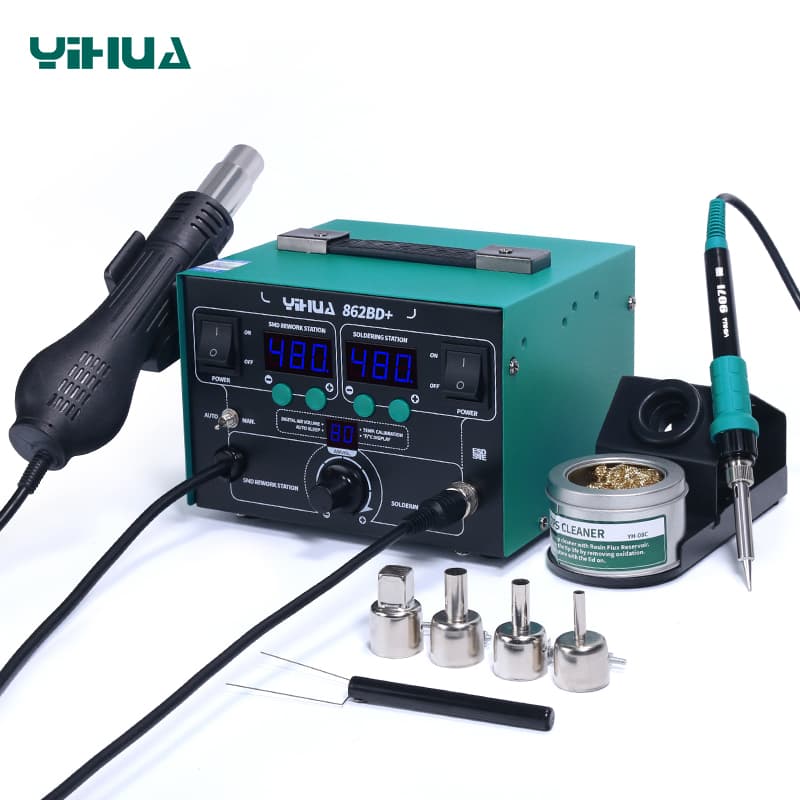
YIHUA 862BD+
A soldering iron and a hot air rework station in one box, for SMD and BGA work a plain iron can't touch.
Best for:SMD/BGA rework alongside general soldering
The 862BD+ pairs a 75W soldering iron with a separate 500W hot air gun in one station, aimed at SMD and BGA rework rather than general through-hole soldering alone. It's a genuinely different tool category from a standalone iron, not just a cheaper or pricier version of one.
Why it fits: Makers who salvage parts, fit SMD modules or shrink tubing get a 500W hot air gun alongside a 75W iron, with separate readouts, in one ESD-safe station. If your projects are all through-hole kits, the hot air side will gather dust and the unit takes more bench space than a plain station; the iron's tip series isn't named on the listing.
- Power
- 75W iron / 500W hot air (720W total)
- Temperature range
- 200–480°C iron, 100–480°C hot air
- Display
- LED, independent iron/air readouts
- Best for
- SMD/BGA rework alongside general soldering
Reasons to buy
- +Combines a soldering iron and hot air rework station in one unit
- +Wide temperature range on both the iron and the hot air gun
- +Independently adjustable iron and hot air temperatures with separate LED readouts
Reasons to avoid
- −This US listing is the 110–127V version; buyers elsewhere need their region's variant
- −Larger and more complex than a basic iron if you never do SMD rework
FNIRSI HS-02A
A 100W USB-C smart iron with a color screen, three presets and a 100W charger in the box.
Best for:Portable kits that need real power
The HS-02A is a pen-sized smart iron that draws up to 100W from USB-C PD or QC (9–20V), covers 100–450°C and shows settings on a 0.96-inch color screen. It stores three temperature presets, supports calibration and has sleep, auto power-off and a child lock. This kit includes six tips (K, KU, JS, I, C2, B), a 100W charger and a mini stand, and the iron weighs 61 g. It has no battery, so it always needs a supply, and FNIRSI lists a different tip set for the HS-02B, so buy HS-02A tips.
Why it fits: With up to 100W from USB-C, three presets and six tips, it is the pen iron for projects that include thick wires and big connectors as well as small pads, and the 100W charger is in the kit. It weighs 61 g. It always needs a PD or QC supply, ESD safety isn't stated and its tips differ from the HS-02B's.
- Power
- Up to 100W, USB-C PD/QC 9–20V
- Heat-up time
- 2–3 s tinning (FNIRSI's figures differ)
- Temperature control
- Digital, color screen, 100–450°C, 3 presets
- Best for
- Portable kits that need real power
Reasons to buy
- +100W charger and six tips included
- +Three presets plus calibration
- +Only 61 g
Reasons to avoid
- −No built-in battery: needs a PD/QC supply
- −FNIRSI's 2-year warranty applies to direct orders, per its site
X-Tronic 3020-XTS
An ESD-safe PID station from a US-based brand, with a 3-year warranty and a 10-minute sleep timer.
Best for:Hobby benches that want a long warranty
X-Tronic's 3020-XTS is a 75W station (60W to the iron, 15W to the iron's control board) with PID control, a 200–480°C range, ±2°C static stability and a blue LED readout with a C/F switch. It's ESD safe, sleeps and cools down after 10 minutes, and runs on 110V only. The Amazon kit includes two helping hands, a silicone mat, five spare tips, a 50 g lead-free roll and a brass tip cleaner. X-Tronic, based in Lincoln, Nebraska, backs it with a 3-year warranty. Its own page also quotes 90–480°C for the iron, so the low end of the range is inconsistent.
Why it fits: A reliable kit-builder's station: ESD safe, PID control at ±2°C, sleep with auto cool-down after 10 minutes, and a box with helping hands, a silicone mat, five tips and lead-free solder, all under a 3-year warranty. It runs on 110V only and X-Tronic's pages disagree on the minimum temperature.
- Power
- 75W station (60W iron)
- Heat-up time
- Under 30 s, 200 to 480°C (X-Tronic's listing)
- Temperature control
- PID, LED display, 200–480°C, ±2°C
- Best for
- Hobby benches that want a long warranty
Reasons to buy
- +ESD safe with a 10-minute sleep and auto cool-down
- +3-year warranty and US-based support
- +Kit includes helping hands, silicone mat and five tips
Reasons to avoid
- −110V only, no 220V version
- −X-Tronic's pages give two different minimum temperatures
YIHUA 926 III
A compact PID station with sleep and calibration, sold as a full kit with helping hands and six tips.
Best for:First station for hobby electronics
The 926 LED III is a small digital station with the iron holder built into the body and tip slots in the rear guard. It covers 90–480°C with PID control, switches between °C and °F, supports digital calibration and sleeps after 5, 10 or 30 minutes idle. The Amazon kit adds two helping hands, six 900M-series tips, lead-free solder, a solder sucker and ESD-safe tweezers. Power figures conflict: the listing says 60W, while YIHUA's own page lists 130W maximum and 18W rated.
Why it fits: Its iron holder is built into a compact body, which suits a small desk, and it brings PID control from 90–480°C, calibration, an adjustable sleep and six 900M tips plus helping hands. YIHUA doesn't state ESD safety for the station, and the listing and maker disagree on its wattage.
- Power
- 60W per listing (YIHUA site: 130W max, 18W rated)
- Heat-up time
- Not stated by YIHUA
- Temperature control
- PID, LED display, 90–480°C
- Best for
- First station for hobby electronics
Reasons to buy
- +Adjustable sleep timer and digital calibration
- +Six 900M-series tips and helping hands in the kit
- +Holder built into the station saves bench space
Reasons to avoid
- −Wattage figures conflict between the listing and YIHUA's site
- −Station ESD safety isn't stated (only the tweezers are ESD safe)
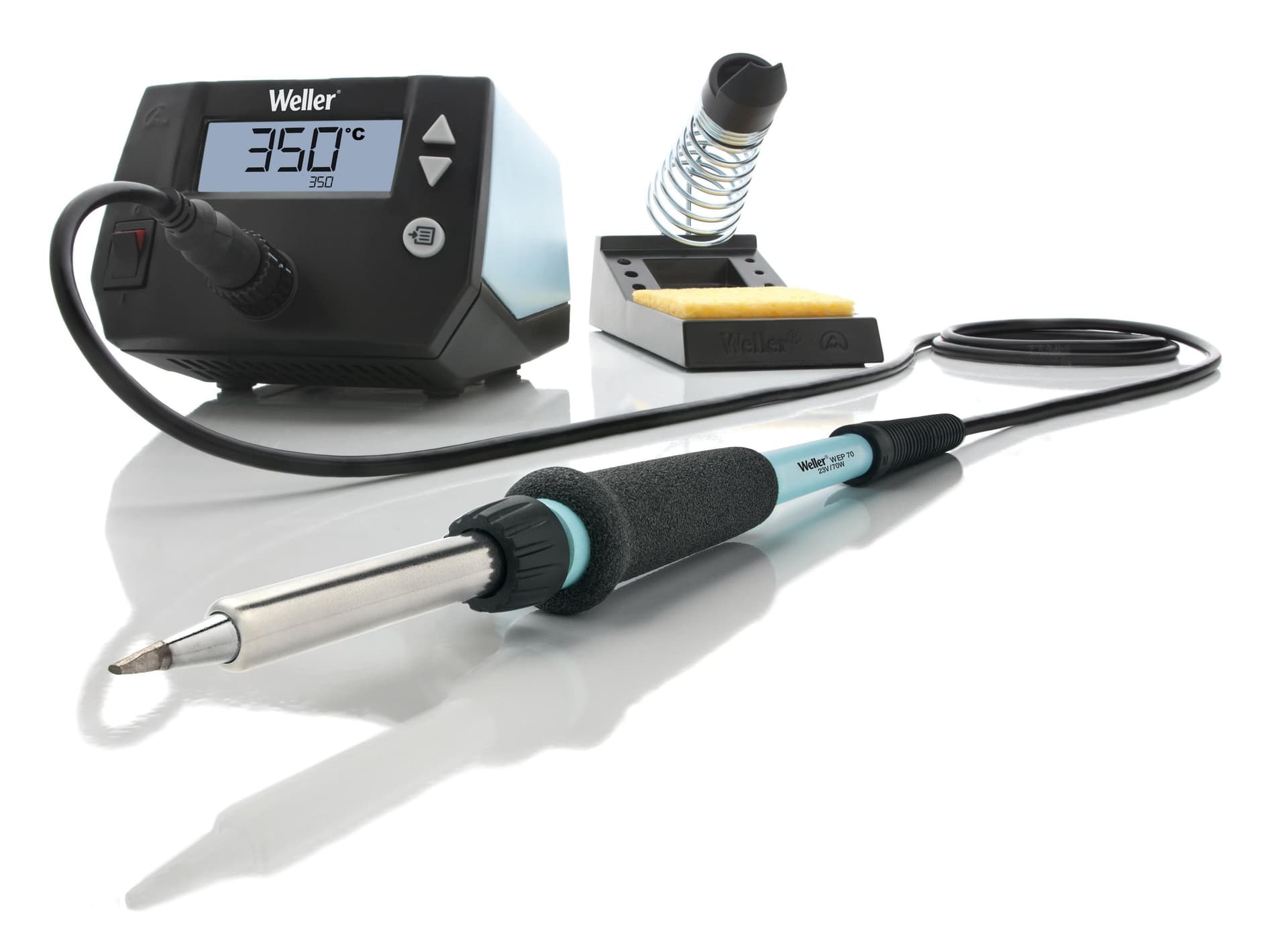
Weller WE1010NA
ESD-safe construction and tight temperature stability for a dedicated electronics bench.
Best for:Dedicated workbenches, professional use
Weller's WE1010NA brings ESD-safe construction and tight temperature stability to an 85W digital station driving a 70W iron, making it a strong choice for anyone running a dedicated electronics bench.
Why it fits: An ESD-safe 70W station with Weller ET tips, standby with auto setback and a password lock, which is ideal for a makerspace where several people share one bench. For a single hobbyist, the Hakko offers a wider range and tighter published stability, and the Weller's 450°C ceiling is lower.
- Power
- 85W station (70W iron)
- Heat-up time
- ~28 seconds (50–350°C)
- Temperature control
- Digital, 100–450°C, ESD-safe
- Best for
- Dedicated workbenches, professional use
Reasons to buy
- +ESD-safe design protects sensitive components
- +Strong temperature stability under sustained use
- +Backed by Weller's long-standing reputation
Reasons to avoid
- −Higher price point than hobbyist kits
- −Not portable — bench-only design
Hakko FX-601
A temperature-controlled Hakko iron with the dial on the handle and no station to find room for.
Best for:Heavy wire, terminals, stained glass
The FX-601 is a mains-powered iron with closed-loop temperature control built into the handle: a ceramic heater with its own sensor, a 240–540°C dial and a lock key to stop it being knocked. At 67W it reaches higher than most bench stations, which suits heavy wire, terminals and stained-glass work, but it has no display and its lowest setting of 240°C is warm for fine electronics.
Why it fits: A 67W mains iron with closed-loop control in the handle, a 240–540°C dial and a lock key, built for heavy wire, terminals and stained glass. That makes it the right partner iron for battery packs, speaker wiring and large connectors. It has no display and its 240°C minimum is too warm for delicate SMD parts, so it is a second iron for most makers.
- Power
- 67W (120V)
- Heat-up time
- Not stated by Hakko
- Temperature control
- Dial on handle, closed-loop, 240–540°C
- Best for
- Heavy wire, terminals, stained glass
Reasons to buy
- +No station: plugs straight into the wall
- +High 540°C ceiling for big joints
- +Lock key keeps the setting fixed
Reasons to avoid
- −No temperature display
- −240°C minimum is hot for delicate SMD work
- −Sold by third parties on Amazon; Hakko warns of counterfeits
Liouhoum 80W Soldering Iron Kit
A digital-readout pen iron with auto sleep for about the price of a spool of solder.
Best for:Beginners on a tight budget
Liouhoum's 80W kit is a plug-in pen iron with an LCD, so you set and read 180–480°C directly instead of guessing from a dial. Per the listing, it drops its temperature after 5 minutes on the stand, remembers the last setting, supports calibration and switches between °C and °F. The kit includes five tips, rosin-core solder, flux, a sponge and a basic stand. There's no station, no ESD rating and no stated tip series, so it suits starter and occasional repair work rather than a daily bench.
Why it fits: An 80W plug-in pen with an LCD from 180–480°C, temperature memory and a 5-minute auto sleep, with solder, flux, five tips and a stand in the kit. It covers occasional projects. Its specs come only from the listing, there's no ESD rating and the tip series isn't named, so replacements are a guess.
- Power
- 80W, 110–120V
- Heat-up time
- 10 s (listing's claim)
- Temperature control
- LCD, buttons, 180–480°C
- Best for
- Beginners on a tight budget
Reasons to buy
- +Digital temperature readout at a very low price
- +Auto sleep after 5 minutes on the stand
- +24-month replacement offered by the seller
Reasons to avoid
- −No ESD rating or named tip series
- −Light stand and basic accessories
Before you buy
Buying advice
Plan for the heaviest joint in your hobby
Most DIY irons are chosen for fine work and then struggle the first time you solder a battery lead or a speaker terminal. List the biggest joint you expect, whether that's a 12 AWG wire, a jack lug or a ground pad on an LED strip, and make sure your iron has the power and a large enough tip for it. A second, heavier iron is often cheaper than overbuying one.
Think about where you will solder
A station is the most comfortable tool for long sessions at a fixed desk. If you build at a makerspace, in a garage or while traveling, a USB-C pen such as the Pinecil V2 or FNIRSI HS-02A goes where you go. Plenty of makers end up with one of each, using the pen as the portable or backup iron.
Grow into hot air rather than starting with it
Hot air is excellent for salvaging parts, fitting SMD modules and heat-shrink, but most first projects don't need it. If your interests move toward surface-mount boards, repairing gadgets or building your own PCBs, a combined unit like the 862BD+ or a separate hot air tool is the natural next step.
Keep consumables in the same family
Buy spare tips from the iron's own family, a solder diameter that suits your work (0.6–0.8 mm covers most hobby boards) and a flux pen for SMD and rework. A brass tip cleaner and tip tinner keep tips alive longer. Stocking the right consumables does more for joint quality than a pricier iron.
Methodology
How we chose
We ranked these ten for hobbyists who build a wide mix of projects: how much of the range from fine header pins to heavy battery wiring each iron can handle, then temperature control and tip choice, portability, room to grow into hot air and SMD work, and ESD safety. Every figure comes from the maker's site or the official Amazon listing, and conflicts are noted; this is desk research, and none of these ten has been hands-on tested by us.
Picks marked "Hands-on Tested" have been bought and tested by us; the rest are desk research. A pick only carries that badge once we have actually bought and tested that unit. More on how we research.
Questions
Frequently asked questions
What wattage soldering iron do I need for DIY electronics?+
Around 60–80W on the heater handles nearly all hobby projects, provided the iron is temperature-controlled. Header pins and small wires need little power; LED strip pads, guitar jack lugs and 12 AWG battery leads pull far more heat. A higher-power iron at the same set temperature recovers faster on those joints. The FX-601 and HS-02A in this list offer the most reserve for heavy work.
Can I solder thick battery wires with an electronics soldering iron?+
Often, if you fit the largest chisel tip you have and the iron has reserve power. A tiny conical tip on a low-power iron will sit on the joint for ages and still leave a cold, grainy result, which is a real risk on battery leads. For regular work on XT60 connectors or thick pack wiring, a high-power iron such as the Hakko FX-601 is the safer choice.
Is the Pinecil V2 good enough as my only soldering iron?+
For many hobbyists, yes. Pine64 rates it up to 88W at 24V, it heats in about 12 seconds on a suitable supply and it runs from USB-C PD. The catches are that no stand comes in the box, it needs a capable PD supply for full power, and Pine64 doesn't publish a temperature range or ESD rating. A bench station is more comfortable for long sessions.
Do I need a fume extractor for hobby soldering?+
Rosin flux smoke irritates the eyes and airways, and regular exposure is worth avoiding. A small fan that pulls smoke away from your face and toward an open window helps a lot; a filtered fume extractor with activated carbon is better for frequent sessions. Leaded solder doesn't vaporize at normal iron temperatures, so the main concern is flux smoke plus washing your hands afterwards.
What is the difference between a soldering iron and a hot air station?+
An iron heats one joint at a time through direct contact with the tip, which suits pins, wires and most surface-mount parts. A hot air station blows heated air over an area so several joints melt at once, which is how you remove multi-pin chips, salvage parts or shrink tubing. The YIHUA 862BD+ combines both in one unit for makers who need each.

