Disclosure: OhmSavvy earns a commission from qualifying Amazon purchases made through the links below, at no extra cost to you. How we're funded.
At a glance
Our top picks
Siglent SDS1104X-E
More bandwidth and a better UI than the Rigol, for projects that will get more demanding.
Check price on Amazon →Why we picked it ↓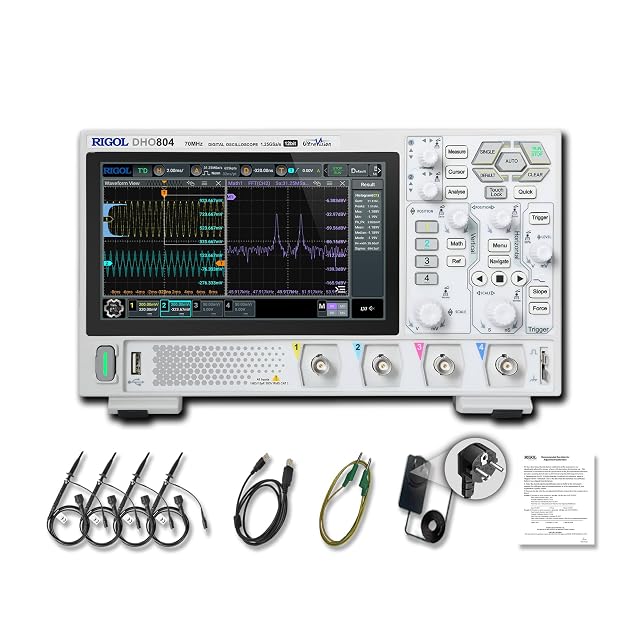
Rigol DHO804
Four channels, 12-bit resolution and a 7-inch touchscreen in a compact body that runs from USB-C power.
Check price on Amazon →Why we picked it ↓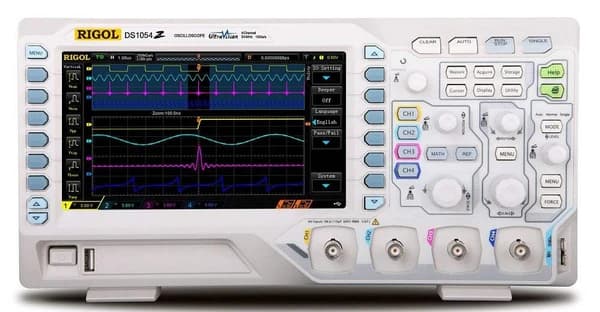
Rigol DS1054Z
The default beginner oscilloscope recommendation for years, and still worth it.
Check price on Amazon →Why we picked it ↓Also great
- 4
 Siglent SDS1202X-ECheck pricePrice →Best 200MHz Value4.5★★★★★
- 5
 Hantek DSO2D10Check pricePrice →Best Compact Bench Option4.3★★★★☆
- 6
 Rigol DS1102Z-ECheck pricePrice →Best 2-Channel Rigol4.4★★★★☆
- 7
 OWON HDS2202SCheck pricePrice →Best 3-in-1 Handheld4.3★★★★☆
- 8Hantek 2D72Check pricePrice →Best 3-in-1 Handheld4.3★★★★☆
- 9
 FNIRSI 1013D PlusCheck pricePrice →Best Touchscreen Tablet Scope4.1★★★★☆
- 10
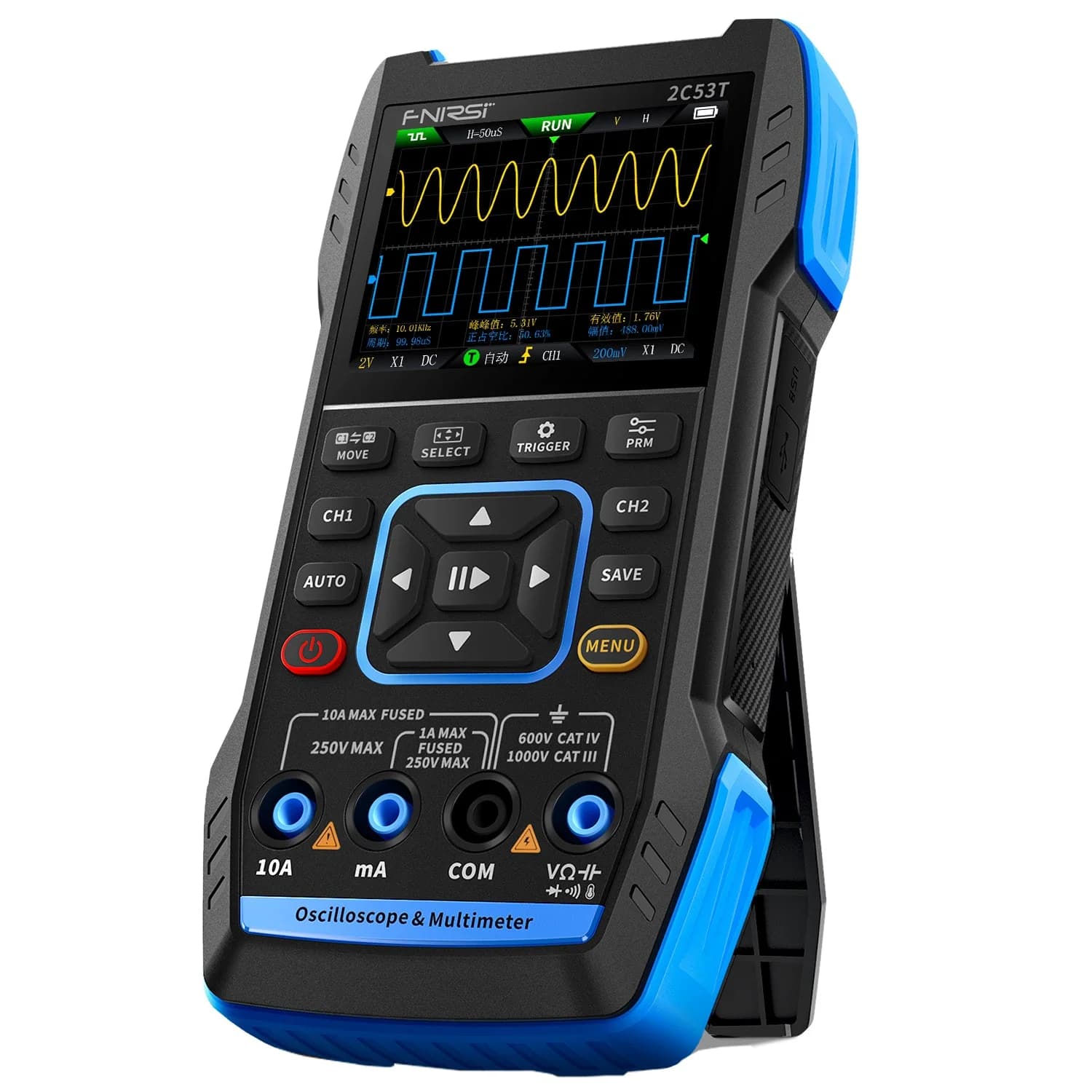 FNIRSI 2C53TCheck pricePrice →Best Budget Handheld 3-in-14.1★★★★☆
Quick shopping
Compare at a glance
Swipe sideways on mobile to see every spec.
| Model | Award | Rating | Bandwidth | Channels | Sample rate | |
|---|---|---|---|---|---|---|
| #1Siglent SDS1104X-E✓ Tested | Best for Growing Into | 4.8★★★★★ | 100MHz | 4 | 1 GSa/s | Check price → |
 #2Rigol DHO804✓ Tested | Best 12-bit Upgrade | 4.8★★★★★ | 70MHz | 4 | 1.25 GSa/s (1 ch); 312.5 MSa/s (4 ch) | Check price → |
| #3Rigol DS1054Z✓ Tested | Best Overall | 4.8★★★★★ | 50MHz | 4 | 1 GSa/s | Check price → |
| #4Siglent SDS1202X-E | Best 200MHz Value | 4.5★★★★★ | 200MHz | 2 | 1 GSa/s (1 ch); 500 MSa/s (2 ch) | Check price → |
| #5Hantek DSO2D10 | Best Compact Bench Option | 4.3★★★★☆ | 100MHz | 2 | 1 GSa/s | Check price → |
| #6Rigol DS1102Z-E | Best 2-Channel Rigol | 4.4★★★★☆ | 100MHz | 2 | 1 GSa/s (1 ch); 500 MSa/s (2 ch) | Check price → |
| #7OWON HDS2202S | Best 3-in-1 Handheld | 4.3★★★★☆ | 200MHz | 2 | 1 GSa/s | Check price → |
| #8Hantek 2D72 | Best 3-in-1 Handheld | 4.3★★★★☆ | 70MHz | 2 | 250 MSa/s (1 ch); 125 MSa/s (2 ch) | Check price → |
| #9FNIRSI 1013D Plus | Best Touchscreen Tablet Scope | 4.1★★★★☆ | 100MHz | 2 | 1 GSa/s | Check price → |
| #10FNIRSI 2C53T | Best Budget Handheld 3-in-1 | 4.1★★★★☆ | 50MHz | 2 | 250 MSa/s | Check price → |
In depth
Detailed reviews
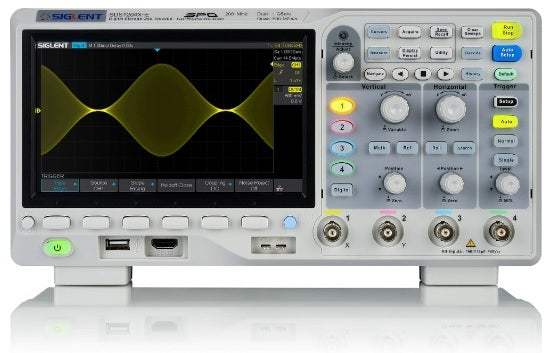
Siglent SDS1104X-E
More bandwidth and a better UI than the Rigol, for projects that will get more demanding.
Best for:Intermediate hobbyists, future-proofing
Double the Rigol's bandwidth (100MHz vs 50MHz) and twice its per-channel sample rate with three or four channels on (500 MSa/s vs 250 MSa/s), with a well-regarded user interface. A strong pick for anyone who expects their projects to get more demanding over time.
Why it fits: Ranked first because it covers the widest spread of repair jobs: four channels for following a signal through several stages, 100 MHz, a 100,000 wfm/s update rate that makes rare glitches show up, and a 400,000 wfm/s sequence mode for capturing intermittent events. It is mains powered and 8-bit, so it stays on the bench.
- Bandwidth
- 100MHz
- Channels
- 4
- Sample rate
- 1 GSa/s
- Best for
- Intermediate hobbyists, future-proofing
Reasons to buy
- +Higher bandwidth headroom than entry-level scopes
- +Well-regarded, intuitive UI
- +Strong value at the 100MHz tier
Reasons to avoid
- −Pricier than the Rigol DS1054Z
- −Overkill for pure beginners
Rigol DHO804
Four channels, 12-bit resolution and a 7-inch touchscreen in a compact body that runs from USB-C power.
Best for:Hobbyists who want 12-bit detail and a touchscreen
The DHO804 brings 12-bit vertical resolution to a beginner budget: 70 MHz, four channels, up to 1.25 GSa/s and 25 Mpts with one channel on, a 7-inch 1024 × 600 capacitive touchscreen, HDMI output and serial decoding of UART, I2C, SPI, CAN and parallel buses. It is powered over USB-C, so it can run from a portable power source. There is no built-in signal generator or logic channels, and sample rate and memory fall as you enable more channels (312.5 MSa/s and 5 Mpts with all four on).
Why it fits: Second for its 12-bit vertical resolution, which shows small ripple and noise on a supply rail in finer steps than any 8-bit scope here, plus four channels and up to 25 Mpts. Its 70 MHz bandwidth and the drop to 312.5 MSa/s with all four channels on keep it just behind the Siglent.
- Bandwidth
- 70MHz
- Channels
- 4
- Sample rate
- 1.25 GSa/s (1 ch); 312.5 MSa/s (4 ch)
- Best for
- Hobbyists who want 12-bit detail and a touchscreen
Reasons to buy
- +12-bit vertical resolution
- +7-inch 1024 × 600 touchscreen and HDMI out
- +USB-C powered, compact body
Reasons to avoid
- −No built-in signal generator or logic channels
- −Per-channel sample rate drops to 312.5 MSa/s with four channels on
Rigol DS1054Z
The default beginner oscilloscope recommendation for years, and still worth it.
Best for:Hobbyists, students, general electronics
The DS1054Z has been the default recommendation for beginner oscilloscopes for years, and for good reason — 4 channels and 50MHz of bandwidth at a genuinely approachable price.
Why it fits: A proven four-channel bench scope with deep memory (24 Mpts on Rigol's datasheet, 12 Mpts on its product page) that handles most power, audio and microcontroller faults. It sits third because its 50 MHz bandwidth and 250 MSa/s per channel with three or four channels on leave less margin for fast edges.
- Bandwidth
- 50MHz
- Channels
- 4
- Sample rate
- 1 GSa/s
- Best for
- Hobbyists, students, general electronics
Reasons to buy
- +4 channels at this price is rare
- +Large, clear 7-inch display
- +Strong community support and documentation
Reasons to avoid
- −Menu navigation has a learning curve
- −Bandwidth is modest for RF work
Siglent SDS1202X-E
200 MHz on two channels with a fast 100,000 wfm/s update rate and standard serial decoding.
Best for:Faster digital and switching work on two channels
The SDS1202X-E is the two-channel member of Siglent's X-E line with 200 MHz bandwidth: 1 GSa/s with one channel (500 MSa/s each with two), 14 Mpts of memory on one channel, 100,000 waveforms per second (400,000 in sequence mode), a 7-inch 800 × 480 display and standard I2C, SPI, UART, CAN and LIN trigger and decode. The MSO, AWG module, Bode plot and Wi-Fi options belong to the four-channel models, so don't count on them here.
Why it fits: The fastest bench scope in this list at 200 MHz, with the same 100,000 wfm/s update rate as its four-channel sibling, so it suits repairs on faster digital boards. Two channels is the reason it ranks fourth: comparing a clock, a reset line and a data line at once is not possible.
- Bandwidth
- 200MHz
- Channels
- 2
- Sample rate
- 1 GSa/s (1 ch); 500 MSa/s (2 ch)
- Best for
- Faster digital and switching work on two channels
Reasons to buy
- +200 MHz bandwidth
- +100,000 wfm/s update rate
- +Serial trigger and decode as standard
Reasons to avoid
- −Only 2 channels
- −No MSO, AWG or Bode plot (four-channel models only)
- −Memory halves to 7 Mpts per channel with both on
Hantek DSO2D10
An oscilloscope and waveform generator in one unit — practical for space-limited benches.
Best for:Space-limited benches, combined testing
Combines an oscilloscope and waveform generator in one compact unit — a practical two-in-one for hobbyists who don't have bench space for separate instruments.
Why it fits: Its built-in 25 MHz signal generator lets you inject a test signal into a dead audio or RF stage and watch where it disappears, which is why it ranks above the other two-channel bench models for repair. Expect 8 Mpts on one channel and 4 Mpts with both on, less than the Rigol and Siglent benches.
- Bandwidth
- 100MHz
- Channels
- 2
- Sample rate
- 1 GSa/s
- Best for
- Space-limited benches, combined testing
Reasons to buy
- +Built-in waveform generator saves bench space
- +Solid 100MHz bandwidth for the price
- +Compact footprint
Reasons to avoid
- −Only 2 channels, vs. 4 on the Rigol and Siglent
- −The built-in generator is single-channel (25 MHz)
Rigol DS1102Z-E
Rigol's two-channel, 100 MHz benchtop with deep memory, for people who never need a third or fourth channel.
Best for:Two-channel debugging, students
The DS1102Z-E is a two-channel version of the DS1000Z platform with 100 MHz bandwidth: 1 GSa/s on one channel (500 MSa/s on two), 24 Mpts of memory per Rigol's datasheet, a 7-inch 800 × 480 display, up to 30,000 waveforms per second and standard decoding of UART, I2C, SPI and parallel buses. It has no built-in generator or digital channels. Choose it over the DS1054Z if bandwidth matters more to you than channel count.
Why it fits: A solid two-channel choice when bandwidth matters more than channel count: 100 MHz, 24 Mpts per Rigol's datasheet and standard UART, I2C, SPI and parallel decoding. It has no generator and only two inputs, so it trails the Hantek for signal-tracing repairs.
- Bandwidth
- 100MHz
- Channels
- 2
- Sample rate
- 1 GSa/s (1 ch); 500 MSa/s (2 ch)
- Best for
- Two-channel debugging, students
Reasons to buy
- +100 MHz on two channels
- +Deep memory: 24 Mpts per Rigol's datasheet
- +Serial decoding included
Reasons to avoid
- −Only 2 channels
- −8-bit ADC (12-bit only in High Resolution mode)
- −No built-in generator
OWON HDS2202S
A battery handheld that combines a 200 MHz two-channel scope, a 20,000-count multimeter and a 25 MHz generator.
Best for:Field work that needs a scope, meter and signal source in one
The HDS2202S is a handheld with three instruments: a two-channel, 200 MHz, 1 GSa/s, 8-bit oscilloscope with an 8K record length and 10,000 waveforms per second; a 20,000-count multimeter (1000 V DC, 750 V AC, 10 A); and a single-channel generator (sine to 25 MHz, square, pulse and arbitrary to 5 MHz). It has a 3.5-inch LCD, runs 3 to 6 hours on an 18650 battery and charges over USB-C. OWON doesn't state the per-channel sample rate with both channels on or the screen resolution.
Why it fits: The best fit here for on-site repair, combining a 200 MHz two-channel scope, a 20,000-count multimeter and a generator with sine output to 25 MHz in one battery handheld. The 8K record length and 3.5-inch screen make long captures and close inspection harder than on any bench model above it.
- Bandwidth
- 200MHz
- Channels
- 2
- Sample rate
- 1 GSa/s
- Best for
- Field work that needs a scope, meter and signal source in one
Reasons to buy
- +Scope, multimeter and generator in one handheld
- +200 MHz on two channels
- +Battery-powered with USB-C charging
Reasons to avoid
- −Small 3.5-inch screen
- −8K record length
Hantek 2D72
A handheld oscilloscope, multimeter and signal generator in one: 70 MHz, two channels, battery powered.
Best for:Field service and portable kits
The 2D72 combines a 70 MHz, two-channel oscilloscope (250 MSa/s on one channel), a 4,000-count multimeter and a one-channel signal generator (sine to 25 MHz) in a 624 g handheld with a stand and USB-C charging. The trade-offs are a 2.8-inch 320 × 240 screen and very short record length: 6K samples on one channel, 3K per channel with two. Hantek's site and the Amazon listing disagree on whether batteries are included.
Why it fits: A lighter three-in-one handheld (624 g) for service calls, with a 70 MHz scope, a 4,000-count meter and a sine generator to 25 MHz. It ranks below the OWON on bandwidth and on record length: 6K samples on one channel and 3K per channel with two.
- Bandwidth
- 70MHz
- Channels
- 2
- Sample rate
- 250 MSa/s (1 ch); 125 MSa/s (2 ch)
- Best for
- Field service and portable kits
Reasons to buy
- +Scope, multimeter and generator in one handheld
- +Sine output to 25 MHz
- +Battery powered with USB-C charging
Reasons to avoid
- −Small 2.8-inch screen
- −Record length only 6K samples
- −Battery inclusion differs between Hantek and the listing
FNIRSI 1013D Plus
A battery-powered tablet oscilloscope with a 7-inch touchscreen, sold with a 100X high-voltage probe.
Best for:Portable two-channel work with a large touchscreen
The 1013D Plus is FNIRSI's 1013D tablet scope bundled with a P4100 100X probe: two channels, 100 MHz (FNIRSI notes 5 MHz with a 1X probe), 1 GSa/s and a 7-inch 800 × 480 capacitive touchscreen. It runs about 4 hours from a 6000 mAh battery, charges over USB-C and can be used while charging. FNIRSI lists FFT, Lissajous and roll modes and 1 GB of storage for screenshots and waveforms. It has no signal generator, and FNIRSI doesn't state its ADC resolution, its sample rate with both channels on, or what its "240 Kbit" memory figure means in points.
Why it fits: The 7-inch touchscreen and the bundled 100X probe make it a useful portable scope for looking at higher-voltage nodes, with about 4 hours of battery and use while charging. It has no generator or multimeter, and FNIRSI does not publish its ADC resolution, so it sits near the bottom.
- Bandwidth
- 100MHz
- Channels
- 2
- Sample rate
- 1 GSa/s
- Best for
- Portable two-channel work with a large touchscreen
Reasons to buy
- +7-inch touchscreen in a battery-powered tablet
- +Includes a 100X high-voltage probe
- +Usable while charging over USB-C
Reasons to avoid
- −No signal generator
- −ADC resolution and memory depth not clearly stated
FNIRSI 2C53T
A low-cost two-channel handheld scope with a 19,999-count True RMS multimeter and a basic generator.
Best for:Beginners who want a meter and scope in one
The 2C53T pairs a 50 MHz, two-channel scope at 250 MS/s with a 19,999-count True RMS multimeter (to 1000V DC and 750V AC) and a simple function generator to 50 kHz, in a 300 g handheld with a 3,000 mAh battery. The scope side is basic: 1 Kpts record depth, a 2.8-inch 320 × 240 screen and a ±400V input limit, and FNIRSI doesn't state its vertical resolution. Its multimeter is stronger than the Hantek 2D72's; its scope and generator are weaker.
Why it fits: Worth carrying for its 19,999-count True RMS multimeter with a scope attached, at 300 g. The scope side is the most limited in this list, with a 1 Kpts record and a 50 kHz generator ceiling, so it suits quick checks rather than serious fault-finding on a board.
- Bandwidth
- 50MHz
- Channels
- 2
- Sample rate
- 250 MSa/s
- Best for
- Beginners who want a meter and scope in one
Reasons to buy
- +19,999-count True RMS multimeter built in
- +Light: 300 g
- +Built-in 3,000 mAh battery
Reasons to avoid
- −1 Kpts record depth
- −Generator tops out at 50 kHz
- −Vertical resolution not stated
Before you buy
Buying advice
Decide where the repairs happen
If broken equipment comes to your bench, a mains-powered four-channel scope such as the Siglent SDS1104X-E, Rigol DHO804 or Rigol DS1054Z gives you the large screen, deep memory and extra inputs that make fault-finding faster. If you repair things where they are installed, such as arcade machines, studio racks or industrial controls, a battery handheld like the OWON HDS2202S or Hantek 2D72 saves carrying a separate meter and signal source. Many repair techs end up owning one of each.
Memory depth matters more than you expect
Repair faults are often slow or intermittent: a supply that drops out once a minute, a board that resets when it warms up. Capturing that at a useful time resolution needs a deep record, and this is where the bench models pull far ahead. The Rigol and Siglent benches hold 14 to 25 million points on one channel, while the handhelds hold between 1,000 and 8,000. A short record forces you to choose between seeing the whole event and seeing its detail.
Count the signals you need to compare
Many faults only make sense when you see cause and effect together: an enable pin against a regulator output, a clock against a reset line, an input against an output across an amplifier stage. Two channels cover simple before-and-after checks. Four channels let you watch a whole power-up sequence or a bus with its control lines, which is why the top three picks all have four inputs.
A signal source speeds up dead-stage hunting
When an amplifier or receiver is silent, feeding a known signal in at the front and following it with the probe stage by stage is one of the quickest ways to find the failed part. The Hantek DSO2D10, OWON HDS2202S and Hantek 2D72 have generators built in. The FNIRSI 2C53T has one too, but it tops out at 50 kHz, which limits it to audio-range work.
Methodology
How we chose
We ranked these ten for repair rather than for overall score, weighing channel count, record length, update rate and repair aids such as a built-in generator or multimeter above headline bandwidth. Specs come from desk research against each maker's site, datasheet or official Amazon listing; only the Siglent SDS1104X-E, Rigol DHO804 and Rigol DS1054Z carry our Hands-on Tested badge.
Picks marked "Hands-on Tested" have been bought and tested by us; the rest are desk research. A pick only carries that badge once we have actually bought and tested that unit. More on how we research.
Questions
Frequently asked questions
What oscilloscope bandwidth do I need for electronics repair?+
For most repair work, 50 to 100 MHz is enough. Power supplies, audio amplifiers, motor drives and typical microcontroller boards all run well inside that range. A common rule of thumb is to choose bandwidth three to five times the highest frequency you need to see clearly. Faster digital boards with quick edges benefit from 200 MHz, which the Siglent SDS1202X-E and OWON HDS2202S offer.
Do I need a four-channel oscilloscope for repair work?+
Not always, but it helps more than extra bandwidth for many faults. Two channels let you compare an input with an output. Four channels let you watch a power-up sequence across several rails, or a clock, reset and data line together, which is often where a fault becomes obvious. The Siglent SDS1104X-E, Rigol DHO804 and Rigol DS1054Z all have four.
Is it safe to use an oscilloscope on mains-powered equipment?+
Only with care. On a mains-powered bench scope the probe ground clip connects to protective earth, so clipping it onto the primary side of a power supply can short the circuit through the scope and destroy parts. Use an isolation transformer for the device under test or a differential probe, and never remove the scope's earth connection. Stay within the probe and input voltage ratings.
Is a handheld oscilloscope good enough for electronics repair?+
For field service and quick checks, yes. The OWON HDS2202S and Hantek 2D72 combine a scope, a multimeter and a signal generator in one battery unit. Their limits are small screens and short record lengths, 8K and 6K points respectively, so slow or intermittent faults are harder to capture than on a bench scope with millions of points of memory.
Should I buy an oscilloscope or a better multimeter first for repair?+
Most repairers start with a multimeter, because many faults are dead shorts, open fuses or missing voltages that a meter finds quickly. An oscilloscope becomes essential once the voltage looks right on the meter but the circuit still misbehaves: excessive ripple, a missing clock, ringing or noise. Those problems are invisible to a meter's averaged reading, so the two tools complement each other.
How does an oscilloscope help find intermittent faults?+
Set a trigger on the condition you suspect, such as a rail dipping below a threshold, then use Single or Normal mode so the scope waits and freezes the event when it happens. Deep memory lets you see what led up to it. A fast update rate, like the 100,000 wfm/s of the Siglent X-E models, and persistence display make rare glitches visible on screen.