COMPARISON · OSCILLOSCOPES
Rigol DHO804 vs Siglent SDS1104X-E
Rigol DHO804 vs Siglent SDS1104X-E is a rare even match on channels: both give you four. What separates them is the kind of headroom each buys. The Siglent has 100 MHz of bandwidth and keeps 500 MSa/s on every channel with all four running. The Rigol stops at 70 MHz but adds 12-bit resolution, 25 Mpts on one channel, a 1024 × 600 touchscreen, HDMI and USB-C power. Both include serial decoding as standard.
By the OhmSavvy Research Team ·
Disclosure: OhmSavvy earns a commission from qualifying Amazon purchases made through these links, at no extra cost to you. How we're funded.
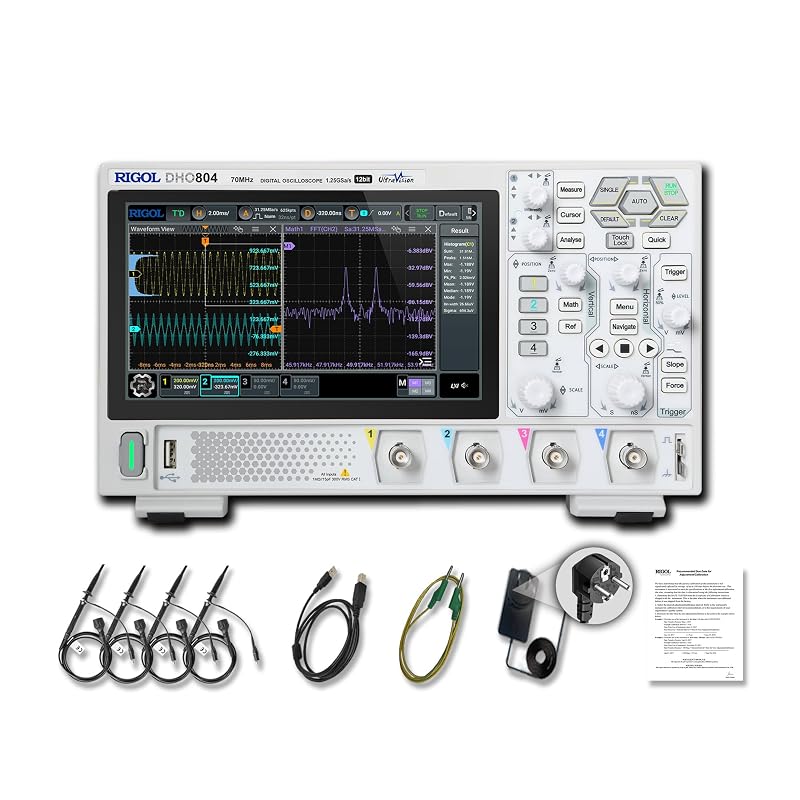
Rigol DHO804
4.8★★★★★Four channels, 12-bit resolution and a 7-inch touchscreen in a compact body that runs from USB-C power.
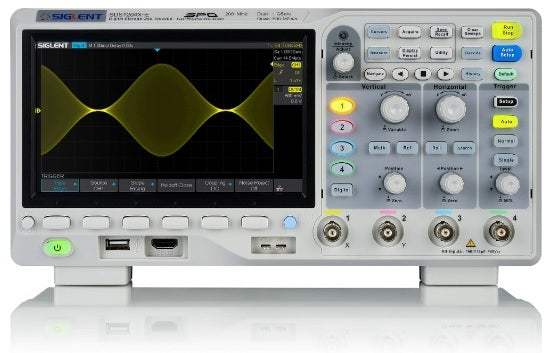
Siglent SDS1104X-E
4.8★★★★★More bandwidth and a better UI than the Rigol, for projects that will get more demanding.
Specs side by side
| Rigol DHO804 | Siglent SDS1104X-E | |
|---|---|---|
| Rating | 4.8★★★★★ | 4.8★★★★★ |
| Bandwidth | 70MHz | 100MHz |
| Channels | 4 | 4 |
| Sample rate | 1.25 GSa/s (1 ch); 312.5 MSa/s (4 ch) | 1 GSa/s |
| Best for | Hobbyists who want 12-bit detail and a touchscreen | Intermediate hobbyists, future-proofing |
| Sample rate, four channels on | 312.5 MSa/s per channel | 500 MSa/s per channel |
| Vertical resolution | 12-bit | 8-bit |
| Memory | 25 Mpts (1 ch); 5 Mpts (4 ch) | 14 Mpts (1 ch per pair); 7 Mpts (4 ch) |
| Serial decoding | Standard: UART, I2C, SPI, CAN, parallel | Standard: I2C, SPI, UART/RS232, CAN, LIN |
| Display | 7-inch 1024 × 600 touchscreen | 7-inch 800 × 480 TFT-LCD |
Specs checked against manufacturer documentation and official Amazon listings. Both products hands-on tested by OhmSavvy. How we research.
Key differences
- →Both have four channels, so input count doesn't separate them.
- →Bandwidth: 100 MHz on the Siglent against 70 MHz on the Rigol, about 43% more.
- →Single-channel sample rate favors the Rigol (1.25 GSa/s against 1 GSa/s); with all four channels on the Siglent leads (500 MSa/s each against 312.5 MSa/s).
- →Resolution: the DHO804 is 12-bit; Siglent lists the SDS1104X-E as 8-bit.
- →Memory: 25 Mpts on the Rigol with one channel against 14 Mpts on the Siglent, but with all four on the Siglent keeps 7 Mpts each against the Rigol's 5 Mpts.
- →Both decode serial buses as standard: Rigol lists UART, I2C, SPI, CAN and parallel; Siglent lists I2C, SPI, UART/RS232, CAN and LIN.
- →The Rigol has a 7-inch 1024 × 600 capacitive touchscreen, HDMI output and USB-C power; the Siglent has a 7-inch 800 × 480 screen, no HDMI in its I/O list, and runs from 100–240 V AC.
- →The Siglent's interface is widely regarded as intuitive. Both scopes carry our Hands-on Tested badge, and both score 4.8 in our roundup.
Spec by spec
With four channels each, the numbers that differ are bandwidth, how the sample rate and memory are shared, resolution and the screen. Rigol figures come from our verified pick data; Siglent's come from its SDS1000X-E series page and data sheet.
Bars use a logarithmic scale: each step is ten times the last.
| DHO804 | SDS1104X-E | |
|---|---|---|
| Vertical resolution | 12-bit | 8-bit |
| Memory depth | 25 Mpts (1 ch); 5 Mpts (4 ch) | 14 Mpts (1 ch per pair); 7 Mpts (4 ch) |
| Serial decoding | Standard: UART, I2C, SPI, CAN, parallel | Standard: I2C, SPI, UART, CAN, LIN |
| Screen | 7-inch 1024 × 600 touchscreen | 7-inch 800 × 480 |
| Video out | HDMI | None listed (USB, LAN) |
| Power | USB-C | 100–240 V AC, 50 W max |
| Signal generator / logic | None / none | Optional USB AWG / optional 16 ch |
Rigol DHO804 vs Siglent SDS1104X-E for a Home Lab
A home lab scope lives on a desk that also holds a soldering station, a bench supply and a laptop, and it gets used for whatever the current project is. Since channel count is tied here, the practical questions are how fast your signals get, how small the details you chase are, and how much the instrument itself should fit around your bench.
The DHO804 suits a bench built around microcontrollers and power. Its 12-bit converter gives 4,096 vertical steps, so the switching ripple on a buck converter's output or the slow drift of a temperature sensor stays legible after you zoom in, where the Siglent's 8-bit converter has 256. Decoding an ESP32's UART log or an I2C sensor read into bytes works on either scope, and with four inputs you can decode a bus while a fourth channel watches a reset or interrupt line. USB-C power and HDMI out make it easy to place: run it from a USB-C source and mirror the screen to the monitor you already have.
The SDS1104X-E suits a bench where signals keep getting faster. Its 100 MHz rating stretches the comfortable range to roughly 20 to 33 MHz, and it holds 500 MSa/s per channel when all four inputs are busy, which is the situation where the Rigol gives up the most. Siglent's interface is also widely regarded as easy to learn, which counts for a lot on a tool you reach for in short sessions after work. It decodes I2C, SPI, UART, CAN and LIN as standard and keeps 7 Mpts per channel with four on, more than the Rigol's 5 Mpts. The trade is 8-bit resolution, a non-touch 800 × 480 screen and mains power instead of USB-C.
| Home-lab task | Better fit | Why, from the data |
|---|---|---|
| Buck or boost converter ripple on a 5 V or 12 V rail | Rigol DHO804 | 12-bit resolution shows small ripple in detail |
| ESP32 or Arduino UART and I2C debugging | Either | Both decode UART and I2C as standard |
| CAN or LIN bus on a car or e-bike project | Either; Siglent for LIN | Both decode CAN; only Siglent lists LIN |
| Long one-off captures on one channel, such as a brown-out | Rigol DHO804 | 25 Mpts against 14 Mpts |
| Bench with a spare monitor and little desk room | Rigol DHO804 | HDMI output and USB-C power |
| Four signals at once near full speed | Siglent SDS1104X-E | 500 MSa/s and 7 Mpts per channel vs 312.5 MSa/s and 5 Mpts |
| Clocks and edges above about 15 MHz | Siglent SDS1104X-E | 100 MHz vs 70 MHz rated bandwidth |
| First scope, where ease of use matters most | Siglent SDS1104X-E | Interface is widely regarded as intuitive |
What each scope can and can't measure
Bandwidth is defined at the frequency where a sine wave reads 3 dB low, about 70% of its real amplitude. Applying the familiar 3 to 5 times rule, the DHO804 handles signals up to roughly 14 to 23 MHz with good fidelity and the SDS1104X-E up to roughly 20 to 33 MHz. In hobby terms, both cover I2C at 400 kHz, UART, PWM, audio and the switching frequency of most small converters many times over. The gap shows on a 25 MHz SPI clock or a fast logic edge: inside the Siglent's comfortable band, past the Rigol's. More detail is in our explainer on what oscilloscope bandwidth means.
For edges, a widely used estimate puts a scope's own rise time at 0.35 divided by its bandwidth: about 5 ns for 70 MHz and 3.5 ns for 100 MHz. That figure varies with each front end's design, so use it as a guide. A logic edge faster than the scope's own rise time is shown slower and rounder than it really is, which can hide overshoot or make timing between two lines look different from reality.
Sample rate is shared across channels on both. With one channel on, the Rigol samples faster (1.25 GSa/s against 1 GSa/s). With four on, the Siglent keeps 500 MSa/s each against the Rigol's 312.5 MSa/s, so a four-signal capture of a fast bus favors the Siglent twice: more bandwidth and more samples. Our guide to what GSa/s means explains why sample rate per channel is the figure to check.
Neither has a built-in generator: Rigol lists no generator or logic channels for the DHO804, and Siglent offers a USB 25 MHz generator module and 16 digital channels for the four-channel SDS1104X-E only as paid options. If you test filters and amplifiers, budget for a source whichever you choose.
Speed or detail
Mains and high-voltage circuits
To compare the Siglent with Rigol's older four-channel model, see Rigol DS1054Z vs Siglent SDS1104X-E; for the two-channel Siglent with 200 MHz, see Rigol DHO804 vs Siglent SDS1202X-E. You can also browse the best oscilloscopes for a home electronics lab, the beginner scope roundup, the oscilloscope buying guide and our Siglent SDS1104X-E review.
Choose the Rigol DHO804 if…
- ✓Your bench work is mostly microcontrollers, sensors and power rails rather than fast edges
- ✓You want to see millivolt-level ripple and noise with 12-bit resolution
- ✓You want parallel-bus decoding alongside UART, I2C, SPI and CAN, all included from the start
- ✓Desk space is tight and you like the idea of USB-C power and an HDMI monitor output
Choose the Siglent SDS1104X-E if…
- ✓You expect to look at clocks and edges above roughly 15 to 20 MHz
- ✓You often run all four channels and want the higher per-channel rate of 500 MSa/s
- ✓A well-regarded, approachable interface matters to you as much as the spec sheet
- ✓You want 100 MHz of bandwidth as sold, with room for projects to get faster
The bottom line
For a home lab centred on microcontrollers, sensors and power supplies, the Rigol DHO804 gives you more to work with: 12-bit resolution, 25 Mpts on one channel, a touchscreen, HDMI and USB-C power on four channels. Both decode serial buses as standard. If your signals are heading past 15 to 20 MHz, or you often run all four channels on fast signals, the Siglent SDS1104X-E's 100 MHz and 500 MSa/s per channel make it the better long-term scope.
Frequently asked questions
Is the Rigol DHO804 or the Siglent SDS1104X-E better for a home lab?+
For most home benches built around Arduino, ESP32, sensors and power supplies, the DHO804: 12-bit resolution, a 1024 × 600 touchscreen, HDMI and USB-C power. Both include UART, I2C, SPI and CAN decoding. The SDS1104X-E is the better pick when fast clocks and edges are the focus, thanks to 100 MHz and 500 MSa/s per channel with four on.
Is 70 MHz on the DHO804 enough, or do I need the Siglent's 100 MHz?+
By the 3 to 5 times rule, 70 MHz covers signals up to roughly 14 to 23 MHz, which includes most hobby buses, PWM, audio and converter switching. You need the Siglent's 100 MHz, good to roughly 20 to 33 MHz, mainly for faster SPI clocks and for viewing sharp logic edges accurately.
Which samples faster with all four channels on?+
The Siglent SDS1104X-E, at 500 MSa/s per channel against the DHO804's 312.5 MSa/s. With one channel on the order flips: the Rigol reaches 1.25 GSa/s and the Siglent 1 GSa/s. So the Rigol is quicker for single-signal work and the Siglent for four-signal work.
Does the Siglent SDS1104X-E have 12-bit resolution like the DHO804?+
No. Siglent's SDS1000X-E data sheet lists 8-bit vertical resolution, or 256 levels. Rigol specifies the DHO804 as 12-bit, which gives 4,096 vertical levels. If small-signal detail such as ripple decides your purchase, that favors the DHO804.
Can either scope generate a test signal?+
Not on their own. Rigol lists no built-in generator or logic channels for the DHO804. Siglent sells an optional USB 25 MHz generator module for the four-channel SDS1104X-E, which plugs into its USB host port. For filter, amplifier or sensor-input testing, plan on a separate function generator alongside whichever scope you choose.
Related