COMPARISON · OSCILLOSCOPES
Hantek 1008C vs DSO2C10: Automotive vs Bench Testing
These two Hantek products share a brand but almost nothing else. The 1008C is a screen-less, USB-powered, eight-channel automotive diagnostic tool built for a Windows laptop. The DSO2C10 is a self-contained, two-channel, 100 MHz general-purpose bench oscilloscope. They aren't really competing for the same buyer — this comparison exists to help you figure out which category you actually need.
By the OhmSavvy Research Team ·
Disclosure: OhmSavvy earns a commission from qualifying Amazon purchases made through these links, at no extra cost to you. How we're funded.

Hantek 1008C
4.0★★★★☆The top tier of Hantek's shared 1008 automotive USB scope hardware, with more diagnostic software.
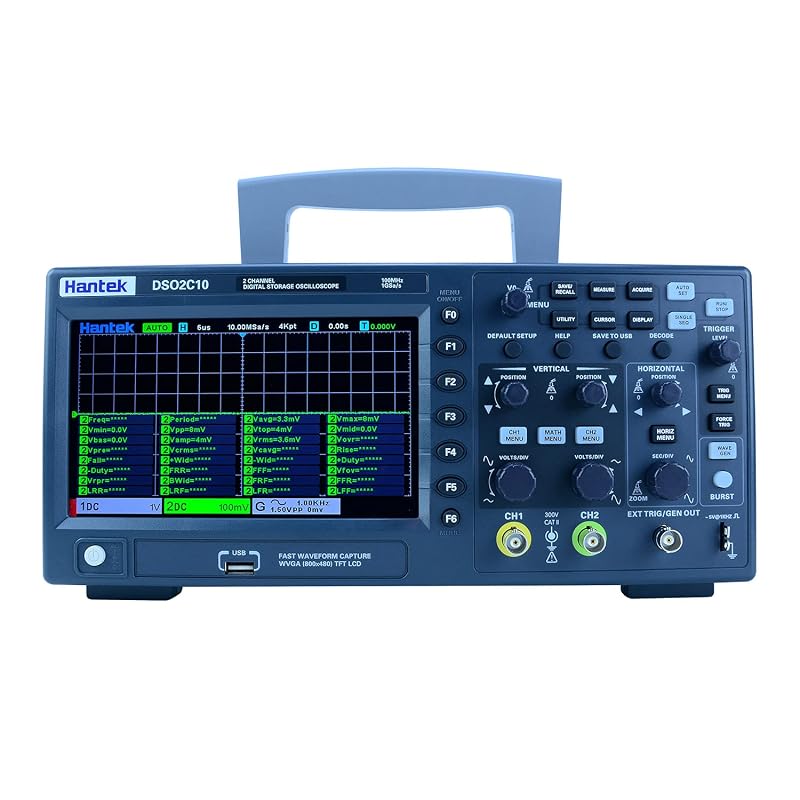
Hantek DSO2C10
4.3★★★★☆The DSO2D10 without the signal generator: two 100 MHz channels with deep memory and serial decoding.
Specs side by side
| Hantek 1008C | Hantek DSO2C10 | |
|---|---|---|
| Rating | 4.0★★★★☆ | 4.3★★★★☆ |
| Bandwidth | 100kHz (per manual, shared across 1008A/B/C) | 100MHz |
| Channels | 8 | 2 |
| Sample rate | 2.4 MSa/s (1 ch) | 1 GSa/s (1 ch); 500 MSa/s (2 ch) |
| Best for | Automotive diagnostics needing the fuller software/function library | Low-cost serial-bus debugging on two channels |
| Channels | 8 | 2 |
| Bandwidth | 100kHz (per manual) | 100MHz |
| Sample rate | 2.4 MSa/s (1 ch) | 1 GSa/s (1 ch); 500 MSa/s (2 ch) |
| Memory | 4K points | 8 Mpts (1 ch); 4 Mpts (2 ch) |
| Display | None — requires a Windows PC | 7-inch, 800 × 480, built in |
| Signal generator | 8-channel LVTTL, up to 250kHz (crank/cam simulation) | None (per Hantek's spec table) |
| Serial decode | Not applicable (automotive function library instead) | UART, I2C, SPI, CAN, LIN |
| Power | USB-powered from the host PC | Mains power |
| Primary use case | Automotive sensor/actuator/ignition diagnostics | General electronics bench work |
Specs checked against manufacturer documentation and official Amazon listings. Desk research, not bench testing. How we research.
Key differences
- →Category: the 1008C is a specialized 8-channel automotive diagnostic DAQ with no screen; the DSO2C10 is a general-purpose 2-channel bench oscilloscope with a built-in display. They solve fundamentally different problems.
- →Channel count: 8 on the 1008C against 2 on the DSO2C10 — useful for comparing multiple automotive sensors at once, but at far lower bandwidth and sample rate.
- →Bandwidth and speed: the DSO2C10's 100 MHz and 1 GSa/s dwarf the 1008C's 100 kHz and 2.4 MSa/s — the 1008C is built for slow automotive signals, not general electronics.
- →Generator: the 1008C's 8-channel LVTTL generator exists specifically to simulate crank/cam sensor signals; the DSO2C10 has none at all.
- →Decoding: only the DSO2C10 lists serial bus trigger/decode (UART, I2C, SPI, CAN, LIN), including the CAN and LIN vehicle-network buses; the 1008C offers its automotive function library instead.
Spec by spec
Comparing these two on a single chart is almost misleading — they're built for different signal speeds entirely. The numbers below illustrate just how far apart they are, not which one is "better."
Bars use a logarithmic scale: each step is ten times the last.
The 1008C's low bandwidth isn't a weakness for its intended job — automotive sensor, actuator and ignition signals are mostly slow by electronics standards, and its real value is the eight simultaneous channels, built-in automotive diagnostic library and crank/cam signal simulator. Using it as a general electronics scope, or using the DSO2C10 for multi-sensor engine diagnostics, would usually be the wrong tool either way.
Where the screen, power and software live
The spec gap is easier to understand once you follow a signal from the probe tip to your eyes. The two Hantek products split that job very differently, and the split decides where you can use them.
The 1008C is really the front half of an instrument. It draws its power from the USB port and depends on the laptop for the display, the controls and Hantek's automotive function library, so in a workshop the laptop on the fender is part of the kit. The upside is eight simultaneous 12-bit channels, each with a 1 MΩ input rated to 400V peak, viewed on a laptop screen that is usually larger than any handheld display.
The DSO2C10 is the whole instrument. Plug it into the wall, clip on two probes and it runs on its own 7-inch screen, with 8 Mpts of memory and serial decoding built in. It is also worth knowing that two of its decoders, CAN and LIN, are vehicle-network protocols, so it can read bus traffic on a car's network even though it lacks the 1008C's eight channels and ready-made engine tests. For a broader look at scopes chosen for car work, see our automotive oscilloscope picks.
Ignition and mains voltages need the right probe
Hantek 1008C vs DSO2C10: automotive vs bench testing
The right question here isn't "which has better specs" — it's "which job are you actually doing."
If you're diagnosing a vehicle: the 1008C
Eight channels let you compare multiple cylinder ignition patterns, sensor outputs or actuator signals at once — something a 2-channel bench scope simply can't do. Hantek's 80+ built-in automotive diagnostic functions and the crank/cam signal simulator are purpose-built for this job, and the low bandwidth is a non-issue since automotive signals rarely need more.
If you're working on electronics or embedded projects: the DSO2C10
Standalone operation, a real screen, and 100 MHz of bandwidth with serial decoding make the DSO2C10 the right tool for microcontroller, sensor and digital-bus debugging — none of which the 1008C is built to do.
Check your ignition probe before relying on it
Which should you buy?
| Buyer or job | Better fit | Why |
|---|---|---|
| Automotive sensor, actuator or ignition diagnostics | Hantek 1008C | 8 channels, automotive function library, signal simulator |
| General electronics or embedded projects | Hantek DSO2C10 | 100 MHz, standalone screen, serial decode |
| Need to compare multiple automotive channels at once | Hantek 1008C | 8 channels vs. 2 |
| Debugging UART, I2C, SPI, CAN or LIN buses | Hantek DSO2C10 | Only this one lists serial decode |
| Want a standalone tool without a laptop | Hantek DSO2C10 | Built-in 7-inch screen; the 1008C needs a PC |
Want to see the DSO2C10 against its generator-equipped sibling instead? See Hantek DSO2C10 vs DSO2D15. The beginner oscilloscope roundup ranks both, and the oscilloscope buying guide explains every spec from scratch.
Not really a head-to-head
Choose the Hantek 1008C if…
- ✓You're diagnosing automotive sensors, actuators, ignition or bus signals
- ✓You need eight channels at once (e.g. comparing multiple cylinders or sensors)
- ✓You already have a Windows laptop to run it from, and don't need a standalone screen
- ✓You want built-in automotive-specific diagnostic functions and a signal simulator
Choose the Hantek DSO2C10 if…
- ✓You need a general-purpose bench scope with its own screen
- ✓Your work is electronics or embedded projects, not automotive-specific diagnostics
- ✓You want serial decoding for UART, I2C, SPI, CAN or LIN
- ✓You want a scope that works standalone, without a laptop
The bottom line
The Hantek 1008C and DSO2C10 aren't real alternatives — the 1008C is a specialized 8-channel automotive diagnostic tool with no screen of its own, while the DSO2C10 is a general-purpose 2-channel bench scope with 100 MHz of bandwidth and a built-in display. Choose based on the job: automotive sensor/actuator/ignition work points to the 1008C, general electronics and embedded debugging points to the DSO2C10.
Frequently asked questions
Can the Hantek 1008C be used for general electronics work?+
Not really — its 100 kHz bandwidth (per Hantek's manual) and 2.4 MSa/s sample rate are far too slow for most general electronics signals. It's purpose-built for automotive sensor, actuator and ignition diagnostics, where signals are typically much slower.
Does the Hantek 1008C have its own screen?+
No — it's a USB-powered data acquisition device that requires a Windows PC to display and analyze waveforms. The DSO2C10, by contrast, is a standalone scope with its own 7-inch display.
Does the Hantek 1008C come with an ignition probe?+
It's unclear for this specific listing. Hantek's shared 1008A/B/C specification page lists an ignition/HV probe as included, but this exact ASIN's own included-components list doesn't itemize one. Confirm with the seller before assuming it's included.
Why would someone buy both of these?+
Because they serve genuinely different purposes — the 1008C for automotive diagnostic work across multiple channels, and the DSO2C10 for general electronics bench work with serial decoding. A shop doing both kinds of work might reasonably own both rather than choosing one.
Can the Hantek DSO2C10 read a car's CAN bus?+
It can decode it. Hantek lists CAN and LIN among the DSO2C10's trigger and decode protocols, alongside UART, I2C and SPI, so you can trigger on CAN frames and read their contents on screen. What it can't do is watch eight sensors at once or run guided engine tests; that is the job the 1008C's channel count and automotive function library are built for.
Related