HOW-TO GUIDE
Analog vs Digital Oscilloscopes
By the OhmSavvy Research Team ·
How an analog (CRT) oscilloscope works
An analog scope steers an electron beam directly: the input signal's voltage deflects the beam vertically while a timebase circuit sweeps it horizontally, striking a phosphor-coated screen that glows briefly where the beam hits. There is no sampling, no analog-to-digital conversion, and no memory — what you see is the signal driving the display in true real time, with the phosphor's brief persistence being the only thing that makes a repeating waveform appear as a continuous trace rather than a single moving dot.
How a digital storage oscilloscope works
A digital scope's front end samples the incoming signal at discrete moments in time (the sample rate), converts each sample to a digital value, stores a sequence of them in memory, and draws the waveform on an LCD by connecting those stored points. This is what enables freezing a capture, taking automatic measurements, exporting data, and single-shot triggering — all of which depend on actually having the waveform stored as data, not just displayed live.
Continuous beam vs. discrete sample moments
Visualized over time, the difference is literal: an analog beam traces every instant of the signal continuously, while a digital scope only knows the signal's value at the specific moments it samples, filling in the gaps between those moments when it redraws the trace.
The aliasing trade-off, unique to digital
Sampling introduces a risk analog scopes simply don't have: if the sample rate isn't high enough relative to the signal's frequency content, the reconstructed waveform can show a false, lower-frequency pattern that was never actually present — a phenomenon called aliasing. An analog scope, with no sampling step, can't alias in this way, since the beam tracks the actual instantaneous signal continuously.
Side-by-side comparison
| Analog (CRT) | Digital (DSO) | |
|---|---|---|
| Display method | Electron beam driven live by the signal | Sampled, stored, then redrawn from memory |
| Freeze / single-shot capture | Not possible on standard analog scopes | Standard feature |
| Automatic measurements, cursors | Not available | Standard feature |
| Aliasing risk | None — no sampling takes place | Possible if sample rate is too low for the signal |
| Intensity grading (occurrence frequency) | Natural, built into the phosphor's behavior | Emulated via "digital phosphor" display modes |
| Availability new | Rare — mostly discontinued | Standard across all current scope lineups |
Analog's one attempt at "freezing" a capture
Where analog still has a genuine edge
Which should you actually buy today?
For virtually all modern hobbyist, repair, and professional work, a digital scope is the practical choice — the storage, measurement, and triggering flexibility it offers outweighs analog's narrow advantages for nearly everyone. See our buying guide for what to check on a digital scope, and what is an oscilloscope for how the other types (mixed-signal, handheld, PC-based) fit in alongside this core analog-vs-digital distinction.
Digital scopes worth considering
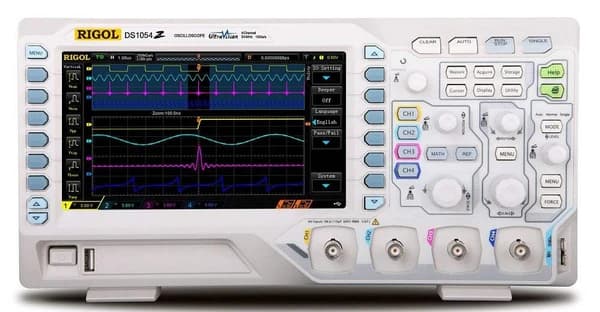
4 channels, 50MHz, 1 GSa/s — well above most hobby signals.
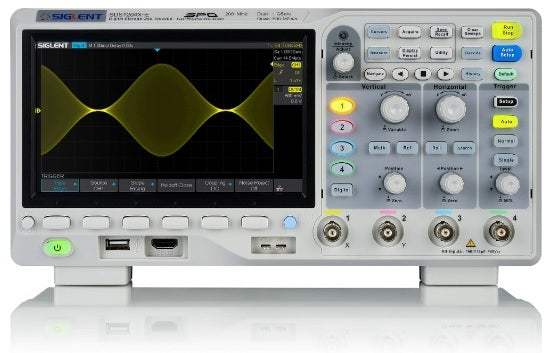
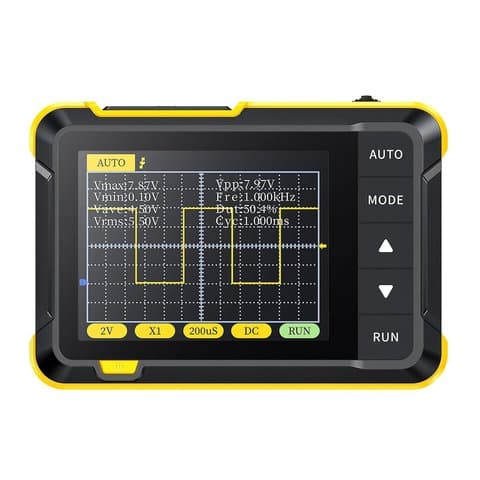
Pocket-sized digital scope for quick, low-frequency checks.
As an Amazon Associate I earn from qualifying purchases. Prices and availability are shown on Amazon.
Frequently asked questions
Can a digital scope ever fully replace what an analog scope shows?
For the vast majority of modern work, yes — digital scopes have closed most of the practical gap, including emulating analog-style intensity grading through "digital phosphor" display modes. The one thing digital fundamentally can't offer is a true, zero-sampling real-time display with no aliasing risk whatsoever, though at sufficient sample rates this is rarely a practical limitation.
Are analog oscilloscopes still manufactured new?
They're now rare in new production — most current scope lineups from major manufacturers are entirely digital. Analog scopes you'll encounter today are mostly older used units, still functional and useful for certain teaching or legacy applications, but not where most buyers should look for a primary scope.
What does "digital phosphor" mode actually do?
It's a digital scope feature that emulates the analog CRT's intensity-grading behavior, varying trace brightness or color based on how often each point on the display is hit across many acquisitions. This recovers much of the "frequency of occurrence" information an analog scope's phosphor naturally shows, while keeping digital's storage and measurement advantages.
Is aliasing something I need to worry about on a modern digital scope?
Rarely, as long as the scope's sample rate is comfortably higher than the frequency content of what you're measuring — a common rule of thumb is at least 5-10x the highest frequency of interest. It becomes a real concern mainly when probing signals near or above a scope's rated sample rate, or when using overly aggressive memory-saving settings that reduce the effective sample rate.
Is a cheap used analog oscilloscope a good first scope for a beginner?
It can teach the basics of triggering and timebase, but it is usually a poor first buy. Old units often need recalibration, worn switches and tired CRTs are common, and you lose single-shot capture, cursors and automatic measurements that make learning faster. An entry-level digital bench scope does everything the analog one does for hobby signals, plus storage and screenshots.
